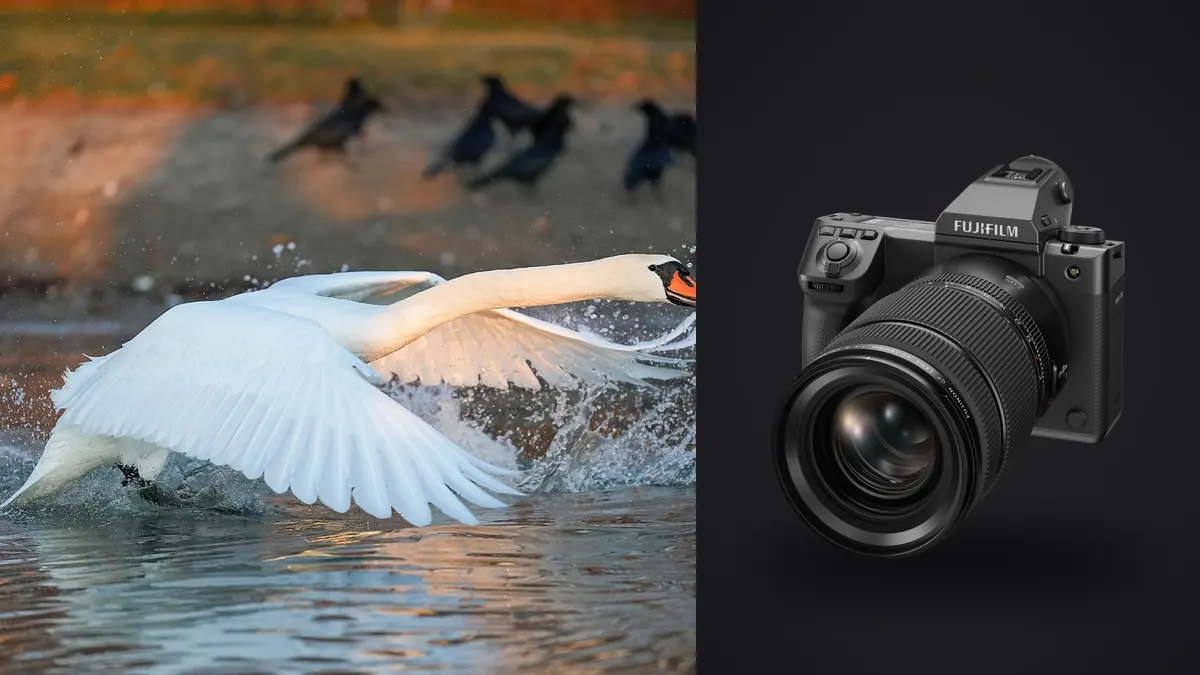
I'll say the quiet part first: nobody in a wildlife hide expects to see a medium format camera pointed at a flock of dunlin twisting over a mudflat. Medium format has a reputation, earned over decades, for being the format you bring to a studio or a landscape, not the format you swing at a peregrine stooping on a pigeon. The Fujifilm GFX 100 II doesn't fully overturn that reputation, but it dents it more than I expected when I first put a GF 500mm on the front and pointed it at gulls working a fishing boat's wake.
This isn't a spec sheet regurgitation. I've spent stretches of this spring and early summer running the GFX 100 II on ospreys, terns, and a disappointingly uncooperative pair of red kites, trying to figure out where the 102-megapixel sensor actually helps a birder and where it just makes the SD cards fill up faster. Here's what I found.
The case for bringing a medium format body to a bird hide
The argument for using the GFX 100 II on birds in flight has nothing to do with speed and everything to do with pixels. At 102 megapixels, a bird that fills a third of the frame still leaves you enough resolution after a hard crop to print reasonably large or run a tight web crop without the image falling apart. On a 24 or 26 megapixel full-frame body, the same crop starts showing softness and noise structure that no amount of sharpening masks convincingly. With the GFX 100 II, I've cropped a swift down to roughly 15 percent of the original frame and still had a usable 15-megapixel file, something that would leave you with a postage stamp on most APS-C bodies.
There's also the dynamic range angle, which matters more for birds than people give it credit for. Backlit wings, white plumage against a blown sky, dark eye rings that need to hold detail without crushing: the GFX sensor's extra stops of headroom mean I recover feather detail in highlights that would simply be gone on a smaller sensor shooting the same exposure. Herring gulls and egrets, the classic "blown highlights" subjects, are noticeably easier to rescue.
Autofocus: better than its reputation, still not a sports camera
Fujifilm's phase-detection AF with subject detection, including a dedicated bird recognition mode, genuinely works. It finds an eye on a perched raptor at range reliably, and it will lock onto a gull crossing open sky without much hunting. Where it starts to strain is exactly where every camera strains: birds against cluttered backgrounds, birds banking hard against foliage, or small fast subjects like swallows changing direction unpredictably. In those conditions the hit rate drops noticeably compared to what I get from a dedicated sports-oriented full-frame body.
Practical settings that helped me: I run AF-C with the tracking sensitivity turned down from the default, so the system doesn't jump to a closer branch when a bird flies behind it. I also disabled face detection entirely and left only bird-eye detection active, since the two modes occasionally fight each other when a human walker enters the frame behind the subject. Back-button focus is non-negotiable here; letting the shutter button also drive focus caused enough false triggers on distant clutter that I gave up on it within the first outing.
Frame rate and buffer: the real limiting factor
This is where the GFX 100 II shows its medium format roots most plainly. You can get to roughly 8 frames per second with the vertical grip's boost mode and the electronic shutter, which sounds competitive on paper next to a flagship sports body, but the buffer tells a different story. Shooting compressed RAW, I ran out of buffer room after a few seconds of sustained bursts, and the write-to-card recovery pause afterward is long enough that I've missed the second pass of a bird circling back. A full-frame sports body will happily eat a ten-second burst and keep going.
My workaround has been discipline rather than gear: short, deliberate bursts timed to the moment of the wingbeat or the turn, rather than holding the shutter down and hoping. It's a return to a more film-era style of shooting birds, which some days I actually prefer, and other days I resent when I miss the shot because I paused half a second too early.
Rolling shutter on fast wingbeats
With the electronic shutter engaged for that higher frame rate, rolling shutter becomes visible on fast wing motion, especially on smaller, quicker-flapping species like terns and waders. Wingtips can show a slight skew in individual frames. It's rarely bad enough to ruin a shot outright, but if you're pixel-peeping a hero image destined for print, it's worth switching back to the mechanical shutter for slower-flying subjects like herons and raptors where you don't need the extra fps anyway.
| Factor | Fujifilm GFX 100 II | Typical full-frame sports body (e.g. Sony a1-class) |
|---|---|---|
| Resolution | 102MP | 24-50MP |
| Effective reach with a 500mm lens | ~395mm full-frame equivalent (0.79x crop factor) | 500mm native, or 750mm+ with APS-C crop mode |
| Max continuous burst (boosted) | ~8 fps | 20-30 fps |
| Usable RAW buffer at max fps | Roughly 3-5 seconds before slowdown | 10+ seconds sustained |
| Native AF-friendly long telephoto options | GF 500mm f/5.6, plus 1.4x teleconverter | Multiple 400mm-800mm native primes and zooms |
| Average RAW file size (uncompressed) | 200-230MB | 25-60MB |
The reach column is worth dwelling on. The GFX sensor is larger than full-frame, so a 500mm lens on the GFX 100 II actually behaves closer to a 395mm on full-frame once you account for the sensor's crop factor relative to full-frame, which sounds backwards until you remember medium format captures a wider field of view at the same focal length. In practice this means you need more focal length to get the same framing on a distant bird than you would on a full-frame or APS-C sports body, and Fujifilm's GF telephoto lineup, currently topping out at the 500mm f/5.6, doesn't give you the same reach options that Canon, Nikon, or Sony do with their 600mm and 800mm primes.
Lens reality: one good option and a teleconverter
The GF 500mm f/5.6 is the lens that makes this whole exercise viable. It's sharp wide open, focuses fast enough to keep up with the sensor's AF system, and at around 1,375g it's genuinely handholdable for a session, helped considerably by the body's in-body stabilization working in tandem with the lens's own optical stabilization. Add the 1.4x teleconverter and you're at roughly 700mm (about 550mm full-frame equivalent) with a one-stop light loss that costs you some AF speed in low light but is otherwise usable.
Beyond that pairing, your options thin out fast. There's no native 800mm or 1000mm in the GF lineup the way there is for the major full-frame mounts, so if your target species regularly demands extreme reach, birds you can't approach closely like eagles on distant cliffs, you'll find yourself wishing for glass Fujifilm simply doesn't make yet.
The file size problem nobody warns you about
A day of serious birding with the GFX 100 II produces an amount of data that catches people off guard the first time. A single uncompressed RAW file sits around 200-230MB, so a session of a few thousand frames, which isn't unusual when you're chasing a fast-moving flock in short bursts, can easily total half a terabyte or more before you've even opened a laptop. I've gone home from a morning at a tern colony with more raw data than a typical wedding shoot generates.
This is where the culling step stops being a nice-to-have and becomes the actual bottleneck of the day. Scrolling through thousands of near-identical burst frames at full resolution on a laptop screen is slow and genuinely hard on the eyes, and it's easy to pass over the one frame in a sequence of twelve where the wingtip is caught exactly right. I run these sessions through imagic afterward specifically because its local sharpness scoring flags the sharpest frame in each burst without me having to zoom into every single one, and the duplicate and burst clustering groups near-identical frames together so I'm reviewing sequences instead of individual files. Because the huge GFX RAWs never leave my machine, there's no upload wait either, which matters a lot when a single card dump is bigger than most people's photo libraries.
Field workflow that actually holds up
What works for me: shoot in short bursts as described above, do a first-pass card backup in the field on a portable SSD, then run the cull that evening rather than letting three days of shooting pile up. Waiting too long means you lose the memory of which frame in a burst had the bird's head turned the right way, and no software substitutes for that context.
Where it genuinely struggles
I want to be honest about the downsides rather than talk myself into loving a camera I paid a lot of money for. Dense woodland flight shots, warblers darting through branches, are a real weak point; the AF hunts more than it should and the buffer runs out before the bird clears the gap in the canopy. Low light performance past dusk, when owls and nightjars start moving, is noticeably behind what a full-frame body with larger, faster-reading pixels delivers, both in AF speed and in usable high-ISO noise. And the weight of body plus 500mm plus grip adds up over a six-hour hide session in a way that a lighter full-frame kit doesn't.
If your primary subject is small, fast, and erratic, think swifts, swallows, or hummingbirds, I'd steer you toward a dedicated sports body instead. The GFX 100 II rewards patience and slower, more predictable flight patterns: raptors on thermals, herons on a fixed flight line, gulls working a consistent wind pattern along a coastline.
Is it worth it for a birder specifically
My honest answer after a season with it: bring the GFX 100 II when the payoff is a large, detailed, croppable file of a subject that flies in a somewhat predictable pattern, and leave it at home when you're chasing something fast and chaotic. For gear and workflow advice that isn't tied to one specific body, our broader wildlife photography guide covers the ground this piece doesn't. It's not replacing my full-frame kit for general bird photography, but for the specific case of large, patient birds where I want maximum detail for a print or a heavily cropped composition, it's earned a permanent spot in the bag.
Frequently Asked Questions
Can the GFX 100 II keep up with a diving raptor like a peregrine?
It can track and record the sequence, but the combination of an 8fps ceiling and a buffer that fills within a few seconds means you'll likely miss frames during the fastest part of a stoop that a 20-30fps sports body would capture in full. You get fewer chances at the exact peak moment, though the frames you do get carry more resolution to work with afterward.
Do I need the GF 500mm, or can I adapt other telephoto lenses?
The GF 500mm f/5.6 is currently the only native long telephoto built specifically for fast AF tracking on this system, and it shows in how confidently the body locks onto birds through it. Adapted lenses from other mounts exist but generally lose autofocus speed and subject tracking performance, which defeats much of the point for birds in flight specifically.
Is the crop factor a real disadvantage for reach compared to full-frame?
Yes, in the sense that you need more focal length to match the framing a full-frame shooter gets from the same lens, since the larger sensor captures a wider field of view. A 500mm on the GFX 100 II frames roughly like 395mm on full-frame, so distant, small subjects require getting physically closer or accepting a smaller subject in frame compared to a full-frame 500mm.
How do I manage the huge file sizes from a full day of shooting?
Plan for it before you go out rather than after. Bring more storage than feels necessary (a single burst-heavy session can exceed 500GB), and build in a cull pass at the end of each day rather than letting files accumulate. Tools that score sharpness locally and cluster burst duplicates, which is how I use imagic, cut the review time down substantially compared to scrolling through every frame manually at full resolution.