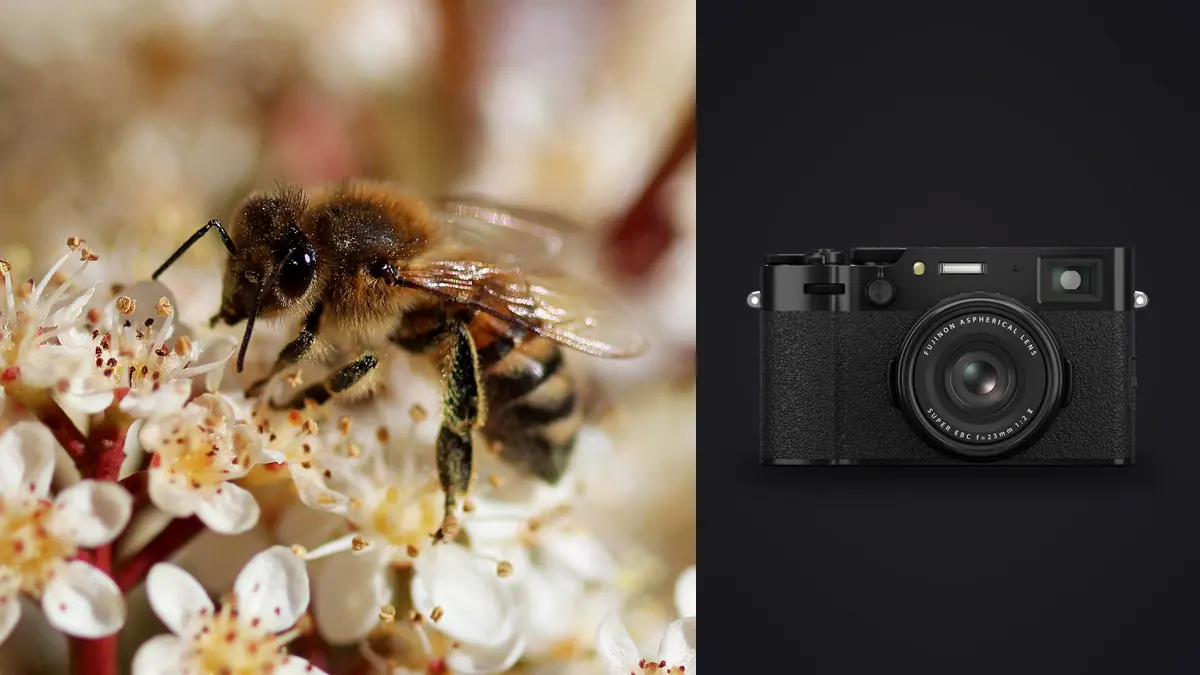
A guy at a local macro meetup asked me last spring whether the X100VI was worth dragging along on a dedicated bug hunt. My honest answer surprised him: sort of, but only if you go in with realistic expectations about what a fixed 23mm lens can do up close. This is not a macro camera in the way a 90mm dedicated macro lens on a mirrorless body is a macro camera. It's a street and travel camera that happens to have a "macro" setting in its focus menu, and the gap between those two things trips up a lot of people who buy one expecting dragonfly wing detail straight out of the box.
I've now spent three seasons pointing this camera at everything from garden bees to a genuinely uncooperative praying mantis, first with nothing but the stock lens, then with a stack of clip-on diopters, and eventually with Fujifilm's own teleconverter bolted on. What follows is what actually happened, not what the spec sheet implies.
The fixed-lens problem, explained with actual math
The X100VI's 23mm f/2 lens is a 35mm-equivalent field of view on the APS-C sensor, which is a fantastic focal length for a person's face across a table and a genuinely awkward one for a beetle six centimeters away. Wide lenses need to get physically close to a subject to produce any meaningful magnification, and once you're that close with a fixed lens (no extension tubes, no swapping to something longer), you run into three problems at once: your own shadow falls across the subject, the working distance is short enough that most insects fly off before you finish focusing, and the lens's minimum focus distance puts a hard ceiling on how big anything gets in the frame regardless of how badly you want it bigger.
None of this means the camera is useless for insects. It means "macro" on this body means something closer to "close-up environmental shots of insects in their habitat" rather than "fill the frame with a jumping spider's eyes." If that distinction bothers you, an actual macro lens on an interchangeable-mount body is the honest answer. If you already own the X100VI and want to know what it's genuinely capable of, keep reading.
What the built-in macro mode actually gets you
Flip the focus mode toggle and you get a shorter minimum focus distance, roughly 10cm measured from the sensor plane, which works out to something like 4cm from the front element in real terms. That's close, but the magnification you get from it is modest, somewhere around 0.2x by my own rough measurements against a ruler. A ladybug at that distance fills maybe an eighth of the frame width. It's enough for a nicely composed shot of a bumblebee working a flower head, and it's nowhere near enough for the kind of eye-level, frame-filling portrait people associate with the word macro.
Autofocus in macro mode also gets noticeably more deliberate. It's not slow in a way that matters for a still flower, but a insect that's actively moving, antennae twitching, wings adjusting, will frequently win the race against the AF system. I switched to manual focus with focus peaking turned up for anything that wasn't already still, and my keeper rate improved immediately. The camera doesn't offer in-camera focus bracketing in this mode either, at least not in any menu I've found across firmware updates, so if you want a stacked result you're shooting a manual sequence and stacking it later.
Closing the gap with add-on glass
Raynox clip-on diopters
The X100VI's 49mm filter thread (with the included adapter ring) takes screw-on and clip-on close-up filters without much fuss, and this is where the setup starts to earn its keep. A Raynox DCR-150 dropped my working distance to around 12-14cm from the front element while noticeably boosting magnification, close to 0.4x by feel. The DCR-250, which is a stronger diopter, gets you more magnification still but shrinks working distance down to somewhere around 8cm, which for a wasp is basically an invitation to leave. I use the DCR-150 for anything mobile and save the 250 for slow-moving subjects like caterpillars or resting butterflies in cool morning air.
The TCL-X100 II detour
Fujifilm's own teleconverter, the TCL-X100 II, bumps the effective focal length to roughly 50mm equivalent and, combined with macro mode, gives you a longer working distance for a given magnification than the bare lens does. In practice this means you can back off a little further from a dragonfly perched on a reed and still get a reasonably tight frame, which matters more than raw magnification numbers once you've spent an afternoon watching subjects bolt the second your shadow crosses them. It doesn't out-magnify the Raynox stack, but it buys breathing room, and breathing room is often the difference between a shot and an empty frame.
| Setup | Effective focal length | Approx. working distance | Rough magnification | Best for |
|---|---|---|---|---|
| Built-in macro mode, no accessories | 23mm (35mm equiv.) | ~4cm from front element | ~0.2x | Habitat shots, flowers with a resting insect |
| + Raynox DCR-150 clip-on | 23mm | ~12-14cm | ~0.4x | Bees, beetles, anything semi-active |
| + Raynox DCR-250 clip-on | 23mm | ~8cm | ~0.55x | Still subjects only, cool mornings |
| + TCL-X100 II teleconverter + macro mode | ~33mm (50mm equiv.) | ~15-18cm | ~0.25x | Skittish subjects needing extra distance |
Field technique that actually moves the keeper rate
Timing matters more with this setup than gear does. Insects are far less mobile in the first hour after sunrise, when the air is still cool and their flight muscles haven't warmed up, so that's when I get most of my usable frames. By mid-morning on a warm day, a dragonfly that let me get within fifteen centimeters at 7am will bolt at fifty centimeters by ten.
On aperture, I mostly sit between f/8 and f/11. Wider than that and depth of field at these distances is measured in millimeters, narrower than that and diffraction starts softening detail on this sensor noticeably enough that I can see it at 100%. Shutter speed I keep at 1/500 or faster whenever there's any wind at all, since a swaying flower stem with an insect on it will blur before the insect itself moves. Because there's no image stabilization system on this body, I'm hand-holding everything, bracing an elbow against a knee or a fence post where I can, and just accepting a lower hit rate than a stabilized body with a proper macro lens would give me.
I also shoot the electronic shutter for anything within striking distance of a subject that might spook. The mechanical shutter on this camera is quiet by DSLR standards but still audible enough, up close, to make a resting butterfly reconsider its life choices.
The part nobody mentions: sorting through the wreckage afterward
Here's the thing about all of the above: even with good technique, insect macro on a fixed 23mm lens produces a lot of near misses. Antennae move a fraction of a second before the shutter fires, focus lands on a wing instead of an eye, a gust shifts the whole plane of focus mid-burst. On a good outing I might come home with 400 frames of a single dragonfly and maybe 25 that are genuinely sharp where it counts. Going through all of that by eye, zoomed to 100% on every frame, used to eat an entire evening. I run these through imagic now specifically because its local sharpness scoring flags which frames actually nailed focus on the subject rather than the background reeds, which matters a lot when depth of field is this thin. It also clusters burst sequences and near-duplicate frames together, so instead of scrolling past 40 nearly identical shots of the same beetle one at a time, I'm comparing a handful of genuinely distinct options within a cluster. If you haven't looked into how that scoring actually works under the hood, there's a decent breakdown at how AI photo culling works.
Two other things about it fit this kind of shooting specifically. It runs entirely on my own machine, nothing gets uploaded anywhere, which matters more than people expect once you're photographing anything at a location you'd rather not have geotagged and shared, like a rare orchid patch that happens to also be where the good dragonflies are. And the apply_my_style preset, which trains on edits you've already made rather than a generic filter pack, has kept my macro sets looking consistent across three seasons without me manually matching white balance and contrast on every single insect shoot. It's a one-time purchase rather than a subscription, which for a niche use case like this, culling insect bursts a few weekends a year, matters more than it would for someone shooting daily. If your current workflow is the bottleneck rather than your camera gear, it's worth a look at tightening up the workflow before buying more glass.
Frequently Asked Questions
Is the X100VI's macro mode actually 1:1?
No, and Fujifilm doesn't claim it is. True 1:1 macro means the subject projects onto the sensor at life size, and this lens, even in macro mode, lands closer to 0.2x on its own. You need a clip-on diopter like the Raynox DCR-250 to get meaningfully closer to that territory, and even then you're approximating it rather than hitting it precisely.
Can I use extension tubes on the X100VI?
Not in the traditional sense, because the lens isn't removable. There's no mount to insert a tube into. Your practical options for boosting magnification are screw-on or clip-on close-up diopters at the 49mm filter thread, or the TCL-X100 II teleconverter, which changes focal length rather than minimum focus distance.
What aperture should I use for insect macro on this camera?
f/8 to f/11 is the range I use for almost everything. Wider apertures leave you with a sliver of depth of field that's nearly impossible to place accurately on a moving subject, while apertures narrower than f/11 start showing visible diffraction softening on this sensor, based on my own pixel-level comparisons.
Is this a sensible first camera for someone getting into insect photography specifically?
If insect macro is your main goal from day one, I'd point you toward an interchangeable-mount body with a dedicated macro lens instead, it'll get you there faster and with less fuss. The X100VI makes more sense if you already own one for street or travel work and want to know how far it stretches into macro territory on the side, which is a very different starting point than buying gear specifically for bugs.