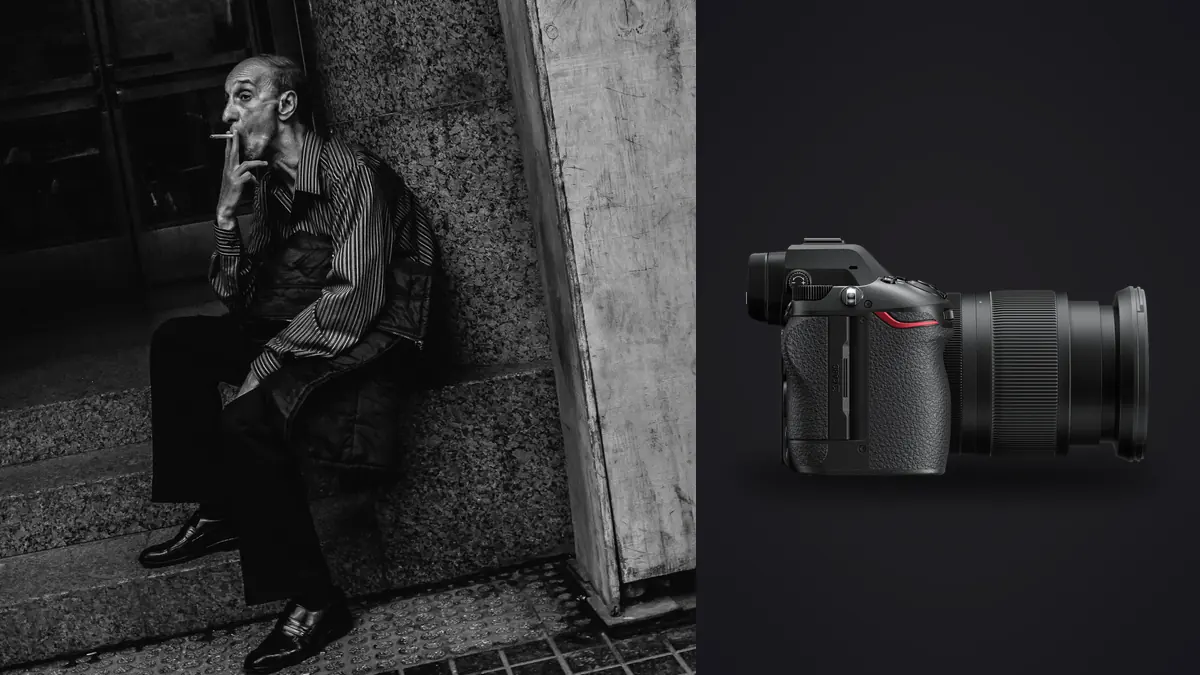
I picked up the Z6 III about four months into a documentary project following a fish market before dawn and a night market after dark, on the same day, most weeks. That schedule is a decent stress test for a camera because it never lets you settle into one lighting condition. You go from black-and-orange sodium light at 5am to flat grey overcast by 9am to LED-lit stalls at 9pm, and the camera either keeps up with you or it becomes the thing you're fighting instead of the story.
This isn't a spec sheet regurgitation. It's what actually mattered to me shooting people who didn't sign up to be photographed, in conditions that change every twenty minutes, with a bag that also has to carry a thermos and a second battery because the day is twelve hours long.
The sensor readout speed is the real headline, not the resolution
Nikon markets the Z6 III on its partially stacked 24.5MP sensor and EXPEED 7 processor, and on paper that reads like typical camera-launch language. On the street it translates into something specific: the rolling shutter skew that used to make bicycle wheels lean sideways and lampposts bend when panning is mostly gone. I shoot electronic shutter by default now, something I wouldn't have done on the Z6 II without wincing at distorted verticals in a market crowd. The bigger practical win is the blackout-free viewfinder during continuous shooting. On the older body, holding a burst meant a stuttering slideshow in the EVF while the subject moved through your frame. On the Z6 III at full 20fps electronic, 14-bit raw, you keep a mostly continuous view of what's happening, which means you can actually track a kid running through a stall, a hand reaching for change, a dog cutting across the frame, and know in real time whether you got the moment instead of guessing and hoping.
Handling it without turning into the show
Street and documentary work lives or dies a little on how much attention the camera itself draws. The Z6 III at roughly 760g body-only isn't small, and next to a rangefinder-style body like a Fujifilm or a Leica it reads as "camera" in a way that changes how people react to you. I've had market vendors go quiet and stiff the moment they clock the grip and the size of the lens barrel, something that happens far less with a compact fixed-lens body. What helps is going silent electronic shutter and killing every beep, and setting the rear screen to tilt rather than fully articulate so I can shoot from waist height without drawing a line of sight straight at my face. One thing I learned the hard way: silent electronic shutter under mixed LED market lighting can produce faint banding on some fixtures. It's not constant, and the camera's flicker reduction option helps, but I've started test-firing a frame or two under new lighting before committing to a sequence, because finding banding on the walk home is a bad surprise.
Autofocus in a crowd is good, not psychic
Subject detection with 3D tracking picks out a face reliably even at a distance and partially turned away, which is genuinely useful when you're pre-focusing on a spot and waiting for someone to walk into it. Where it struggles is dense crowds with multiple faces at similar distance. It will occasionally jump to the wrong person mid-burst, usually the one closest to center rather than the one you actually care about. I've rebound the AF-ON and joystick so I can snap the focus point back to a specific person without hunting through a menu, and that manual override gets used more often than I expected going in.
Lens pairings that actually earn their keep
I rotate between four lenses depending on the assignment, and weight matters more than most gear reviews admit, because you're carrying this around for ten or twelve hours.
| Lens | Focal length | Weight | Street price (used to new) | Where it earns its spot |
|---|---|---|---|---|
| Nikkor Z 40mm f/2 SE | 40mm | 170g | $260-300 | All-day carry, close enough to normal vision that framing feels instinctive |
| Nikkor Z 28mm f/2.8 | 28mm | 155g | $260-300 | Environmental context, works when you can't back up in a tight alley or stall row |
| Nikkor Z 35mm f/1.8 S | 35mm | 370g | $750-850 | Night market and interior work, weather-sealed for the rain I didn't plan for |
| Nikkor Z 24-70mm f/4 S | 24-70mm | 500g | $900-1,000 | Travel days where I don't know the shoot until I'm in it, trades speed for range |
If someone asked me for one lens to bring on a week-long documentary trip, it's the 40mm f/2 SE. It disappears in the bag, disappears on the body, and the field of view stops you from overthinking composition in a way a zoom never does for me.
Exposure settings across a day that never sits still
I logged what I was actually shooting at over a two-week stretch covering the same market at different hours, and the spread is wider than a generic "street photography settings" chart would suggest.
| Scenario | Aperture | Shutter | ISO range | Notes |
|---|---|---|---|---|
| Midday hard sun | f/8 | 1/1000 | ISO 100 | Zone-focus and let depth of field cover missed AF, EVF gets hard to read in direct light |
| Overcast / open shade | f/4-5.6 | 1/500 | ISO 200-400 | Easiest light of the day, subject detection tracks cleanly with even contrast |
| Indoor stall or cafe | f/2 | 1/125 | ISO 3200-6400 | Auto ISO with minimum shutter tied to focal length, watch for AF hunting on low-contrast stock |
| Night market / blue hour | f/1.8-2 | 1/60-1/125 | ISO 6400-12800 | Noise is manageable at this range, I don't fight it in camera, I flatten it in the edit |
That top end of ISO 12800 is usable for editorial work in a way it wasn't on cameras I shot five years ago, but I still treat it as a last resort rather than a comfortable cruising speed. Grain in a documentary image reads as honest; grain plus banding plus a soft AF miss reads as a bad photo, and it's easy to stack all three when you're rushing in low light.
Where the buffer and the cull actually collide
Here's the part nobody puts in a camera review: a 20fps burst on a decisive moment produces 15 to 40 nearly identical frames of the same three seconds, and multiply that by a full day of market shooting and you're looking at two or three thousand images by evening, most of them variations on ten or fifteen actual moments. The CFexpress B slot keeps the buffer from choking mid-burst, which is great in the field and genuinely painful three hours later staring at a memory card. This is the part of the workflow where I actually rely on imagic rather than just skimming through Lightroom's grid view hoping something jumps out. Because it clusters bursts and near-duplicate frames locally on the machine, I'm not scrolling through forty versions of the same handshake trying to spot the one where the eyes are open and the hand isn't blurred. The sharpness scoring specifically catches something eye AF sometimes misses in a burst: a subject moving fast enough that focus drifted a frame or two into the sequence even though the camera locked correctly at the start. There's also a quieter reason this matters for documentary and street work specifically. These are photos of strangers who didn't consent to a photo shoot, only to being in public. Running that raw folder through a cloud culling service to sort duplicates has never sat right with me, and it's part of why the fact that imagic processes everything on the machine, no upload step, isn't a nice-to-have for this kind of project. It's closer to a requirement.
Keeping a consistent look across a multi-week take
The other place the workflow used to break down was tone. A documentary series shot over weeks in wildly different light needs to hold together visually, and manually re-deriving the same grade night after night is how projects end up looking like five different photographers shot them. I built out the look on a smaller edited set first, the warmth in the shadows for the night market frames, the desaturation I like for the harsh midday stuff, and used imagic's apply_my_style feature to carry that grade across the rest of the take instead of rebuilding it by eye every session. It's trained on my own prior edits rather than some generic film-emulation preset, so it doesn't flatten the differences between a sodium-lit stall and an overcast street corner into one look, it adapts the starting point per image and I still nudge from there. If you want more on how the culling side of that pipeline actually scores frames, this breakdown of how AI photo culling works covers the mechanics in more depth than I will here.
Battery, weather sealing, and the stuff that ruins a day
The EN-EL15c gets me through a twelve-hour market day if I'm disciplined about EVF brightness and don't chimp every frame, but I still carry a spare because "if" is doing a lot of work in that sentence, especially once video clips or heavy burst shooting enter the mix. Weather sealing has held up through two genuine downpours at the night market with the 35mm f/1.8 S mounted, no issues, though I wipe down the card door and battery door seams before opening either, out of habit more than necessity at this point.
What actually bugs me about it
I'd rather list real complaints than pretend this thing is flawless. The body is still louder in mechanical shutter mode than a leaf-shutter compact, and there are settings, like a hushed indoor gathering, where even the electronic shutter's total silence doesn't offset the fact that raising a camera of this size to your eye is itself a visible, noticeable act. The menu system, while better organized than older Nikon bodies, still buries a couple of settings I change often (flicker reduction, silent mode toggle) two levels deeper than I'd like, and I've missed shots fumbling for them. And at 20fps raw with electronic shutter, it is very easy to develop a habit of holding the shutter down "just in case," which is exactly how you end up with three thousand images to cull instead of eight hundred. The camera didn't create that discipline problem, but it makes it easier to fall into.
Frequently Asked Questions
Is the Z6 III too large to shoot candid street photography without being noticed?
It's noticeable in a way a compact fixed-lens camera isn't, especially with the 35mm f/1.8 S mounted. It's not a deal-breaker for documentary work where being seen with a camera is often part of the arrangement, but if pure candid invisibility is the priority, pair it with the 40mm f/2 SE or 28mm f/2.8, both of which keep the front-of-lens profile small and the whole rig lighter to carry and raise quickly.
Which single lens makes the most sense for a documentary trip if I can only pack one?
For me it's the Nikkor Z 40mm f/2 SE. The field of view is close enough to how you naturally see a scene that you spend less time recomposing, it's light enough to leave mounted all day, and f/2 covers most indoor and evening situations without needing a tripod or flash.
Does the electronic shutter cause banding under market or streetlight LEDs?
Sometimes, depending on the specific fixture's flicker frequency. It's inconsistent enough that I now fire a couple of test frames under new lighting before shooting a real sequence, and I lean on the camera's flicker reduction setting as a first fix rather than assuming every LED-lit stall will behave the same way.
How do you realistically cull thousands of near-duplicate street frames after a shoot day?
Manually scrolling a grid view doesn't scale once you're past a thousand images from one day. I run the folder through imagic first to cluster bursts and near-duplicates and surface the sharpest frame from each cluster, which cuts the real editing set down to a size I can actually make judgment calls on, and it happens locally without the raw files of strangers on the street ever leaving the machine. From there it's a normal edit, just against a few hundred images instead of a few thousand.