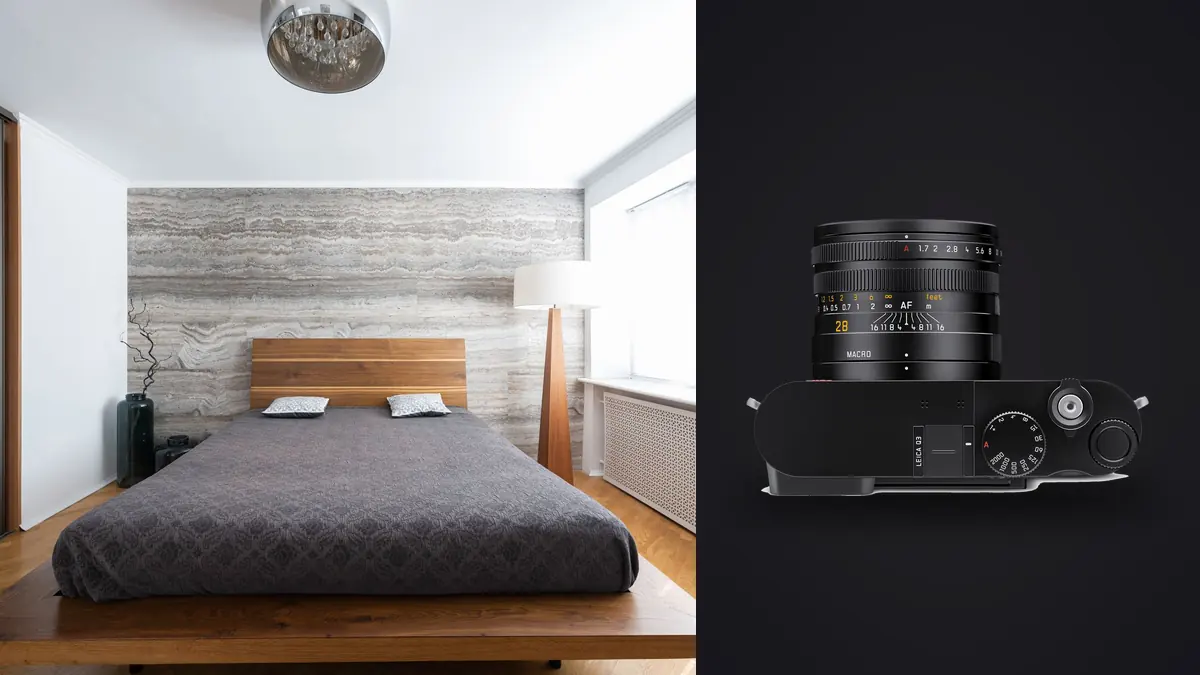
I get asked about this pairing more than almost any other in my inbox: can a camera with one lens, and a wide one at that, actually carry a boudoir session? The Leica Q3 is not the camera most photographers reach for first when the brief is intimate portraiture. It has a fixed 28mm Summilux f/1.7, no interchangeable mount, and a price tag that makes people assume it's a street photography toy for collectors. I've been testing it for boudoir-style portraits in tight spaces (small apartments, low ceilings) and I want to walk through what actually works, what I had to change about how I shoot, and where it genuinely surprised me.
The 28mm problem, and why it's smaller than you think
Boudoir photography lives and dies on flattering compression and a shallow, forgiving background. A 28mm lens is the opposite of the classic 85mm or 105mm portrait prime, so on paper this looks like a bad match. Get close enough for a face-filling frame at 28mm and you'll exaggerate the nose, widen the jaw, and generally do the one thing every client fears in front of a camera. I won't pretend that isn't real. Full-frame, full-body 28mm shots at close range look distorted, and no amount of client trust survives a session full of warped proportions.
What changes the equation is the 60-megapixel sensor and the in-camera crop modes. The Q3 lets you shoot at 28mm and crop in-body to 35mm, 50mm, or 75mm equivalents, and because the base file is so dense, the cropped output still holds up. A 75mm crop comes out around 8 to 9 megapixels, which is thin for a magazine cover but completely fine for web delivery, client galleries, or a modest print. For the actual portrait moments in a session, I shoot the 50mm crop almost exclusively. It gives close to a standard portrait perspective without walking into the subject's personal space in a room that's already emotionally loaded.
The wide native field of view earns its keep in a different part of the shoot: the environmental frames. Boudoir work isn't only tight skin-and-fabric close-ups. Clients want a few shots that show the room, the light through the curtain, the whole pose on the bed or chaise. That's where 28mm is genuinely better than a portrait tele, because you're not backed into a hallway trying to fit the frame.
How I actually split the shot list
Roughly: forty percent full-frame 28mm environmentals, forty percent 50mm-crop half body and three-quarter frames, twenty percent 75mm-crop tight detail and face shots. That ratio moved around by client and by room size, but it's a decent starting split if you're bringing this camera into a boudoir session for the first time.
Working distance and framing by crop mode
This is the part I wish someone had spelled out for me before my first portrait shoot with it, because I spent the first twenty minutes doing math in my head instead of directing the shoot. Here's what I've measured in real use, not lab numbers.
| In-camera crop | Approx. output resolution | Distance for head-and-shoulders | Distance for half body | Where it's actually useful |
|---|---|---|---|---|
| 28mm (native) | 60 MP | Not recommended (distortion) | 1.5 m | Full-room environmentals, wide reclining poses |
| 35mm crop | ~37 MP | 2.0 m (still risky close-up) | 1.2 m | Three-quarter poses in a small bedroom |
| 50mm crop | ~19 MP | 1.1 m | 0.8 m | Default portrait perspective, most of the shoot |
| 75mm crop | ~8-9 MP | 0.75 m | 0.5 m (tight framing only) | Face-forward detail, hands, fabric, jewelry |
The practical takeaway from that table is that you basically never want to shoot a close portrait at native 28mm unless you're intentionally going for a stylized, slightly warped look (some clients like that for a single hero image, most don't). Live in the 50mm crop for the bulk of the session and reach for 75mm when you need a tighter, more intimate frame without stepping uncomfortably close in a room that's already got a lot of trust riding on body language.
What the f/1.7 Summilux actually does in a dim bedroom
Boudoir sessions are frequently shot in ambient window light, a single softbox, or (my least favorite but most requested) candlelight-adjacent moody lamp lighting. This is where the Q3's fast aperture earns its reputation. At f/1.7, wide open, with the leaf shutter running silently, I've handheld usable frames down to shutter speeds I wouldn't trust on a mirror-slap DSLR. The leaf shutter itself matters more than people expect for this genre specifically: there's no mechanical clack breaking the mood in a quiet room, which sounds like a minor thing until you're mid-session with a nervous first-time client and every camera noise makes her flinch.
The catch is depth of field control once you crop in. At f/1.7 and native 28mm, depth of field is genuinely deep, deeper than people expect from an f/1.7 lens, because focal length and aperture interact. Crop to the 75mm equivalent and the effective look changes (you're using a smaller circle of the same image circle, so background separation reads closer to what you'd expect from a longer lens at that aperture), but it's still not going to melt a background the way an 85mm f/1.4 on a full frame body will. If buttery bokeh is the entire point of your boudoir aesthetic, this camera will disappoint you. If you want a sharp, intimate, slightly documentary look with backgrounds that stay present but soft, it's a strong match.
Macro mode for detail work
The Q3's macro switch on the lens barrel gets underused in most reviews I've read, but it's genuinely handy for the detail shots that round out a boudoir gallery: lace texture, a ring, a strap against skin. Focus down to around 17 cm and you get real close-focus capability without needing a second lens in the bag, which matters a lot when the whole point of this camera choice was traveling light into a client's home.
Color and skin tone rendering
Leica's color science gets talked about like a mystical thing and mostly it isn't, it's a specific, slightly warm, slightly desaturated-in-the-highlights rendering that happens to suit skin very well straight out of camera. On JPEG or the baked-in profile in Lightroom's Camera Match, midtone skin tones read warm without going orange, and highlight roll-off on skin is gentle rather than clipping hard, which matters a lot when you're shooting near a window with a client backlit by afternoon sun. RAW files still need real grading work, this isn't a "skip post" situation, but the starting point is closer to done than files from a lot of other bodies I've used for this genre.
If you're building a consistent look across a boudoir portfolio (and clients booking this kind of session do look at your gallery consistency before they book), I'd rather train a repeatable edit once and apply it than re-invent the grade every session. That's the one piece of my workflow I moved into a proper grading process rather than eyeballing each shoot, and it's also where imagic's apply_my_style feature has actually saved me time: I trained it on a set of Q3 edits I was happy with, and it now gets new shoots most of the way to my grade automatically, which I then fine-tune per set instead of starting from a flat profile.
Client comfort and the one-lens reality
There's an underrated psychological benefit to a fixed-lens camera that nobody puts in the spec sheet. Clients in a boudoir session are frequently anxious, and a photographer swapping lenses mid-shoot, rummaging through a bag, breaks the rhythm every time. With the Q3 I stay in the room, in the moment, adjusting crop and aperture with my thumb instead of stopping to unmount glass. Sessions have run noticeably smoother because of it, and more than one client has commented that the whole thing "felt fast," which for this genre is a compliment about comfort, not just efficiency.
The trade-off is real too. If a client wants an image that genuinely needs 135mm compression, a tight face crop from across a large room with heavy background blur, this camera cannot give you that no matter how you crop. It is worth being upfront about what the camera can and can't do before a shoot, and a brief that specifically wants a "long lens headshot aesthetic" is one this body just isn't built for.
The part of this workflow nobody mentions: culling a boudoir shoot is its own headache
A typical two-hour session on the Q3 produces somewhere between 900 and 1,400 frames once you account for the crop-mode bracketing (I'll often fire the same pose at two crop levels to give myself options later). Boudoir sessions in particular generate enormous near-duplicate runs, five or six frames of a held pose with barely perceptible changes in expression or hand position, because you're not chasing action, you're chasing the exact right micro-expression.
Sorting that manually used to eat half my editing day. I moved to imagic mostly because the sessions are shot and reviewed entirely on my own machine, with no cloud upload step, which matters enormously for this genre given how sensitive the material is. Its duplicate and burst clustering groups those five-or-six-frame runs automatically so I'm choosing between three or four real candidates instead of scrubbing through a folder of near-identical thumbnails, and the local sharpness scoring catches the soft-focus frames from handheld work at 75mm crop before I waste time opening them in Lightroom. For a genre where client trust and data privacy are the whole business, keeping every pass of the culling and rough-edit process off any server isn't a nice-to-have, it's close to a requirement.
A basic settings starting point
For anyone bringing this pairing into a session for the first time, here's roughly where I start before adjusting to the room:
- Aperture priority, f/2 to f/2.8 for most portrait crops (wide open at f/1.7 only for available-light close-ups)
- Auto ISO capped around 6400, since the Q3's high-ISO files clean up well but I still prefer to grade rather than lean on noise reduction
- Single-point autofocus with face detection on, eye detection tends to hunt on the 75mm crop in low light so I switch to a fixed single point for the tightest frames
- Electronic first-curtain shutter enabled to keep things quiet without the rare full-electronic-shutter banding under mixed indoor lighting
Frequently Asked Questions
Is the Leica Q3's 28mm lens too wide for boudoir close-ups?
At true 28mm, yes, for close portrait framing it distorts faces in a way most clients won't like. The workaround is the in-camera crop modes: shooting at the 50mm or 75mm equivalent crop gives a standard portrait perspective while keeping the full 60MP sensor's resolution advantage, just at a reduced output file size.
Can you get shallow depth of field for boudoir portraits with a fixed 28mm lens?
Some, not a lot. Wide open at f/1.7 the background separation is noticeably softer than a smaller aperture, but a 28mm lens will never produce the compressed, melted background of an 85mm or 105mm prime at a similar aperture. If heavy bokeh is central to your style, plan around it or supplement with a longer lens for select frames.
Is the Q3 discreet and quiet enough for an intimate session in someone's home?
This is genuinely one of its strengths. The leaf shutter is close to silent, there's no mirror slap, and because there's no lens swapping, the whole session stays uninterrupted. Clients who are nervous in front of a camera tend to relax faster with less mechanical noise and fewer pauses.
How do you manage the sheer number of near-duplicate frames from a boudoir session?
Volume is the real challenge with this genre, not the camera. Held poses generate long runs of nearly identical frames, and a two-hour shoot on the Q3 can easily clear a thousand images once you factor in shooting the same pose at multiple crop levels. Running the take through automated culling that clusters bursts and near-duplicates locally, without uploading sensitive files anywhere, cuts the review pass down from hours to a focused pass through a handful of real candidates per pose.