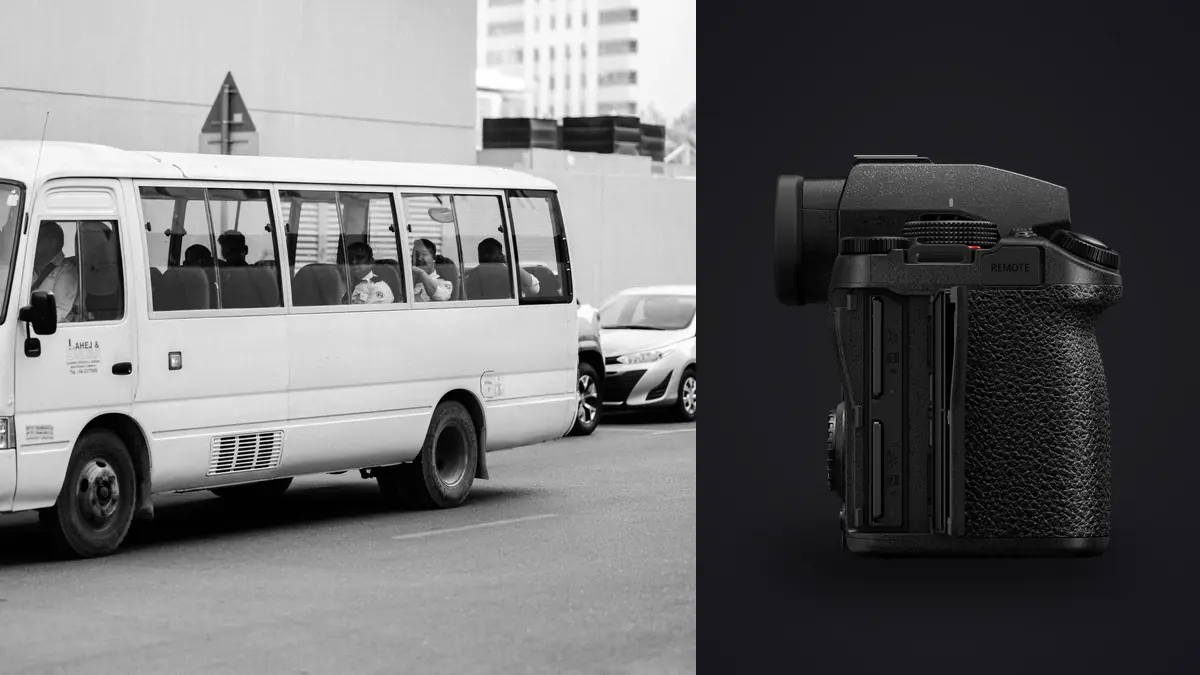
I picked up the S5IIx about four months into a personal project documenting a neighborhood market before it got redeveloped. I'd been shooting the original S5 for that kind of work for two years and mostly liked it, except for the one thing that matters most in candid photography: the camera hesitating right when a moment happened. Panasonic's older contrast-detect autofocus system, DFD, had a habit of "wobbling" past focus before settling, which is fine for a tripod portrait and genuinely bad for a kid running through a frame or a vendor's hands moving fast over a scale. The S5IIx fixes that specific problem, and that fix is really the whole reason this camera belongs in a conversation about street and documentary work rather than just being another full-frame hybrid body.
This isn't a spec-sheet rundown. It's what changed in practice when I swapped bodies mid-project, what I'd tell someone deciding between this and a Fuji X100VI or a used Sony A7C for the same kind of shooting, and where the S5IIx still isn't the right tool.
The autofocus change is the actual headline
Panasonic finally moved to phase-hybrid detection with the S5II generation, and the S5IIx inherits it wholesale. If you've used any prior Lumix full-frame body, you know the old complaint: focus would rack past the subject and pull back, a fraction of a second that's invisible in a studio and fatal on the street. With phase detection in the mix, that pulsing is gone. Eye and body detection lock fast enough that I stopped pre-focusing on a spot and waiting for someone to walk into it, which had been my workaround for years with the S5.
It's not flawless. In genuinely low light, say inside a covered market stall lit by a single bare bulb, hunting still happens occasionally, and it's slower to reacquire a face that turns away and back than what I've seen on recent Sony bodies. But for the 90 percent case of someone walking, gesturing, or working at a market stall in daylight or open shade, it tracks reliably enough that I trust it in a way I never trusted the S5.
Handling: the flip screen is a bigger deal than it sounds
The S5IIx uses a fully articulating vari-angle screen rather than a tilt-only design. Purists who shoot street work with rangefinders or X100-series cameras sometimes prefer tilt-only because it keeps the camera looking more like a normal shooting posture (screen flat against the back, tilted up for waist level). The vari-angle screen sticks out to the side when flipped, which is more conspicuous.
In exchange you get something genuinely useful for documentary work: shooting from low angles at an actual angle to the subject, not just straight down. Crouching to shoot a stallholder's hands while the screen faces you off to one side reads less like "person holding camera at you" and more like someone quietly working. I found myself using low, off-angle framing far more with this body than I ever did handheld with an OVF-only camera, simply because the screen made it comfortable to check focus and framing without lifting the camera to eye level.
Body weight sits around 740g without a lens, which is heavier than an X100VI or a Ricoh GR III but lighter than most full-frame DSLRs people used to carry for the same work. Paired with a small prime it doesn't scream "documentary shoot," though it's never going to disappear into a jacket pocket the way a compact will.
Shutter behavior matters more than most reviews mention
For candid work the electronic shutter is the one you actually live in day to day, since it's silent and doesn't announce a frame being taken in a quiet room. The S5IIx's rolling shutter readout is fine for walking subjects and normal conversation, but it's not a stacked sensor, so fast lateral motion (a cyclist crossing close to frame, a hand slapping a table) can show skew if you're at a slow-ish electronic shutter speed. I keep it around 1/250 or faster whenever I'm anticipating any quick motion and drop to mechanical shutter for anything where the click doesn't matter, like posed environmental portraits during the same assignment.
Burst speed tops out around 30fps electronic with focus tracking active, but I rarely shoot near that for documentary work. Nine or ten frames a second on the mechanical shutter, or a slower burst on electronic, is plenty for a gesture sequence and produces far less to sort through afterward. This matters more than it sounds like it should: shooting a wedding-style burst of every handshake and laugh at a market stall for three hours generates thousands of near-duplicate frames, and if your culling process is "scroll through everything in Lightroom clicking P," you'll burn half a day per outing just triaging.
This is where I've leaned on imagic for this project rather than doing it manually. It runs entirely on my laptop (nothing leaves the machine, which matters to me since a lot of these frames are of people who didn't necessarily agree to be photographed for a project, let alone have their faces uploaded to a cloud service for sorting), and it groups burst sequences and near-duplicate frames automatically using local sharpness and focus scoring rather than me eyeballing thirty nearly identical shots of the same handshake. For anyone shooting the S5IIx at anything near its faster burst rates for documentary work, some kind of automated first pass on sharpness and duplicates stops being a nice-to-have pretty quickly.
Lens pairings for street and documentary work
The L-mount alliance means you're not stuck with Panasonic-only glass, and for street work specifically the lens choice changes the character of the whole kit more than most camera differences do. Here's what I've actually shot with the body, not a theoretical list:
| Lens | Weight | Best for | Trade-off |
|---|---|---|---|
| Lumix S 26mm F8 | ~57g | Pocketable, always-on carry; zone focusing | Fixed f/8 only, no autofocus, unusable indoors or at dusk |
| Lumix S 35mm F2 | ~305g | General documentary, one-lens assignments | Not especially fast for dim interiors |
| Sigma 35mm F2 DG DN | ~325g | Same focal length, faster aperture, cheaper | Slightly slower AF motor than native Panasonic glass |
| Lumix S 50mm F1.8 | ~300g | Portraits within a scene, isolating a subject | Too tight for cramped market aisles or interiors |
| Leica Summicron-SL 35mm F2 | ~750g | Rendering quality, low light drawing wide open | Nearly triples the cost of the Sigma equivalent |
My honest working setup is the Sigma 35mm F2 for probably 70 percent of a shoot, switched to the 26mm pancake when I want the camera to look like nothing at all and I've already got the shot mentally planned at f/8 and a fixed distance. The Leica glass is genuinely lovely, especially the way it draws out-of-focus backgrounds in busy urban scenes, but I wouldn't tell someone starting out to spend Leica money before they know their own shooting distance and habits.
Low light and ISO in real documentary conditions
Documentary work rarely happens in ideal light. Markets, workshops, backstage areas, late-evening street scenes, all of it pushes ISO higher than a landscape or studio shooter would tolerate. The S5IIx's 24.2MP sensor holds up cleanly through about ISO 6400 with only mild grain, and I've pushed to 12800 for moments I wasn't going to get again, accepting the noise as part of the image rather than something to fight in post. Above that it gets rough fast, more so than what I've seen from Sony's current sensors at the same megapixel count, but that gap only matters if you're regularly shooting past 12800, which for most street and documentary work at f/2 primes you shouldn't need to.
In-body stabilization rated around 6.5 stops with compatible lenses lets handheld shutter speeds drop lower than you'd expect for static or slow-moving subjects, useful for interior documentary shots where you don't want to bump ISO further but your subject isn't moving fast. It does nothing for subject motion blur, obviously. A market vendor's hands chopping vegetables will still blur at 1/30 no matter how good the IBIS is.
Color rendering and why it changes your editing workflow
Panasonic's color science on this generation leans warmer and slightly more saturated in skin tones out of camera than Sony's, closer to what people describe as a "Leica-adjacent" look, which makes sense given the L-mount partnership. For documentary work where you're often publishing a consistent set from one shoot, this matters because you spend less time correcting skin tones frame to frame across mixed lighting than I remember doing with earlier Sony bodies.
The camera also supports real-time LUT application, baking a look into JPEGs and video as you shoot rather than only in post. I don't use this for final files (I still process RAW for anything going into a final edit) but I use it constantly for on-location previews, applying a rough black-and-white contrast LUT so I can judge a frame's tonal structure on the rear screen instead of guessing how a color image will translate once desaturated later.
Where this connects to my actual post workflow: once I'm back at the laptop with a card full of RAW files, I run a first pass through imagic to cut duplicates and soft-focus misses, then apply a preset trained on my own previous edits from this same project using its apply_my_style feature, so a hundred images from a new session land close to the tonal choices I made on the first fifty without me manually matching curves shot by shot. It's not a replacement for actually looking at every frame, but it removes the repetitive part of matching a look across a large, inconsistent-light shoot, which is exactly the kind of grind documentary work produces in volume that studio work usually doesn't. If you're new to the idea of software doing this first pass for you rather than a human editor, it's worth reading up on how AI photo culling actually works before assuming it means losing control over the edit.
Weather sealing and the realities of extended assignments
Street and documentary shooting means being outside in whatever the day gives you, and the S5IIx's magnesium alloy chassis with weather sealing has held up through a genuinely unpleasant rain session at the market without issue, condensation on the lens front element aside (no camera fixes that). Dual SD UHS-II slots matter for anything approaching professional documentary work, not because a card is likely to fail mid-shoot, but because backup-while-shooting removes one entire category of anxiety on a once-only assignment, a protest, a festival, an event that isn't repeating tomorrow.
Battery life sits around 370 shots CIPA-rated, which undersells real-world use since CIPA testing cycles through menu navigation and flash firing that a documentary shooter mostly skips. I typically get through a four to five hour outing on one battery with the screen active most of the time and a mix of stills and short video clips. I still carry a second battery for anything past a half day, which is standard practice regardless of camera brand at this point.
Where this camera isn't the right choice
If total inconspicuousness is the priority over everything else, a Fuji X100VI or Ricoh GR III will disappear into a bag or pocket in a way the S5IIx never will, full stop. If you're shooting almost exclusively available-light interiors at ISO 25600 and above, a body with a more forgiving high-ISO sensor will serve you better. And if you're coming from Sony and already own a full L-mount-incompatible lens collection, the switching cost is real money, not just a preference. The S5IIx earns its place specifically for people doing sustained documentary or street work who need reliable autofocus, don't mind a bit more bulk than a compact, and want a body that can also shoot serious video (this is, after all, the "x" variant built around video features like ProRes recording and USB-SSD output that a pure stills shooter will likely never touch).
One more practical note if you're weighing this purchase against upgrading your editing side instead of your camera body: a faster, more reliable AF system only helps if your review and sort process can keep up with what it captures. Some of the workflow tips in this rundown on speeding up a photo workflow apply just as well to a new camera body as they do to new software.
Frequently Asked Questions
Is the S5IIx's autofocus actually reliable enough for fast-moving street scenes?
For walking pace and normal gestures, yes, consistently. For genuinely fast unpredictable motion, like a skateboarder or a dog running toward the lens, it's good but not the best in its class; recent Sony and Canon bodies still track erratic motion a touch more confidently. For the pace of most documentary and street subjects it's more than sufficient, and a clear step up from Panasonic's pre-2024 full-frame AF.
Do I need the "x" version, or would the standard S5II work just as well for documentary photography?
For stills-focused documentary and street work, the standard S5II gets you the same sensor, same autofocus system, and same IBIS for less money. The x version's extras (ProRes, unlimited internal recording limits, USB-SSD recording, all-black cosmetic finish) matter almost entirely to video shooters. If you're not delivering video alongside your stills, save the difference and get the S5II.
How does the S5IIx handle high-volume burst shooting from a workflow standpoint?
The camera itself handles bursts fine up to its rated speeds, but the resulting card of near-duplicate frames is a real workflow cost that the camera doesn't solve for you. Tools built around duplicate and burst clustering, like imagic, cut that sorting time down considerably by grouping similar frames locally rather than requiring a manual scroll through every shot.
Is a used original S5 or S5 II a reasonable budget alternative for someone starting out in street photography?
The original S5 is a real budget option now that used prices have dropped, but you inherit the old contrast-detect AF wobble discussed above, which is genuinely limiting for candid work involving movement. The S5II (non-x) is the better value target if phase-detect AF matters to you, which for street and documentary work, it should.