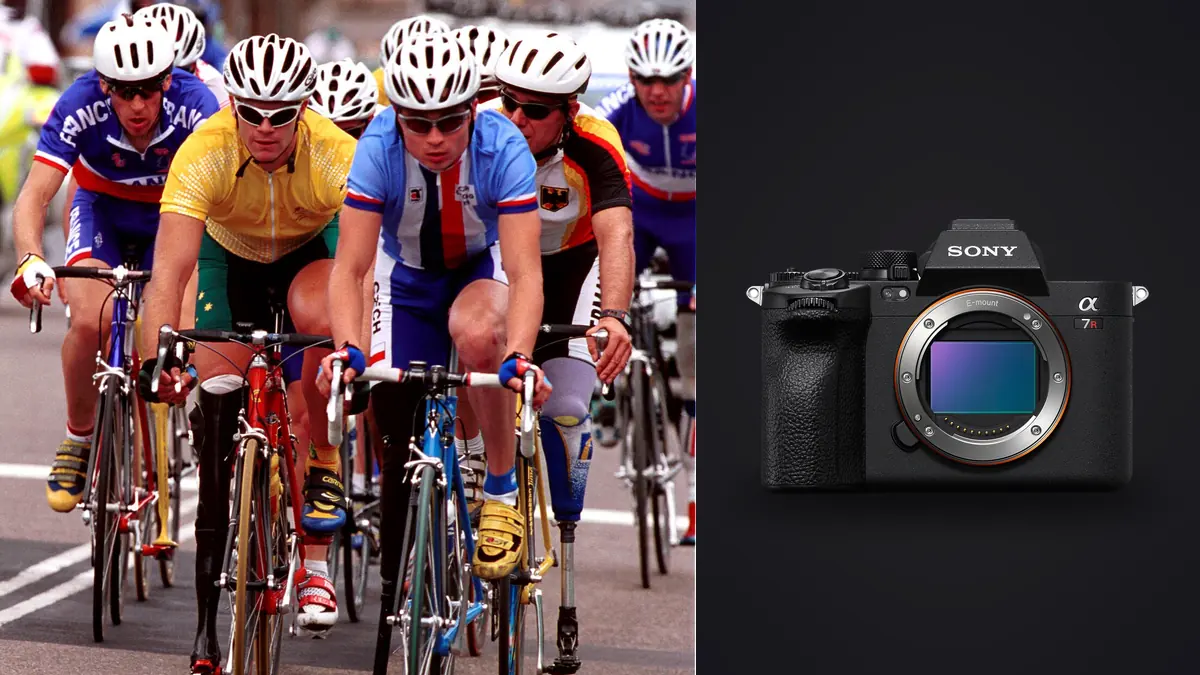
Every track season I get some version of the same question from a parent or a school paper photographer: "I've got an A7R V, can I actually use it for meets?" The honest answer is yes, but not the way you'd use an A9 III or even an A7 IV. The A7R V was built to resolve detail, not to chase a 200-meter sprinter through eight frames a second without choking. If you understand what the camera is actually optimized for, you can get results out of it at a track meet that a speed-first body can't match. If you fight its nature, you'll spend Saturday night deleting soft frames and wondering why you bought a 61-megapixel camera to shoot people running in straight lines.
The real trade-off: resolution versus readout speed
The A7R V uses a 61-megapixel back-illuminated sensor, and it is not a stacked sensor. That distinction matters more at a track meet than almost anywhere else you'll point a camera. A stacked sensor, like the ones in the A9 III or the A1, reads out the full frame extremely fast, which is what lets those bodies shoot at high frame rates with minimal rolling shutter distortion. The A7R V's sensor has to move a lot more data off the chip for every single frame, and that slower readout shows up in two places: burst speed and rolling shutter behavior on the electronic shutter.
In practice, that means the A7R V tops out at 10fps with full AF and AE tracking, and that number needs an asterisk. You get it on either the mechanical or electronic shutter, but the buffer empties faster than the spec sheet number makes it sound, especially if you're shooting compressed RAW at 14-bit and not lossless compressed. I've had the buffer catch me mid-relay exchange more than once, right as the baton actually leaves the outgoing runner's hand. That's the exact moment you can't afford a stall.
Autofocus is the camera's actual selling point here
Where the A7R V earns its keep at a meet isn't speed, it's the AI-driven subject recognition. The dedicated processing unit does real human pose detection, not just a face box floating around the frame. For a 100-meter final where a runner's head is tucked and their arms are pumping through the frame, that pose-aware tracking holds onto the torso and legs even when the head briefly turns away from the sensor. I run it in Human recognition mode with tracking set to a fairly aggressive sensitivity for sprints, and a looser sensitivity for hurdles, where a runner's silhouette changes shape dramatically clearing each barrier and you don't want the system jumping to the hurdle itself.
693 phase-detection points covering close to 80% of the frame means you rarely lose a subject to the edges, which matters on a track because athletes cross your frame laterally rather than approaching head-on like they would in football or basketball. I keep AF area set to Wide with subject recognition doing the selection rather than manually chasing a zone, because manually recentering a focus point while panning a 400-meter runner around the curve is a losing game.
Frame rate, buffer depth, and where this body runs out of gas
This is the part that actually decides whether the A7R V is the right camera for a given event. I put together the numbers below from what I've measured shooting UHS-II cards, not manufacturer marketing figures, because real buffer depth depends heavily on card speed and file settings.
| Camera | Resolution | Max burst (AF/AE tracking) | Realistic RAW buffer before slowdown | Best-suited track event |
|---|---|---|---|---|
| Sony A7R V | 61MP | 10fps | Roughly 60-70 compressed RAW frames, then a noticeable stutter | Field events, finish-line detail shots, portraits between heats |
| Sony A9 III | 24.6MP | 120fps (global shutter, no blackout) | Effectively card-limited, rarely stalls in a single race | Sprints, relays, anything with a hard decisive moment |
| Sony A7 IV | 33MP | 10fps mechanical, 6fps electronic | Around 30-35 compressed RAW frames | Field events and warm-up shooting on a tighter budget |
What that table tells me every time I'm packing a bag for a meet is that the A7R V is not the camera I want glued to lane 4 for the entire 100-meter final. It's the camera I want for the long jump runway, for pole vault where the action is slower and more vertical, for javelin release, and for the walk-around portraits and warm-up shots where 61 megapixels lets me crop a tight headshot out of a frame I never got physically close enough to shoot.
Rolling shutter is real, and it shows up on pans
If you shoot the A7R V on the electronic (silent) shutter while panning with a sprinter, you will see skew. Verticals that should be straight, like a starting block or a lane line crossing the frame diagonally as you pan, will lean. It's subtle at 1/2000s and faster, but it gets visibly worse the slower your shutter speed and the faster your pan speed, which is basically the exact combination you use for a deliberately blurred-background sprint shot. My workaround is boring but effective: for anything with a fast lateral pan, I shoot mechanical shutter, not electronic. You lose the silence, which nobody cares about outdoors at a track meet anyway, and you get a sensor readout method that isn't dragging a rolling curtain across a moving subject.
Using the APS-C crop instead of buying a longer lens
A lot of track photography is shot from the infield or from stands that put you 40-60 meters from the actual lanes, and full-frame reach at those distances usually means a 400mm or 600mm prime that most of us aren't buying for a hobby or a school gig. The A7R V's sensor gives you a real out here: shoot APS-C crop mode and you're still working with roughly 26 effective megapixels, which is genuinely usable file size, while your 200mm lens behaves like a 300mm. I use this constantly with a 70-200mm f/2.8 for track events specifically because it turns a lens I already own into something with enough reach for the far straightaway, without the autofocus speed penalty that comes with slower long telephotos.
The trade-off is you're throwing away resolution you paid a premium for, and full-frame mode is where the A7R V's actual advantage over a lower-megapixel body shows up. So I switch back and forth depending on the event: crop mode for far-side sprint action, full frame for anything closer where I want maximum detail for a print or a tight editorial crop later.
The part nobody warns you about: what 61 megapixels does to your evening
Here's the practical problem that has nothing to do with autofocus or burst rate. Shoot a full day of a track meet on this camera in compressed RAW and you will come home with somewhere north of 40-50GB of images, and a meaningful chunk of every burst is near-duplicate frames of the same stride or the same hurdle clearance, just one or two frames apart. Culling that by eye, at full resolution, on a laptop in a hotel room the night before a paper deadline, is miserable.
This is honestly the reason I moved to imagic for the culling pass. It runs the sharpness and focus scoring locally on the machine, so I'm not uploading a card's worth of 61-megapixel files anywhere before I've even picked a shortlist, which matters when I'm working off event wifi that barely handles email. It also clusters burst sequences and near-duplicates automatically, so a 12-frame hurdle sequence gets grouped instead of showing up as twelve separate decisions I have to make one by one at 1am. Once I've picked the keepers, I run the apply_my_style preset, which is trained on my own previous edits rather than some generic sports preset, so a gallery of 300 selects across four events still looks like one consistent set when I hand it off.
If you're new to culling workflows in general and want the broader mechanics of how automated focus and duplicate detection actually work, the how AI photo culling works writeup covers the underlying approach in more depth than I have room for here.
Field events ask for something different than the track does
Sprints and hurdles are about tracking speed and holding focus through erratic motion. Field events are a different problem entirely, and honestly a much better fit for this camera. Pole vault has a clear anticipation window: the plant, the rise, the bar clearance. You don't need 20fps for that, you need to nail one or two frames at the peak with maximum detail, because that's the frame that ends up printed or submitted to a recruiting profile. Same with long jump takeoff and shot put release. I shoot these at 6-8fps rather than maxing out the burst rate, partly to protect the buffer and partly because I genuinely don't need the extra frames when the peak moment is a specific, predictable instant rather than a continuous unpredictable sprint.
Discus and hammer throw are the outliers where I still want speed, because the release point is fast and the rotation makes timing harder to predict than a vertical jump. For those I'll bump back up to the full 10fps and lean harder on the pose-tracking AF to hold the athlete through the spin.
Lenses that actually make sense for this
You don't need exotic glass to make this camera work at a meet. A 70-200mm f/2.8 covers most field events and closer track work comfortably, and with APS-C crop it stretches far enough for the backstretch on most high school and college tracks. If you're regularly shooting from the stands at a bigger venue, a 100-400mm is the more honest choice, even though autofocus hunts a touch more in low light under stadium lighting during evening finals. I'd steer away from anything slower than f/5.6 at the long end for night meets specifically, because the A7R V's autofocus, while accurate, isn't the fastest-acquiring system Sony makes, and a slow lens compounds that in dim conditions.
Frequently Asked Questions
Is 61 megapixels overkill for shooting track and field?
For sprints specifically, mostly yes, you're rarely printing a 100-meter dash frame at a size that needs that much data, and the extra resolution just means bigger files and a slower buffer. For field events, portraits, and any shot where you plan to crop hard after the fact (a distant pole vault clearance, for example), the resolution earns its keep because it gives you room to reframe without falling apart.
Should I rent an A9 III instead for a big meet?
If the meet is mostly sprints, relays, and hurdles and you need every frame in a fast sequence, yes, the A9 III's global shutter and 120fps ceiling will get you shots the A7R V simply can't produce in that specific scenario. If the schedule leans toward field events, longer distance races, or you're shooting for print and portrait work between heats, the A7R V's resolution advantage is worth more than the extra frame rate.
What autofocus settings work best for hurdles specifically?
I use Human subject recognition with a lower tracking sensitivity than I'd use for a flat sprint, since a hurdler's outline changes fast and you don't want the AF darting to the hurdle bar itself. Wide focus area with recognition doing subject selection, rather than a manually placed zone, holds up better through the clearance than trying to track it yourself.
Does the rolling shutter actually ruin panning shots of sprinters?
It won't ruin a shot outright, but you'll see skewed verticals on background elements during fast pans if you're on the electronic shutter at slower shutter speeds. Switching to mechanical shutter for panned sprint shots solves it, at the cost of a slightly louder shutter, which isn't a real issue outdoors at a track.