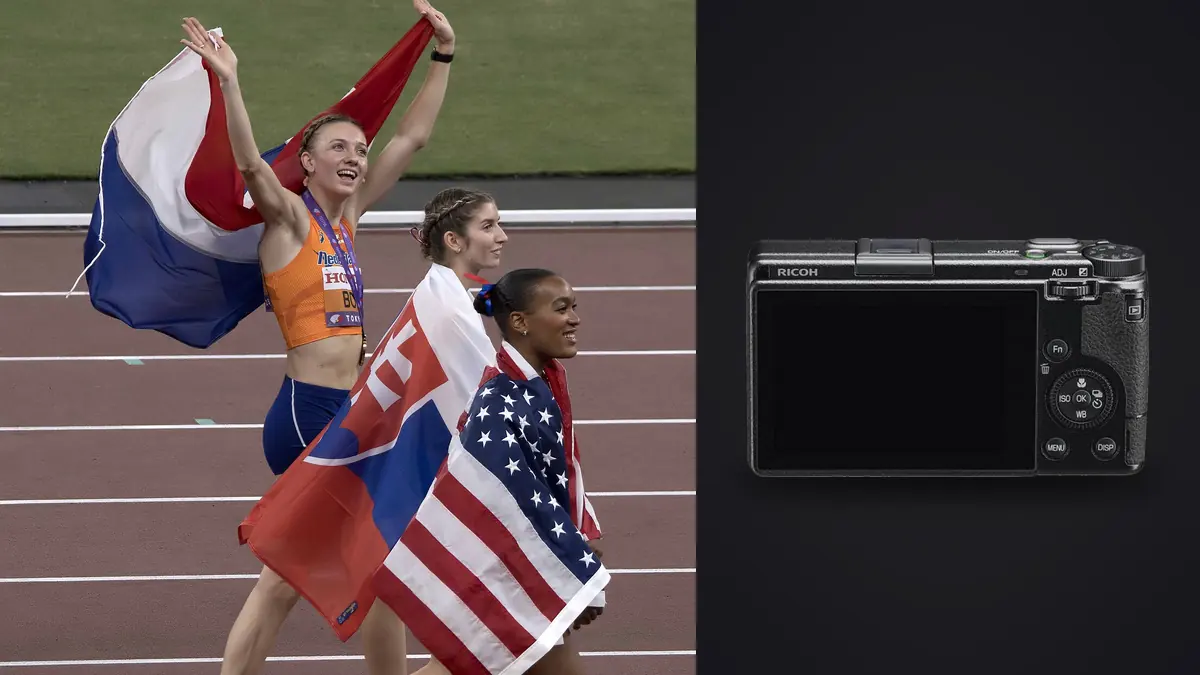
The Ricoh GR IIIx is not a sports camera. It has one lens, a 40mm-equivalent f/2.8 prime that doesn't zoom, an autofocus system built for street corners and cafe tables rather than sprinters, and a buffer that runs dry after a handful of raw frames. None of that stopped me from bringing one to a regional track and field meet last spring, mostly because it was the only camera I had that fit in a jacket pocket between events I was also helping time. What I came away with surprised me: a stack of usable frames, a much better understanding of where this camera earns its keep at a meet, and a clear list of moments it simply cannot cover. This is that list, with the settings and habits that made the difference.
Why bring a fixed 40mm to a track meet at all
The honest answer is access and speed, not reach. At most youth and regional meets you are not credentialed for infield access, so you're working the same rail, the same finish-line fence, and the same warm-up area as every other parent and assistant coach. A camera you can carry all day without a strap digging into your neck, that wakes up and shoots in under a second, and that doesn't scream "professional photographer, please stop me" turns out to matter more than a 400mm lens you can't actually get close enough to use anyway from the stands.
The GR IIIx also happens to be quiet, has no mirror slap, and its APS-C sensor at 24 megapixels gives you enough resolution to crop hard in post when you misjudge distance, which you will. None of that makes it a sprint camera. It makes it a very good camera for the 80 percent of a track meet that isn't the 100 meter final: blocks being set, chalk marks, relay exchanges viewed up close, a coach's hand on a shoulder before the 800m, the exhausted collapse past the line.
Where the autofocus actually holds up
Ricoh's GR series uses a contrast-detect AF system, not the phase-detect tracking you'd get on a dedicated sports body. Point it at a runner sprinting laterally across the frame at speed and it will hunt, and by the time it locks, the moment is gone. I tried single-point AF-C on sprinters for the first two heats of the meet and kept roughly one usable frame in ten. That's not a camera that's "kept up," that's luck.
What changed everything was switching to Snap Focus. This is the GR series' signature feature: you set a fixed focus distance (I used 5 meters for most track work, 2.5 meters for close relay exchanges), pick an aperture that gives you enough depth of field to cover the timing error in your own judgment, and the shutter fires the instant you press it, no AF hunt at all. It's zone focusing with a digital assist, the same technique rangefinder shooters have used for decades to catch fast unpredictable subjects. Set the zone at the outer edge of lane eight, wait for a runner's shoulder to cross that invisible line, and fire. It works because you're removing the autofocus system from the decision entirely.
Settings that actually froze motion
At f/2.8 wide open the depth of field at 5 meters with Snap Focus is thin enough that a runner half a stride off your mark can be soft, so I mostly shot at f/5.6 to f/8, which on an overcast day meant ISO 800 to 1600 to hold a shutter speed north of 1/1000s. On a bright afternoon you can drop that to ISO 200-400 and still get 1/2000s, which is what you want for anything faster than a distance pack. Here's roughly what worked event by event.
| Event | Realistic shooting distance | Best technique with a fixed 40mm | Settings that worked |
|---|---|---|---|
| 100m / 200m sprints | Rail-side near the start or finish only | Snap Focus at 5m, pre-aim at your zone, fire on the lean | f/5.6, 1/1600s+, ISO auto to 3200 |
| 4x100 / 4x400 relay exchange | 2.5-4m if you can stand near the exchange zone | Snap Focus at 3m, frame wide for two runners | f/5.6, 1/1000s, continuous shutter for 2-3 frames |
| Long jump / triple jump | 3-6m from the pit if permitted | Snap Focus at 4m, wait for takeoff or landing | f/4, 1/1000s, focus zone set before the runway approach |
| High jump | 4-8m, side angle | Snap Focus at 5m, fire as the bar clears | f/5.6, 1/1250s, ISO bumped for shade under stands |
| 800m / distance races | Anywhere along the rail, repeated laps | AF-C is usable here, pace is forgiving | f/4, 1/500-1/800s, single-shot AF acceptable |
| Shot put / discus | 8m+, behind the sector line | Too far for 40mm to be more than a wide environmental shot | Use for the wind-up and reaction, not the throw itself |
The reach problem, and the crop workaround
A 40mm equivalent field of view fills a frame with a person at somewhere around 4-5 meters. That's fine for relay exchanges and blocks, useless for the far turn of a 400m oval. The GR IIIx has two in-camera digital crop modes that simulate roughly 50mm and 71mm equivalent framing by cropping into the 24-megapixel sensor before saving the file. I used the 50mm crop constantly for finish-line shots when I couldn't get right on the rail, and it holds up fine printed at normal sizes, though you're throwing away resolution you might want for a hard crop later. The 71mm crop is a last resort. Image quality softens and the file size drops enough that I only reached for it on the rare occasion I had no other angle. Neither replaces an actual telephoto, but they buy you a stop of flexibility you don't get from the lens alone.
If you know in advance you'll need the far side of a track, this isn't the camera for that shot, full stop. I brought a second body with a 70-200mm for exactly that reason and used the GR IIIx almost entirely within about 8 meters of myself.
Indoor meets are a different problem entirely
Everything above assumes daylight, and daylight is the easy case. Take the same camera into a fieldhouse for a winter indoor meet and the fixed f/2.8 maximum aperture stops being a minor limitation and starts being the whole story. Gymnasium lighting is dim, often mixed temperature (sodium vapor mains next to newer LED banks retrofitted over one corner of the track), and on older fixtures it flickers at a rate your eye won't catch but your shutter will, showing up as banding or an odd exposure shift between two frames shot a tenth of a second apart. I ended up shooting most indoor sprints at ISO 6400, which the sensor handles with noise that cleans up fine for web use but starts showing chroma noise in shadow areas once you push shadows in an edit.
Snap Focus still works indoors, arguably better, since the shorter 200m indoor oval means your subject-to-rail distance is more consistent lap to lap. But you lose the shutter speed cushion daylight gives you. At f/2.8 and ISO 6400 you're often still only at 1/500-1/640s under typical fieldhouse lighting, enough to freeze a distance runner but marginal for a sprinter's arm swing, which shows up as slight motion blur at the hands even when the torso is sharp. Knowing that going in changes what you aim for: faces and torsos in focus, and accepting soft extremities as part of the look rather than fighting it with settings the light won't support.
Buffer, battery, and the parts nobody mentions
The raw buffer is shallow. You get a handful of full-resolution DNG frames in a continuous burst before the camera slows down to write to the card, so "spray and pray" bursts through an entire relay leg aren't really an option. I shot 2-3 frame bursts around the moment I'd pre-judged with Snap Focus rather than holding the shutter down, and that discipline actually produced a better hit rate than machine-gunning would have, because I was thinking about timing instead of hoping volume would cover for me.
Battery life is the other quiet problem. The DB-110 pack is small and CIPA-rated for roughly 200 shots, which sounds like plenty until you spend a track meet chimping the LCD after every attempt to check focus, since there's no viewfinder to shield the screen from midday sun. I carried two spare batteries and still swapped one out by the final events. And the GR IIIx isn't weather sealed in any meaningful way, so a meet with rain in the forecast, or a windy day kicking up track dust and chalk, is a real risk to think about before you commit to it as your only body.
What happens after the meet
Snap Focus zone shooting has a side effect: you end up with small clusters of near-identical frames around every moment you tried to catch, two or three shots of the same relay exchange a fraction of a second apart, one of them sharp and the other two slightly off because the runner's stride didn't land exactly where you guessed. Sorting through 900 frames from a full meet by eye, zoomed in on a laptop screen between heats, is not a good use of the twenty minutes you have before the next race. I started running the day's card through imagic between events instead, since it does its focus and sharpness scoring and burst clustering entirely on-device. There's no wifi at most school track facilities worth trusting with an upload, so having the whole pass happen locally on the laptop, no cloud round trip, meant I could actually finish a cull sitting on a bleacher.
The other piece that saved real time was imagic's apply_my_style feature. I'd already trained it on a batch of my own edited street shots, the kind of contrasty, slightly desaturated look I use for most of my personal work, and applying that same trained preset across a meet's worth of images got me to a consistent, already-mine look across a few hundred frames in one pass rather than re-grading each one from scratch. It's not a universal preset pulled from someone else's style, it's built from my own prior edits, so it didn't fight the color and contrast decisions I'd already make by hand anyway. For anyone shooting quick-turnaround events on a compact camera, that kind of local, personalized batch pass is the difference between finishing the edit that night and still being behind a week later. If you're new to how that scoring and clustering actually works under the hood, we cover the mechanics in more detail in how AI photo culling works, and the broader habits that speed up a shoot-to-delivery pipeline are in our faster workflow guide.
Would I do it again
Yes, but as a second camera, deliberately, not as a substitute for a telephoto body when I know I need one. For a meet where I'm mostly documenting rather than chasing PR-worthy sprint frames from the far straight, the GR IIIx's size and speed of operation win out over what a bigger camera would technically be capable of. For a championship meet where the shot that matters is a photo finish from 40 meters away, I wouldn't rely on it alone. Know which meet you're walking into before you decide what's in your bag.
Frequently Asked Questions
Can the Ricoh GR IIIx track a sprinter well enough to keep autofocus locked through a 100m dash?
Not reliably. Its contrast-detect AF system isn't built for lateral high-speed subjects and will hunt rather than lock in continuous mode. Snap Focus, where you set a fixed distance and fire without waiting for AF, is the far more consistent method for sprints and jumps.
Is the fixed 40mm-equivalent lens too tight for shooting an entire track meet?
For anything happening more than about 8-10 meters away, yes, even using the in-camera crop modes. It's well suited to blocks, exchanges, field-event approaches, and finish-line shots taken close to the rail, but it can't replace a telephoto for far-turn sprint action or throwing events shot from behind the sector line.
What aperture and shutter speed combination actually freezes track action with this camera?
f/5.6 to f/8 gives enough depth of field to cover small focus-distance misjudgments with Snap Focus, and 1/1000s or faster is the practical floor for sprints and jumps. On overcast days that pushes ISO into the 800-1600 range, which the sensor handles reasonably cleanly.
How do you deal with the shallow raw buffer during back-to-back heats?
Shoot short 2-3 frame bursts timed around a pre-judged Snap Focus zone rather than holding the shutter down continuously. It forces better timing discipline and actually produces a higher keeper rate than relying on volume, since the buffer would stall a longer burst anyway.