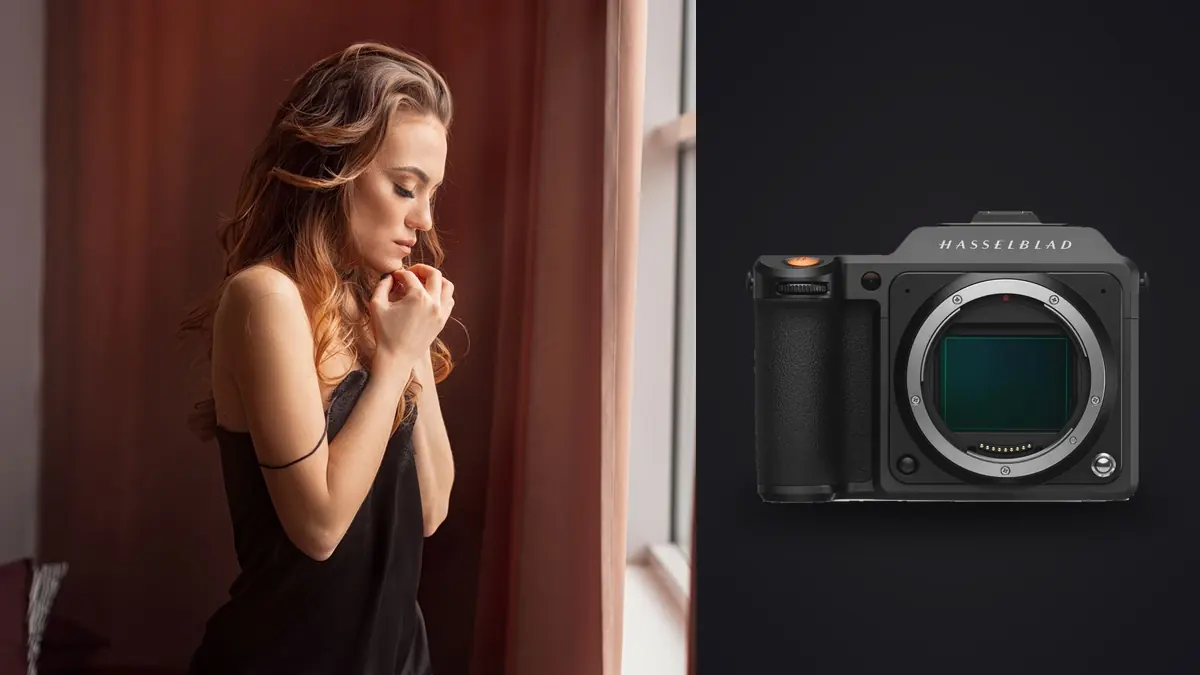
Medium format has a reputation problem in boudoir circles. It gets filed under "landscape camera" or "editorial fashion camera," the kind of thing you rent for a magazine cover and never touch again. I picked up a Hasselblad X2D 100C two years ago for exactly that kind of job and ended up using it for almost every intimate portrait session I've shot since. Not because it's the obvious choice. Because once you've dealt with the specific problems boudoir work throws at a camera (skin under low, warm light, lace that either resolves beautifully or turns into mush, clients who need to see a handful of genuinely excellent frames rather than four hundred mediocre ones), the X2D solves more of them than it creates.
What the sensor buys you in a bedroom or a hotel suite
The X2D's 100-megapixel sensor is physically larger than any full-frame chip, at 43.8 by 32.9mm, and it shoots 16-bit RAW rather than the 14-bit you get from most mirrorless bodies. On paper that's a spec sheet number. In practice, on a boudoir set, it means the transition from a lit collarbone into shadow along a sheet or a strap doesn't band or clip the way it can on a smaller sensor pushed hard in mixed light. Hotel suites are the worst lighting environments in this genre: warm tungsten lamps, cool window light, maybe a single strobe you've brought in to fill. The extra bit depth gives you real room to pull that scene into something coherent in post without the skin looking posterized.
Hasselblad's color science (they call it the Natural Colour Solution) also earns its keep here. I don't love marketing language around "natural" color, but on this specific subject matter it's noticeably true: skin tones out of the X2D need less correction across a range of undertones than what I was getting off my old full-frame body, and that matters when half your editing time on a boudoir gallery is spent making sure every subject looks like herself and not like a preset. There's no anti-aliasing filter either, so lace, fishnet, and fine hair detail resolve with a crispness that's genuinely different from what I was shooting before. That's flattering for texture-heavy wardrobe and unflattering for skin if you're not careful with your diffusion, so I've had to adjust how hard I light and how much I soften in post.
The leaf shutter is the real reason to own this camera
People fixate on the megapixel count. The feature that actually changed my lighting on set is the leaf shutter built into the XCD lenses, which syncs flash at any shutter speed up to 1/2000s. On a focal-plane shutter camera you're capped at your sync speed, usually somewhere around 1/200 to 1/250, which means bright rooms force you to either stop down hard, add ND, or fight the ambient with a huge amount of flash power. In a hotel suite at 11am with a wall of windows, that's the difference between a shoot that works and one where you're taping garbage bags over the glass.
With the X2D I can shoot at 1/1000 or 1/1600, aperture wide open at f/2.5, and use the shutter speed itself to knock the ambient down two or three stops while a single small strobe does the actual key lighting. That gives you the shallow, intimate look boudoir clients expect (soft background falloff, isolated subject) in rooms that would otherwise force you into a stopped-down, everything-in-focus look you don't want for this kind of work. It also means I can feather a strobe through a diffuser at low power instead of blasting it, which keeps the light quality soft on skin.
Shoot scenario cheat sheet
| Scenario | Lens | Aperture | ISO | Shutter | What's actually happening |
|---|---|---|---|---|---|
| Overcast window light, bedroom | XCD 55V | f/2.8 | 200 | 1/125 | Soft directional light needs almost no shaping, just a reflector camera-left to open shadow |
| Bright hotel suite, single strobe fill | XCD 90V | f/3.2 | 64 | 1/1250 | High shutter speed suppresses window ambient so the strobe reads as the dominant light source |
| Studio, softbox key plus rim | XCD 55V | f/4 | 64 | 1/200 | Sync speed is irrelevant here since ambient is zero; aperture chosen purely for depth of field |
| Fine art black and white, silhouette against a curtain | XCD 90V | f/5.6 | 100 | 1/500 | Backlighting requires exposing for the highlight edge, letting the subject fall to near-black |
| Detail work, lace and jewelry | XCD 90V, cropped in post | f/4.5 | 100 | 1/250 | Lens minimum focus distance won't get true macro magnification, so the 100MP sensor does the cropping instead |
Lenses that actually earn a spot in a boudoir bag
The XCD V-series lenses I reach for most are the 55V and the 90V. The 55V sits close to a natural perspective (roughly a 43mm full-frame equivalent) and is what I use for anything where I want the room to feel present, like a hotel bed shot with context around it. The 90V compresses more (about 71mm equivalent) and is my default for tighter, more intimate crops where I want the background to disappear and the subject's face and shoulders to be the entire story. Both are f/2.5 lenses, which sounds slow next to an f/1.4 full-frame prime, but on this sensor size the actual depth of field rendering is closer to what an f/2 or f/1.8 full-frame lens gives you.
What these lenses don't do well is close-up detail work. Minimum focus distance on the 90V is around 0.7m, which is nowhere near macro territory, so shots of lace trim, a garter clasp, or jewelry against skin need to be planned as crops from a wider frame rather than a dedicated close-focus shot. With 100 megapixels to work with that's a genuinely usable workaround (you can crop to a quarter of the frame and still have a print-quality file) but it's a real limitation if you're used to a dedicated macro lens for that kind of coverage.
Where the camera actively fights you
I'd be lying if I said the X2D was easy to shoot fast. The autofocus is contrast-detect based, and while it's improved a lot since the original X1D, it is not going to keep pace with a subject shifting weight from one hip to the other or turning her head mid-laugh the way a modern hybrid AF full-frame body will. In dim bedroom light it hunts, and I've missed frames because of it. My workaround is to shoot more deliberately: I ask for held poses rather than movement, and I lean on focus peaking and a slower overall pace on set, which actually fits the mood of this genre better than the rapid-fire pace of a fashion shoot anyway.
Continuous shooting tops out around 3.3fps, so this is not a burst camera. And there's no memory card slot at all on this body, just a 1TB internal SSD, which means your offload workflow has to run through a cable or Hasselblad's own dock rather than pulling a card. That caught me off guard the first time I set up on location without the right cable in my bag. It's a deliberate design choice on Hasselblad's part, but it's one more thing to plan around compared to a camera with dual card slots you can hand off mid-shoot.
Getting from a full SSD to a client gallery without losing a weekend
Here's the part nobody puts in the spec sheet comparisons: a single 3FR RAW file off this sensor lands well north of 100MB, sometimes considerably more depending on scene detail, and a typical two-hour boudoir session with wardrobe changes and pose variations can leave you with 60 to 90GB of RAW data to get through. Because a boudoir set works best as a curated, comfortable selection of images rather than a firehose of options, the culling pass matters more here than in almost any other kind of shoot.
That's the point where I stopped trying to eyeball focus on a laptop screen and started running sessions through imagic before I open anything in an editor. The sharpness scoring catches the frames where the AF hunted for a fraction of a second and the eyes are just soft enough that you wouldn't notice until you'd already sent the gallery, which happens more with this camera's autofocus than I'd like to admit. The bigger time saver is the burst and duplicate clustering: boudoir poses tend to get shot in small runs of near-identical frames (same pose, three or four expression variations) and having those grouped automatically instead of scrolling through them one by one cuts a real chunk out of the editing session. If you want the mechanics of how that clustering actually works, this breakdown of AI photo culling covers it in more depth than I can here.
The part that matters most for this specific genre, though, is that imagic processes everything locally and never uploads your images anywhere. For most photography that's a nice-to-have. For intimate portrait work it's close to a requirement; these are files clients are trusting you with, and running them through a cloud service you don't fully control is a risk not worth taking on their behalf. Once you've hand-graded the first batch of selects from a session, you can use the apply_my_style feature to carry that color and skin-tone treatment across the rest of her gallery, which keeps the whole session looking consistent without re-grading every frame from scratch. Between the culling pass and the style matching, a session that used to eat most of a weekend now gets to a delivery-ready gallery in an evening. There's a longer list of habits that speed up this kind of turnaround in this workflow guide, most of which apply directly to high-file-count medium format sessions like these.
Is it worth the price for this specific genre
Body alone runs somewhere around $8,200, and once you add a couple of XCD lenses you're well past the cost of a very capable full-frame mirrorless kit with lenses left over for lighting gear. I don't think it's the right first camera for someone starting a boudoir business. But if you're already established, already know your lighting, and the thing holding your work back is the last ten percent of skin tone accuracy and file quality on prints, it's a genuine upgrade rather than a vanity purchase. The way skin looks in the final images compared to files from other systems is the real argument for it.
Frequently Asked Questions
Is 100 megapixels overkill for boudoir and intimate portrait sessions?
For final delivery, yes, most clients receive images sized well below the sensor's full output. Where the resolution actually pays off is in cropping flexibility during editing (reframing a pose without losing print quality) and in how much detail survives heavy retouching without falling apart. If you never crop and never print large, you won't miss it.
Does the leaf shutter actually matter if I mostly shoot with window light and no flash?
Less so. The leaf shutter's main advantage is high-speed flash sync, so if your entire style is natural light with no strobes or speedlights, you'll get less practical benefit from it day to day. It still matters the moment you add even one small flash to fill shadow in a bright room, which is common in hotel-suite boudoir work.
How do you handle client privacy given how large these RAW files are?
Volume and privacy are separate problems that both get worse with 100MP files. Keep the working drive local and encrypted, avoid syncing session folders to any cloud storage during editing, and do the entire culling and first-pass edit offline before anything gets exported. Choosing tools that process locally rather than uploading to a server is part of that, not an afterthought.
Can the X2D 100C keep up with a subject who's moving, or is it strictly a tripod camera?
It's usable handheld and the in-body stabilization is genuinely good for slower shutter speeds, but the autofocus is the real limiting factor for movement. It handles held poses and gradual shifts fine. It struggles with fast, unpredictable motion in low light. I've adapted by directing more deliberately rather than shooting reactively, which suits the pacing of most boudoir sessions anyway.