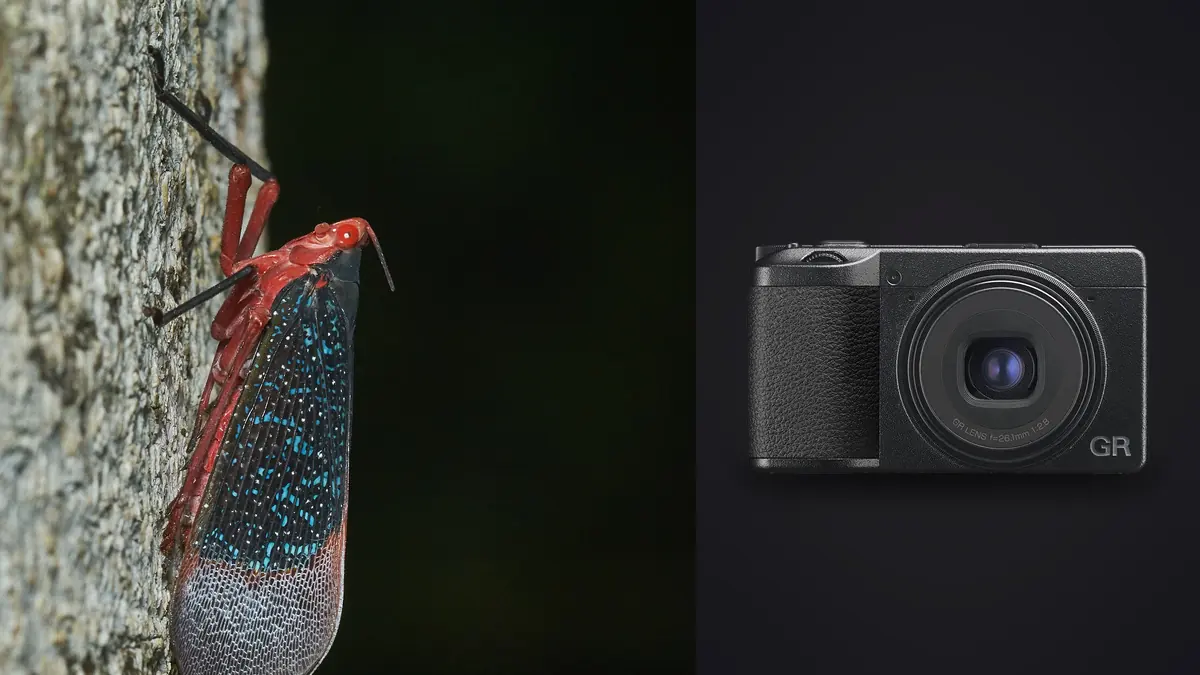
Why I Even Tried This
I carry a Ricoh GR IIIx because it disappears into a jacket pocket, not because I ever expected it to double as a macro rig. But last June I was three days into a hiking trip with no other camera on me, and a fritillary butterfly sat still on a thistle head for what felt like a full minute. The only lens I had was the fixed 26.1mm on the GR IIIx (a roughly 40mm field of view once you account for the APS-C crop), and the only option was to press the macro button and see what happened. That frame, cropped hard afterward, came out sharper than I expected, and it sent me down a rabbit hole of actually testing whether this camera has any business being used for insect photography on purpose, rather than by accident.
The short answer is: sometimes, and only if you plan around some real limits. The long answer is everything below, based on about four months of carrying the GR IIIx specifically to test this, alongside my usual 100mm macro setup for comparison shots.
What "Macro Mode" Actually Means on This Camera
Press the down arrow on the GR IIIx and a little flower icon appears on screen. That's macro mode, and it changes the focus range the camera is willing to search, not the optics themselves. There's no internal macro element that swings into place and no magnification boost. What you get is permission to focus as close as roughly 12cm from the front of the lens, versus about 24cm in normal mode. That's it.
Worth knowing if you're comparing it to the standard GR III: because the GR IIIx has a longer focal length (40mm equivalent versus 28mm), its close-focus distance is also longer. The GR III can rack down to about 6cm from the lens in macro mode, which sounds worse until you realize magnification on both cameras ends up in a similar ballpark, somewhere around a fifth of life size. Neither one is a true macro lens by the 1:1 definition photographers usually mean when they say "macro." Ricoh calls it macro mode because it's the closest focusing option available, not because it reproduces subjects at life size on the sensor.
The Working Distance Problem With Live Subjects
This is the part that actually matters if your subject has wings and an opinion about being approached. Twelve centimeters from the lens element means your camera body, at its closest point, is maybe 7 or 8cm from the insect. That's closer than most bees, wasps, dragonflies, and butterflies will tolerate before flying off. A shadow falling across a resting fly at that range is often enough to spook it.
Compare that to a 100mm macro lens on an APS-C body, which reaches 1:1 magnification while keeping 13 to 15cm of working distance between the front element and the subject, sometimes more depending on the exact lens. That extra distance isn't a luxury, it's the difference between the insect noticing you and not. I've had far more success with the GR IIIx on subjects that were already still for other reasons: cold mornings, spiders sitting in webs, beetles that had already decided to freeze rather than flee, moths resting on a wall after dark.
How It Actually Compares on Paper
I put together the numbers I kept coming back to while testing, using approximate figures gathered from repeated field measurements rather than lab conditions, since that's closer to how most of us actually shoot.
| Setup | Closest focus (from lens) | Approx. working distance to subject | Max magnification | Realistic for live insects? |
|---|---|---|---|---|
| GR IIIx macro mode (40mm equiv.) | ~12cm | ~7-8cm | ~0.2x | Only calm, cold, or dead-still subjects |
| GR III macro mode (28mm equiv.) | ~6cm | ~2-3cm | ~0.22x | Rarely, almost nothing tolerates that |
| APS-C body + 100mm macro lens | ~30cm (from sensor) | ~13-15cm | 1.0x | Yes, this is the standard tool for a reason |
| Smartphone macro mode | ~2-4cm | ~1-2cm | ~0.5-1x (computational) | Rarely, even closer than the GR III |
The table makes the GR IIIx look bad next to a dedicated macro lens, and honestly, it is. But it's also better positioned than either GR III macro mode or a phone, which is the more useful comparison if a compact camera is genuinely what you're carrying that day.
Getting Depth of Field and Light to Cooperate
Even once a subject holds still, two more problems show up immediately. First, depth of field at f/2.8 and 12cm is razor thin, we're talking a couple of millimeters in front-to-back sharpness on something like a hoverfly's compound eye. I stop down to f/8 or f/11 for anything with real depth to it, which costs shutter speed and pushes ISO up in shade. Go past f/11 on this sensor and diffraction starts softening fine detail anyway, so there's a real ceiling on how much you can compensate this way.
Second, at 7 to 8cm working distance, the camera body itself blocks a meaningful amount of ambient light from reaching the subject. You end up shooting your own shadow half the time. There's no accessory shoe flash option worth using at this range on the GR IIIx (mounting anything on the hot shoe puts the flash head too far from a subject the lens is nearly touching), so I lean on natural light and timing instead: early morning side light, or a small reflector card held in my free hand to bounce a bit of fill back in.
Focusing Techniques That Actually Work
Autofocus hunts more at this distance than anywhere else in the camera's range, understandably, since it's working with a razor-thin plane. A few things that helped me get a higher hit rate:
Touch-to-focus over half-press. Tapping the exact point on the insect's eye on the rear screen is more reliable than letting the AF point drift while you frame. Rocking the whole camera. Rather than trying to rack focus with the lens (which the GR IIIx doesn't really let you do smoothly by hand anyway), I lock focus roughly where I want it and physically rock forward and back a centimeter at a time, firing as the subject crosses the plane of sharpness. This is standard practice with dedicated macro lenses too, it just feels more awkward on a compact body with no depth cue in the viewfinder, because there isn't one. Burst mode, always. Insects breathe, sway on stems, and shift their wings constantly. I don't try to nail one perfect frame anymore, I hold the shutter and fire six or eight frames per attempt, accepting that most will miss.
Sorting Through What You Actually Shot
That last point creates its own problem: a single decent close-focus session with the GR IIIx can leave you with 200 to 400 frames of the same dragonfly, most of them slightly soft or with the antenna in focus instead of the eye. Scrolling through all of that on a laptop screen, zooming into each one to check sharpness, is the part of macro shooting nobody enjoys.
This is honestly where I've started leaning on imagic for this specific genre. Its local sharpness scoring flags which frames in a burst are actually critically focused rather than just close, which matters a lot more here than in normal shooting because the difference between a keeper and a miss is often a millimeter of depth of field, not a dramatic blur you'd catch at a glance. It also clusters near-duplicate burst shots together, so instead of paging through 40 nearly identical frames of the same beetle one at a time, I'm comparing four or five candidates it already grouped. Since it runs entirely on the machine (nothing gets uploaded anywhere), that's also one less thing to think about when a session includes location data for a species I'd rather not broadcast, which comes up more than you'd think with rarer insects. If you want more detail on how that sharpness pass actually works under the hood, I wrote about it separately at how AI photo culling works.
Once the keepers are picked, I run the batch through a preset I trained on my own past macro edits using imagic's apply_my_style feature, so the color and contrast treatment stays consistent across a session instead of me re-deciding it from scratch every time I sit down to edit. For anyone shooting a lot of these close-focus sessions, tightening that whole loop is worth more than it sounds, and I go into more of the workflow habits that helped in 10 tips for a faster photo workflow.
Where the GR IIIx Actually Earns Its Keep for Bugs
None of this means leave it at home. The situations where it's genuinely useful for insect subjects:
Dew-covered mornings, when cold has slowed everything down and a damselfly will sit for a full minute while you get close. Environmental macro, where you want the insect in context on its leaf or flower rather than a tight crop filling the frame, since the GR IIIx's magnification ceiling actually suits a wider composition better than it suits a tight one. Dead or preserved specimens, where working distance is a non-issue. And simply the days you didn't bring a macro lens at all, where a mediocre close-up beats no photo. I've gotten usable, printable shots of moths on porch lights at night this way more times than I expected, mostly because moths under artificial light are far more tolerant of a camera 8cm away than anything flying in daylight.
What I'd Reach for Instead
If insects are the actual point of a trip, not a bonus, I still pack the 100mm macro and a body that can take it. The working distance alone settles the argument for anything that can fly away, and true 1:1 magnification lets you fill the frame with a jumping spider's face in a way the GR IIIx simply cannot do regardless of technique. The GR IIIx's real strength is that it's the camera already in my pocket on the 90% of days I'm not planning to shoot insects at all, which is exactly when the interesting subject shows up.
Frequently Asked Questions
Can you get true 1:1 macro out of the GR IIIx?
No. Even in macro mode, magnification tops out around a fifth of life size. It's a close-focus mode, not a macro lens in the strict optical sense, and there's no way to add true 1:1 reproduction to a fixed 40mm-equivalent lens without an adapter Ricoh doesn't make for this body.
Should I pick the GR III or GR IIIx if insects are the main reason I'm buying one?
Neither is built for it, but if you're choosing between the two for this specific use, the GR IIIx's slightly longer working distance makes it marginally more forgiving of skittish subjects. Neither will match a lens designed for the job, so I'd pick based on the focal length you prefer for everything else you shoot and treat insect shots as a bonus either way.
Does the built-in shake reduction help at 12cm?
A little, mostly for hand-held stability while you're rocking the camera to find focus, but it doesn't compensate for the shallow depth of field problem, which is an aperture and distance issue, not a motion one. You're still choosing between a blurred background at f/2.8 or diffraction softness past f/11.
Is a clip-on close-up filter worth adding?
I tried a screw-in close-up diopter using the GR IIIx's optional adapter ring, and it does pull magnification up noticeably. The tradeoff is it shortens working distance even further, which makes the skittish-subject problem worse, not better. It's more useful for static subjects like flowers or dew drops than for anything that might fly off mid-shot.