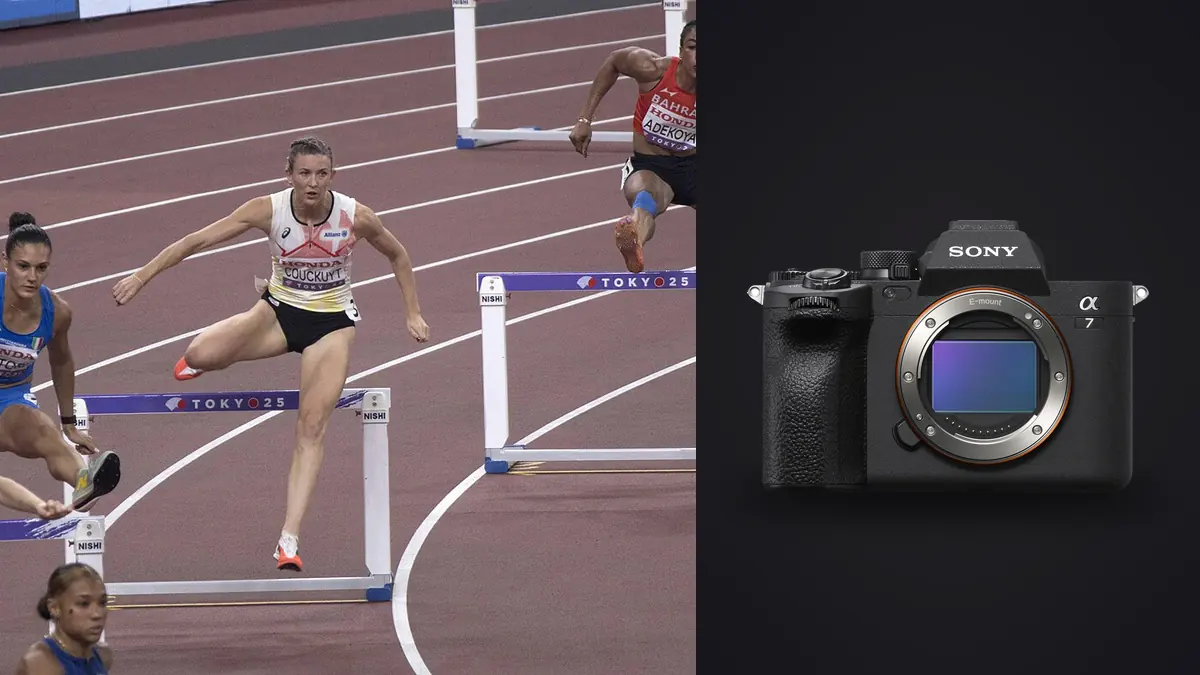
The Sony A7 IV was never marketed as a sports camera, and Sony's own lineup makes that obvious the moment you put it next to an A9 III or even an A1. It's a hybrid stills-and-video body built around a 33-megapixel sensor, tuned more for weddings and portrait work than for chasing a 100m final. And yet a lot of track and field photographers, myself included, end up shooting meets with one anyway, because it's the body already in the bag, or because the price gap to a true sports camera is hard to justify for a hobby. The question worth answering isn't whether the A7 IV is the "best" camera for track. It's whether it's good enough, and where exactly it starts to strain.
Short answer: it holds up fine for most of a track meet, and it struggles in a few very specific, very predictable moments. Knowing which is which changes how you shoot the day.
Where the A7 IV Is Genuinely Fine for Track
Distance races, relays, and most field events give a camera time to think. A 1500m runner isn't accelerating unpredictably lane to lane the way a sprinter out of the blocks is, and the A7 IV's real-time tracking autofocus (the same core AF engine Sony rolled into several bodies around this generation) locks onto a bib number or a runner's face and just stays there. I've had long runs of a distance race where I barely touched the focus point placement for fifteen minutes because the subject tracking was doing the work.
Field events are similarly forgiving, with one exception I'll get to. Shot put, discus, and javelin all have a wind-up phase that gives the AF system time to settle before the moment that matters. High jump and pole vault are a bit trickier because the athlete crosses a cluttered background (mats, the bar, the standards) right at the point of peak action, but a tight focus area rather than wide tracking usually solves that.
Where It Actually Struggles
Sprint finishes are the honest weak point. Eight athletes converging on a line at close to top speed, often with the pack bunched tightly in the frame, is exactly the scenario where a stacked-sensor body earns its price premium. The A7 IV's sensor isn't stacked, so if you're using the electronic shutter for silence or the full 10fps ceiling, you'll see rolling shutter skew on anything moving hard across the frame at close range, arms and legs will lean at an angle that wasn't there in reality. It's not extreme, and most viewers scrolling a social feed will never notice, but if you're printing a lean-at-the-tape shot big, it shows.
The mechanical shutter avoids the skew but caps you at a lower top speed in some drive modes, and the shutter mechanism itself adds noise and vibration that some meet organizers don't love from a rail position twenty feet from the track. Practically, most of the sprint shooters I know split the difference: mechanical shutter for anything shot from a tight angle where skew would be visible, electronic for everything else.
Buffer Depth Is the Number Nobody Tells You Until You Hit It
On paper the A7 IV shoots up to 10fps. In practice, what determines whether you actually get 10fps through an entire 100m sprint is your memory card, and this is the spec that trips up photographers coming from crop-sensor sports bodies with deeper buffers. Because you're generating 33-megapixel RAW files at speed, the buffer fills faster than the marketing number suggests, and once it's full the camera slows to whatever pace the card can write at, which at a track meet is exactly the wrong moment to slow down.
| Card | File format | Rough burst before slowdown | Recovery feel mid-meet |
|---|---|---|---|
| CFexpress Type A (fast, e.g. 800MB/s class) | Compressed RAW | Well over 100 frames, rarely an issue in a single sprint | Buffer clears in a couple of seconds between heats |
| CFexpress Type A | Uncompressed RAW | Around 40-60 frames before pacing drops | Noticeably slower to clear during back-to-back field attempts |
| Fast UHS-II SD (300MB/s class) | Compressed RAW | Roughly 30-45 frames, enough for one clean sprint burst | Can lag behind a fast series of long jump attempts |
| Budget UHS-II SD | Compressed RAW or JPEG | Drops off hard past 20-25 frames | Visibly stutters, worst possible card for finish lines |
The practical takeaway: if you're shooting sprints seriously, put a CFexpress Type A card in the primary slot and use compressed RAW rather than uncompressed. The image quality difference between the two compression modes is not something you'll see in a track photo, and the buffer headroom is worth far more than the marginal file quality.
AF-C Settings That Matter More Than People Assume
Sony buries five parameters inside the AF-C custom settings that most shooters never touch, and two of them genuinely change how the A7 IV behaves on a track. AF Subject Shift Sensitivity controls how readily the camera jumps to a new subject when something crosses in front of your intended one, which happens constantly in a crowded infield or a bunched sprint pack. For sprints I run this low (locked on), so the camera doesn't panic-switch to a nearer runner cutting across the frame. For field events with a single athlete and a clean background, I'll bump it up slightly since there's less risk of a false trigger.
AF Area Switching Sensitivity matters more for relays, where the baton and the incoming runner's hand create a moment where the camera has to decide what the actual subject is. A slower switching sensitivity keeps focus glued to the runner rather than jumping to the baton itself.
Back-button focus is close to mandatory here. Separating AF activation from the shutter button means you can pre-track a runner approaching the blocks, hold focus through the gun, and never worry about a half-press resetting your lock at the worst possible instant. It's a five-minute setup change that removes a surprising number of soft-focus keepers from a day's shooting.
Lens Pairings for Different Positions Around the Track
Where you're allowed to stand at a meet dictates the lens more than personal preference does. Press credentials at bigger meets get you infield or trackside access; without them you're often stuck behind a barrier or up in stands, and the lens choice shifts accordingly.
| Position | Typical lens | Best for | Tradeoff |
|---|---|---|---|
| Trackside, straightaway | 70-200mm f/2.8 | Sprint finishes, relay handoffs, 400m turns | Have to move position between events, limited reach for distant lanes |
| Infield or field-event access | 100-400mm | Long jump, triple jump, javelin run-up | Heavier, slower minimum aperture at the long end hurts in dim stadium lighting |
| Stands, no infield access | 200-600mm | Distance races, far-side field events, discus and hammer cage shots | Bulky for handheld panning, benefits from a monopod |
| General coverage, one-lens day | 24-105mm f/4 | Crowd, coaches, warmups, award ceremonies | Not fast enough for tight action shots, more of a "everything else" lens |
If I'm only allowed one lens and no infield access, the 200-600mm covers more of a track meet than any other single option, simply because so much of the actual competitive action (distance races, throws, jumps on the far side) happens well outside a 70-200's reach. The tradeoff is a slower maximum aperture, which under stadium floodlights at an evening meet pushes ISO higher than I'd like. That's a real limitation, not a minor one, and it's worth test-shooting a evening session before committing to that lens for a meet that matters.
The APS-C Crop Question
The A7 IV's Super 35mm crop mode gives roughly 1.5x extra reach at the cost of dropping resolution to around 14 effective megapixels. For a lot of track work that trade is worth taking, particularly on far-side field events like hammer or javelin where every extra millimeter of focal length matters more than pixel count. Fourteen megapixels is still plenty for web use and reasonable print sizes; it only becomes a real constraint if you're planning to crop hard afterward on top of the in-camera crop, which stacks two reductions and can leave you short of resolution for anything beyond a small print.
I use crop mode selectively rather than as a default setting, mainly for far lanes and distant field events, and switch back to full frame for anything closer where the extra reach isn't needed and the resolution matters more.
Sorting a Day's Worth of Bursts
A single track meet with the A7 IV set to 10fps generates an absurd number of frames. A sprint final alone, shot from the gun through the lean, can produce eighty or more frames of essentially the same three seconds of action, and multiply that across heats, semis, and finals in several events and you're looking at thousands of near-duplicate shots by the end of the day. Going through that manually, flagging the two or three frames per burst where focus actually landed on the eyes or the leading foot, is the part of sports photography nobody enjoys.
This is the part of the workflow where I stopped doing things by hand. I run the day's card through imagic before I open a single image in an editor, since it clusters each burst automatically and scores sharpness locally on the machine rather than sending anything to a cloud service, which matters at a track venue where wifi is usually nonexistent anyway. It surfaces the sharpest frame or two out of each burst instead of making me click through eighty near-identical sprint shots looking for the one where the runner's eyes are open and the focus actually landed. If you want the mechanics of how that kind of sharpness-based culling works rather than just simple duplicate detection, there's a longer breakdown at how AI photo culling works.
The other piece that's saved real time is imagic's apply_my_style feature, which trains a preset on edits you've already made and applies that look automatically to a new batch. Track photos across a season tend to want similar treatment (skin tones, grass and track surface color, that slightly warmer late-afternoon look), so once I'd built the preset from a few meets I'd already edited by hand, new meets come in already close to finished rather than starting from zero every Saturday.
A Realistic Settings Baseline
For sprints and relays I run shutter priority or full manual around 1/1600 to 1/2000, f/4 to f/5.6 depending on light, Auto ISO with a reasonable ceiling, mechanical shutter, wide-area tracking locked onto the athlete's torso rather than face (faces turn away or tilt down at the moment of the lean, and torso tracking holds up better through that motion). For field events I drop shutter speed slightly, since the action is generally more contained, and switch tracking sensitivity up since there's less risk of a stray subject stealing focus.
None of this is exotic. It's mostly just matching the camera's settings to what a given event actually demands instead of leaving one AF configuration running for an entire six-hour meet, which is the single biggest mistake I see from photographers newer to shooting track.
Frequently Asked Questions
Do I need an A9 III instead of the A7 IV for sprint finishes?
If sprint finishes at close range are the majority of your work and you're shooting for a wire service or a client who needs pin-sharp frames printed large, a stacked-sensor body removes the rolling shutter concern entirely and gives you a genuinely deeper buffer. For everything else, most club and school meets, most field events, most distance races, the A7 IV covers the work without that upgrade being necessary.
What's the realistic buffer depth during an actual meet, not the spec sheet number?
With a fast CFexpress Type A card and compressed RAW, you'll get through a full sprint burst without slowing down. Push into uncompressed RAW or drop to a slower SD card and you can hit the buffer wall mid-burst, right as the runners cross the line, which is the single worst moment for the camera to hesitate.
Should I shoot in APS-C crop mode for distant field events?
For hammer, discus, or javelin shot from the stands, yes, the extra reach usually matters more than the resolution you give up. For anything within reasonable range of a full-frame 200-600mm, I'd stay in full frame and keep the resolution for cropping flexibility later.
Does Eye AF still work reliably when athletes are wearing sunglasses or visors?
It degrades but doesn't fail outright. The tracking generally falls back to the head or torso when the eyes aren't visible, which is one reason I favor torso-based tracking over strict eye tracking for sprint work specifically, it's more consistent when faces are turned, tilted, or obscured by gear.