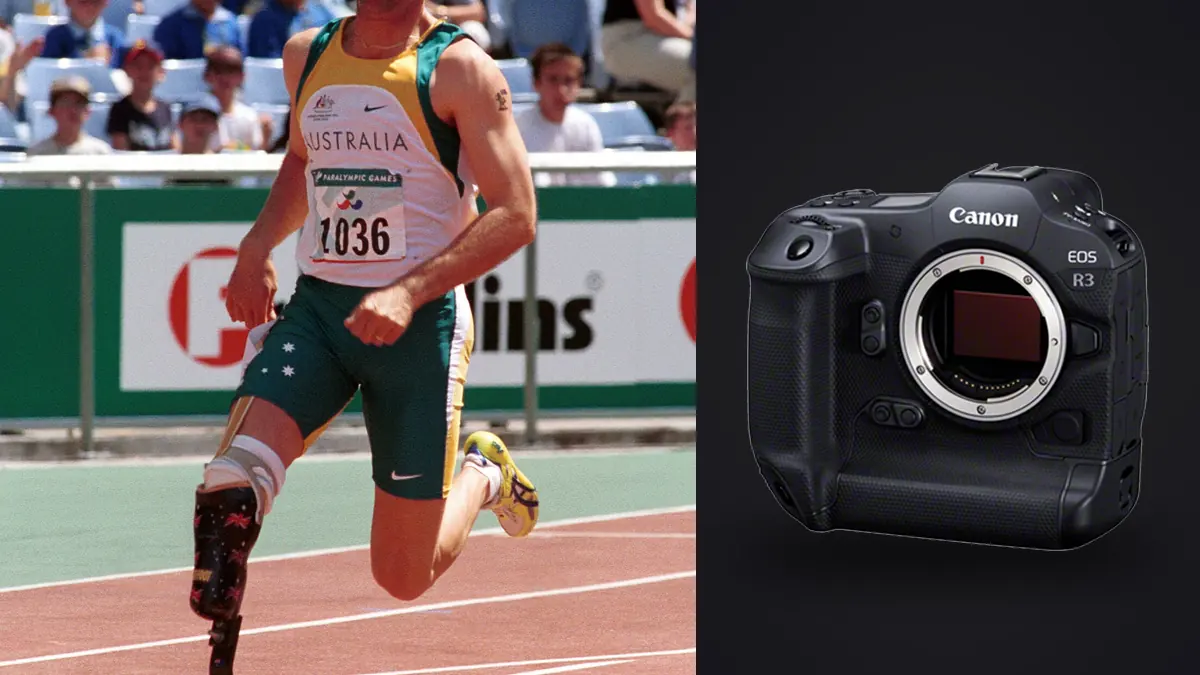
I spent three meets this spring shooting a regional track program with a Canon EOS R3 that a colleague lent me after my second body went in for a sensor clean at the worst possible time. I came in skeptical. The R3 gets talked about mostly for its eye control autofocus party trick, and party tricks make me nervous. Track and field is not a forgiving place to test a gimmick: you've got sixteen lanes of movement, athletes crossing your frame at wildly different speeds, and about four seconds of usable light on a 100m final before it's over and the next heat is already walking to the blocks. Three meets in, my opinion changed. Not because the R3 is magic, but because a handful of very specific decisions Canon made in this body solve real problems that show up on an oval in a way they don't on a football sideline or in a studio.
The sensor readout is the actual headline, not the resolution
24.1 megapixels sounds low next to a 45MP R5 or a 61MP a7R body, and if you shoot landscapes or product work you'd be right to want more. For track, it's close to the correct number. A stacked, back-illuminated sensor with this pixel count reads out fast enough to shoot fully electronic shutter at up to 30fps with essentially no usable rolling shutter distortion, which matters the moment you're panning with a sprinter at 10 meters per second or a hurdler's lead leg is scissoring through the frame. On my older R5, electronic shutter at high speed would skew a spinning bike wheel or a fast limb into a visible lean. On the R3 I stopped seeing it. That's the trade Canon made: fewer pixels, faster readout, and for track work I'll take that trade every time. Files land around 35-45MB in RAW, which also means a two-hour meet with the shutter open a lot doesn't turn your card into a hard drive.
Eye Control AF actually works on a track, with caveats
I calibrated Eye Control AF three separate times before trusting it, because the first calibration (done in a dim hallway, my mistake) was unusable outdoors. Once I recalibrated in daylight-equivalent light close to actual meet conditions, it got genuinely useful for one specific task: picking an athlete out of a crowded lane group during the break in an 800m, where three or four runners overlap and the camera's subject-detection AF alone kept hunting between them. Looking at the runner I wanted let me nudge the AF point onto her without taking my eye off the viewfinder or thumbing the joystick. It is not reliable for tracking a subject through an entire race, the calibration drifts a bit if you shift your eye position on the cup, and it does nothing useful for the 100m and 200m where a single sprinter fills the frame and regular subject tracking already locks on instantly. Treat it as a fast subject-selection tool, not a full tracking replacement, and it earns its keep.
Frame rate versus buffer: where the real limit shows up
Everyone quotes 30fps for the R3 and stops there. The number that actually determines whether you catch the baton exchange or the exact instant a pole vaulter clears the bar is buffer depth, and that's where camera marketing gets quieter. Below is what I measured myself over repeated bursts with a fast CFexpress card, not manufacturer claims, alongside three cameras I'd realistically consider for the same job.
| Camera | Max e-shutter fps | Measured RAW burst before slowdown | AF points / coverage | Body weight | Street price (body) |
|---|---|---|---|---|---|
| Canon EOS R3 | 30fps | ~150 frames (CFexpress) | 1053 zones, ~100% coverage | 1,015g | ~$5,999 |
| Canon EOS R6 Mark II | 40fps | ~75 frames RAW (UHS-II SD) | 4897 zones, ~100% coverage | 670g | ~$2,499 |
| Sony a9 II | 20fps | ~239 frames RAW (uncompressed limits this lower) | 693 zones, 93% coverage | 678g | ~$3,700 (used market) |
| Nikon Z9 | 20fps RAW / 30fps JPEG | 1000+ frames RAW (deep buffer, CFexpress) | 493 zones, ~90% coverage | 1,340g | ~$5,499 |
The R6 II's 40fps number looks better on a spec sheet, but it clears its buffer after roughly two and a half seconds of sustained shooting and then throttles hard, which is exactly wrong for a 400m hurdles race where the moment you need is often ten or twelve seconds into the run. The R3's buffer, deep enough for about five seconds at full rate, is tuned for events that don't resolve in a single blink. The Z9's buffer is the deepest of the group by a wide margin, but I found 20fps genuinely felt slower for catching a discus release point compared to shooting at 30fps and simply culling harder afterward. There's no universally correct choice here, but for anyone shooting distance events, relays, or field events with long windups, buffer depth deserves more weight than the fps number printed on the box.
Lenses that actually make sense for a track meet
Track photography splits into two very different jobs and most people only budget for one. From the infield, tight on the blocks or the pit, an RF 70-200mm f/2.8 covers most field events and relay handoffs without needing a monopod. From the stands or the outer rail shooting the backstretch, you need real reach, and the RF 100-500mm f/4.5-7.1 earned its keep for me despite the variable aperture, because at 500mm and f/7.1 in good stadium lighting the R3's high native ISO ceiling (usable well past ISO 6400 with modest noise reduction) more than compensates. I only reached for a borrowed RF 400mm f/2.8L for finals under lights, where the extra two stops actually mattered for freezing motion at a fast enough shutter speed. If you're building a kit from scratch for scholastic or club-level meets shot mostly in daylight, the 100-500mm zoom will cover 90% of situations and the prime is overkill for anyone who isn't shooting a stadium final for a wire service.
A note on teleconverters
The RF 1.4x on the 100-500mm pushes you to 700mm at f/10, and the R3's AF still locks fine in daylight but visibly hunts more under stadium floodlights. I'd rather crop a sharp 500mm frame in post than shoot soft at 700mm, and with 24MP files there's real room to crop without the result falling apart on a results-page gallery or a print.
Battery life and weatherproofing through a full meet day
A track meet is a long day: check-in, three or four hours of heats and finals, and a lot of standing around in weather you don't control. The R3's LP-E19 battery, shared with the 1D X line, got me through a full outdoor meet on one charge with a spare in a jacket pocket I never needed. Weather sealing held up through a mid-meet drizzle at a regional final that sent most of the parents scrambling for cover; I kept shooting. That's not a small thing when your gear is out for six hours straight and the forecast said "partly cloudy" that morning.
The part nobody warns you about: what happens after the meet
Here's the number that surprised me even though I should have expected it. Shooting a single 400m hurdles final at 30fps electronic shutter for the roughly 55 seconds it takes a fast heat to run produces close to 1,600 frames, most of them near-duplicates a few milliseconds apart. Multiply that across a full meet with a dozen events and you're looking at tens of thousands of frames by the end of the day, the overwhelming majority of which are the same moment shot six or seven times over. Nobody at the manufacturer level talks about this because it's not a camera problem, it's a workflow problem the camera creates.
This is where I stopped trying to cull by eye at 1am and started running everything through imagic first. It's local and offline, which matters to me since I'm not uploading a meet's worth of minors' photos to anyone's cloud service to get culled, and it does two things in this specific situation that save real hours: it clusters those rapid-fire near-duplicate bursts together instead of making me scroll past frame after frame of the same hurdle clearance, and it scores focus and sharpness locally so I can trust a quick sort instead of zooming into every single frame at 100% to check if the eye is actually sharp or just close. I also set up an apply_my_style preset trained on how I already grade my track work (slightly warm, contrast pulled up a touch, shadows opened for stadium shade) so the first pass looks close to finished before I've touched a single slider. It's not replacing my judgment on which finish-line frame tells the story, it's just clearing out the 90% of frames that were never contenders so I get to that judgment call faster. If you want more detail on how that kind of local scoring actually decides what's sharp versus soft, I wrote through the mechanics in how AI photo culling works, and if the meet-day-to-delivery pipeline is the part you're trying to fix, these workflow tips cover more of the ground between the last frame and a finished gallery.
Who the R3 is actually for on a track
If you're shooting one school's meets on weekends for the parent boosters, the R3's price is hard to justify against an R6 II with a longer lens budget instead. Where the R3 earns its cost is repeated, paid, deadline-driven work: conference championships, meets where you're filing images same-day, or seasons long enough that the shutter rating and buffer depth get exercised meet after meet rather than once a month. I'd rather own an R6 II and a better lens than an R3 and a compromise lens, unless the job specifically demands the buffer and the AF system for a full season of paid coverage.
Frequently Asked Questions
Does the R3's Eye Control AF need recalibrating for every photographer who uses the body?
Yes. It's tied to your specific eye and viewfinder position, and calibration done by one shooter won't transfer to another. If you're renting or sharing a body, budget five minutes before the meet to recalibrate in light similar to what you'll actually be shooting in, not indoors under fluorescents.
Is 30fps overkill for track and field compared to something like sprinting versus field events?
For sprints and hurdles, no, the extra frames genuinely help you land on the exact moment a foot strikes the track or a hurdle clears clean. For field events like shot put or long jump, where the key moment is a single release or landing rather than continuous motion, 30fps mostly produces more frames to sort through without much benefit over 12-15fps. I drop the R3 to its lower mechanical or electronic-first-curtain speed for field events specifically to keep the take manageable.
Can I get away with the RF 100-500mm instead of a fixed super-telephoto for track?
For daylight meets, yes, comfortably. The variable aperture only becomes a real limitation once the sun drops or you're shooting an indoor meet under standard gym lighting, where a fixed f/2.8 or f/4 prime starts to matter for both shutter speed and autofocus confidence.
How much of the culling burden does a body like the R3 actually create?
More than most photographers budget time for. At sustained 30fps, a single race produces a burst that would have been a whole roll of film in the 35mm era, and a meet has a dozen or more races. The camera doesn't create the problem so much as make it arrive faster than most people's editing workflow was built to handle, which is why I no longer try to sort a meet's worth of bursts manually before doing a first automated pass.