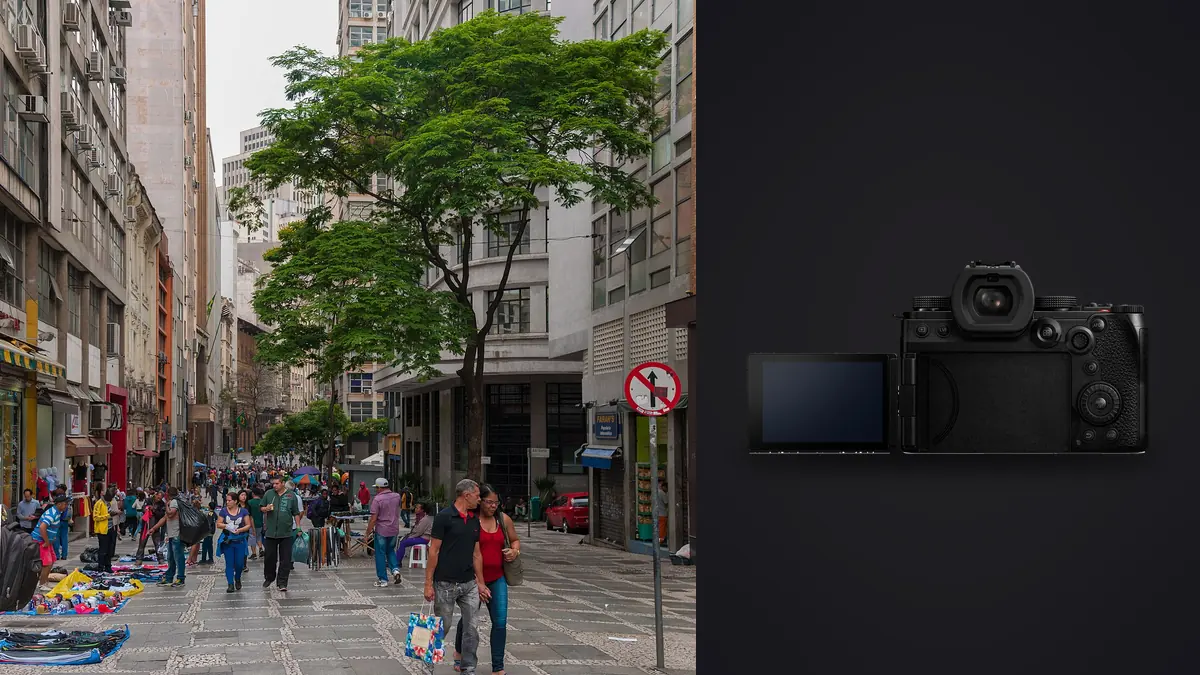
The Panasonic Lumix S5IIX is a 24.2 megapixel full-frame hybrid camera, so a street documentary assignment can move between still photographs, short motion sequences, and recorded sound. That flexibility also creates more decisions: which medium is justified, whether audio changes consent expectations, where a compact L-mount lens can maintain a respectful distance, and how the route moves through public and private space.
This Lens and Location Guide builds a street plan around visual distance rather than lens quantity. It links compact primes and practical zooms to markets, transit edges, civic events, quiet neighborhoods, and evening streets, then defines light transitions, camera positions, ethical boundaries, and local file handling for a coherent documentary sequence.
Decide what the project needs from a hybrid camera
Write a short editorial premise before choosing equipment. A neighborhood change, public ritual, night economy, transport route, craft, protest, or daily routine each requires different access and evidence. List the still images, motion clips, ambient sound, portraits, captions, and establishing context that would support the premise. Do not record video merely because the camera can.
Motion changes the social and legal footprint. A still frame is made in an instant, while a video clip may follow a person, preserve a conversation, or reveal an address over time. Audio can capture private speech from beyond the intended subject. Check local recording law and obtain explicit permission for interviews or identifiable private conversations.
Set a clear boundary between observational public scenes and collaborative portraits. When an individual becomes the primary subject rather than part of a broad scene, introduce the project where practical and ask. Vulnerability, medical events, minors, grief, or danger require greater care than the minimum legal standard.
Assign L-mount lenses by human distance
| Lens class | Route fit | Documentary effect |
|---|---|---|
| Compact 24mm or 28mm class | Dense interiors with permission and broad public scenes | Strong environment with demanding edge control |
| Compact 35mm class | General walking, markets, and layered sidewalks | Subject shown within immediate context |
| Compact 50mm class | Quieter streets and collaborative portraits | Clear subject emphasis from moderate distance |
| Short telephoto prime | Details, stages, and agreed portraits | Narrow context and separated background |
| Standard zoom | Commissioned events with varied access | Fast framing changes with more size and visibility |
Use one primary prime when the project needs a consistent relationship to people and place. A 35mm-class lens encourages a different physical distance from a 50mm-class lens, and viewers can feel that relationship across a sequence. Add a second focal length only for a defined chapter, such as environmental openings or authorized portraits.
The S5IIX accepts lenses within the L-Mount system, but compatibility does not make every option useful for walking. Compare total size, focus behavior, aperture, weather protection, stabilization cooperation, and close-focus ability. A compact body with a large fast zoom remains a conspicuous and tiring kit.
Test lens changes inside a safe, clean area rather than at a curb or in a crowd. If the route alternates constantly between focal lengths, the editorial plan may be too broad. Two passes with separate visual goals can be better than swapping glass every block.
Choose a route with a beginning and an end
Map where the story begins, changes, and resolves. A transport project might open at the neighborhood stop, follow waiting and boarding, show the journey, and close at the destination. A market story can move from setup to peak trade to cleanup. This structure leaves room for unexpected scenes without reducing the edit to unrelated singles.
Walk the route at the intended day and hour without photographing first. Note public and private boundaries, crowd density, shade, reflections, road crossings, construction, security points, and locations where stopping would obstruct movement. Ask vendors, station staff, or property managers about photography and recording rules.
Identify a shorter route and a sheltered route. Rain, a demonstration, a closure, a security instruction, or a subject's request can make the original path inappropriate. A backup should support the same premise instead of becoming generic street wandering.
Record approximate times and caption needs, but protect sensitive coordinates. Documentary notes can establish sequence while leaving out a refuge, private home, vulnerable person's routine, or restricted access point that should not be published.
Build fixed camera positions into a walking project
Movement through streets does not require constant movement by the photographer. Select corners, arcades, stairs, crossings, and sheltered edges where people pass through a meaningful background. Stand outside curb ramps, doors, cycle lanes, platform edges, and emergency routes.
From each position, watch one full cycle before raising the camera. Learn traffic signals, delivery patterns, reflections, and where people naturally pause. Establish the frame, then let actions enter it. This produces clearer relationships and is less intrusive than following one person without agreement.
Check the background at subject height. Bright signs, vehicle lights, poles, bins, and isolated faces can overpower the main action. Move laterally first. A small change can align a person with open shade, a repeated facade, or a layer of distant activity without changing the human distance established by the lens.
For motion clips, hold a stable opening and closing rather than panning after every passerby. The S5IIX's stabilization can smooth small camera movement, but it does not give permission to block a path or walk backward while viewing the screen.
Scout light as a sequence of transitions
Tall buildings create moving strips of direct sun and open shade. A subject crossing the boundary can exceed the chosen exposure before autofocus becomes the problem. Mark where the change occurs and decide whether to hold exposure for the lit zone, use a controlled automatic setting, or wait until the action remains within one light.
Reflected light from glass, pale walls, wet pavement, and vehicles can shape faces briefly. Visit at the same hour because a useful reflection may vanish when traffic or sun angle changes. Backlight can describe rain and atmosphere, but one dirty drop on the front element will repeat through a long sequence.
After dusk, shop windows and street lamps create isolated pools with different color. Use those changes as chapters rather than forcing one white balance across every block. Capture a neutral reference where color accuracy matters, while preserving a reasonable record of the existing atmosphere.
Test silent capture against artificial light and motion
Electronic shutter can reduce camera sound, but it can also interact with LEDs, signs, displays, and rapidly moving subjects. Test a plain surface and a moving vertical edge at the intended speed. Look for bands, partial color, skew, or broken display graphics at full size.
A mechanical or electronic-first-curtain mode may produce more reliable geometry under some conditions, subject to the camera's current mode limitations. Silence does not make the photographer invisible; body movement, lens size, repeated framing, and proximity still affect behavior.
For stills, select shutter speed for the meaning of movement. A sharp foot or hand may carry a gesture, while a slower exposure can describe crowd flow against a stable building. Stabilization helps the stationary part of the scene, not the moving person.
Use autofocus as an editorial control
Phase-hybrid autofocus and human detection can assist, but a broad area may choose the nearest face rather than the person carrying the story. Restrict the focus zone to the part of the composition where the action matters. Keep a small-area option available for layered scenes, reflections, or subjects partly hidden by foreground objects.
Pre-focus works at a doorway, crossing, counter, or fixed patch of light. Choose an aperture that allows normal route variation without turning the full background into equal emphasis. Do not mark or obstruct public ground to force people into the plane.
For video, focus transitions should have a reason. A shift from foreground hands to a craftsperson can explain work; repeated hunting distracts from it. Rehearse the move only with a collaborating subject, and use a stable focus distance for unrepeatable public action.
Treat sound as identifiable information
The S5IIX can be part of a serious video rig, but a visible microphone, headphones, cage, or monitor changes the scale and expectations of street work. Use the smallest setup that meets the brief and remains safe. A formal interview should have a quiet, permitted position, release process, and monitoring plan.
Listen before recording. Music, announcements, private conversations, business details, and copyrighted performance can enter a track beyond the visual frame. Capture room tone or public ambience only where lawful, then label it accurately. Do not hide a recorder to obtain speech a person would not knowingly provide.
Keep headphone use compatible with situational awareness. Near roads, demonstrations, crowds, or platforms, one ear must remain available for instructions and hazards. A second person can monitor sound during a controlled portrait or interview.
Separate public access from private permission
Shopping centers, transit interiors, cafes, markets, museums, event grounds, and building lobbies may look public while being privately managed. Published rules can differ for stills, video, tripods, lighting, and commercial work. Ask when the equipment or intent moves beyond casual observation.
At protests and public incidents, remain outside police, medical, and emergency operations. Do not stage behavior or expose a source through metadata, audio, or a recognizable meeting place. Consult an editor or legal adviser when publication could place someone at risk.
Do not use a long lens to defeat a clearly expressed boundary. If someone objects, lower the camera, listen, and follow applicable law and editorial policy. A defensible street project is built from context and accountability, not a contest over access.
Prepare the body for weather and long walks
Carry the complete kit over the planned distance. Include card, battery, microphone, rain layer, water, and secure storage. A lens that feels reasonable at the desk can affect posture and attention after several hours. Reduce duplicate equipment before compromising navigation or safety supplies.
Use weather protection that permits ventilation and control access. The S5IIX includes an active cooling design, so do not cover vents contrary to Panasonic guidance. Let the camera acclimate between air conditioning and humid streets, and seal it before moving from cold conditions into a warm wet environment.
Set clock, time zone, and file naming before departure. Synchronize any audio recorder or second camera. Keep full media in a dedicated pocket and do not review sensitive material where bystanders can see the screen.
Keep still and motion assets in one documented timeline
Copy every card to two verified locations before formatting. Preserve original names and recording time, then note which stills, clips, and audio belong to the same event. Check long video clips for successful closure before ejecting media, and keep sidecar audio synchronized through a slate or clear reference.
imagic desktop can scan supported RW2 stills before local analysis, group similar images, and set reversible culling statuses without deleting originals. It is not a video editor, audio tool, or full documentary catalog. Automated still scores cannot determine consent, factual importance, caption accuracy, or whether a visually imperfect frame is essential to a sequence.
Reselecting re-ranks stored scores and does not reanalyze them. Check freshness and reanalyze stale photos when appropriate. Style application needs a learned profile, while export applies stored edits to new still files. Keep video and still color related through deliberate references rather than assuming one preset will match every codec and light. More sequence methods appear in Workflow and Editing.
The Lumix S5IIX supports a broad documentary vocabulary, but breadth needs boundaries. A primary human-distance lens, a route with narrative stages, tested street light, explicit audio decisions, and careful access produce a stronger record than switching modes whenever the scene becomes difficult.
Frequently Asked Questions
Which L-mount lens is best for S5IIX street photography?
A compact 35mm-class lens is a versatile starting point for people within context, while 50mm creates more separation. Choose the focal length that supports a consistent, respectful working distance.
Should electronic shutter always be used for quiet street work?
No. It can band under artificial light or distort fast motion, and silent capture does not make the photographer socially invisible. Test the location and select the reliable mode.
Can imagic organize S5IIX video and audio?
imagic can scan and work with supported RW2 still photographs, not serve as a video or audio editor. Keep motion and sound assets in a separate, synchronized project structure.