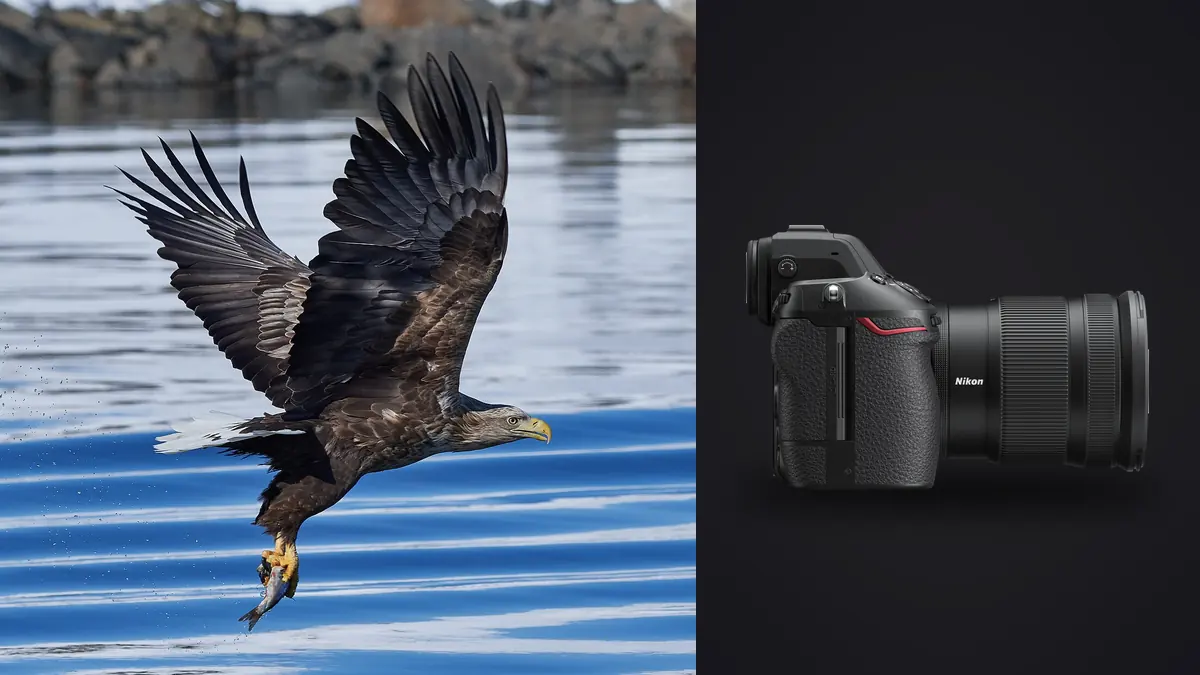
I spent most of last winter parked at a heron rookery with a Z8 and a 400mm f/4.5, waiting for birds that mostly did not cooperate. Herons are lazy fliers, which makes them a decent warm-up subject, but the real test came in March when the ospreys showed up and started diving on fish forty yards from the bank. That is where a camera either earns its keep or it doesn't, and the Z8 mostly did, with a few caveats I did not expect from the spec sheet.
This is not a spec dump. Nikon's own page will tell you the sensor is a 45.7-megapixel stacked design and the buffer is deep. What I want to cover is what actually changes when you point this camera at something moving unpredictably through three dimensions, because birds in flight are a different problem than a soccer player running in a mostly flat plane.
What the stacked sensor actually buys you
The readout speed is the part that matters for flight work, more than the resolution figure ever will. Rolling shutter distortion on a bird's wingtip is real and I have seen it on older bodies, that faint skew where a fast-beating wing looks slightly warped because the sensor scanned top to bottom while the wing moved. On the Z8 that artifact is essentially gone at normal shutter speeds. I have pushed 1/3200s on swallows over a pond and the wing edges stay clean.
Frame rate is where people get excited and then disappointed. 20fps in raw is genuinely usable, not a marketing number that falls apart with a slow card. I run a 325GB CFexpress Type B card and the buffer doesn't choke me mid-sequence the way my old body did after about 25 frames. That said, 20fps for eight seconds straight generates an obscene number of files, and if you are not ruthless about culling afterward you will drown in near-duplicates. This is exactly the problem I built my culling habit around: I shoot the whole burst, then let imagic's local sharpness scoring flag which frame actually has the eye in focus before I ever open Lightroom. With osprey dives specifically, out of a 40-frame burst maybe four frames have the eye sharp and the fish visible, and finding those four by eye is slower than it should be.
Where the sensor speed does not save you
High-speed frame capture at C30 or C60 is JPEG only and cropped, which nobody mentions loudly enough in the marketing. It is a genuinely useful tool for something like a kingfisher's dive, where the decisive moment is a fraction of a second you cannot predict, but you are trading raw file flexibility for it. I use it sparingly, mostly for behavior documentation rather than portfolio frames, because a cropped 8-bit JPEG does not hold up under any real edit.
Autofocus in practice, not in the brochure
Bird detection AF on the Z8 is good against open sky and mediocre against clutter. That is the honest version. A hawk soaring against a flat blue background gets locked on almost instantly and tracks through banking turns without much drama. The same hawk gliding past a treeline with branches in the background will occasionally have the AF box jump to a branch tip for a frame or two before recovering. It happens less than it did on the Z6 II I used before, but it still happens, and I have lost frames to it during a peregrine stoop where the bird crossed in front of a stand of pines.
3D tracking combined with bird detection is my default for anything unpredictable, songbirds changing direction, gulls fighting over food. For a bird flying a relatively steady line, like a heron on approach to a nest, wide-area AF with bird detection on tends to be more stable because it is not constantly re-evaluating the whole frame. I keep both mapped to custom banks (C1 and C2) so I am one dial click away from switching rather than diving into a menu while a bird is closing distance.
One quirk worth mentioning: at longer distances, the detection box sometimes locks onto a wingtip rather than the eye, particularly with raptors that have pale wing markings the algorithm seems to key on. It corrects itself as the bird gets closer, but if your keeper frame happens to be the distant one, you may find the eye is a touch soft even though the AF system reported a confident lock. I did not expect this and only caught it by comparing focus points against actual pixel sharpness afterward.
Pre-release capture, and why I underrated it
Firmware 2.0 added pre-release capture, which buffers up to a second of frames before you fully press the shutter. I was skeptical, it sounded like a gimmick for people who cannot time a shutter press. Then I used it on a kestrel launching off a fence post and realized the launch itself, the exact moment the legs extend, happens faster than human reaction time allows you to catch reliably. Pre-release capture got me three frames of that launch I would have missed pressing normally. I still would not use it for everything, it eats buffer and battery, but for launch and landing sequences it has earned a permanent spot in my settings.
Lens pairings that actually work in the field
The Z 100-400mm f/4.5-5.6 is my go-to for anything within about 30 meters, ducks on a pond, gulls, songbirds at a feeder station. It focuses fast enough to keep up with the Z8's tracking and it is light enough to hand-hold for an entire afternoon, which matters more than people admit when you are standing at a blind for six hours.
For distant raptors and anything over open water, I switch to the Z 180-600mm. It is not as snappy to acquire focus in low light, dawn osprey shots in particular can hunt for half a second before locking, but the reach makes a real difference when the bird is not coming to you. I have also run it with the 1.4x teleconverter, which drops you to roughly f/9 at the long end and does slow the AF down noticeably. Usable, but I only reach for that combination when the bird is stationary or moving slowly, not for fast BIF work.
The Z 800mm f/6.3 PF is the specialist tool. Beautiful for eagles and ospreys at real distance, but it is a one-trick lens, anything closer than about 15 meters and you are cropping the bird out of the frame entirely. I rented one for a week during peak osprey season and it produced my sharpest frames of the year, but I would not own it as a primary lens unless raptors at distance are most of what I shoot.
| Scenario | AF area mode | Shutter speed | Lens I'd grab |
|---|---|---|---|
| Osprey diving on fish, open water | 3D-tracking + bird detection | 1/3200s or faster | Z 180-600mm |
| Songbirds launching from a feeder perch | Wide-area (S) + bird detection, pre-release capture on | 1/2000s | Z 100-400mm |
| Raptor soaring against open sky | Auto-area + bird detection | 1/1600s | Z 800mm PF |
| Swallows over water, erratic direction changes | 3D-tracking + bird detection | 1/3200s or faster | Z 100-400mm |
| Waterfowl landing approach on a pond | Wide-area (L) + bird detection | 1/2000s | Z 180-600mm |
The pattern in that table is not accidental: wide-area modes earn their keep when the flight path is predictable, and 3D-tracking earns its keep when it is not. I switch between them constantly during a single session rather than picking one and leaving it.
Settings I actually use, bank by bank
I run three custom banks permanently configured for flight work so I am not rebuilding settings mid-session:
- Bank A, open sky: auto-area AF with bird detection, 20fps raw, 1/2000s minimum via auto-ISO floor, AF-C.
- Bank B, cluttered background: 3D-tracking with bird detection, 20fps raw, back-button AF-On only so a half-press does not re-trigger tracking on a branch.
- Bank C, launch and landing: wide-area (S), pre-release capture enabled, 1/2500s, single AF point placed slightly ahead of where I expect the bird to enter frame.
Back-button focus is not optional for me on this body. Half-press AF activation combined with 3D-tracking has a habit of grabbing whatever crosses the frame edge for a split second, and re-acquiring your actual subject costs frames you don't get back. Separating focus from the shutter button fixed most of my false-lock complaints.
Where I still get it wrong
Auto-ISO ceiling is something I underestimated for a long time. I had it capped at 6400 out of habit from an older body, and on overcast days chasing fast raptors I was getting shutter speeds too slow to freeze a wingbeat because the camera couldn't push ISO higher to compensate. Raising the ceiling to 12800 and accepting the noise, which the Z8 handles better than I expected, got me more usable frames than staying conservative on ISO ever did.
The part after the shutter closes
A single afternoon at the rookery this spring produced just under 3,000 frames. Nobody wants to scrub through that by eye, and I don't. I run the card through imagic afterward, which does its sharpness and focus scoring locally on my laptop with no upload step, which matters when I'm working from a truck in a parking lot with no signal. It clusters the burst sequences automatically, so the 40-frame osprey dive becomes one group instead of 40 individual thumbnails I have to click through, and I can jump straight to the frames it scored highest for actual focus rather than guessing from thumbnail previews. It has saved me real hours compared to how I used to do this by hand.
The other habit that has stuck is running my edited raptor images through imagic's apply_my_style preset once I've hand-graded a handful from a session. It is trained on my own prior edits rather than some generic preset pack, so it tends to land close to where I would have taken the color and contrast myself, especially for backlit wing shots where I consistently push shadows a certain way. I still check every frame, but it cuts the first pass down considerably. If you want more detail on how the underlying culling logic works, this piece on AI photo culling covers the mechanics better than I can here.
Frequently Asked Questions
Is the Z8 actually fast enough for something like peregrine stoops?
For the dive itself, yes, 20fps raw at that sensor readout speed keeps up fine. The harder part is autofocus reacquisition after the bird pulls out of the dive and changes direction sharply. I have more misses on the recovery than on the stoop itself, which is more a physics problem than a camera problem.
Should I shoot full raw or the smaller raw options for burst-heavy sessions?
I shoot full-size lossless compressed raw and accept the card space cost. High-efficiency raw saves storage but I have seen slightly more banding in extreme shadow pulls on backlit wings, and wing shadow detail is exactly where I tend to push exposure in post.
Does the in-body stabilization matter for flight shots at all?
Less than you'd think, since your shutter speed for freezing a wingbeat is already well above where stabilization does much work. Where it actually helps is hand-holding the 180-600mm for hours while waiting for something to happen, keeping the viewfinder steady enough that I can track a distant bird without arm fatigue throwing off my framing.
Is bird detection reliable enough to leave on all the time, even for non-bird subjects mixed into the same outing?
I leave it on for dedicated bird sessions but switch back to animal detection or general subject detection if I know deer or foxes are likely at the same location. Bird detection specifically will sometimes ignore a mammal in frame entirely, which is fine when you know that going in and frustrating when you don't.
None of this replaces time in the field. The Z8 removed several technical excuses I used to have with older gear, but it did not remove the part where you still need to know when a heron is about to launch or which direction the osprey will bank. That part is still just hours logged at the water's edge.