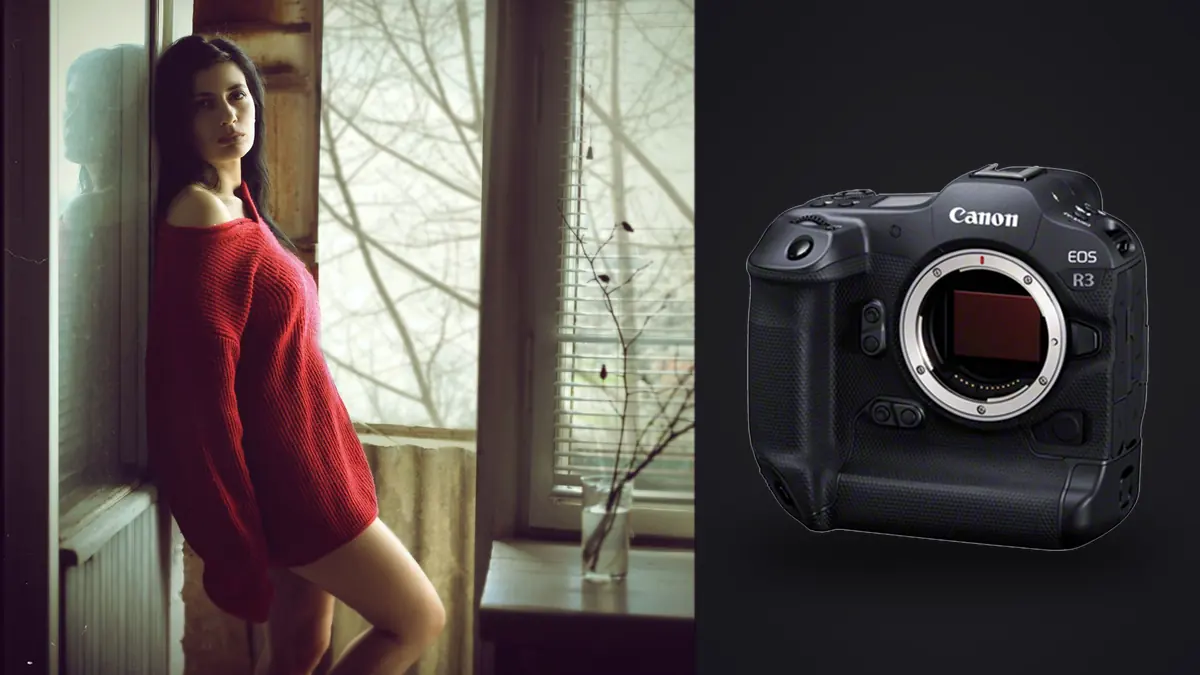
Picture a boudoir session given as a gift, with the recipient asking, half joking, whether it will be shot "on that Canon they use for the Olympics." The honest answer is that the EOS R3 can earn its place in a bedroom-sized space, but the reasons have almost nothing to do with 30 frames per second or tracking a sprinter out of the blocks. They have to do with how a camera behaves when the subject is nervous, the room is small, and the light is whatever's coming through one window.
A Sports Camera in a Bedroom-Sized Studio
The R3 was built for photojournalists and sideline shooters who need to nail a moving subject in bad light from fifty meters away. None of that describes a typical intimate portrait session, where the subject is two meters from you, mostly still, and moving in slow, deliberate ways rather than sprinting. So the first honest question anyone should ask is whether a body engineered for that job has any business in this one.
The answer, after two years of using it for exactly this kind of work, is that some of its "overkill" features turn out to be the most useful things in the room, while others genuinely go to waste. That's worth separating out rather than treating the camera as either a miracle tool or a vanity purchase.
What Actually Matters When the Subject Is Two Feet Away
Boudoir and intimate portraiture live and die on a short list of things: whether the client trusts you, whether the light flatters skin without exaggerating it, and whether focus lands exactly where it needs to at f/1.2 or f/1.4, where the margin for error is a few millimeters. Frame rate and autofocus-tracking sports statistics don't show up on that list at all.
What does show up, and where the R3 genuinely delivers, is the fully silent electronic shutter. Shooting a mechanical shutter in a quiet hotel room with a first-time client is a small but real source of tension, every click is a reminder that a picture was just taken. Switching to full electronic and letting the shutter go completely silent changes the energy of a session more than people expect. Subjects tend to relax visibly once they realize they can stop bracing for a sound that isn't coming.
The fully articulating rear screen matters more here than in most genres too. Low, tight angles from the foot of a bed, shooting up past draped fabric, working from a doorway at floor level, all of that is far easier with a screen that flips and twists rather than one that only tilts on a single axis. I use it constantly for angles I'd otherwise be lying on the floor to check through the viewfinder.
In-body stabilization rated around eight stops sounds like a spec-sheet number until you're working by window light at 1/60 with a heavy 85mm f/1.2 lens and no time to set up a tripod between poses. It buys real flexibility to keep ISO down without sacrificing shutter speed, which matters when skin tones start showing noise pattern before shadow detail does.
Eye Control AF: Genuinely Useful or a Party Trick
Eye Control AF is the feature everyone brings up first, and opinion on it is split for good reason. It works by tracking where your eye is looking through the viewfinder and moving the AF point there, which in theory means you can recompose and reposition focus just by looking at a different part of the frame, without touching a joystick.
In practice it needs a proper calibration pass for your specific eye and viewing angle, and it drifts if you shift your grip, wear glasses inconsistently, or shoot with your eye at a different angle than during calibration. I recalibrate it every session because even small changes throw it off. When it's dialed in, though, it's genuinely fast for the kind of shooting boudoir involves: a subject shifts from a three-quarter pose to looking back over her shoulder, and my focus point follows my eye to her new eye position faster than I could drag a joystick across the frame. When it's not dialed in, it's more annoying than helpful, and I'll turn it off entirely and go back to standard Eye Detect AF with a wide zone, which is reliable and doesn't need babysitting.
My honest recommendation: don't buy the R3 for Eye Control AF alone. Buy it if the rest of the package makes sense, and treat Eye Control as a bonus you'll use maybe half the time.
How It Actually Compares for This Kind of Work
Most photographers shooting this genre are choosing between three Canon bodies in practice: the R3, the R6 Mark II, and the R5. Here's how they stack up on the things that actually matter for intimate portrait sessions, rather than the full spec sheet.
| Factor | EOS R3 | EOS R6 Mark II | EOS R5 |
|---|---|---|---|
| Body weight (body only) | Heavy, roughly 1015g, noticeably front-heavy with fast primes | Light, around 588g, easy to hand-hold all afternoon | Moderate, around 738g |
| Shutter discretion | Fully silent electronic shutter with no banding issues under mixed LED light in my experience | Silent shutter available but more prone to banding under flickering artificial light | Silent shutter available, similar banding risk as R6 II under bad lighting |
| Resolution | 24.1MP, plenty for prints and albums, smaller files to cull | 24.2MP, same practical output | 45MP, more cropping room but roughly double the file size and storage cost |
| Screen articulation | Fully articulating, best for low and awkward angles | Fully articulating | Fully articulating |
| Eye Control AF | Yes, needs calibration and can drift | Not available | Not available |
| Approx. street price (2026, used/current) | $3,500 to $4,200 | $1,900 to $2,300 | $2,600 to $3,100 |
| Practical verdict for boudoir | Best AF and shutter discretion, but heavy and expensive for what most sessions need | Best value, lighter for long handheld sessions, missing the AF and shutter refinements | Best middle ground if you also shoot large prints or crop heavily |
If I were starting a boudoir business from zero with a fixed budget, I'd tell myself to buy the R6 Mark II and a good 50mm f/1.2 before I'd tell myself to buy the R3 body alone. The R3 earns its keep for me because I also shoot events and low-light documentary work where the tracking and shutter speed ceiling matter, and it happens to be excellent at this too. Buying it purely for boudoir is a harder case to make on price alone.
Lenses That Actually Work in a Hotel Room
The RF 85mm f/1.2L is the lens most people picture with this camera, and it's beautiful, but working distance is the catch nobody mentions until they're standing with their back against a wall trying to fit a full-length pose into frame. In a genuinely small room, an 85mm forces you into corners and doorways more than it should.
My actual go-to on the R3 for this work is the RF 50mm f/1.2L for tighter spaces and a more natural perspective at close range, with the RF 35mm f/1.4L as a backup for full-room environmental shots that include the setting, window light, unmade sheets, whatever's telling the story of the space. The 85mm comes out for larger suites, outdoor golden hour sessions, or anywhere I have six or seven meters of working distance, where the compression genuinely earns its reputation.
The RF 70-200mm f/2.8 gets less use than people expect in this genre because intimacy reads better at closer working distances, but it's worth having in the bag for the rare session in a large space or for shots where you want the subject to forget the camera is even close.
What 30 Frames a Second Actually Costs You Later
Here's the part nobody warns you about before you buy a body capable of 30fps: you will, at some point, hold the shutter down half a second longer than you meant to during a natural movement sequence, a hair flip, a robe sliding off a shoulder, fabric settling, and end up with forty nearly identical frames from a single gesture. Multiply that across a three-hour session and a typical shoot that used to produce 500 to 700 images now produces 1,200 to 1,800, most of them a few milliseconds apart from each other.
That's not a camera complaint, it's a workflow reality, and it's the actual reason I run every card through imagic before I open anything in an editor. The burst and duplicate clustering groups those forty near-identical frames from one gesture into a single stack instead of leaving me to scroll through them one at a time, and the sharpness scoring flags which frame in that stack actually has the eye or the fabric edge in crisp focus at f/1.2, where the difference between a keeper and a miss is genuinely a few millimeters of depth of field. On a body that shoots this fast, skipping that step means either burning an entire evening in Bridge or Lightroom manually comparing frames, or worse, missing the one sharp shot buried in a stack of thirty close calls.
The other reason it matters specifically for this genre is privacy. These are images clients are trusting you with under an assumption of discretion, and imagic processes everything locally on the machine, nothing gets uploaded anywhere during culling. For a boudoir photographer that's not a nice-to-have, it's close to a non-negotiable when you're explaining your workflow to a client who's understandably asking where her images are going to sit while you edit them.
Once the culling pass is done, I lean on the apply_my_style preset, trained on my own previous edits, to get a consistent starting point across a session shot in mixed light, window light in one corner, a lamp in another, so skin tones don't swing wildly from frame to frame before I do the finer manual adjustment. It's not magic, it still needs a human pass, but it cuts the boring, repetitive part of getting a session to a consistent baseline down from hours to minutes. If you're trying to speed up the exact stage between "camera full of files" and "gallery ready to send," it's worth reading through how AI photo culling actually works before you assume every tool in this category behaves the same way, because the local-versus-cloud distinction matters a lot more here than it does for landscape or product work.
Is It Worth the Money for This Genre Specifically
I don't think the R3 is the obvious choice for someone building a boudoir-only business from scratch. It's heavy for a genre where you're often shooting handheld for hours in a single room, it's priced closer to a sports or wildlife body than a portrait one, and a meaningful chunk of its headline spec, the 30fps stacked sensor readout, goes almost entirely unused in this kind of session.
What justifies it for me is that I don't only shoot boudoir. The same body handles low-light events, the silent shutter matters for wedding ceremonies as much as it does for a nervous first-time boudoir subject, and the eye control AF, when calibrated, speeds up posed sequences across every genre, not just this one. If your business is single-genre and budget-conscious, the R6 Mark II gets you the shutter discretion and the screen articulation for close to half the price, and you can put the difference toward a second fast prime or a proper studio strobe setup instead. If you're already deciding between camera bodies with an eye on speeding up the parts of the job that eat your evenings, it's also worth a look at general workflow habits that apply regardless of body, covered in tips for a faster photo workflow, since gear choice only closes part of that gap.
Frequently Asked Questions
Is the Canon EOS R3 too loud or obvious for a client who's nervous about being photographed?
Not if you use the electronic shutter, which is completely silent. The mechanical shutter is louder than a mirrorless body like the R6 or R8, so I'd avoid it in an intimate setting, but the full electronic mode removes the sound entirely. The one caveat is that fully electronic shutter can introduce banding under certain flickering LED or fluorescent lighting, so test the specific room's lighting before relying on it for a paid session.
Do I need 30 frames per second for boudoir photography?
No, and you'll rarely use it intentionally. Most photographers shooting this genre work in single-shot or a slower continuous mode to stay deliberate with posing and expression. Where the fast burst does help is capturing fabric or hair movement mid-motion, a robe falling, hair being tossed, where a couple of frames per second isn't fast enough to land the exact peak moment.
Is the R3's 24 megapixels enough for boudoir prints and albums?
Yes, comfortably. Most boudoir clients order albums or prints in the 8x10 to 16x20 range, and 24 megapixels covers that with room to spare for moderate cropping. Unless you're regularly printing beyond poster size or doing heavy crops after the fact, the R5's 45 megapixels is more storage cost than practical benefit for this specific genre.
Should I calibrate Eye Control AF for every session or just once?
Recalibrate more often than you'd expect, ideally at the start of any session where your seating position, glasses, or even how tired your eyes are has changed. It's sensitive enough that a slightly different viewing angle through the finder throws off accuracy, and a drifting AF point is worse than not having the feature at all in a session where you can't afford a missed shot of a fleeting expression.