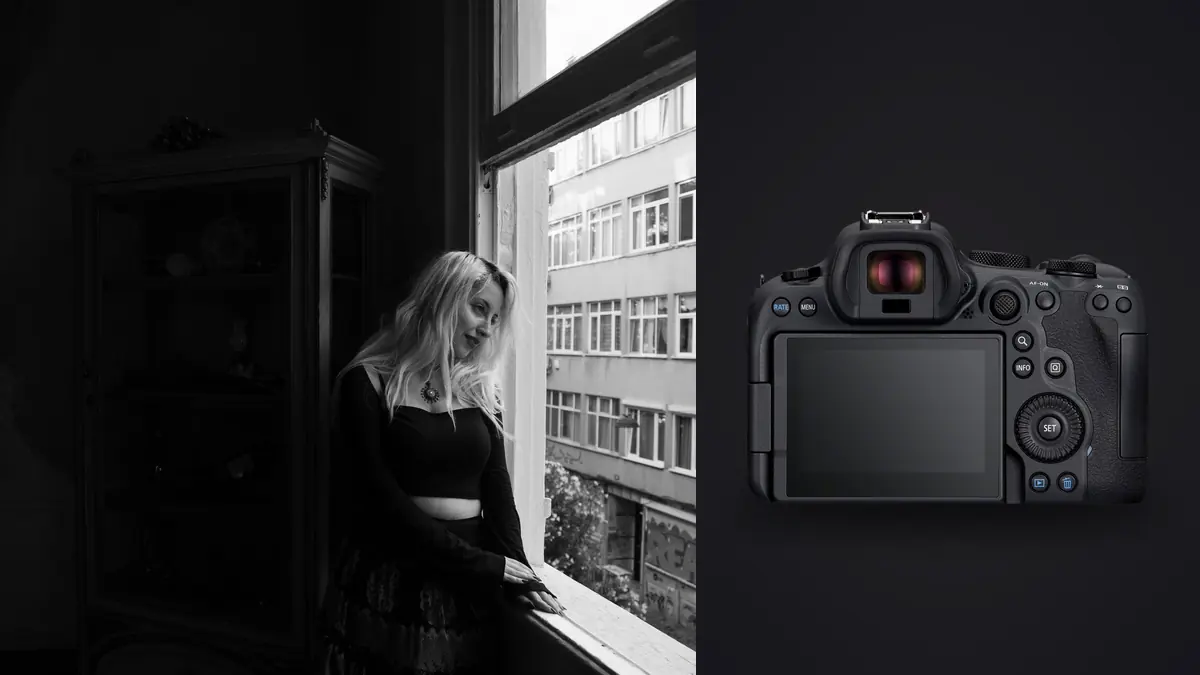
I picked up the Canon EOS R6 Mark II about eighteen months into a boudoir-focused portrait business, replacing a body that kept missing eye focus in dim bedrooms and hotel suites. The upgrade wasn't glamorous. Nobody posts about buying a new camera because their old one hunted for focus in a client's poorly lit guest room. But that's the actual, unsexy reason this body earns its keep for this specific genre: boudoir sessions happen in real spaces with real (often bad) light, at close working distances, with subjects who move constantly and don't want to be told to hold still.
This isn't a spec-sheet rundown. Canon's own page will tell you the sensor size and the burst rate. What I want to cover is what actually changes in a boudoir session when you're shooting this body specifically: how the autofocus behaves at f/1.2 three feet from a face, what the in-body stabilization buys you when you refuse to bring strobes into someone's bedroom, and where the files pile up afterward.
Eye detection at close range, wide open
Boudoir work lives at wide apertures. Shallow depth of field does a lot of the emotional heavy lifting in this genre, separating a subject from a cluttered bedroom or a plain studio backdrop with nothing but a smear of soft blur. The problem is that at f/1.2 or f/1.4, your in-focus plane at three or four feet is measured in millimeters. Miss the eye by the width of an eyelash and the shot is unusable, no matter how good the pose or the light was.
The R6 Mark II's eye detection holds onto that plane far better than the sensor-based tracking I was using before. It doesn't just find an eye and lock, it keeps re-evaluating as the subject shifts weight, turns their chin, or looks away and back. In a genre where you're often shooting a continuous sequence of small movements rather than a single held pose, that persistence matters more than raw megapixels ever will. I still miss shots. Nobody hits 100 percent at f/1.2. But the miss rate dropped enough that I stopped instinctively stopping down to f/2.2 "just to be safe," which was quietly costing me the look I was actually going for.
One caveat worth saying out loud: eye AF gets confused by hair falling across the face, by hands near the eyes (which happens constantly in boudoir posing), and by strong backlight from a window. It's good, not psychic. I still chimp the screen more than I'd like to admit, especially on close crops.
Shooting available light without a tripod
A lot of boudoir photographers, myself included, lean on window light and ambient room light rather than hauling strobes into somebody's bedroom. It keeps the session feeling less clinical and more like an actual private moment instead of a lit set. The trade-off is that you're often shooting at ISO 1600 to 6400 in a dim room, handheld, because a tripod kills the loose, responsive feel you need when you're directing someone through small adjustments in real time.
The in-body image stabilization on the R6 Mark II is rated up to 8 stops depending on the lens, and in practice that means I can hold 1/30s or even 1/15s at a 50mm equivalent focal length and get a sharp frame more often than not, as long as the subject isn't moving. It does nothing for subject motion blur, obviously, so you still need enough shutter speed to freeze a breath or a shifting shoulder. But for the camera-shake half of the sharpness equation, it buys real flexibility in rooms where you don't want to bump the ISO into visibly grainy territory or bring in continuous LED panels that flatten the mood.
The silent shutter matters more here than in most genres
This gets under-discussed in gear reviews because it's not a spec anyone brags about, but the fully electronic silent shutter mode changes the emotional temperature of a boudoir session. A mechanical shutter clacking away next to someone in various states of undress is a constant, audible reminder of the camera. Switch to silent electronic shutter and that reminder disappears. Clients relax faster. I've had people tell me, unprompted, that they forgot I was shooting for stretches of the session, and I genuinely think the lack of shutter noise is part of that.
The one thing to watch for is rolling shutter distortion if there's fast motion in frame, which is rarely an issue at boudoir working speeds, and banding under certain flickering artificial lights, which is worth testing in whatever room you're shooting in before you commit to a full session using it.
Lens pairings that actually get used
I rotate between three RF lenses for this work, and each one earns a different part of the session.
| Lens | Where it gets used in a boudoir session | What I'd flag about it |
|---|---|---|
| RF 50mm f/1.2L | Wide two-thirds and full-length shots in tighter rooms, detail work on hands and jewelry | Focus breathing is noticeable if you're shifting between close and far shots quickly; heavy on the wrist for a long handheld session |
| RF 85mm f/1.2L | Close portraits, flattering compression on the face, separation from background clutter | Needs real working distance, awkward in small hotel rooms or walk-in closets used as sets |
| RF 24-70mm f/2.8L | Environmental context shots, wide room establishing frames, quick reframing without lens changes | f/2.8 reads noticeably different from f/1.2, less separation, occasionally I'll skip it entirely for smaller spaces |
If I had to keep exactly one, it would be the 50mm f/1.2. It's the one lens that covers most of a session's needs in a normal bedroom or hotel suite without forcing me to stand in a closet to get enough distance, which the 85mm regularly does.
A note on the RF mount tax
Canon's RF glass in this range isn't cheap, and there isn't much of a mature third-party ecosystem yet compared to what Sony shooters have access to. If budget is the constraint, the RF 50mm f/1.8 STM is a genuinely usable substitute for the f/1.2 in this genre. You lose some of the wide-open character and the AF motor is noticeably less refined, but for a photographer starting out in boudoir work, it's a defensible way to get 80 percent of the look for a fraction of the cost.
Where the files actually go afterward
A single boudoir session with this body, shot in bursts to catch the right micro-expression or hand placement, routinely leaves me with 800 to 1,400 raw files. That's the part of the workflow nobody warns you about when they're excited about the camera's autofocus. Culling that volume by eye, at full resolution, checking focus on the eyes frame by frame, is genuinely the slowest part of my week if I let it be.
This is where I stopped trying to do it manually and started running the take through imagic before I open anything in Lightroom. It scores sharpness and focus locally on the machine (nothing leaves my laptop, which matters a lot given the subject matter), and it clusters the near-identical burst frames so I'm choosing between five visually similar shots instead of scrolling past forty. For a genre where a huge share of your shots are minor variations of the same pose, that clustering alone probably saves me two or three hours per session.
The other piece that's become part of my actual editing routine is the apply_my_style preset feature. I trained it on a batch of my own finished boudoir edits, the skin tone warmth, the shadow lift, the specific contrast curve I use for this kind of low-key work, and now new sessions get a first pass that already looks like my work rather than a flat, generic raw conversion. I still go in and adjust individual images, especially skin retouching, but the starting point is close enough that I'm not rebuilding my look from scratch every single time. If you're curious about how automated culling actually decides what to keep, the mechanics are worth understanding before you trust it with a client's session; there's a breakdown at how AI photo culling works that covers the scoring logic in more detail.
Skin tones under mixed and low light
Boudoir sessions punish color science more than most genres because skin is the entire subject, there's no wardrobe or environment to distract from an off tone, and lighting is frequently mixed (window daylight plus a warm lamp, or a single tungsten bulb in an otherwise dark room). The R6 Mark II's out-of-camera JPEGs lean warm and flattering on a range of skin tones without the slightly waxy smoothing I've seen from some competing bodies, but I don't rely on the JPEG rendering for anything beyond a quick preview on the back of the camera. Every real edit starts from raw.
Where the camera actually helps is white balance consistency across a burst. When you're shooting fifteen frames of the same pose under one warm lamp, you want those fifteen frames to land close enough in color that your batch edit doesn't need frame-by-frame correction. In my experience this body holds that consistency better than the original R6 did, particularly under flickering LED sources where auto white balance used to hunt visibly between frames.
Frequently Asked Questions
Is the R6 Mark II's autofocus reliable enough for wide-open apertures in dim bedrooms?
Mostly yes, with caveats. Eye detection holds up well down to fairly low light, but it can lose confidence when hair, hands, or strong window backlight obscure the face. I still check critical frames on the rear screen rather than trusting the green focus box blindly, especially at f/1.2.
Do I need strobes for boudoir, or is available light with this camera enough?
It depends on the room. In a space with a decent window, the R6 Mark II's high-ISO performance and in-body stabilization make available-light sessions very workable without any additional gear. In genuinely dark rooms with small or heavily curtained windows, you'll still want at least one continuous light source; the camera buys you flexibility, it doesn't manufacture light that isn't there.
How many images should I expect to shoot and keep per session?
Shot counts vary a lot by photographer, but 800 to 1,400 raw files per session isn't unusual once you account for burst shooting through wardrobe and pose changes. Final delivered counts are typically a small fraction of that, often 40 to 80 images, which is why sorting speed on the back end matters as much as the capture itself.
Is the silent shutter mode safe to use for the whole session?
For boudoir specifically, yes, most of the time. Subject motion is generally slow (small pose shifts, not sports), so rolling shutter distortion is rarely visible. The one thing worth testing in advance is banding under any flickering artificial lights in the room, since electronic shutter can pick that up in a way a mechanical shutter won't.
What's the biggest workflow bottleneck once the shoot is done?
Culling, not editing. With burst counts this high, deciding which of five nearly identical frames has the sharpest eyes and the best hand position takes longer than the actual retouching if you're doing it manually. Running the take through a local culling pass before you open Lightroom, using sharpness scoring and duplicate clustering rather than eyeballing every frame, is the single biggest time saver I've added to this workflow. It's also part of why I keep the whole process offline; there's no version of trust in this genre that survives uploading intimate session files to a cloud culling service.