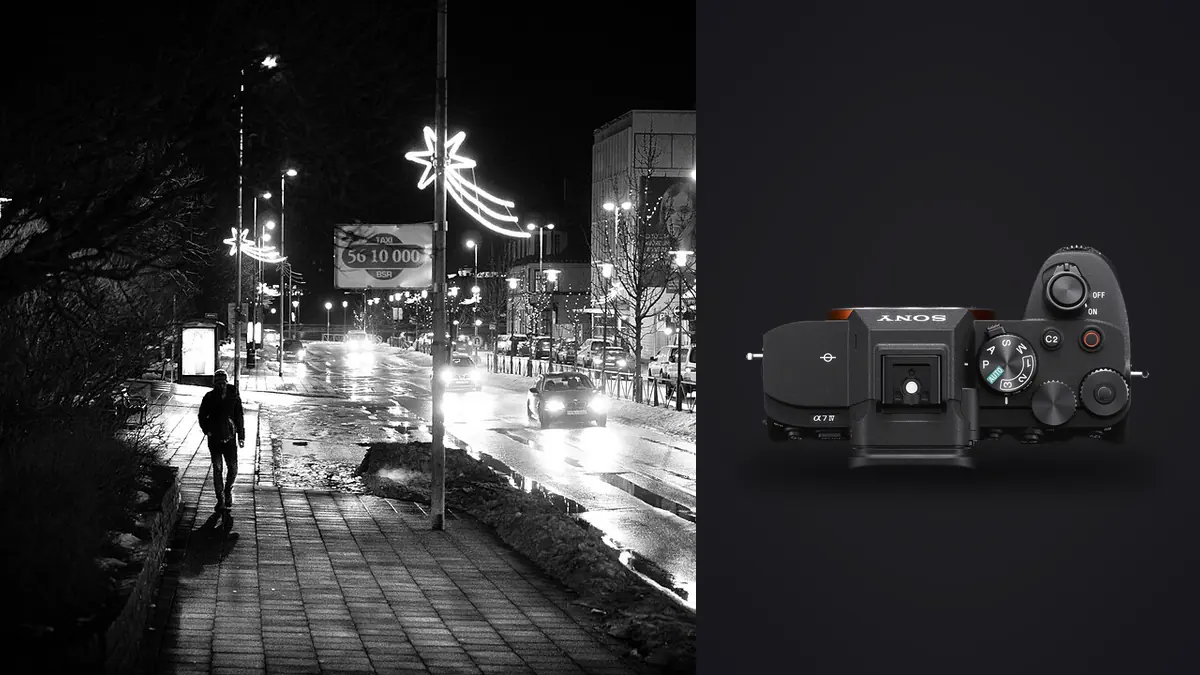
I've shot a Sony A7 IV as my main body for street and documentary work for a while now, through two damp winters of dim bar interiors, a handful of protests, a community theatre documentary project that ran long, and more Saturday market days than I can count. It is not the camera I would choose if the only goal was to vanish into a crowd. A Fuji X100V or a Leica Q2 does that better. But for the specific mix of unpredictable light, moving subjects, and the need for files that hold up when you crop or push shadows two stops, it has earned its spot in the bag in a way a lot of flashier gear hasn't.
This isn't a spec sheet regurgitation. It's what actually changes about how you shoot when you take this camera onto a street corner or into someone's kitchen for a documentary sit-down, where it helps, and where it gets in the way.
The autofocus is the real reason to pick this camera
Everything else about the A7 IV is good-to-very-good. The autofocus is the thing that's genuinely a step above what I was using before. Real-time Tracking combined with Eye AF for humans means I can point the camera at a person walking toward me, half-press, and the box locks onto an eye and rides with them through a recompose, a lens hunt behind a lamppost, even a partial turn of the head. For documentary interview setups, I'll set a subject in frame, let the camera hold focus on them while I move around with a second angle in mind, and not worry about missing focus because I got distracted watching for the moment rather than watching the focus box.
Where it isn't perfect: in a genuinely dense crowd, the tracking will occasionally jump to the wrong face, usually someone closer to the lens or better lit than my actual subject. It also gets sticky around foreground obstructions. If someone walks between me and my subject for even half a second, the AF sometimes decides the obstruction is now the subject and takes a beat to recover once they've passed. That beat has cost me frames during fast street sequences. The fix I've settled on is running a smaller, manually placed focus zone rather than the widest tracking area whenever I'm shooting in a crowd rather than open space, and reassigning it with the joystick on the fly instead of trusting the camera to always pick correctly.
Size, weight, and whether it actually stays quiet
The body alone is around 658 grams. Pair it with something like the 40mm f/2.5 G and you're carrying roughly 700 grams of camera, noticeably more than a Fuji X100V's 478 grams and a bit less than a Leica Q2's 734 grams. It is not a camera that disappears into your jacket pocket, and people notice you're holding a "real camera" in a way they sometimes don't with a compact. For candid work where anonymity matters, that's a real cost, and I won't pretend otherwise.
What it buys back is a grip you can actually hold onto for eight hours of walking and shooting, which the thinner rangefinder-style bodies don't give you, and a genuinely silent electronic shutter mode. Inside a quiet room during a documentary sit-down, or photographing someone praying, arguing, or grieving, a completely silent shutter has let me get frames I simply wouldn't have gotten with an audible click drawing attention at the wrong moment. The trade-off is that the electronic shutter's rolling readout causes visible banding under a lot of sodium and LED street lighting at night, and the anti-flicker shooting mode helps but doesn't eliminate it. If I know I'm shooting under mixed artificial light after dark, I'll switch back to the mechanical shutter and accept the small amount of noise it makes.
Lenses that actually earn their place in this kind of kit
What you put on the front matters more for street and documentary work than almost any other genre, because you're balancing speed, discretion, and how close you're comfortable getting. Here's what I've actually rotated through and what each one is genuinely good for, not a generic spec dump.
| Lens | Weight | Typical used price | Where it earns its keep | The catch |
|---|---|---|---|---|
| Sony FE 40mm f/2.5 G | 173g | €550-600 | All-day walking lens, close to a "normal" field of view, disappears on the body | f/2.5 isn't fast enough for dim interiors without bumping ISO hard |
| Sony FE 28mm f/2 | 200g | €350-420 | Doorway-to-street environmental shots, gets you close without distortion getting silly | Autofocus motor is a generation behind the G lenses, noticeably slower to lock |
| Sigma 35mm f/2 DG DN | 325g | €500-550 | Documentary interiors, wider aperture for handheld available light work | Bigger and heavier than the Sony primes, less pocketable |
| Sony FE 55mm f/1.8 Zeiss (legacy) | 281g | €700-900 used | Tighter portraits within a documentary sequence, compresses busy backgrounds | Getting harder to find used at a fair price, no longer sold new |
| Voigtlander 40mm f/1.2 (manual) | 410g | €900 new | Deliberate, slow street work where you're pre-focusing and waiting for the moment | Fully manual focus, unusable for fast tracking sequences |
If I had to keep exactly one, it's the 40mm G. It's the only one light enough that I forget it's on the camera by hour six, and the field of view sits close enough to how you naturally frame a scene with your eyes that I spend less time recomposing after the shot than I do with wider glass.
What the files actually give you back at the desk
The 33-megapixel sensor is the resolution sweet spot for this kind of work in a way I didn't fully appreciate until I needed it. Street photography involves a lot of shooting from the hip, through gaps in crowds, or slightly wider than you'd like because you didn't have time to change lenses. Having enough resolution to crop a third of the frame away and still print or post the result cleanly has saved shots I'd have thrown out with a lower-resolution body.
Dynamic range matters just as much. A lot of street work happens in exactly the lighting documentary photographers dread: a subject standing in a shaded doorway with a blown-out sunlit street behind them, or a market stall lit unevenly by patchy midday sun through a tarp. The raw files hold enough in both the shadows and the highlights that I can pull a stop and a half out of the shadow side without the noise becoming distracting, which is the difference between a usable frame and a reshoot that never happens because the moment's already gone.
Where this genre gets genuinely painful is volume. A single afternoon of street shooting, or one day following a documentary subject, easily produces six or seven hundred frames, most of them duplicates of the same three seconds shot in bursts as a moment develops. I run that take through imagic before I ever open a proper editor, letting its local sharpness scoring flag which frame in a twelve-shot burst actually nailed focus on the eyes, and its duplicate and burst clustering group the near-identical frames so I'm not scrolling past the same handshake nine times. Everything runs on the machine, nothing gets uploaded anywhere, which matters more than it sounds like it should when some of what you're culling involves people who didn't necessarily agree to be photographed and definitely didn't agree to their faces sitting on a stranger's server. If you haven't seen how that kind of automated first-pass culling actually works, it's worth reading through how AI photo culling works before you assume it's just a fancier version of flagging frames by hand.
Keeping up when something is actually happening
Documentary work occasionally turns into a burst-shooting exercise whether you planned for it or not: a scuffle breaks out at the edge of a protest, a kid does something unrepeatable at a family gathering you're covering, a market vendor and customer start arguing over a price. The A7 IV shoots at 10 frames per second in both mechanical and electronic modes, and with a fast UHS-II card the buffer holds up for somewhere around 800 JPEGs or close to 80 uncompressed raw frames before it starts to slow down, which in practice has never once run out on me mid-sequence. What has occasionally bitten me is forgetting to switch back off electronic shutter after a quiet indoor sequence, and getting rolling shutter skew on a fast pan during an outdoor burst later that same day. It's a habit thing, not a camera flaw, but it's one worth building deliberately if you move between the two shutter modes as often as this kind of work makes you.
Dual card slots matter more here than in most genres too. On anything I'd call a serious documentary project rather than a casual outing, I run simultaneous raw backup across both cards. Losing a card after a day spent building trust with a subject isn't a redo, it's gone.
A settings starting point for the situations that actually come up
These are the combinations I actually dial in, not a theoretical "recommended settings" table. Treat them as a starting point you adjust from, not a formula.
| Situation | Shutter | ISO range | AF area | Shutter type |
|---|---|---|---|---|
| Bright midday street, moving subjects | 1/500-1/1000 | 100-400 | Tracking: Zone | Electronic, no issue |
| Indoor documentary, subject seated and talking | 1/125 | 800-3200 | Tracking: Spot S | Fully silent electronic |
| Night street, mixed neon and sodium lighting | 1/250 | 1600-6400 | Tracking: Wide | Mechanical (banding risk) |
| Fast-moving event, crowd, unpredictable action | 1/1000+ | 400-3200 (Auto) | Tracking: Wide, continuous burst | Mechanical for reliability |
The pattern worth noticing is that I default to mechanical shutter more often than the marketing around silent shooting would suggest, simply because the banding risk under real-world artificial lighting is common enough that it's not worth the gamble unless quiet matters more than clean files in that specific moment.
Where it genuinely falls short for this genre
The fully articulating rear screen is the one design choice I still don't love for street work. A lot of street shooters prefer a screen that only tilts up and down, because you can shoot from waist height without the extra step of flipping the screen out to the side first, which draws more attention and takes an extra beat you don't always have. The A7 IV's screen works fine once it's positioned, but getting there from a closed position takes longer than a simple tilt hinge, and that half-second sometimes matters.
Battery life is fine, not great. CIPA rates it around 520 shots per charge using the viewfinder, and in cold weather during a winter documentary shoot I've seen that drop noticeably faster than the spec suggests. I carry two spares on anything longer than a half day now, which I didn't used to bother with.
And it's worth being honest that this isn't the cheapest way into this kind of photography. If all you want is street candids and nothing else, a used Fuji X-T body with a 23mm or a fixed-lens compact will get you there lighter and for less money. The A7 IV earns its price when you're doing both street and documentary work, or mixing in video, or need a system that can also carry longer glass for other assignments. As a single-purpose street camera it's arguably more machine than the job requires.
Frequently Asked Questions
Is the Sony A7 IV too big and obvious for candid street photography?
It's noticeably bigger and more visible than a compact like the X100V or a rangefinder-style body, and people will register that you're holding a serious camera more often than they would with something smaller. It's not a discreet camera in the way a pocketable one is. Where it makes up for that is autofocus reliability and file quality, which matters most if you're mixing street work with documentary assignments rather than shooting purely candid street.
Does the silent shutter actually work for photographing people without drawing attention?
Yes, indoors and in most daylight conditions it's genuinely silent, no click at all, which has let me get frames in quiet rooms I wouldn't otherwise have gotten. The catch is rolling shutter banding under certain artificial lighting at night, particularly older sodium streetlights and some LED signage, so I switch to the mechanical shutter for a lot of night street work rather than trust electronic-only.
What's the single best lens to start with for this kind of shooting?
The 40mm f/2.5 G, if I had to pick one. It's light enough to forget it's there after a full day, the field of view is close to natural so you spend less time recomposing, and the aperture is fast enough for most daylight and evening street conditions even if it's not ideal for dim interiors. A 28mm f/2 is the second lens I'd add for tighter, more environmental framing.
How much of a real day's shooting actually ends up as a finished edit?
Realistically, somewhere between five and ten percent of the raw frames from a busy street or documentary day make it into a final selection, and most of what gets cut is near-duplicate bursts rather than genuinely bad frames. That's the part of the workflow that used to eat the most time for me, scrolling past nearly identical shots trying to spot which one is actually sharpest. Running the take through imagic's local culling first, then applying a preset trained on my own past edits through apply_my_style so the surviving frames already look roughly consistent before I fine-tune, has cut that part of the process down to a fraction of what it used to take. If your current culling process is still entirely manual, a few workflow changes can save you hours before you even touch a dedicated tool.