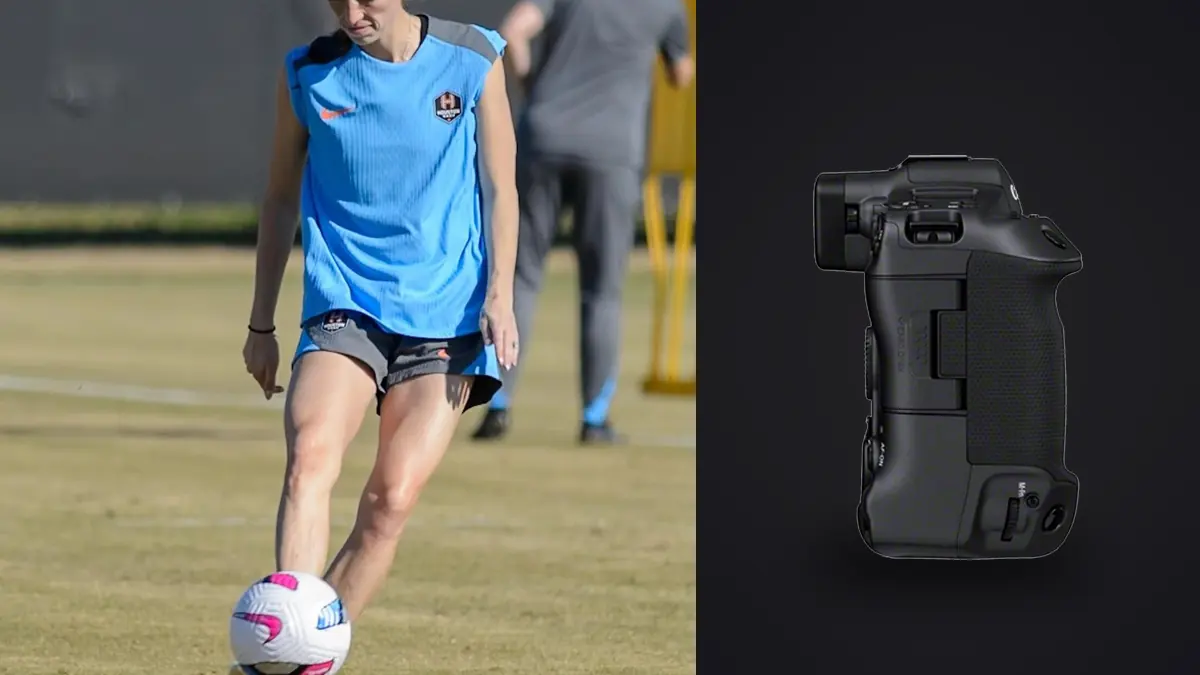
The First Thing You Notice on the Backstretch
The first time I ran a Canon EOS R3 through a full track and field meet, from the 100m heats in the morning to javelin qualifying in the late afternoon heat, the number that got all the attention beforehand (30 fps) wasn't what stuck with me. What stuck with me was how little I had to think about the viewfinder blacking out mid-pan. On a mechanical-shutter body, every frame in a burst is a tiny strobe of darkness while the mirror or shutter curtain resets, and over a few hundred frames that adds up to real fatigue when you're trying to hold a sprinter's head in the same third of the frame for eight seconds. The R3's stacked sensor and electronic shutter mean the viewfinder feed barely interrupts. You keep the athlete in view the entire time you're firing, which changes how confidently you pan, not just how many frames you capture.
Readout Speed Matters More Than the fps Number
Every camera brand loves to print the top burst rate on the box, but for track and field the number that actually determines whether your files are usable is sensor readout speed, not frames per second. The R3 reads its full 24.1MP frame in roughly 1/180 of a second in electronic shutter mode, which is fast enough that you can pan hard on a 200m runner coming off the curve without the rolling shutter skew that used to bend lane lines and limb positions on older stacked and non-stacked sensors alike. It isn't zero. If you whip-pan a relay baton exchange at close range with a long lens, you can still coax a very slight lean into vertical elements like the finish-line gantry if you're sloppy with your pan speed. But compared to a 1D X Mark III shooting its 16 fps electronic mode, or a first-generation stacked sensor from a few years back, the R3's rolling shutter artifacts are close to a non-issue at normal panning speeds. That's the real headline, not the 30 fps figure itself.
Where the frame rate does matter is field events with a short, violent peak: pole vault bar clearance, the release moment in discus, a long jumper's foot at the board. At 30 fps you're capturing a moment every 33 milliseconds, which is enough resolution in time to actually choose between three or four near-identical frames for the one with the cleanest limb extension and no motion blur on the trailing hand. At 12 fps mechanical, which is still an option on the R3 if you want a more traditional shutter sound and feel for events where silence isn't required, you'll sometimes only get one frame anywhere near the peak, and it might not be the best one.
Eye Control AF Works Beautifully in One Specific Scenario
Canon brought Eye Control AF back from the film-era EOS 3, and it's genuinely useful at a track meet, but only in a narrower window than the marketing suggests. Where it earns its keep is a single-lane pursuit: a 100m or 110m hurdles race shot from a low angle near the finish, where you're locked onto one runner in one lane and you just need the AF point to follow your eye as the runner's position drifts in the frame faster than a joystick nudge can keep up. Calibrated properly (and it does need real calibration, not the thirty-second version, do it indoors under stable light and redo it if you put on or take off glasses), it saves you from the classic problem of the AF point drifting onto an adjacent lane or the infield during a fast pan.
Where it gets unreliable is anywhere with harsh, direct sun hitting your eye through the viewfinder, which describes most outdoor afternoon sessions, and in relay exchanges where your own eye is naturally jumping between the incoming and outgoing runner. I've had it snap focus to the wrong athlete during a handoff more than once. My workaround is boring but it works: Eye Control AF for individual sprint and hurdle lanes shot straight-on, back to a registered AF point plus Case tracking for anything with multiple bodies converging, like relays, the long jump runway, or a crowded steeplechase water jump.
Settings by Event, Because One Configuration Doesn't Cover a Meet
A full meet asks the R3 to do completely different jobs within the same hour, and I've stopped trying to run one master setup for the whole day. These are the combinations I actually land on, adjusted from a season of shooting regional and university meets:
| Event Type | Shutter Speed | Drive Mode | AF Case / Tracking | Typical Lens |
|---|---|---|---|---|
| 100m / 200m sprints | 1/3200 to 1/4000 | Electronic, 30 fps | Case 2 (accelerate/decelerate), high sensitivity | RF 400mm f/2.8, occasionally with 1.4x |
| Hurdles | 1/3200 | Electronic, 30 fps | Case 4 (erratic), Eye Control on single lane | RF 100-500mm around 300-400mm |
| 800m / 1500m (pack running) | 1/1600 to 1/2000 | Electronic, 20 fps | Case 1 or Auto Case, medium sensitivity | RF 100-500mm, wider end for pack shots |
| 4x100 relay exchanges | 1/2500 | Electronic, 30 fps | Registered AF point, manual re-select at handoff | RF 70-200mm f/2.8 |
| Long jump / triple jump | 1/2500 | Electronic, 30 fps, burst timed to takeoff | Case 3 (ignore obstacles), zone AF | RF 100-500mm around 300mm |
| Pole vault | 1/2000 | Electronic, 30 fps at bar clearance only | Case 5 (subject changes speed rapidly) | RF 100-500mm, full reach for bar height |
| Discus / shot put / javelin | 1/2000 | Mechanical, 12 fps (silence not required) | Case 1, single point AF at release circle | RF 100-500mm |
The mechanical 12 fps choice for throws isn't about the sound rule, since throwing circles don't have the same silence requirement that, say, a golf swing or a tennis serve toss does. I use it there because the buffer cost of 30 fps electronic on an event where the actual peak moment (release) lasts about a tenth of a second is wasteful, and it lets that card breathe for the sprints coming up right after.
The Buffer Is the Real Limiting Factor, Not the Sensor
On paper the R3's buffer holds somewhere around 150 raw frames before it starts to slow down, shooting lossless compressed RAW to a fast CFexpress Type B card. In practice, at 30 fps that's five seconds of continuous shooting, which sounds like plenty until you realize a false start, a restart, and then the actual race can eat through that in one heat if you're trigger-happy. I burned through a buffer mid-race exactly once, during a 100m final where I held the shutter from the gun instead of bursting in short controlled pulls, and watched the frame rate stall right as the field crossed the line. Since then I shoot sprints in three or four separate one-second bursts timed to the start, the mid-race stride, and the lean at the tape, rather than one long continuous hold. It's a discipline thing more than a hardware limitation, but the hardware makes the mistake much more expensive because at 30 fps a moment of hesitation costs you dozens of frames you'll never look at.
The SD UHS-II slot is genuinely useful here too, not as a speed match for the CFexpress card but as an overflow or JPEG backup destination while the CFexpress card handles the RAW load. For meets where others are counting on the photos, run RAW to CFexpress and a simultaneous JPEG to the SD card, so if you need to hand a coach or an athlete's parent a usable image on the spot before you've even opened a laptop, it's already sitting on a card you can pull.
What a Full Meet Day Does to Your Card, and Your Evening
The unglamorous part of shooting a meet this way is what happens after the last event. A single day covering six or seven track events plus two or three field events at 20 to 30 fps in short bursts easily produces four to six thousand RAW files. Almost none of those files are meaningfully different from the frame next to them, they're the same stride or the same bar clearance captured four times a second apart, and sorting that by eye in a traditional catalog is the part of this job nobody enjoys.
This is the point where I stopped trying to do the first pass manually. I run the day's card through imagic before anything else, which handles the two problems that actually matter for burst-heavy sports work: it scores focus and sharpness locally on every frame using edge detail rather than relying on which AF point lit up (useful, because Eye Control and Case-based tracking both occasionally lock onto the wrong thing for a frame or two even when the burst as a whole looks fine), and it groups the near-duplicate frames from each burst into clusters so I'm choosing between five real options instead of scrolling past forty. All of that runs on my own machine with nothing uploaded anywhere, which matters more than it sounds like it should when you're dealing with images of minors at a school meet, since the files never leave my laptop. Once I've got a shortlist per event, imagic's apply_my_style step carries the color and tone treatment I've already dialed in from past meets across the new selects automatically, so the grading pass on a six-thousand-frame day takes closer to twenty minutes than two hours. If you're new to the idea of software doing the first sharpness and duplicate pass instead of you, our piece on how AI photo culling actually works goes into more detail on what that scoring is doing under the hood.
Indoor Meets Change Almost Everything
Everything above assumes a reasonably bright outdoor track. Indoor meets are a different job entirely. Banked indoor tracks are usually lit with a mix of fluorescent or LED fixtures that flicker at a rate your eye doesn't register but a 1/2000 shutter absolutely will, showing up as inconsistent exposure or color banding frame to frame within a single burst. The R3's anti-flicker detection helps, and I leave it on by default indoors, but it works by timing the shutter to the peak of the light cycle, which can mean it declines to fire at the exact instant you wanted if the flicker phase is wrong. Combined with the lower light levels indoors pushing ISO up into the 6400 to 12800 range on a fast telephoto, indoor sprints and jumps are where I most often drop to 20 fps instead of 30, partly for buffer depth and partly because the extra frames aren't buying you much when three out of ten already have visible banding.
Eye Control AF also gets noticeably less reliable indoors under mixed lighting, in my experience, so I lean much more heavily on a fixed AF point with Case tracking rather than trying to recalibrate eye tracking for a venue I might only shoot once a season.
Lens Pairings Worth Knowing About
The R3's autofocus system can still drive focus down to f/11, which matters more than it sounds like for track work because it means an RF 400mm f/2.8 with a 2x extender (landing at 800mm f/5.6, comfortably inside that f/11 ceiling) still autofocuses reliably for distance events shot from the far side of an outdoor track or from elevated stands. For most of a meet, though, the RF 100-500mm is the lens that stays on the body longest simply because a meet moves around the infield constantly and a zoom saves you from missing a race while you swap glass. The RF 70-200mm f/2.8 earns its place specifically for relay exchange zones and close hurdle work, where you need the wider field of view to catch two athletes at once rather than a tight single-runner frame.
Frequently Asked Questions
Is 30 fps actually necessary for track and field, or is 20 fps enough?
For most of a meet, 20 fps is genuinely enough and it's easier on your buffer and your card. Where 30 fps earns its cost is the very short, violent peaks: a pole vault bar clearance, a discus release, the exact instant a long jumper's foot hits the board. Those moments last a fraction of a second and having more frames in that window increases your odds of catching clean limb extension with no blur.
Does the R3's rolling shutter cause problems with fast panning on the track?
Rarely, and only at the extremes. The stacked sensor's fast readout keeps distortion minor even during hard pans on sprinters coming off a curve. You can still introduce a slight lean on vertical background elements if you whip-pan aggressively at close range with a long lens, but it's a much smaller issue than on non-stacked sensors or older electronic shutter implementations.
How reliable is Eye Control AF for tracking a single sprinter?
Very reliable once properly calibrated, and specifically strong for single-lane pursuits like an individual sprint or hurdles race shot straight-on. It gets shakier in bright direct sun through the viewfinder and during relay exchanges where your own eye naturally jumps between two athletes. Recalibrating indoors under stable light, and redoing it if your eyewear changes, makes a real difference.
What's the fastest way to go through several thousand burst photos from a single meet?
Manually scrolling through six-plus-frame bursts one by one is the slowest part of this workflow if you do it in a traditional catalog. Running the card through imagic first clusters near-duplicate burst frames together and ranks them by local sharpness scoring before you ever open an editor, so you're picking the best frame from a small, pre-sorted group instead of eyeballing every file. It's worth reading through these workflow tips if burst-heavy shoots are eating your evenings.