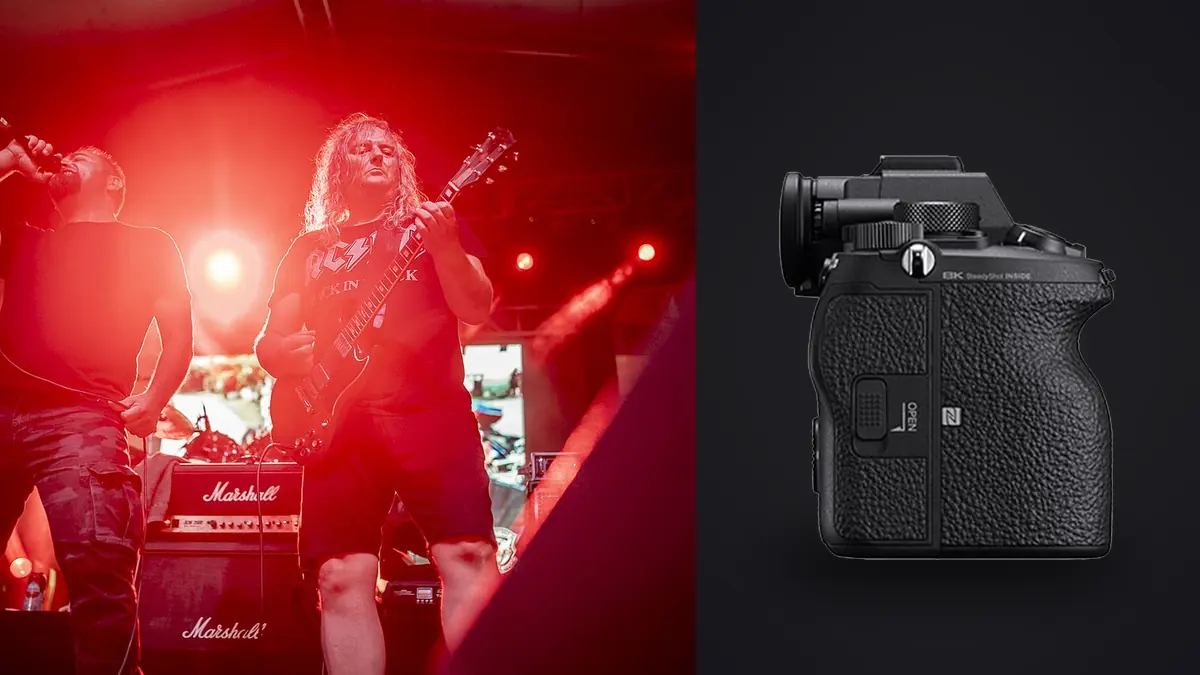
Three songs, no flash, and a lighting rig that swings from a single amber wash to a strobe wall in the space of a chorus. That's the environment the Sony A1 gets judged in, not a spec sheet. I've carried one through club pits with 200 people crammed against the barrier and through arena floors where the photo line is fifty photographers deep and everyone's chasing the same three-song window. The camera holds up in both, but not for the reasons most spec comparisons lead with.
The Shutter Question Nobody Explains Well
The A1's 50.1MP stacked CMOS sensor reads out fast enough that the electronic shutter genuinely doesn't black out the viewfinder during a burst. That sounds like a marketing line until you're tracking a singer moving unpredictably along a stage edge and you realize you never lost the frame. With a mechanical shutter camera, every frame is a flicker of blackness where you're guessing at where the subject went next. With the A1 in electronic mode, the finder stays live through the whole 30fps burst, and that changes how you frame, not just how many frames you get.
The catch is that electronic shutter and cheap LED lighting don't always get along. A lot of small venues run PAR cans or moving heads on PWM dimming that isn't in sync with a fast electronic readout, and you'll see horizontal banding in some frames that you won't see in others from the same burst. It's inconsistent enough that I keep the camera set to mechanical shutter as a default in unfamiliar clubs and only switch to full electronic once I've shot a test burst and checked the rear screen for banding. In venues with proper theatrical lighting (larger halls, festival stages with real dimmer packs) the electronic shutter is clean and I leave it there for the silence alone.
Rolling shutter skew is the other thing worth knowing about before you rely on electronic mode for whip pans or spinning stage effects. The A1's readout speed is fast enough that it's rarely a problem for a singer moving across a stage, but if you're panning hard with a wide lens during a lighting rig spin, you can catch the leading edge of a truss bending slightly in the frame. It's subtle, and most editorial clients will never notice, but it's there if you go looking for it in a 100% crop.
Autofocus in Rooms That Refuse to Behave
Stage lighting is the worst possible environment for autofocus: backlighting from follow spots, sudden drops to near black between songs, smoke, and performers who won't hold still. The A1's real-time Eye AF for humans is what makes it usable here. It holds onto a singer's eye through a spotlight sweep in a way that older Sony bodies would hunt through, and it recovers fast when a performer turns their head into silhouette and back.
Where it struggles is guitarists and drummers who spend half the set with their face turned away or buried in the instrument. Eye AF has nothing to lock onto, so I switch to Zone or Expand Spot for those shots and place the focus point manually on the hand or the neck of the guitar rather than trusting subject tracking to guess. The rated low light AF sensitivity down to about -4EV is real (I've had it lock in near-black moments between songs when the only light source was a phone screen in the crowd), but "locks" and "locks on the right thing" are different claims, and in true blackout the camera will happily focus on the mic stand instead of the singer's face if you let tracking run wide open.
Battery drain is worth mentioning here too, because continuous Eye AF plus a 30fps burst is one of the more demanding combinations you can ask of the NP-FZ100. CIPA numbers don't mean much in a pit; realistically I get through two to three full sets on one battery when I'm shooting bursts liberally, and I carry a spare in a jacket pocket rather than a bag pocket because change breaks happen in seconds, not minutes.
Buffer Depth and the Card Slot That Actually Matters
The A1 has two card slots, one CFexpress Type A / SD UHS-II combo slot and one SD UHS-II only slot. If you're shooting 30fps bursts and want the buffer to actually clear between songs, the CFexpress Type A card in the top slot isn't optional, it's the whole reason the camera can sustain that speed for more than a couple of seconds. I learned this the expensive way on an early shoot with two SD UHS-II cards in a mirror setup: the buffer filled inside four seconds of continuous 30fps and the frame rate crawled to a stop for the rest of the chorus.
| File type | Approx. buffer (CFexpress Type A) | Approx. buffer (SD UHS-II) | Clear time after full buffer |
|---|---|---|---|
| Compressed RAW | ~400+ frames | ~90-120 frames | 4-6 sec (CFexpress) / 12-18 sec (SD) |
| Lossless compressed RAW | ~230-250 frames | ~60-80 frames | 6-9 sec (CFexpress) / 15-20 sec (SD) |
| Uncompressed RAW | ~150-180 frames | ~35-45 frames | 10-14 sec (CFexpress) / 25-30 sec (SD) |
| JPEG Fine (Large) | Effectively unlimited | ~200+ frames | Negligible |
In practice I shoot compressed RAW for pit work. Lossless compressed is nice for tonal range in a studio session, but for a three-song set where I might fire six or seven bursts a song, the buffer margin from compressed RAW matters more than the marginal quality gain, and the files are still plenty clean for a full-page magazine spread or a promo gallery.
How the Settings Actually Change by Room
What I dial in changes more by venue size and lighting rig than by artist or genre. This is roughly the decision tree I run through walking into a new room:
| Venue type | Shutter mode | ISO ceiling | AF area | Drive speed |
|---|---|---|---|---|
| Small club, single wash light | Mechanical (banding risk on electronic) | 6400 | Wide + Eye AF (Human) | Hi+ (20fps) |
| Seated theater, house lighting | Electronic (silent, no shutter noise complaints) | 3200 | Zone | Lo (5fps) or single shot |
| Mid-size venue, moving-head rig | Electronic | 8000 | Expand Spot + Eye AF | Hi+ (30fps) |
| Outdoor festival, daylight into dusk | Electronic, shutter speed shifts 1/2000 down to 1/125 as light drops | 100 rising to 12800 | Wide | Hi (20fps), 30fps for key choruses |
The theater row surprises people. Silent shooting at 5fps sounds like a downgrade, but in a seated venue with a quiet passage in a set, a mechanical shutter slapping away at 20fps is genuinely disruptive, and I've had house sound engineers ask photographers to stop. The A1's fully silent electronic mode is the reason I still get invited back to those rooms.
Handling It for Three Hours Standing Up
At 737g body only, the A1 isn't a lightweight camera, and paired with a 70-200mm f/2.8 GM it's a two-handed commitment for a full night. The in-body stabilization rated around 5.5 stops is genuinely useful at the tail end of a set when I'm shooting handheld at 1/60 to drag some ambient stage color into a frame without a tripod, but it doesn't fix subject motion, only camera shake, so a moving performer at a slow shutter is still going to smear regardless of how good the IBIS is.
The grip is deep enough that I can shoot one-handed for short stretches while changing a card or checking a text with the other hand, which matters more than it sounds like in a crowded pit where you don't always have room to bring the camera down. Weather sealing has held up through a couple of outdoor festival sets in light rain, though I still keep a rain sleeve in the bag for anything heavier than a drizzle.
What Happens to the Files After the Show
This is the part that doesn't get covered enough in gear write-ups. A three-song pit set shot the way I described above, several 20 to 30fps bursts per song across three songs, easily produces 600 to 1,000 compressed RAW frames. Compressed RAW files off the A1 run roughly 55 to 65MB each, so a single night's shoot can land at 40 to 60GB before you've touched a single edit.
That volume is exactly the problem imagic was built to sit in front of. I run the card through imagic before I open anything in an editor, and the burst clustering groups the near-identical frames from each 30fps run so I'm not scrolling past forty versions of the same beat looking for the one where the singer's eyes are actually open. The local sharpness and focus scoring is what saves the most time on a night like this, because at 30fps a huge share of frames in any burst are marginally soft from subject motion even when the AF locked correctly, and picking the sharpest frame by eye across a thousand images is a different kind of exhausted by 2am. If you haven't looked at how that kind of automated first-pass culling actually works under the hood, there's a breakdown at how AI photo culling works that goes into the mechanics.
The other piece that's specific to touring or repeat-venue work is the apply_my_style preset. I shoot enough club and theater dates that I've built up a consistent edit for how I want stage lighting to render, warmer highlights, deeper shadow detail without crushing the blacks under the spotlights, and rather than rebuilding that look manually every time, imagic applies it based on my own previously edited sets rather than a generic preset pack. It's not going to nail a wildly different lighting rig on the first pass, but for the bulk of a season's worth of similar rooms it gets me most of the way there before I do manual adjustments.
Because everything runs locally with no cloud upload step, it's also just practical on tour. Venue wifi is unreliable at best and gig footage shouldn't sit in someone else's upload queue before you've even looked through it. If your current culling routine is still a manual first pass in Lightroom, the workflow changes I made after switching are laid out in more detail in 10 tips for a faster photo workflow.
Frequently Asked Questions
Does the A1's electronic shutter really eliminate blackout during a three-song pit set?
Yes, in the viewfinder. The stacked sensor reads out fast enough that the EVF stays live through a full 30fps burst rather than flickering to black each frame, which is the single biggest practical difference from an older mechanical-shutter body when you're trying to track a performer's movement in real time. It doesn't affect exposure or image quality, only your ability to keep the subject framed while firing.
Is CFexpress Type A mandatory, or can I get away with fast SD cards for a full night of sets?
You can shoot SD UHS-II and it will work, but the buffer fills in a handful of seconds at 30fps and the write-out slowdown is noticeable mid-burst. If you're shooting compressed RAW at high frame rates for multiple songs back to back, CFexpress Type A is what keeps the camera from stalling exactly when you need the next burst.
Will silent electronic shooting cause banding under cheap venue LED lighting?
Sometimes. It depends on the dimming method the venue's lighting rig uses. PWM-dimmed LED PAR cans and budget moving heads can produce horizontal banding in electronic-shutter frames that won't show up with a mechanical shutter. Shoot a quick test burst when you walk into an unfamiliar room and check the rear screen before committing to electronic mode for the whole set.
Is 50 megapixels overkill for editorial concert delivery, and does it slow down culling?
For most editorial and promo delivery, 50MP is more resolution than the end use needs, but the tradeoff is worth it for crop flexibility when you're shooting wide from a fixed pit position and need to punch in during the edit. The file size does mean culling matters more, not less, which is why I run bursts through local sharpness scoring before opening anything in an editor rather than eyeballing a thousand nearly identical frames one at a time.