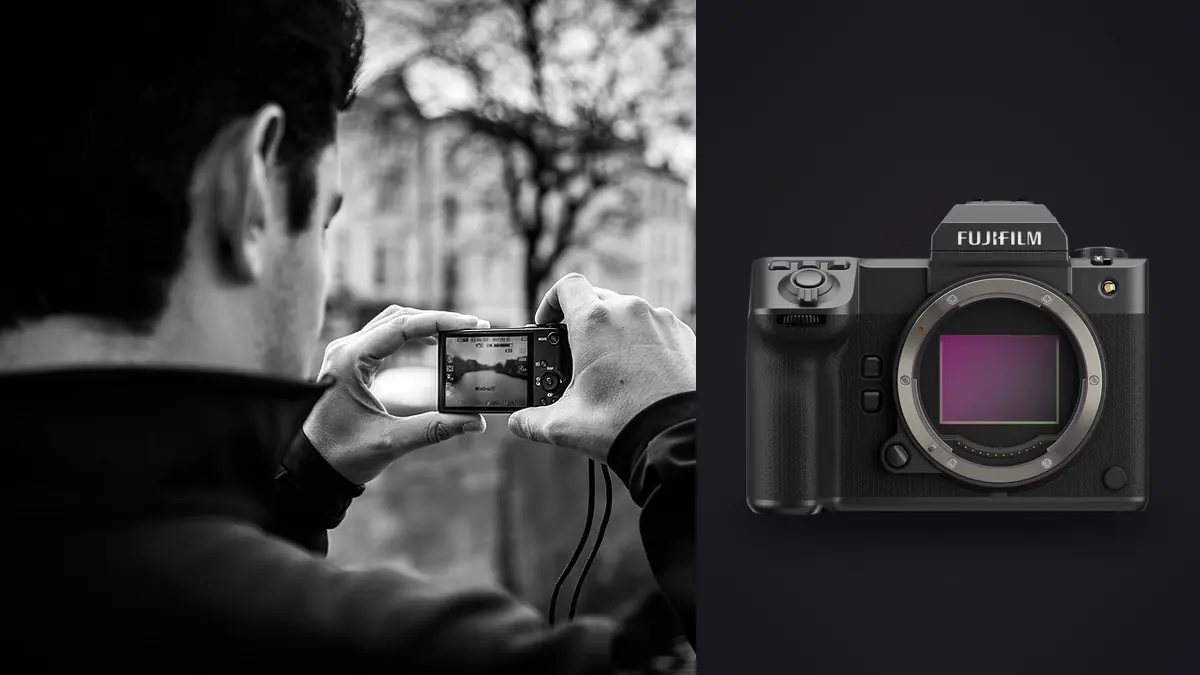
I brought a medium format camera to a housing protest in Manchester in February and spent the first twenty minutes convinced I'd made a mistake. Everyone else working the story, two agency shooters and a freelancer filing for a broadsheet, carried something small: an X100 body, a Leica on a wrist strap, a stripped-down mirrorless with a 35mm prime taped up so it wouldn't rattle in the cold. I had a Fujifilm GFX 100 II with the 55mm f/1.7 attached, a rig that weighs about as much as a bag of sugar and draws exactly the kind of attention a documentary photographer usually spends a career learning to avoid. Three hours later I had a folder of frames with a level of shadow detail none of the smaller sensors in that scrum could have pulled off, and I'd more or less changed my mind about what this camera is actually for.
The camera nobody expects to see on a street corner
Medium format has a reputation, mostly earned, for being a studio and landscape tool. Slow, deliberate, tripod-bound. The GFX 100 II doesn't fully escape that reputation and it shouldn't try to. It's a 1030-gram body before you attach anything, and the 55mm f/1.7 alone weighs close to 780 grams, so a walking-around kit lands somewhere north of 1.7kg. That's not a camera you forget is hanging off your shoulder after six hours.
What it does have going for it on the street is that it no longer behaves like the medium format bodies I used a decade ago. In-body stabilization rated to roughly 8 stops means I can shoot handheld at a quarter second in a dim stairwell and still get a usable frame of someone descending into a subway platform. The tilting screen, which moves on four axes rather than the usual two, lets me shoot from waist height without craning over an angle finder, which matters more for discretion than the body size ever will. Subjects notice a camera pointed at their face. They notice a camera held at hip level, glanced at sideways, a lot less.
So the honest answer to "is this a street camera" is: not in the Bresson sense, and I'll get to why later in this piece. But for slower, more observational documentary work, where you're spending a day inside a community rather than hunting a single decisive frame on a corner, the size stops being the disqualifying factor people assume it is.
What the autofocus upgrade actually changes in practice
The GFX100S before it had usable but unremarkable autofocus for anything moving. The 100 II is a different animal. Fujifilm rebuilt the phase-detect coverage and added the subject-detection modes borrowed from the X-H2S, including a general "human" mode that catches faces and eyes even when a subject is turned three-quarters away or partially obscured by a doorway or another pedestrian. In a market stall or a crowded platform, that partial-occlusion tracking is the difference between a sharp frame and a wasted one.
Burst speed tops out at 8fps with the electronic shutter, which sounds modest next to an X-T5's 15fps or a Q3's 15fps, and it is. This is not the camera for a cyclist sprinting through frame or a kid mid-jump off a wall. Where it holds up is the more typical documentary rhythm: someone turning to look over their shoulder, a hand reaching for a door, a face shifting from neutral to a laugh over half a second. Eight frames a second covers that gap fine, and because every one of those frames is a 102-megapixel file, you get room to crop into a moment you didn't quite frame perfectly the first time, which happens more than any photographer likes to admit when they're moving through a scene rather than staged in front of it.
How it actually compares to the cameras people really carry on the street
Most of the "best street camera" conversation happens around a handful of specific bodies, so here's how the GFX 100 II sits next to the ones I've actually shot alongside on assignments this year.
| Camera | Sensor / resolution | Typical shooting weight | Max AF-C burst | Native ISO floor | Where it wins for street/doc work |
|---|---|---|---|---|---|
| Fujifilm GFX 100 II | 44x33mm medium format, 102MP | ~1.75kg with 55mm f/1.7 | 8fps | ISO 80 | Shadow recovery, huge crop latitude, slower observational work |
| Leica Q3 | Full frame, 60MP | ~740g, fixed 28mm f/1.7 | 15fps | ISO 100 | Fastest into shooting position, most discreet full-frame option |
| Fujifilm X100VI | APS-C, 40MP | ~520g, fixed 23mm f/2 | 20fps (crop) | ISO 125 | Pure grab-and-go, all-day carry, near invisible in a crowd |
| Fujifilm X-T5 | APS-C, 40MP | ~810g with 23mm f/2 | 15fps | ISO 125 | Fast decisive-moment work, lens flexibility, lighter travel kit |
The pattern in that table is the whole argument for or against this camera. If your documentary work is about being fast and unnoticed, the GFX 100 II is fighting its own physics the entire time. If your work leans toward slower access-based storytelling, spending hours inside a single location or building trust with subjects over a shoot rather than grabbing them mid-stride, the extra resolution and dynamic range start paying for the extra weight.
The 55mm changed how I think about the lens lineup
Before the 55mm f/1.7 launched alongside this body, the GF lens lineup was built for landscape and studio work: slow zooms, a couple of very sharp but very deliberate primes. None of it suited fast handheld shooting. The 55mm changed that. At a roughly 44mm full-frame equivalent (the GFX crop factor is about 0.79x), it sits right in that classic street focal length, close enough to normal that framing feels natural, wide enough to work in tight interiors and doorways.
For a two-lens documentary kit I've settled on the 55mm f/1.7 for most of the day and the GF20-35mm f/4 for interiors and environmental wides where I need to show the room a subject is standing in, not just the subject. The GF35-70mm kit zoom is lighter and covers a useful range, but the variable aperture costs too much light for indoor documentary work where you're often shooting under fluorescent tube lighting at 1/125 to freeze motion. I've largely left it in the bag since the 55mm arrived.
Where the sensor actually earns its size
Street and documentary light is rarely cooperative. You get a subject lit by a shopfront on one side and thrown into deep shadow on the other, or someone silhouetted against a bright doorway with detail you need to pull out of near-black. The GFX 100 II's sensor gives you roughly 14 stops of dynamic range at base ISO, which in practice means I can expose for the highlights, protect a bright sky or a lit window, and still recover a face in shadow in post without the noise and banding that shows up doing the same recovery on an APS-C file.
The 102-megapixel count matters here in a way it doesn't for most photography. On a documentary shoot you're often not perfectly positioned. Access is limited, you can't always move closer, and the moment happens where it happens. Having that much resolution means a crop that would have been unusable at 24 or 40 megapixels still holds up as a full-bleed print. I've reframed more than one important frame after the fact simply because the raw file could absorb it.
What happens after the shutter closes
Nobody talks enough about the workflow cost of shooting medium format on a documentary job, and it's real. A compressed raw off this sensor runs 100 to 130MB depending on scene complexity, and a single afternoon of shooting a market or a protest at even a modest clip produces several hundred frames. That's easily 40 to 60GB before dinner, a volume of near-duplicate frames (the same person, five variations of expression, three of them technically soft because they moved mid-exposure) that would take hours to sort by eye.
This is the part of owning this camera that pushed me to change how I cull entirely. I run everything through imagic before I open a single frame in an editor. It scores sharpness and focus locally on the machine, which matters because I'm not uploading a few hundred 100+ megapixel raws to some cloud service between assignments, and it groups burst sequences and near-duplicates so I'm choosing between three or four real candidates for a moment instead of scrolling past forty. If you've never worked through how that kind of automated culling actually decides what's sharp versus soft, this breakdown of how AI photo culling works covers the mechanics better than I can in a paragraph here.
The other piece that's specific to shooting this much volume on documentary work is consistency of look across a shoot that might span a full day in shifting light. I built a preset in imagic's apply_my_style feature from a set of edits I was happy with on an earlier project, and it applies that same grading logic to new imports so a frame shot at 8am under overcast light and one shot at 6pm under sodium streetlight don't feel like they came from two different photographers. It's not a substitute for actually editing the hero frames by hand, but it gets ninety percent of a large take to a consistent starting point fast, which matters when a client wants a gallery back within a day or two. For anyone drowning in a similar volume problem regardless of camera brand, these workflow tips are worth a read alongside whatever culling tool you land on.
Handling quirks that don't show up on a spec sheet
A few things I only learned by carrying this camera for months rather than reading about it. Battery life is genuinely good for a body this size, I regularly get past 500 frames on one NP-W235 cell, but I still carry three because a dead battery on a documentary shoot means missing something that won't happen twice. The dual card slots (CFexpress Type B plus SD) mean I shoot raw to the fast card and a jpeg backup to SD, which has saved a shoot once already when a CFexpress card started throwing errors mid-day.
Weather sealing is better than I expected for a camera this size. I've shot through drizzle at a fishing harbour without a rain cover and had no issues, which matters for documentary work that doesn't pause for weather. And one small thing: the shutter sound, even in mechanical mode, is quieter than I expected walking in with assumptions from older medium format bodies. It's not silent-shutter quiet, but it's not the loud slap that gives away a frame in a quiet room either.
The real handling cost is that this is a two-handed camera. You cannot casually shoot one-handed at hip height the way you can with an X100 or a Leica, the weight and the lens balance won't let you hold focus and framing steady enough. Anything requiring genuine stealth, working a single hand while the other holds a coffee or a door, isn't this camera's game.
Where I'd leave it at home
I want to be straight about the limits rather than talk this camera up as an all-purpose street tool, because it isn't one. If you're chasing fast, reactive moments on a busy street corner, someone stepping off a curb into a shaft of light, a dog crossing in front of a bus, the classic decisive-moment style of shooting, an X100VI or a Q3 will get you into position and firing faster every time, and you won't be nursing a sore shoulder by hour four. The GFX 100 II rewards patience and access. It's the camera I bring when I know I'll be embedded somewhere for a stretch, a workshop floor, a community kitchen, a slow-moving demonstration, not the camera I grab for a quick hour of wandering a market looking for gestures.
It's also not cheap enough to be a casual second body. At roughly $7,499 for the body alone, this is a considered purchase for photographers who already know medium format's tonal quality is worth the tradeoffs, not a first camera for someone still figuring out whether documentary work is their thing.
Frequently Asked Questions
Is the GFX 100 II too heavy to carry through a full day of documentary shooting?
It's manageable but noticeable. A body-and-lens combo around 1.7kg is fine strapped across the body with a wide strap and moved between shots rather than held up constantly. By the fifth or sixth hour of a long shoot I feel it in my neck in a way I never did with an X-T5. A dual strap harness that redistributes weight to both shoulders is worth the investment if you're using this camera regularly for full-day work.
Can you realistically shoot fast, reactive street photography with a camera this size?
You can, but you'll miss more fast-reaction frames than you would with a smaller, faster-handling body. The autofocus and subject tracking are genuinely good, but the physical bulk slows the process of raising the camera and finding a subject compared to something like an X100VI. It's better suited to scenes you can anticipate a beat ahead of time than to pure reflex shooting.
What's the best starting lens for street and documentary work on this system?
The GF55mm f/1.7 is the obvious answer for most people. It's fast enough for interior and low-light documentary work, sits at a natural everyday focal length once you account for the 0.79x crop factor, and it's noticeably lighter than most other GF glass. Pair it with the GF20-35mm f/4 later if you find yourself needing wider environmental context shots.
Do the 102-megapixel files actually help, or are they just extra storage overhead?
Both, honestly. The resolution gives real cropping latitude when you can't reposition for access reasons, which happens constantly in documentary work. But it also means every shoot generates a serious volume of large files that need sorting fast, which is why a local culling pass before you touch an editor stops being optional and starts being part of the job.