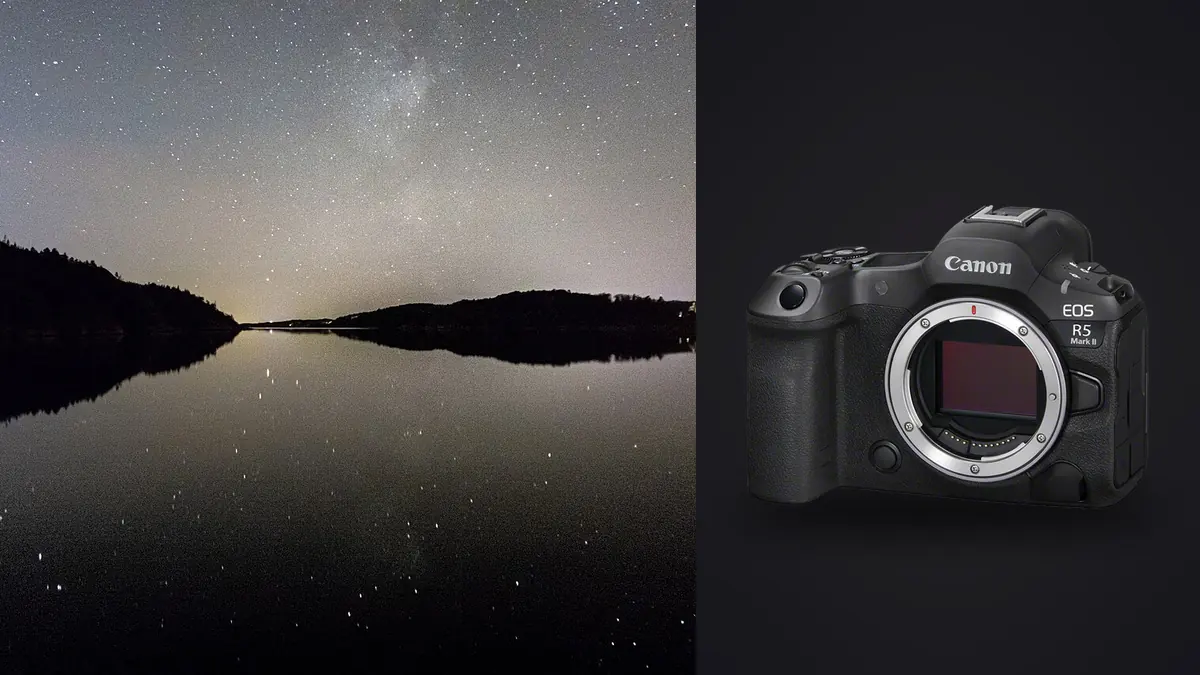
I took the R5 Mark II out for its first real dark-sky session about six weeks after it landed on my desk, up at a trailhead parking lot at 1,800 meters where the Milky Way core clears the ridge line around 11pm this time of year. I went in expecting the usual R5-family quirks (aggressive long-exposure noise reduction defaults, a menu that buries the settings you actually need under three submenus) and came away with a genuinely different opinion of the body for stacked night work. Not because of some headline spec, but because of how the stacked sensor changes what happens between frames when you are shooting 60, 80, sometimes 120 exposures in a row for a stack.
This isn't a spec sheet regurgitation. It's what changed in my actual field workflow, what still annoys me, and how I get from a card full of sub-frames to a finished composite without losing an evening to bad data.
Why the sensor change matters for stacking specifically
The R5 II keeps the 45-megapixel resolution of the original R5 but moves to a stacked, back-illuminated design with a much faster readout. For sports and wildlife shooters that means less rolling shutter skew. For stacking astrophotography, the benefit is quieter: faster readout means less time between when the shutter closes and the camera is ready for the next exposure, which matters a lot when you're trying to squeeze 80 fifteen-second frames into a battery cycle before the core rotates too far and your background stars start showing rotational blur across the stack.
On the original R5, my typical interval between 15-second exposures (with buffer clearing and a 2-second gap I built in for mechanical shutter settle) ran close to 18-19 seconds per cycle. On the R5 II shooting the same sequence, I'm consistently closer to 16 seconds per cycle, and I can shave more off by dropping to electronic shutter (more on why I mostly don't, below). Over a two-hour session that difference adds up to a meaningfully denser stack, which shows up directly as lower noise in the final integration.
Lens pairing and the exposure ceiling
I've run three lenses on this body for wide-field stacking: the RF 14-35mm F4L, the RF 15-35mm F2.8L, and a Sigma 14mm F1.4 DG DN adapted via the RF mount adapter. The Sigma wins on raw light gathering (a full stop and change over the 15-35 wide open) but it's heavier, hunts more in the dark when I try to autofocus off a bright star for a reference point, and shows more coma in the corners at f/1.4 than I'm willing to tolerate in a stack where corner stars are already getting stretched. My honest daily driver is the RF 15-35mm F2.8 at 15mm, f/2.8, because the corner sharpness holds up well enough that I don't need to crop aggressively after stacking, and I can live with the extra stop of ISO the F4 zoom would have cost me.
For untracked stacking (no star tracker, just a sturdy tripod), the old "500 rule" divides 500 by your focal length to get a rough max exposure time before trails appear. That rule was written for cameras with far fewer megapixels than a 45MP sensor. At this pixel density, star movement that the 500 rule would call acceptable is visible the moment you zoom to 100% on a monitor, which matters because stacking software amplifies exactly the kind of misalignment that comes from slightly elongated stars. I use something closer to the NPF rule in practice, and on the R5 II specifically I've settled on the numbers below from actual test frames, not a calculator.
| Focal length | Max single exposure (untracked, R5 II, pixel-peep test) | ISO I actually shoot | Notes from the field |
|---|---|---|---|
| 14mm | 9-10 sec | 3200 | Corner stars start showing faint elongation past 11 sec on the Sigma |
| 15mm | 8-9 sec | 3200 | My usual setting on the RF 15-35 at f/2.8 |
| 20mm | 6-7 sec | 4000 | Tighter framing on the core, less foreground context |
| 24mm | 5 sec | 5000 | Only worth it for a specific composition, noise climbs fast here |
| 35mm | 3-4 sec | 6400 | I don't stack at this length anymore without a tracker, too many frames needed |
Past 20mm I switch strategy entirely and put the camera on a Star Adventurer tracker if I'm not just shooting a foreground-plus-sky composite. Tracked exposures at 24-35mm can stretch to 60-90 seconds without trailing, which cuts the frame count needed for a clean stack by more than half.
Manual focus, because autofocus in the dark is a coin flip
Dual Pixel AF II is genuinely better in low light than the original R5's system, and it will occasionally lock onto Jupiter or a first-magnitude star if you center it and give it a second. I still don't trust it for the actual capture sequence. My process: zoom to 100% magnification on live view, point at the brightest star I can find, nudge focus manually until the star shrinks to the smallest, tightest point it'll go, then tape the focus ring down with a strip of gaffer tape so a stray brush against the lens barrel mid-sequence doesn't cost me the whole night. I check focus again every 20-30 frames by chimping a shot at 100% zoom on the rear screen, because temperature drop over a few hours will shift focus on some lenses enough to matter, especially the Sigma.
The articulating rear screen is a small thing but it's one of the reasons I reach for this body over older gear when the composition points near zenith. Not fighting a right-angle viewfinder attachment at 1am in the cold is worth more than it sounds.
Building the actual frame set
A stack isn't just light frames. My standard sequence for a Milky Way composite:
- 60-100 light frames at the settings from the table above, shot back to back with the built-in interval timer
- 15-20 dark frames at the same ISO, shutter speed, and body temperature, shot with the lens cap on, ideally right after the light sequence before the sensor cools
- 10-15 flat frames shot at dawn or against a lit t-shirt over the lens, to correct vignetting and sensor dust
- A handful of bias frames at the fastest shutter speed the body supports, lens capped
Long exposure noise reduction stays off the entire time. That in-camera dark-frame subtraction is designed for single long exposures, not stacking, and turning it on doubles your time per frame for no benefit since you're building your own dark library anyway.
Where the frame count becomes a problem
Here's the part nobody mentions in the marketing copy: 100 light frames plus darks, flats, and bias frames from one session is 130+ CR3 files, and across a three-night trip that's 400+ RAW files that all look nearly identical at a glance but are absolutely not interchangeable. A gust of wind on frame 34 blurred the foreground rocks. A satellite streaked through frame 51. Frame 78 has a faint contrail catching moonlight that'll show up as a smear the moment you stack it in. Scrolling through all of that at 100% zoom in Bridge or Lightroom after a long night in the cold is exactly the kind of tedious sorting I've stopped doing by hand. I run the sequence through imagic before it goes anywhere near a stacking application. Because the software scores actual sharpness and focus locally on the sequence rather than relying on the file's embedded thumbnail, it flags the wind-blurred foreground frame and the couple of soft-focus outliers where my temperature-drift check caught the issue a beat too late. It also clusters the interval-timer burst as what it is, a near-identical run of frames, so I can flip through the cluster fast and pull the two or three with visible plane trails before they ever reach Sequator. None of that touches the star data itself (that judgment stays with dedicated stacking software), it just keeps the garbage frames out of the input pile, which matters because even one or two badly misaligned or trailed frames in a stack of 80 shows up as ghosting around bright stars in the final integration.
Stacking software: what I actually reach for
The camera body does not stack anything. That part is entirely software, and the choice matters more than most gear articles let on.
| Tool | Platform | Cost | Best for | My honest take |
|---|---|---|---|---|
| Sequator | Windows only | Free | Milky Way with foreground blend | My default for wide-field nightscapes, handles the sky/ground mask automatically and reads CR3 fine |
| DeepSkyStacker | Windows only | Free | Pure sky stacks, no foreground | Better alignment algorithm for tight star fields but the interface hasn't changed in a decade |
| Starry Landscape Stacker | Mac only | Paid (~$40) | Foreground blend on macOS | The closest Mac equivalent to Sequator, worth it if you're not dual-booting |
| PixInsight | Windows / Mac / Linux | Paid (subscription or perpetual) | Tracked deep-sky stacks | Overkill for nightscapes, essential if you're stacking a tracked telephoto sequence on a nebula or galaxy target |
For the wide nightscape composites I shoot most, Sequator wins mainly on convenience. It ingests the CR3 files from the R5 II without a conversion step, does a reasonable job separating sky from foreground automatically, and gets me to a usable 32-bit TIFF in under ten minutes on my laptop for an 80-frame stack. For tracked telephoto work on a specific target I switch to PixInsight, which has a much steeper learning curve but gives you actual control over rejection algorithms when a handful of frames in the stack have residual satellite trails the auto-detection misses.
Bringing it into final edit
Once the stack is flattened into a single TIFF, the actual color and tone work happens in Lightroom or Camera Raw the same as any other image, though the starting point looks nothing like a normal RAW file (the noise floor is already collapsed, the dynamic range in the sky is compressed from the integration). I've built a specific edit for Milky Way composites over the last couple of years, a particular curve and color balance that pulls warmth into the foreground while keeping the core neutral, and I trained an apply_my_style preset in imagic on a batch of my finished astro edits so I can get a consistent starting point across a multi-night trip without re-deriving the same curve adjustments from scratch every morning back at the hotel. It's not a substitute for actually looking at each image, the foreground light and moon phase change enough night to night that some manual work is unavoidable, but it saves the repetitive part.
Everything above happens without an internet connection, which matters more than it sounds like it should when you're at a trailhead with zero signal reviewing three nights of frames before you drive home. Cloud-dependent culling tools are a non-starter for this kind of shoot; the whole point is being able to sort and pre-edit on a laptop battery in a parking lot. I've written up a different night out with this same body chasing a tighter composition in another R5 Mark II star-stacking session, if a second data point on interval timing is useful.
Frequently Asked Questions
Does the R5 Mark II's high ISO performance mean I don't need a star tracker anymore?
No, and I'd push back on anyone claiming otherwise. Better high-ISO handling buys you cleaner individual frames at a given ISO, but it doesn't change the physics of star trailing at a given focal length and exposure time. A tracker still lets you shoot dramatically longer single exposures, which means far fewer frames needed for a clean stack and much better shadow detail in the foreground. I use the R5 II untracked for quick wide-field Milky Way shots and still reach for the Star Adventurer for anything past 20mm or when I want a genuinely deep, low-noise sky.
Can I use the electronic shutter for a star stacking sequence?
You can, and it does speed up the interval between frames since there's no mechanical curtain to reset. I mostly avoid it for stacking because electronic shutter on this body introduces a small amount of banding under certain artificial light sources near the horizon (streetlights, distant town glow) that mechanical shutter doesn't show, and that banding gets baked into every frame of the stack. If your site is genuinely free of any artificial light sources, electronic shutter is a reasonable way to squeeze more frames into a battery cycle.
How many light frames do I actually need for a clean Milky Way stack?
For untracked wide-field work at ISO 3200-4000, I start seeing real noise reduction benefit up to about 60 frames, with diminishing returns past 100 unless you're specifically chasing a very dark, very clean sky for a print. Tracked sequences need fewer frames because each individual exposure already has a better signal-to-noise ratio, 20-30 tracked frames often beats 100 untracked ones.
Why do my stacked stars look slightly soft even when individual frames looked sharp on the rear screen?
Almost always it's a mix of frames with very slightly different focus or slight star elongation being averaged together by the stacking algorithm. The rear screen at normal zoom doesn't show this; you have to check at 100% magnification, and it's exactly the kind of inconsistency that's easy to miss across 80 frames shot over two hours as temperature drifts. Culling out the outliers before stacking, rather than letting the algorithm average them in, makes a bigger difference to final sharpness than almost any other step in the process.