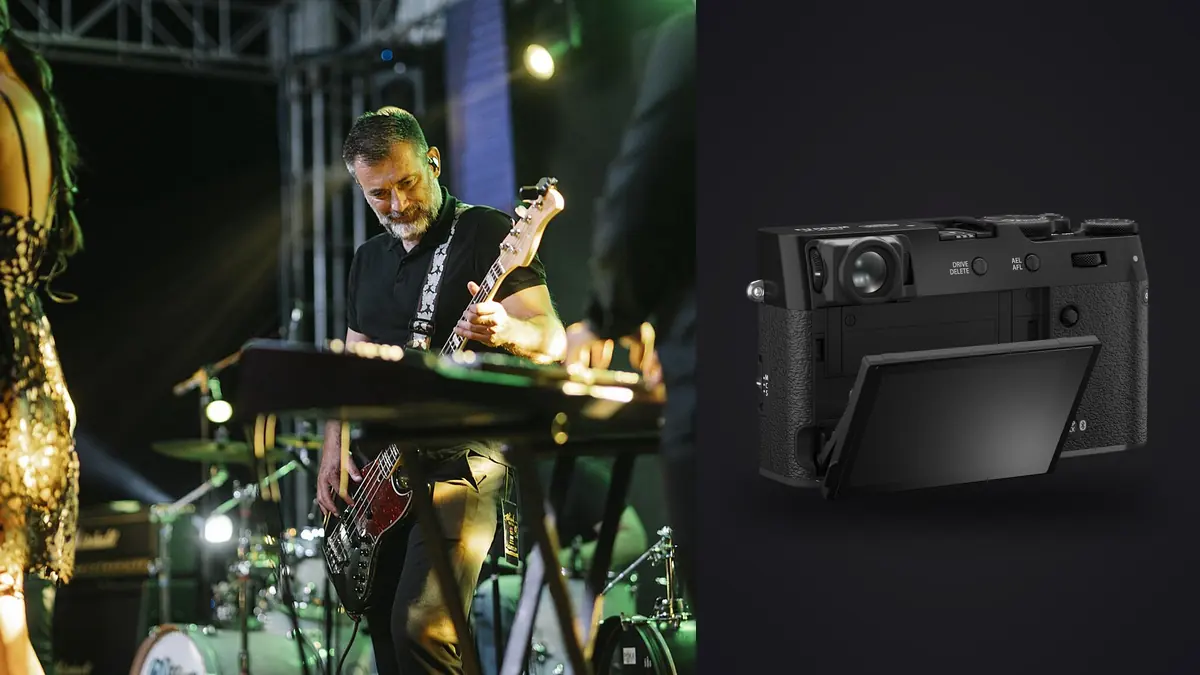
I brought the X100VI to a three-band bill at a 400-capacity venue mostly out of curiosity. I own a mirrorless kit with a 70-200mm for exactly this kind of work, but I wanted to know if a fixed 35mm-equivalent compact could actually deliver a usable set, not just a handful of arty wide shots for Instagram. Two supports and about 900 frames later, the answer was more interesting than I expected: yes, for some venues and some songs, and no, not as a full replacement for a longer lens. Here's what held up and what didn't.
A 35mm lens you cannot take off
The X100VI's 23mm f/2 lens (35mm full-frame equivalent) is the whole reason to consider it for gigs, and also the whole reason to hesitate. At a small club with a low stage and a three-foot barrier, 35mm puts you close enough to fill the frame with a singer leaning into the crowd. At a theatre show with a photo pit twenty feet back and a security rail keeping you off the stage lip, the same lens leaves you with a wide shot of the whole band and a lot of empty stage floor.
The workaround I settled on is shooting tighter than feels natural and letting the 40.2-megapixel sensor do the cropping later. A 40MP file survives a 50% crop and still prints or posts cleanly, which is not something you could say about most fixed-lens compacts a few years ago. The camera also has a built-in digital teleconverter that simulates 50mm and 70mm equivalents by cropping the EVF/LCD preview and baking the crop into JPEGs, which is genuinely useful for framing decisions in the moment even if you shoot RAW and crop properly afterward. What it will not do is give you a tight shot of a drummer's face from across a mid-size room. If your gigs are mostly arena or theatre shows with a real photo pit, this lens alone will not cover you.
Shutter choice matters more than people expect under stage lighting
This is the part of X100VI ownership that trips up photographers coming from DSLRs, because the X100VI gives you three shutter behaviors and picking wrong produces visible problems in a set you can't reshoot.
| Shutter mode | Max shutter speed | Flash / strobe sync | Silent | Behavior under LED stage lighting |
|---|---|---|---|---|
| Mechanical (leaf shutter) | 1/4000s | Syncs at any speed up to 1/4000s | No, audible click | Clean, no banding, no rolling shutter skew on fast movement |
| Electronic shutter | 1/180000s | No flash sync | Yes, fully silent | Prone to horizontal banding under pulsed LED washes; rolling shutter warps fast headbangs or drumstick swings |
| Electronic Front Curtain (EFCS) | 1/4000s | Syncs up to 1/4000s | Mostly, faint mechanical tail | Reduces shutter shock at slower speeds, similar banding risk to full electronic at very high shutter speeds |
For most club shows I default to mechanical, because it is the leaf shutter in this lens (not a focal-plane shutter) that lets it sync flash at any speed, and it never shows the rolling banding that LED video walls and cheap PAR cans introduce into electronic-shutter files. I only switch to fully electronic for quiet acoustic sets where the mechanical click is genuinely audible between songs, or for a support act soundchecking in an empty room where nobody cares about the click. If a band's lighting rig is running fast strobes or heavy LED washes, test a few electronic-shutter frames early and check for banding on the back screen before you commit a whole set to it.
Autofocus and noise once the lights drop
The X100VI's phase-detect autofocus covers most of the frame and locks onto faces reliably even in the dim, mixed-color light typical of a small venue. It is not a sports-camera tracking system. Fast lateral movement, a singer diving toward the crowd, a guitarist spinning, will occasionally cause it to hunt for a frame or two. In practice I shoot single-point AF with face detection as a backup rather than full-frame tracking, because the smaller focus area gives me more control over exactly what's sharp when a subject is only partially lit.
On noise: I shoot most sets between ISO 3200 and 6400 depending on how aggressive the lighting is, and both are usable with modest noise reduction. Push to 12800 and grain becomes obvious in shadow areas, though it's not unpleasant grain, the X-Trans color response holds up reasonably well at that point. In-body stabilization (new to this generation of X100) buys you slower shutter speeds for static or slow-moving subjects, up to a few stops handheld, but it does nothing for a moving musician. IBIS steadies the camera, not the drummer's arm, so you still need enough shutter speed (I rarely go below 1/250s for anything with hands or heads moving) to freeze motion regardless of how good the stabilization feels for stills of the amp stack between songs.
Optical or electronic viewfinder for a live set
The hybrid viewfinder is the X100VI's signature feature and it's genuinely useful here, just not in the way I expected going in. The optical finder is bright and lag-free, which is great for reading crowd energy and anticipating a jump or a mic-stand grab a half second before it happens. But it doesn't show you exposure the way an EVF does, and gig lighting changes color and intensity from song to song without warning. I ended up living in the electronic finder for almost the whole set, switching to optical only during quieter, evenly-lit acoustic moments where I wanted to see past the frame lines to time a shot.
The tilting rear screen, also new to this model, earns its keep in a pit. Holding the camera overhead to shoot over a crowd, or low near the stage floor to catch a pedal board and boots in the same frame, both work far better with a screen you can angle than with one fixed flat to the body.
Kit notes for a three-song pit call
Battery life is rated around 450 shots per charge, and a full set with a support act plus headliner will chew through that faster than the number suggests once you factor in chimping shots on the screen and reviewing focus. I carry two spares and it still gets tight on a long headline set with an encore. Cards: nothing exotic needed, but at 40MP RAW files run large, so bring more storage than you think, especially if you're shooting bursts during a breakdown or a big crowd moment.
The lens has a built-in 4-stop neutral density filter, which is a fun tool for something the X100VI is not typically used for at gigs: deliberate slow-shutter light trails off a moving spotlight or a swinging guitar during a quieter bridge section. It's a creative option worth having rather than something you'll lean on for every show. The weather-resistant configuration requires the optional adapter ring and a protection filter screwed onto the front; without them the camera is not sealed, which matters if you're shooting an outdoor stage and rain is even a possibility.
Where it comes up short for live music work
Honesty matters more than enthusiasm here. If you regularly shoot from a photo pit at a theatre or arena where you're twenty-plus feet from the stage and barred from moving closer, a fixed 35mm equivalent simply cannot deliver the tight performer portraits that a 70-200mm can. Cropping helps, but it isn't a substitute for optical reach, and past a certain distance you're better served leaving the X100VI at home for that specific gig or carrying it as a second body for wide environmental shots while a longer lens covers the tight work.
Rolling shutter on the electronic setting is the other real limitation. A band with a physical, jumpy performance style (hardcore, punk, anything with stage-diving) will occasionally warp in electronic-shutter frames in a way that's obvious even to non-photographers looking at the image. Stick to mechanical or EFCS for anything with that kind of movement, full stop.
Getting from 900 frames to a delivered set
The unglamorous part of any gig is what happens after the last encore. A three-band bill shot on a 40MP body with a habit of bursting through breakdowns produces a genuinely large take, and separating the three usable frames of a jump shot from the eleven near-duplicates around it by eye, at 1am, is where most of my post-show time used to go. I now run the take through imagic before I open anything in an editor. Its local sharpness and focus scoring flags which frame in a burst is actually sharp on the eyes or the guitar headstock, and the duplicate and burst clustering groups the eleven similar frames from that jump so I'm making one decision instead of eleven. Because it runs entirely on the laptop rather than uploading anything, I can do this culling pass in the car in the venue parking lot before the files ever touch a cloud service, which matters when you're trying to get a same-night edit out to a band's socials.
Once I've got a culled folder, I use imagic's apply_my_style preset trained on my own past edits to get a fast, consistent first pass across a set that was shot under three different lighting rigs in one night, then finish the handful of hero images manually. If you're building out a culling workflow from scratch, our breakdown of how AI photo culling actually works and our tips for a faster photo workflow cover the general approach in more depth than I have room for here.
Frequently Asked Questions
Is the X100VI fast enough to freeze a drummer's stick or a fast headbang?
With a fast enough shutter speed, yes, the leaf shutter itself isn't the limiting factor. The risk is using the electronic shutter for that kind of subject, where rolling shutter readout can visibly warp a fast-moving arm or head. Stick to mechanical or EFCS and keep your shutter speed at 1/250s or faster for anything with real movement.
Can I shoot a full arena show with just the X100VI, or do I need a second body?
For a proper arena or theatre photo pit where you're shooting from twenty feet or more, a 35mm equivalent alone will leave you short on tight shots no matter how much you crop the 40MP files. It works well as a wide-environment second body alongside a telephoto, but I wouldn't rely on it as your only camera for that kind of venue.
Does the leaf shutter actually matter if I'm not using flash at gigs?
Even without flash, the leaf shutter's full-speed sync and lack of rolling shutter artifacts at mechanical speeds make it the more reliable choice under LED-heavy stage rigs, where the electronic shutter can introduce banding that a focal-plane shutter camera running mechanically wouldn't show.
Is 40 megapixels overkill for a camera with a fixed 35mm lens at concerts?
Not for gig work specifically. Since you can't zoom in physically, that extra resolution is what makes cropping to a tighter, more portrait-like frame in post a realistic option rather than a quality compromise. It's arguably more useful here than on a body with an interchangeable telephoto, where you'd zoom optically instead.