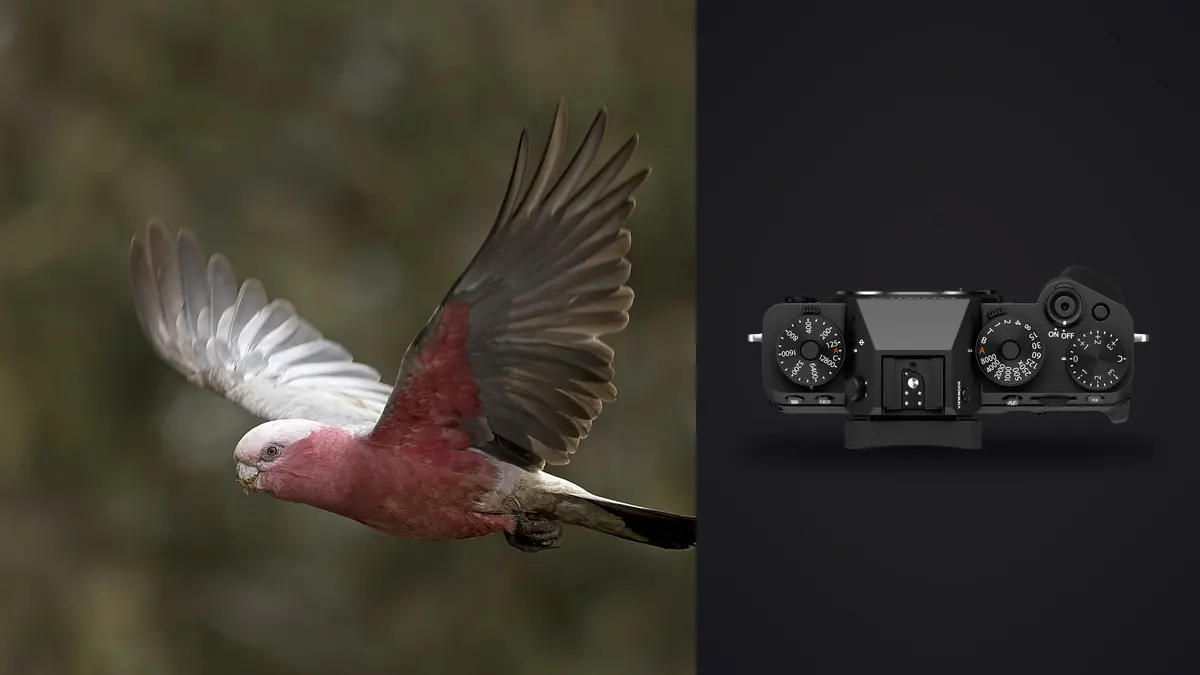
I spent three mornings in a row parked in a floating hide at a heron colony with a Fujifilm X-T5 and the XF150-600mm, mostly because I was tired of forum arguments about whether this camera can actually keep up with birds in flight. The short answer is yes, with real caveats that the spec sheet does not mention. The 40-megapixel sensor that makes the X-T5 so good for landscapes and portraits is the same sensor that gives it a weakness the moment a heron banks hard against open sky. Here is what actually happens when you point this body at fast, unpredictable subjects, and how to work around the parts that do not cooperate.
The Sensor Trade-Off Nobody Explains Clearly
The X-T5 uses Fujifilm's 40.2MP X-Trans CMOS 5 HR sensor, the same one in the X-H2, paired with the X-Processor 5. It is not the stacked, back-illuminated 26MP sensor that goes into the X-H2S. That distinction matters more for birds in flight than for almost any other genre of photography, because sensor readout speed determines how badly a fast-moving subject skews when you shoot with the electronic shutter.
In practical terms, full-sensor electronic shutter readout on the X-T5 sits somewhere around 1/20th of a second. That sounds fast until you remember a swallow's wingtip can travel a meaningful distance across the frame in that window. The result is a rolling shutter effect, wings that look subtly bent or stretched, straight fence posts in the background that lean, propeller-style smearing on fast wingbeats. It is not catastrophic for herons, eagles, or gulls with slow, deliberate wingbeats. It becomes obvious with swifts, terns working a shoreline, or anything crossing the frame at speed rather than flying toward you.
The upside of the 40MP count is reach you get for free. APS-C already gives a 1.5x crop advantage over full frame, and having that many pixels on the sensor means you can crop another 30-40% in post and still end up with a print-ready file. I routinely walk away from a session with birds that filled a third of the frame and come home with a composition that looks like I was shooting at twice the focal length. That only works if focus was accurate in the first place, which is where the autofocus system earns or loses its keep.
Getting Autofocus to Behave on Erratic Flight Paths
The X-T5 inherited its subject detection algorithm from the X-H2 line, and birds are one of the presets alongside animals, vehicles, and a handful of others. Fujifilm has pushed several firmware updates since launch that noticeably improved how reliably it finds and holds a bird's eye rather than snapping to the nearest wing or a branch in the foreground. Current firmware is meaningfully better than what shipped in late 2022, so if you bought a used body, check the version before judging the AF too harshly.
What works for me in the field:
- AF-C with Zone AF at a small or medium box size rather than Wide/Tracking for anything flying against a busy background like reeds or a tree line. Wide/Tracking tends to grab the first high-contrast edge it sees, which is rarely the bird.
- Custom AF-C settings pushed toward the "erratic motion, sudden speed changes" preset for gulls and terns working wind currents over water, and toward the "ignore obstacles" side for raptors that dip behind branches for a fraction of a second.
- Back-button focus, always. Letting the shutter button drive focus means every half-press restarts subject detection, and you lose the bird during the split second it takes to reacquire.
- Bird detection specifically, not the general animal setting, once a bird is reasonably large in frame. It biases toward the eye rather than the whole body, which matters when you are cropping in later.
Where it still struggles: small, fast birds at long range against a cluttered background, think a kingfisher against reeds at 40 meters, or anything backlit hard enough to reduce it to a silhouette. Contrast-based subject detection needs some tonal separation to lock on, and strong backlight removes exactly that. In those situations I go back to a single small AF point and manual pre-focus on the perch or flight line, then time the shutter myself.
Shutter Speed, Burst Rate, and the Buffer Wall
The X-T5 offers 15fps with the mechanical shutter and 20fps with the electronic shutter, though the electronic mode applies a 1.29x crop that brings the file down to roughly 26 megapixels. That crop is not a bad trade for birds in flight since you are usually cropping anyway, but it does mean you are giving up some of the resolution advantage that made the sensor appealing in the first place.
Buffer depth is the part that catches people out. Shooting lossless compressed RAW at 15fps mechanical, I get somewhere in the high teens of frames before the buffer fills and the camera slows to card write speed, which on a fast UHS-II V90 card is still usable but noticeably choppier. That is barely over a second of full-speed shooting. A heron's takeoff sequence, wings unfolding, first downstroke, gaining altitude, easily eats that buffer before the bird has cleared the reeds. I have learned to fire in short, deliberate bursts timed to the moment rather than holding the shutter down and hoping, which is a different discipline than what full-frame stacked-sensor shooters get away with.
Shutter speed itself is genre-dependent. For herons, egrets, and raptors I sit around 1/2000s, which freezes the body while leaving a hint of motion blur in the wingtips that reads as movement rather than a stuffed specimen. For small fast fliers like swallows or hummingbirds I push to 1/4000s or faster, and at that point I lean on electronic shutter's higher top speed and accept the rolling shutter risk because there is no alternative for a hummingbird's wings anyway.
| Shutter mode | Max frame rate | Sensor crop | Approx. rolling shutter | RAW buffer (UHS-II V90) | Best for |
|---|---|---|---|---|---|
| Mechanical | 15 fps | None (40MP) | N/A | ~17-19 frames | Herons, eagles, gulls, anything with slow wingbeats |
| Electronic | 20 fps | 1.29x (~26MP) | ~1/20s full readout | ~20-24 frames | Fast, close action where silence or top speed matters more than a clean pan |
| Mechanical, single/low burst | 1-5 fps | None (40MP) | N/A | Effectively unlimited | Perched birds, deliberate timing, maximum resolution for later cropping |
Glass That Actually Gets You Reach
The XF150-600mm F5.6-8 R LM OIS WR is the lens I reach for most, and on APS-C it behaves like a 225-900mm in full-frame terms. It is not a fast lens, f8 at the long end in overcast conditions pushes ISO higher than I would like, but the reach-to-weight ratio is genuinely good for a body of hides and long hikes to a shoreline. Paired with the X-T5's IBIS, which is rated to 7 stops, I can hand-hold static perched shots at the long end in decent light, though flight sequences still benefit from a monopod just to reduce fatigue over a three-hour sit.
The older XF100-400mm F4.5-5.6 is lighter and a stop or so faster, and with the 1.4x teleconverter it reaches 140-560mm (210-840mm equivalent) at f6.3-8. I keep this combination in the bag for days when I am covering more ground on foot rather than sitting still. For anyone shooting raptors regularly from a fixed hide, the XF200mm F2 with the 1.4x teleconverter is a different animal entirely, 420mm equivalent at f2.8, extraordinary subject separation, but it costs more than the camera body and is not something you carry casually.
A cheaper entry point that has come up a lot since it launched is the Sigma 100-400mm F5-6.3 DG DN for Fuji X mount. It will not match the Fujifilm glass for AF speed in fast tracking, but for someone testing whether birding is a genre they want to invest heavily in, it is a reasonable way to find out before spending XF150-600mm money.
Field Habits That Matter More Than Any Setting
None of the camera settings above matter much if you are not anticipating the bird's flight line. I try to position with the sun behind me and enough open sky or water in the direction I expect the subject to move, since autofocus and rolling shutter both perform better against a clean background than against foliage. Panning smoothly with the bird rather than snapping the camera into position gives the AF system a better chance of tracking continuously instead of losing and reacquiring, which costs frames every time it happens.
Golden hour helps in two ways beyond the obvious light quality. Warm side light adds contrast to the plumage that subject detection AF uses to lock on, and the lower sun angle means fewer birds are silhouetted against a bright sky, which is the single biggest AF killer I run into. Midday sessions over water are the hardest conditions I shoot in with this camera; the AF system loses confidence against blown highlights on the water surface almost as often as it does against a backlit bird.
What Happens After the Shutter Stops
A single good morning at that heron colony produced over 2,200 frames across maybe forty separate flight sequences, and the honest truth is that most of them are near-duplicates of each other, three or four frames from the same burst where only one has the eye pin sharp. Going through that manually at 40 megapixels a frame, zoomed in to check focus on each one, is the part of wildlife photography nobody puts in the highlight reel.
This is the point where I stopped doing that by hand and started running the day's cards through imagic before touching Lightroom. It scores sharpness and focus locally on the machine, so instead of eyeballing forty near-identical wingbeats I get the frame within each burst where the eye is actually crisp, which matters a lot more at 40MP than it does on a lower-resolution body where soft focus is easier to miss on a laptop screen. It also clusters the duplicate and burst frames together automatically, so a 500-frame flight sequence collapses down to the handful worth a second look instead of me scrolling past the same bird forty times. Because everything runs on the machine and nothing gets uploaded anywhere, I am not waiting on a slow connection to process a card full of 40-megapixel RAWs after a morning in a hide with no signal anyway, which is usually where I am shooting from.
The other piece that has actually changed my workflow is the apply_my_style preset, which is trained on my own past edits rather than some generic wildlife preset baked into the software. Heron and egret plumage has a specific tonal range I edit toward consistently, and having that applied automatically across a big batch means I spend my editing time on the two or three hero frames rather than color-matching four hundred near-identical shots by hand. If you are trying to build a consistent look across a season of birding trips rather than one-off edits, that consistency matters more than people expect going in. For anyone building out this kind of high-volume culling habit, it is worth reading through how AI photo culling actually works before assuming every tool does the same thing under the hood, and pairing it with a few habits from tightening up the rest of your workflow so the camera side and the editing side are not fighting each other.
Frequently Asked Questions
Is the X-T5's autofocus fast enough for swifts and swallows, or do I need the X-H2S?
It can track them, but not with the same confidence as the X-H2S's stacked sensor and faster readout. For anything under about 15cm moving at speed against a cluttered background, expect a lower keeper rate on the X-T5. If small aerial insectivores are your main subject, the X-H2S's electronic shutter with minimal rolling shutter is worth the price jump. For herons, raptors, waders, and most mid-size birds, the X-T5 keeps up fine.
Do I need the electronic shutter for birds in flight, or is mechanical enough?
Mechanical is enough for the large majority of birding subjects and avoids rolling shutter entirely, which is why I default to it. Reach for electronic shutter only when you need the extra 5fps or a shutter speed above 1/8000s, and accept that fast horizontal motion may show some skew.
What card should I actually buy for this camera if I'm shooting bursts?
A UHS-II V90 SD card in both slots. The X-T5 does not have a CFexpress slot like the X-H2S, so card speed is your ceiling once the buffer fills. Cheaper UHS-I cards will noticeably lengthen the time it takes to recover between bursts during an active flight sequence.
Will 40-megapixel files from a full day of shooting overwhelm a normal laptop?
They will slow down a lot of standard culling workflows, yes, especially once you are scrubbing through hundreds of near-duplicate burst frames at full resolution to check focus. That is specifically the problem local sharpness scoring and burst clustering are built to solve, since the software does the first pass of "which frame is actually sharp" before you open anything in a full editor.