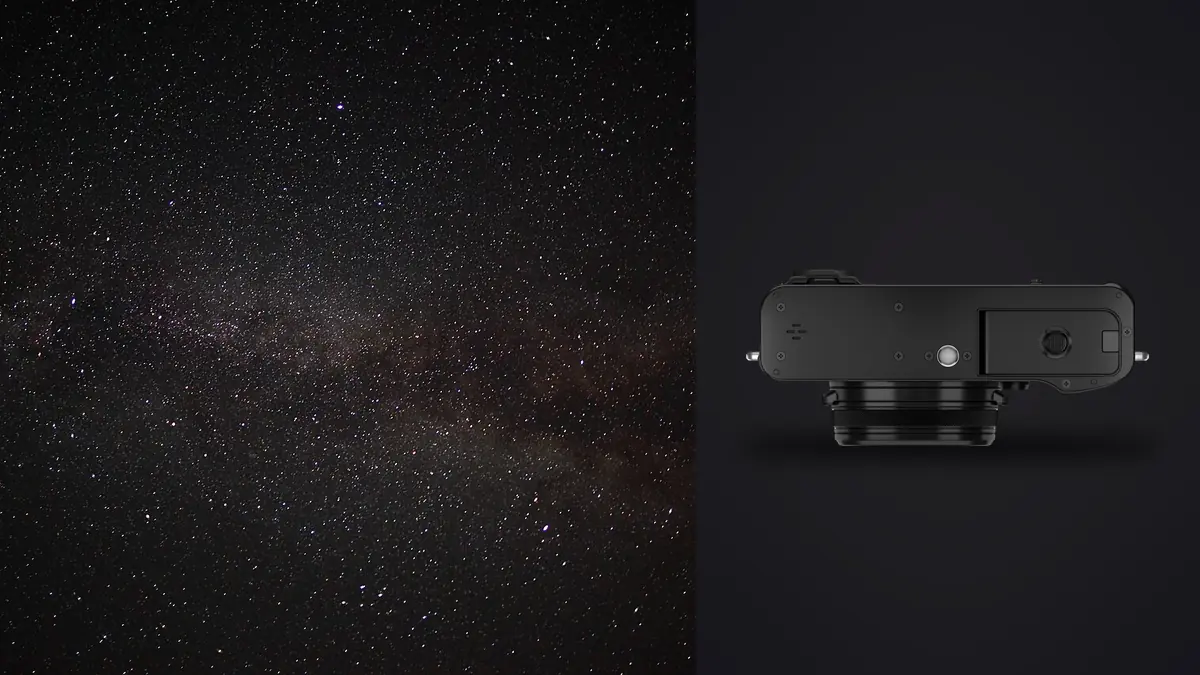
The Fujifilm X100VI can make night-sky photographs, but that is not the same as being the right astrophotography purchase. Its appeal is a compact body with a fixed lens, direct controls, RAW capture, and stabilization for general photography. Its central limitation is equally clear: the built-in lens cannot be exchanged for a wider, faster, or longer optic when the sky project changes.
This Lens and Location Guide begins with the sky subject and foreground, then tests whether the X100VI's fixed lens can frame both from a safe, legal position. Field handling, support, weather, and stacking still matter, but the central constraint cannot be changed after arrival: the camera position and built-in angle of view must already suit the place.
Scout the fixed field of view in daylight
Visit the intended tripod position before darkness and preview the approximate 35mm-equivalent view. Check whether the foreground is too close, whether the sky subject fits above it, and whether stepping backward would cross a road, cliff edge, private boundary, or fragile ground. A fixed lens rewards a location chosen for that frame rather than a location forced into it.
Record north, horizon obstructions, artificial lights, access hours, weather exposure, and a fallback composition. A stitched panorama can widen the result, but it adds overlap, star movement, and foreground parallax. Keep a complete single-frame option when the location permits one.
Start with the fixed 23mm F2 lens
According to Fujifilm's official specifications, the X100VI uses an APS-C sensor and a fixed 23mm F2 lens, giving a field of view similar to a 35mm lens on full frame. That is moderately wide rather than ultra-wide. It can frame a constellation, part of the Milky Way, a landscape under stars, or a stitched panorama when the composition and overlap permit.
The field of view may feel tight for a single-frame Milky Way arch, a cramped foreground, or an interior-to-sky transition. It may feel purposeful for a simple ridge, tree, building, or figure beneath a defined sky region. Look through existing photographs made at an equivalent angle of view and crop sample phone images to approximate it. If most desired compositions require stepping backward off a cliff, road, or private boundary, the fixed lens is the wrong constraint.
F2 provides a useful starting aperture, but open-aperture star shape and corner rendering need to be judged from files, not a specification label. Some photographers may accept softer extreme corners for portability; others making large star fields may prefer a lens that improves when slightly stopped down. Rent or borrow the camera and process representative RAW files at the intended output size.
Decide which kind of astrophotography matters
For untracked landscape astrophotography, the X100VI can be a coherent one-camera kit when the field of view suits the location. A stable tripod, careful manual focus, and a sequence for noise reduction matter more than carrying several lenses. The compact form may make it easier to include a camera on hikes where a larger interchangeable system would stay home.
For tracked deep-sky work, the fixed moderate-wide lens limits target scale. It can record broad sky regions on a suitable tracker, but it cannot become a telephoto for small nebulae or galaxies. The body may also be awkward to integrate with specialized focusing, filter, power, and control accessories compared with a modular camera or dedicated astronomy camera.
For star trails, lens speed is less decisive than interval control, battery planning, weather protection, and the desired composition. Many shorter frames provide more options for removing aircraft or a bumped exposure than one very long file. Confirm current interval and long-exposure behavior in the manual, including any restrictions of shutter mode, noise reduction, and power supply.
Understand what stabilization can and cannot do
The X100VI includes sensor-shift stabilization. That can help handheld photographs of static terrestrial scenes, but it cannot stop stars from moving relative to the camera during a long exposure. For points of light, exposure duration and any tracking mount determine apparent star motion. On a tripod, configure stabilization according to Fujifilm guidance and verify with magnified test frames.
Stabilization also does not align a multi-frame sky stack. The camera must remain stable, and software must register the stars because they move across a fixed landscape. If the foreground matters, it may require a separate exposure or masking strategy. A stabilized body is useful in the broader travel kit, but it should not be the deciding astronomy feature.
If night street scenes, camps, interiors, and handheld twilight photographs are part of the same trip, stabilization can improve the camera's overall fit. Evaluate the entire assignment rather than assigning every feature to the sky portion.
Check focusing and night handling before buying
Astrophotography requires repeatable manual focus near infinity. Test whether you can magnify a bright star, adjust the focus ring precisely, and return to the view without losing framing. Focus-by-wire behavior, display brightness, control feel with gloves, and the visibility of markings all affect use in darkness. A focus setting that appears to reach infinity is not proof that the stars are at peak contrast.
Dim the screen and electronic viewfinder enough to preserve night vision while keeping menus readable. Learn how to disable distracting lights, sounds, wireless functions, and automatic display changes. Verify that the shutter release, interval settings, and playback magnification are accessible without a phone light. These handling details are excellent reasons for a nighttime rental rather than a daytime shop decision.
Temperature changes can shift focus. Check a frame after the camera and lens settle outdoors, and repeat during a long sequence. Tape should not obstruct the focus ring or damage the finish, and it cannot replace periodic inspection. Dew can soften an entire series gradually, so include a hood, cloth, and suitable dew-control plan.
Compare portability with system flexibility
The strongest X100VI case is a photographer who wants one compact camera for travel, street work, family photographs, and occasional night landscapes, and who already likes the built-in field of view. There is no lens bag, mount decision, or temptation to change optics in dust and darkness. The same constraint can simplify composition.
The weaker case is a photographer building an astronomy-centered system. Interchangeable-lens bodies allow an ultra-wide foreground view, a faster normal prime, a telephoto target, and future optical changes. They also allow replacing a damaged lens separately. That flexibility adds bulk, cost, and decisions, but it follows a changing subject.
Do not compare bodies without including the actual lenses, support, batteries, weather protection, and processing path. A small fixed-lens camera on a heavy tracker is no longer a minimal kit. Conversely, an interchangeable body with several lenses is not flexible if only one can realistically be carried to the location.
Test star shape, flare, and foreground rendering
Make RAW test frames with a bright star near the center, mid-frame, and corner. Inspect sagittal stretching, color fringes, flare, and uneven darkness, then view a resized final image. A flaw obvious at extreme magnification may disappear in the intended print, while a bright smeared corner can remain distracting at modest size.
Include a real foreground. Trees, fine branches, rock edges, and artificial lights expose different processing demands from an empty star field. Check whether focus distance requires separate sky and ground frames. Test direct light just outside the frame, since the fixed lens prevents changing to another optical design if flare conflicts with favorite locations.
If you plan panoramas, rotate the camera through a complete trial and verify consistent overlap, exposure, focus, and tripod clearance. Moving stars and foreground parallax can make a panorama harder than its daytime equivalent. A wider final view is possible, but it requires more capture and processing discipline than fitting the scene in one frame.
Budget for power, weather, and storage
Cold conditions, long review sessions, interval capture, and wireless functions can affect practical battery life. Carry charged spares in a protected inner pocket and test any external power arrangement before travel. A power bank and cable can introduce strain, light, or weather openings, so route them without pulling the camera or compromising the tripod. Never plan a night sequence around an untested charging assumption.
The fixed lens avoids sensor exposure during lens changes, but the camera still needs protection from dew, frost, dust, and condensation. Use a suitable cover that leaves controls and heat paths functional. When returning to a warm, humid space, let a cold camera acclimatize in a closed bag before opening it. Check the front element periodically with a dim light because gradual dew can ruin many frames before it becomes obvious on the display.
Estimate card needs from the actual RAF setting and sequence length rather than from a headline capacity. Star stacks, dark frames, foreground variations, panoramas, and interval series multiply files quickly. Leave a practical reserve for unexpected aurora, weather openings, or location changes. Use known compatible cards, format them in the camera after verified backup, and keep exposed media separate from empty cards. A compact camera does not make its data disposable.
Plan the RAF stacking workflow
Choose a consistent manual exposure and white balance for the sky sequence. Disable settings that change the tone or geometry from frame to frame unless the workflow specifically accounts for them. Capture dark or calibration frames only when the chosen stacking method uses them, and document lens, aperture, focus, and temperature changes.
The X100VI records Fujifilm RAF RAW files, which are on imagic's supported list. imagic can scan a directory and locally analyze frames for technical culling, but it does not merge star stacks or panoramas. Culling sets a status and leaves originals on disk. Review grouped frames yourself for satellite trails, clouds, dew, bumped alignment, and subtle focus drift.
Develop the sky sequence consistently before passing files to dedicated stacking software. Preserve the originals and intermediate output. If using imagic for adjustments, exports apply stored non-destructive edits; a personal style can be used only after a style profile has been learned. The desktop page outlines that workflow, and the camera hardware section provides related buying context.
Use a fit matrix rather than a verdict
| Priority | X100VI fit | Reason to test |
|---|---|---|
| Compact travel nightscapes | Potentially strong | One fixed moderate-wide lens and small kit |
| Single-frame ultra-wide sky | Limited | The built-in field of view cannot become wider |
| Broad tracked sky regions | Possible | Tracker compatibility and balance need verification |
| Small deep-sky targets | Weak | No telephoto lens option |
| Mixed street, travel, and night use | Strong candidate | General-purpose handling may justify the compromise |
A used, rented, or borrowed trial is more informative than a specification comparison. Take it to a representative dark location, focus with the controls you will actually use, and process a complete stack before deciding.
Frequently Asked Questions
Is the X100VI lens wide enough for the Milky Way?
It can frame part of the Milky Way and many landscape compositions, but it may be too tight for a full arch or confined foreground. Preview the equivalent field of view at your location.
Can the X100VI stabilization keep stars sharp?
No. Stabilization addresses camera movement, not the apparent movement of stars across the sky. Use an appropriate exposure duration or a tracking mount for point-like stars.
Does imagic combine an astrophotography stack?
No. It can assist local review of supported RAF files, but star alignment and stacking require dedicated software. Preserve the original sequence and inspect it for motion, cloud, and focus changes.