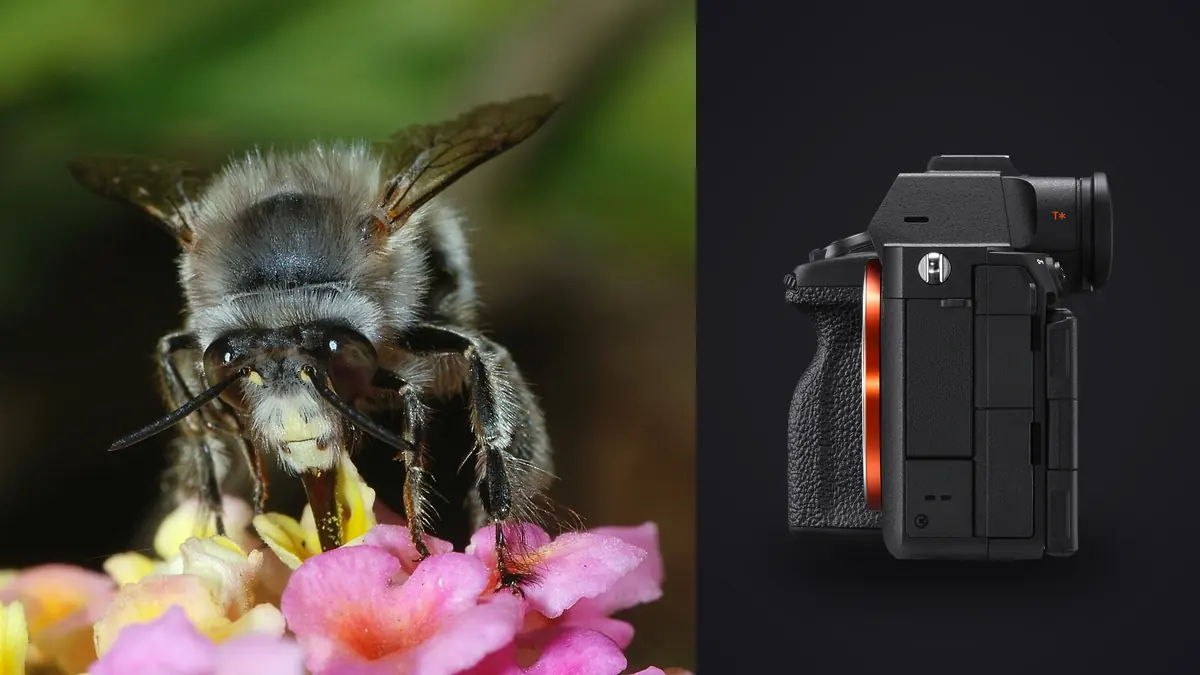
I bought the A7R V expecting it to be a landscape and studio body first, macro second. Six months of chasing dragonflies, jumping spiders, and the occasional very uncooperative hoverfly later, I've landed somewhere I didn't expect: the 61-megapixel sensor is both the best and most annoying thing about using this camera for insects. It resolves detail that a 24MP body simply cannot, down to the individual facets of a compound eye, but it also punishes sloppy technique in ways that lower-resolution cameras quietly forgive. This is what actually happens when you point that sensor at something six millimeters long and moving.
The Resolution Trade-Off Nobody Mentions in the Spec Sheet
Sony markets the A7R V's 61MP sensor as a resolution advantage, and for landscapes or studio product work it is. For insect macro, it's more complicated. At this pixel density (roughly 3.76-micron pixel pitch), diffraction starts showing up on screen earlier than it would on a 24 or 33-megapixel body. Stop down to f/16 for more depth of field on a beetle's carapace and you're already trading real per-pixel sharpness for that depth, even though the JPEG or RAW preview on the rear LCD looks fine at 100%.
In practice, I treat f/8 to f/11 as the working range for single-shot macro on this body, and I stop pretending f/16-f/22 gives me "more sharpness" just because more of the frame is technically in focus. It gives me more coverage, at a real cost to resolving power. If you're used to a lower-resolution APS-C body where diffraction wasn't visible until f/16 or beyond, this is the single biggest adjustment.
| Aperture | Effect on a 61MP sensor | Practical note for insect work |
|---|---|---|
| f/4 – f/5.6 | Full resolving power available | Depth of field is razor thin at 1:1; usable mainly for eyes-only portraits or stacking |
| f/8 | Slight softening begins, barely visible at normal viewing sizes | My default for single-frame insect shots when light allows |
| f/11 | Diffraction visible at 100% crop | Common "compromise" aperture; fine for web use, softer for large prints |
| f/16 | Noticeable resolution loss | Only worth it when depth of field matters more than per-frame sharpness (i.e., when stacking) |
| f/22 | Significant softening, close to visible on a phone screen | Avoid for single frames; occasionally used in stacks where each frame carries a thin DOF slice anyway |
Does the Insect Recognition Autofocus Actually Work?
Sony added dedicated insect subject recognition to the A7R V's AI autofocus system in a firmware update, alongside car and train recognition, and it's genuinely useful, just not universally so. On bees, dragonflies, and larger beetles with a clearly defined head and eye, it locks on fast and tracks reasonably well even with some background clutter. Fuzzy moths and camouflaged stick insects are a different story. The system frequently loses confidence and hunts, especially in low-contrast leaf litter, and I've had it lock onto a leaf vein instead of an antenna more than once.
Where it genuinely earns its keep is on flying subjects at a working distance where manual focus is nearly impossible anyway, hovering hoverflies, damselflies perched but twitching. For anything static at true macro magnification (close to or beyond 1:1), I still switch to manual focus with focus peaking or focus magnification. At those magnifications the depth of field is measured in millimeters, and autofocus, even good AI-driven autofocus, tends to hunt past the plane you actually want.
Lens Choices Change the Experience More Than the Body Does
The A7R V is only half the equation. Which macro lens you pair it with determines whether you're fighting the insect or the gear. Working distance (how far the front of the lens sits from the subject at maximum magnification) is the number that matters most for live insects, since anything under about 10cm tends to spook skittish subjects before you get the shot.
| Lens | Max magnification | Working distance at max mag | Stabilized | Best for |
|---|---|---|---|---|
| Sony FE 90mm F2.8 Macro G OSS | 1.0x | ~23 cm (9 in) | Yes, OSS + IBIS combine | All-around choice; fastest, most reliable AF coupling with the A7R V's recognition modes |
| Sigma 105mm F2.8 DG DN Macro | 1.0x | ~29.7 cm (11.7 in) | No, IBIS only | Slightly more breathing room from the subject, noticeably cheaper |
| Sony FE 50mm F2.8 Macro | 1.0x | ~14 cm (5.5 in) | No, IBIS only | Cheap entry point, but too close for anything that flies off easily |
| Laowa 90mm F2.8 2x Macro APO | 2.0x | ~12 cm (4.7 in) at max mag | No, fully manual focus | Extreme close-ups of cold, slow, or motionless subjects |
| Sony FE 70-200mm F4 Macro G OSS II | 0.5x | ~40 cm+ (16 in+) | Yes | Best working distance for jumpy insects, at the cost of only half-life-size magnification |
My honest recommendation for someone starting out with this body specifically for live insects is the 90mm G OSS. It's the only macro lens in Sony's native lineup where the optical stabilization talks to the in-body system in a way that noticeably steadies the viewfinder image at close range, and the AF motor is fast enough to actually use the insect recognition mode rather than fight it.
In-Body Stabilization Has a Ceiling You Will Hit
Sony rates the A7R V's IBIS at up to 8 stops with compatible lenses, and for general handheld shooting that number is roughly believable. At macro distances it falls apart fast. Stabilization systems compensate for angular shake, but at high magnification, subject-to-sensor movement becomes linear rather than angular, and IBIS is far less effective against that kind of shift. Practically, I get reliably sharp handheld results up to around 0.5x to 0.7x magnification with the 90mm G. Push toward 1:1 and the keeper rate on handheld shots drops hard, not because the stabilization stopped working, but because it was never designed to fix the kind of movement that happens a few centimeters from the subject.
For anything approaching true macro (1:1 or beyond, especially with the Laowa 2x), I use a small tripod or a focusing rail and accept that handheld work is off the table. This isn't an A7R V weakness specifically, every stabilization system in this class behaves the same way, but the temptation to rely on IBIS is stronger here because it's genuinely excellent everywhere else.
Focus Stacking Without a Cooperative Subject
The A7R V has built-in focus bracketing (Menu > Shooting > Drive Mode > Focus Bracket), letting you set shot count and step width and fire off a sequence automatically. This is where a lot of macro guides quietly assume you're photographing something that isn't going to fly away between frames. Live insects rarely cooperate with a 40-shot bracket sequence. What actually works, in my experience, is shooting bracket sequences early in the morning when insects are cold and sluggish, or on subjects that have naturally paused (a bee working a single flower head, a beetle mid-molt). For anything genuinely mobile, I've given up on in-camera stacking entirely and instead shoot a tight burst at a single focus distance, accepting a shallower final depth of field.
Worth clarifying since it trips people up: Pixel Shift Multi Shooting is not focus stacking. It recomposites multiple exposures at slightly shifted sensor positions to boost resolution and reduce noise, and it requires a completely motionless subject and a tripod, processed afterward in Sony's Imaging Edge software. It's genuinely useful for photographing pinned specimens or preserved insects under controlled light, but it has no application to a live bug in the field.
The real workflow cost of stacking is what happens after the shoot. A single stacking attempt on a moving subject can leave you with 15 to 40 near-identical frames, most of them discarded because the insect shifted mid-sequence. Sorting that by eye at 61 megapixels per file is slow. This is where I actually use imagic day to day: its local sharpness and focus scoring flags which frame in a bracket sequence is genuinely the sharpest at the point of focus rather than just "looks okay" at thumbnail size, and the duplicate and burst clustering groups a 30-shot stacking attempt into one stack instead of 30 separate thumbnails I have to click through individually. It runs entirely on the laptop, no upload, which matters when you're culling in a field tent with no signal.
Flash, Diffusion, and Actually Freezing Motion
Ambient light macro of live insects at f/8-f/11 usually means shutter speeds too slow to freeze a moving leg or wing, so most serious insect macro leans on flash. The A7R V syncs at 1/250s with the mechanical shutter (faster with certain flash units in HSS mode), which is enough for a well-diffused twin-flash or ring-flash setup to both freeze motion and let you stop down for depth of field without pushing ISO into territory that starts competing with diffraction for image quality. I run a small diffuser close to the lens front, not a bare flash, because insects have a lot of reflective surface (wing membranes, compound eyes) and a bare flash produces blown specular highlights that no amount of editing recovers cleanly.
Storage and a Field Workflow That Actually Keeps Up
61MP uncompressed RAW files run 120MB or more, and a day of insect macro with bracket sequences and bursts adds up fast, I've filled a 160GB CFexpress Type A card in a single long morning session. That's manageable, but it changes how you shoot: I no longer bracket-shoot everything "just in case," because the card fills, the buffer clears more slowly, and the culling pile afterward gets punishing. I shoot more deliberately, single frames at the aperture I actually want, reserving bracket sequences for subjects that have genuinely paused.
Back at the laptop, the pattern that's worked for me is a first fast pass in imagic to cut duplicates and obvious misses using its local sharpness scoring (no cloud round-trip, which matters with files this size), then a second pass applying a preset trained on my own previous edits through its apply_my_style feature so the surviving frames land close to my usual color and contrast before I do the fine work by hand. It's not a replacement for judgment on a genuinely tricky eye-focus call, but it removes the repetitive triage that used to eat the first hour after every shoot. If you're weighing whether a one-time desktop tool is worth it against a subscription cull app, the pricing page lays out what you actually get for a single purchase versus a recurring fee, which matters more once your shoot volume goes up.
If you're newer to culling large macro batches generally, it's worth reading up on how AI-assisted culling actually evaluates sharpness before you assume every tool scores focus the same way. Insect macro is a genuinely hard case for automated culling because the "in focus" region is often a few millimeters wide, and not every tool handles that well.
Frequently Asked Questions
Is 61 megapixels actually necessary for insect macro, or is it overkill?
It's not necessary, but it's genuinely useful for one specific reason: cropping. Insects are small and skittish, and even a good macro lens sometimes can't get you as close as you'd like before the subject bolts. Shooting at 61MP gives you room to crop in during editing and still have enough resolution left for a decent print or a detailed web image. If you mostly shoot for social media at modest sizes, a 24-33MP body will get you there with fewer diffraction headaches.
Do I need the 90mm G OSS specifically, or will a cheaper macro lens work fine?
A cheaper option like the Sigma 105mm or Sony's own 50mm macro will produce comparably sharp images optically. The real difference is working distance and autofocus responsiveness. The 90mm G's faster, quieter AF motor pairs noticeably better with the camera's subject recognition system, which matters more for live, moving insects than for static macro subjects where you're focusing manually anyway.
Does the AI insect recognition mode replace manual focus for macro work?
No, and I'd be skeptical of any guide that claims it does. It's genuinely helpful for tracking flying or perched insects at moderate magnification where you don't have time to fine-tune manual focus. Once you're working near or beyond 1:1 magnification, depth of field gets thin enough that manual focus with focus peaking gives you more reliable control over exactly which plane is sharp.
What's a realistic aperture range for handheld insect shots on this body?
f/8 to f/11 is the practical sweet spot: enough depth of field to get an eye and part of the head in focus without diffraction eating too much detail at the pixel level. Going to f/16 or smaller trades real resolving power for extra depth of field that's often better achieved through focus stacking on a paused or slow-moving subject instead.