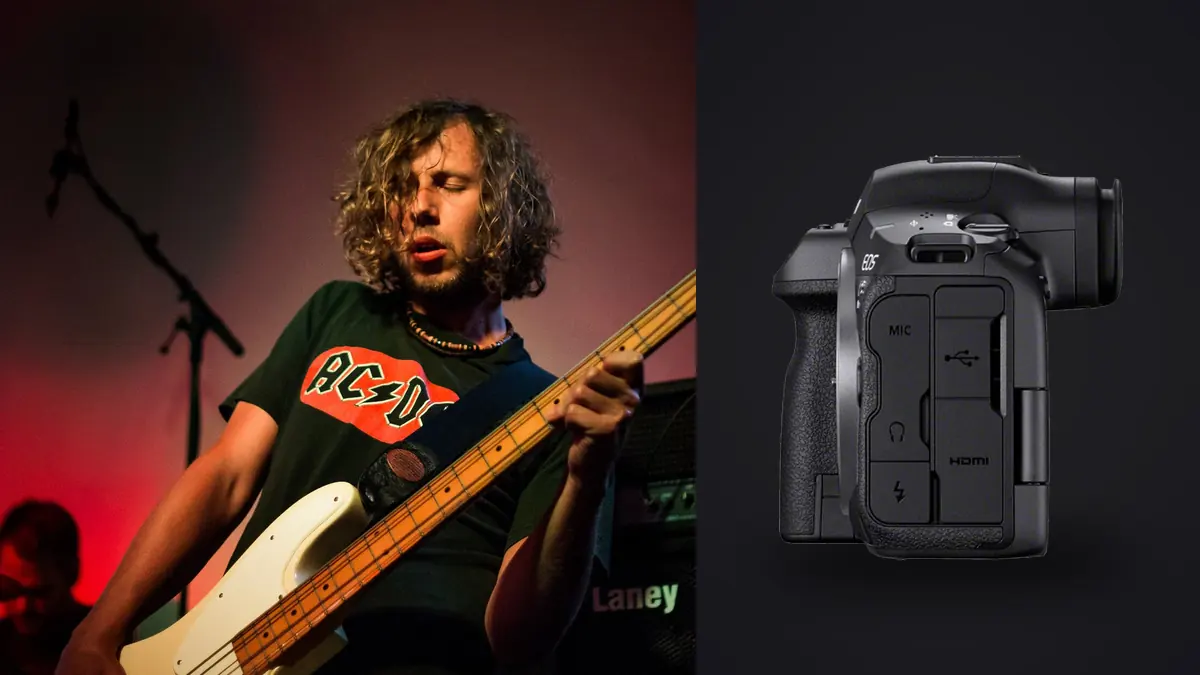
Most venues give a photographer three songs from the photo pit, no flash, and then a security guard waves you toward the exit. That window is a brutal way to test a camera honestly, because there is no do-over and no controlled lighting to fall back on if the gear fumbles a moment. I have run the Canon EOS R5 Mark II through somewhere around forty club and festival shows since picking it up, shooting it alongside my old original R5 as a backup body strapped to the other shoulder, and I want to walk through what actually changes for live music work specifically, rather than repeat the general launch-day spec rundown that every other site already published.
The stacked sensor is the part that matters in the pit
Canon spent most of the R5 Mark II's launch messaging on the megapixel count staying at 45, which made it easy to miss the part that actually changes how the camera behaves at a gig: the sensor is now stacked, with a much faster readout than the original R5's panel. In practice that means the rolling shutter skew that used to show up when a singer sprinted across the stage, or when a guitarist whipped their head during a breakdown, is dramatically reduced. On the old R5, shooting electronic (silent) shutter during a fast horizontal pass across the frame could visibly lean the subject, like the image was being poured sideways. The Mark II still isn't a global shutter camera, so it isn't immune, but I have to work much harder to trigger it now, and most of my "was that skewed" concerns from three years ago just don't come up anymore.
The other place the faster readout pays off is LED video walls and moving-head fixtures, which are everywhere on modern stages. Those panels run at their own refresh rate, and a slow sensor readout combined with the wrong shutter speed produces banding, a horizontal stripe of dead pixels marching through the frame. It hasn't disappeared entirely with the R5 Mark II, but I can shoot noticeably lower shutter speeds against an LED wall before the banding becomes obvious, which matters a lot when you're already fighting for enough light.
Autofocus in a room built to confuse it
Concert lighting exists to look good to the audience, not to help a camera find focus. Single-color washes, strobes timed to the kick drum, backlighting that turns every performer into a silhouette for half the song: it is a hostile environment by design, and no amount of processing power fixes a rig pointed at a subject with zero contrast. That said, the subject detection carried over and improved from the R3 does a genuinely better job holding a face or head through a strobe hit than the original R5 did. The old body would sometimes lose the plot entirely during a strobe burst and hunt for a full second before reacquiring. The Mark II tends to hold the last known position and snap back onto the face the instant the light returns, which during a chorus hit is the difference between getting the shot and getting three blurred frames of nothing.
Where Eye Control AF actually earns its place
I was skeptical of Eye Control AF when it first showed up on the R3, mostly because I calibrate my eyeglasses-wearing eyes badly for anything. On the R5 Mark II, with a careful calibration session done in normal room light before a show (not backstage under green LEDs, which throws the calibration off), it genuinely speeds up one specific pit move: a singer steps up to a bandmate for a shared mic moment, then steps back to their own spot half a second later. Rather than dragging the AF point across the frame with a joystick while bracing a 70-200 against the barrier one-handed, I glance where I want focus and the camera follows. It is not magic and it does not replace subject tracking as the primary system. Think of it as a fast override for the moments subject detection guesses wrong, not a total autofocus philosophy on its own.
ISO ceilings I actually trust, by venue type
Canon didn't widen the native ISO range on paper versus the original R5, both still top out at 51200 native with the same expanded ceiling. What changed is how usable the files look at the settings I actually shoot. Read noise at 6400 through 12800 is visibly cleaner, and shadow recovery on underexposed frames (which happens constantly when you're chasing a moving light source) holds together better before color noise creeps in. Here's roughly where I land depending on the room:
| Venue type | Typical ISO | Shutter floor | Notes |
|---|---|---|---|
| Small club, single wash or house PAR cans | 3200 to 6400 | 1/250s | Usually the hardest light of the three. Wide aperture glass earns its keep here. |
| Festival main stage, moving heads and strobes | 1600 to 5000 | 1/500s | Brighter on average but changes constantly; I ride auto ISO with a locked shutter and aperture. |
| Arena with LED video wall as key light | 2000 to 8000 | 1/320s (avoid 1/500-1/640 band) | That mid shutter range is where I saw the worst banding against wall panels; slower or faster both tend to clear it. |
None of those numbers are gospel, every rig and every venue's dimmer packs behave a little differently, but they're a much closer starting point than "auto ISO and hope" for a shooter walking into a room they've never worked before.
Buffer depth and the cards that keep up with a full song
A verse-chorus-verse-bridge-chorus song structure at 20 or 30fps electronic shutter can hand you 400 to 600 frames of the same three-second moment if you're not disciplined about when you actually hold the shutter down. The R5 Mark II's buffer, paired with a fast CFexpress Type B card, clears noticeably faster than the original R5 managed with its buffer bottleneck around the two-thirds mark of a long burst. I still shoot CFexpress as primary and SD UHS-II as backup rather than relying on SD alone. The SD slot will absolutely keep up for stills at moderate burst rates, but the moment you lean on the higher frame rates for a jump shot or a drum fill, the CFexpress card is doing the real work of keeping the buffer from choking mid-burst.
The other feature worth knowing about is the pre-shutter buffer, which starts recording frames the instant you half-press and keeps a rolling window before your full press registers. For a drummer's stick toss or a singer's mid-air jump, where the actual peak of the action happens faster than human reaction time, this has saved shots I would have missed on the old body by a quarter second every single time.
Glass that actually gets used at a gig
The camera body gets the attention but the lens choice decides more of the outcome. My rotation for shows is an RF 24-70mm f/2.8L for general pit coverage where I need to react fast without a lens swap, an RF 70-200mm f/2.8L for anything on a deeper stage or when I want compression on a guitarist against a lit backdrop, and an RF 50mm f/1.2L for tight club rooms where I'm close enough that the extra stop matters more than reach. The 85mm f/1.2 is gorgeous glass but I leave it at home for pit work specifically, the minimum focus distance and shallow depth of field at f/1.2 make it a liability when a performer lunges toward the barrier and your focal plane suddenly needs three feet of tolerance instead of three inches. It comes out for backstage portraits after the set, not during it.
Getting through the take without losing the week to editing
A well-shot song at 20 to 30fps can leave you sorting through 400 or more nearly identical frames looking for the one where the expression, the light, and the composition all landed at once. Doing that manually across a three-band bill is how a Tuesday night show eats your entire Wednesday. I run everything through imagic afterward specifically because its burst and duplicate clustering groups those look-alike frames together automatically and surfaces the sharpest one in each cluster using local focus scoring, rather than making me click through six hundred thumbnails one at a time. It's changed how I plan a set, honestly, because I'm less afraid to hold the shutter down through a good moment knowing the culling pass afterward won't be miserable. If you want the mechanics of how that scoring actually works, we've covered it in more depth in how AI photo culling works.
Because the processing happens entirely on the machine and nothing gets uploaded anywhere, it also sidesteps a real concern for tour photographers: a lot of artist and label agreements are specific about unreleased images not touching a third-party server before anyone's cleared them. Running the culling pass offline means that's never a question I have to answer for a tour manager.
The other piece I lean on across a multi-night run is the apply_my_style preset, trained on my own previous edits rather than a generic look. Different venues, different colored stage light, different white balance problems every single night, but once I've graded the first show of a run the way I want it, applying that same trained preset to the next night's files gets me most of the way to a consistent look before I touch a slider. It doesn't replace judgment on a frame-by-frame basis, but it kills the repetitive part of the job. For more on trimming that kind of repetitive step out of a shoot-to-delivery pipeline generally, there's a broader rundown at 10 tips for a faster photo workflow.
Where the upgrade doesn't matter
I'd be doing readers a disservice if I pretended every part of the Mark II changes the outcome of a show. Battery life is fine but not remarkable, an LP-E6P will get you through a headline set comfortably but I still carry a spare for anything beyond a single band's slot, same as I did on the old body. Weight and grip feel are nearly identical to the original R5, so if hand fatigue after a three-hour, six-band festival bill was already a problem for you, it still will be. And if you're shooting a well-lit theater show with a house lighting designer who actually cares about photographers, honestly, either camera will get you through the night fine. The upgrade is most obviously worth it in the rooms where the light is working against you, which, if you shoot enough club and DIY-venue gigs, is most rooms.
Frequently Asked Questions
Is the R5 Mark II actually better for live photography, or is the upgrade mostly about video?
Canon marketed a lot of the Mark II around video specs, but for stills-focused concert work the stacked sensor's faster readout and the improved subject tracking are the two changes that show up in your keeper rate. If you never touch the video modes, you're still getting the part of the upgrade that matters most in a pit.
Do I need CFexpress cards, or will SD UHS-II keep up during a set?
SD UHS-II handles moderate burst shooting fine, but if you're using the higher frame rates to chase a specific peak moment, a CFexpress Type B card clears the buffer meaningfully faster and keeps you shooting through a longer burst without the camera stalling mid-song.
Does Eye Control AF hold up under strobes and rapidly changing stage lighting?
It's usable but not something I'd rely on as a primary system during a strobe-heavy set. I treat it as a fast way to redirect focus during calmer moments and fall back on standard subject tracking whenever the lighting turns chaotic.
Is 45 megapixels overkill if most of these photos just end up as web-sized crops?
For social and web use, yes, you're rarely printing large enough to need every pixel. Where the resolution actually helps is cropping a wide pit shot down to a tighter composition after the fact, which happens constantly when you can't physically move closer to the stage during a song.