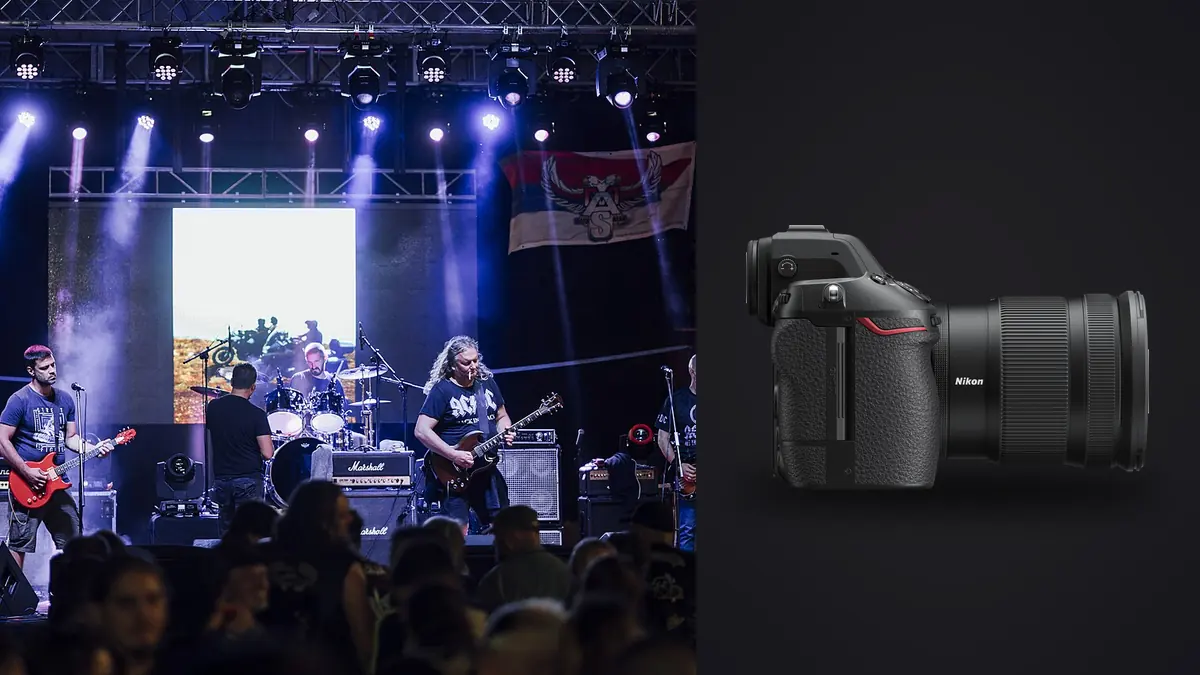
The thing that stands out when you shoot an arena show on a Z8 after it has replaced an aging D850 as the main body in the bag isn't the resolution or the video specs everyone else is talking about. It is that you stop missing the downbeat. With a DSLR you blink through the mirror flip and lose the exact instant a drummer's stick hits the rim or a singer's mouth opens on the first word of a chorus. The Z8's blackout-free electronic viewfinder just keeps showing you the stage, continuously, while it's firing at 20 frames a second underneath you. That single change, more than the extra megapixels, is what makes it a genuinely different tool for live music work.
This isn't a spec sheet regurgitation. I've used the Z8 across club shows with terrible LED walls, two arena tours in the photo pit, and a handful of jazz sets where the whole point was staying invisible and silent. What follows is what actually mattered in those rooms, plus where the camera still makes me work for it.
What a pit actually demands from a body
Most venues give photographers the first three songs, no flash, then you're out. That's roughly twelve to fifteen minutes to come home with a usable set, shooting in light that swings from near darkness to blown-out strobe hits within a single song. The gear questions that matter aren't abstract: can the autofocus hold a face when a follow spot sweeps across it, does the buffer choke if you hold the shutter through a chorus, and does the shutter sound get you thrown out of a seated jazz club. The Z8 answers two of those three well and the third depends entirely on which release mode you remember to switch to before you walk in.
Buffer and frame rate, in practice rather than on paper
Nikon rates the Z8 at 20 fps for full-resolution raw with the electronic shutter, and in daylight testing that number holds. In a dim club, autofocus hunting under low contrast light will occasionally throttle the effective rate a little, but the sensor readout itself doesn't slow down. What actually matters more than the top speed is the buffer depth. With a fast CFexpress Type B card I can hold the shutter through an entire eight-bar drum fill, upwards of 150 raw frames, before the buffer starts to stutter. Drop to a UHS-II SD card in the second slot and that number falls hard, closer to 60 frames before write lag creeps in. If you're shooting backup to both cards simultaneously for safety, budget for the SD card to be your bottleneck, not the CFexpress.
The practical upshot: I stopped mag-dumping through entire songs. Three or four short bursts of fifteen to twenty frames around the moments I actually want (a jump, a guitar swing, a held high note) produces a far more editable set than one continuous 400-frame spray, and it means I never hit the wall mid-song waiting for the buffer to clear.
Autofocus when the light won't cooperate
The Z8's subject detection is genuinely good at picking a singer's face out of a crowd of silhouettes, and 3D-tracking locked onto a moving guitarist crossing the stage holds far better than anything I had on the D850's phase-detect module. Where it still struggles is backlit haze. Concert fog machines plus a hard backlight will occasionally confuse eye-detect into hunting between the performer and the light source itself. When that happens I drop out of auto-area subject tracking and go to a small fixed AF point on the face, controlled manually. It's more work but it's predictable, and predictable beats clever when you've got four minutes left in the set.
Low-light autofocus rating on paper goes down to around -7 EV with an f/1.2 lens attached, and I believe it, but that number assumes stationary contrast to lock onto. A moving performer under a single moving spotlight is a different problem than a static test chart in a dark room, and no camera fully solves that. Expect a miss rate, plan your keeper count around it, and don't chase perfection on every frame.
Settings by venue type
I stopped trying to remember one universal exposure recipe because club, arena, and orchestral pit lighting behave nothing alike. This is roughly what I dial in before walking into each:
| Venue type | Shutter speed | Auto ISO ceiling | AF area mode | Release mode |
|---|---|---|---|---|
| Small club, moving LED wash | 1/320s minimum | 25,600 | Wide-area (S) with manual override | Electronic, high-speed continuous |
| Arena, follow spots + strobes | 1/500s minimum | 12,800 | Auto-area, subject detect: person | Electronic, 20 fps burst |
| Seated jazz or acoustic set | 1/160s minimum | 6,400 | Single-point AF-C | Silent, single or low-speed |
| Festival main stage, daylight | 1/1000s minimum | 3,200 | Auto-area, subject detect: person | Electronic, 20 fps burst |
The jazz club row is the one people skip and regret. Silent electronic shutter with the Z8 is properly silent, no fake shutter sound, no mirror clack, which matters enormously in a room where the loudest thing is a brushed snare. The trade-off is rolling shutter distortion on fast horizontal movement, but a seated set rarely has that problem the way a rock show does.
Rolling shutter and the LED banding question
Electronic-shutter-only cameras have a real weakness under certain stage lighting: banding from LED fixtures that flicker faster than the eye can see but interact badly with a fast electronic readout. The Z8 has a flicker reduction setting that helps, and I leave it on by default at shows, but it isn't a universal fix. Cheaper LED par cans and older moving heads are the worst offenders. If I see banding creeping into test frames, dropping shutter speed to match the lighting frequency (often 1/100s or 1/125s in regions on 50Hz mains, 1/60s or 1/125s on 60Hz) clears it up more reliably than the in-camera flicker setting alone. It's worth a fifteen-second test shot during soundcheck rather than discovering it in the edit at 1am.
Lenses that actually earn their spot in a two-body pit bag
I run two bodies for anything beyond a single-song shoot: one with the 24-70mm f/2.8 S for wide stage shots and crowd context, one with the 70-200mm f/2.8 S for tight face and hand work from the barrier. That combination covers probably 90 percent of what a pit photographer needs. The 50mm f/1.2 S comes out for small clubs where I can get close and want the extra stop plus the falloff, though at 1090 grams it's not a lens I want hanging off a strap for a three-hour set without support.
Third-party Z-mount glass has closed a lot of the gap on price without much of a compromise for this kind of work. A 70-200mm f/2.8 from a third-party maker autofocuses plenty fast enough for a moving performer and costs meaningfully less than Nikon's own, which matters if you're building a two-body kit from scratch. Where I still spend the extra money is the 24-70mm, because that's the lens doing the most work in the widest range of light, and the Nikon glass has been more consistent for me in mixed-color stage lighting. I've written up a similar two-body breakdown from a different run of shows in another Z8 concert photography guide, if you want a second data point on lens choices before you build out your own kit.
After the last song: the part nobody warns you about
A twelve-minute pit set at 20 fps in bursts, shot the way I described above, still lands somewhere around 1,200 to 1,800 raw frames once you add a full festival day with multiple acts. That's the part of concert photography that quietly eats an evening, not the shooting. I used to sit at a laptop at midnight clicking through every frame at 100 percent zoom checking focus on a face lit by a moving spot, which is exactly the kind of judgment call that's hard to make fast and easy to get wrong when you're tired.
That's the workflow gap imagic was built to close for me. It runs entirely on the machine, no upload queue while I'm sitting in a venue parking lot with one bar of signal, and it scores sharpness and focus locally across the whole take so the frames where the singer's face actually resolved sharp under that moving spot rise to the top instead of getting buried in a folder of near-misses. The burst clustering also does something I didn't expect to care about: it groups those fifteen-frame high-speed bursts together as a set instead of showing me 1,500 flat thumbnails, so I'm picking the best of six similar frames rather than scrolling past all of them individually.
The other piece that's specific to this kind of shooting is imagic's apply_my_style preset. I trained mine on a folder of my own finished concert edits, the ones with the deep blacks and the slightly warm skin tones I lean toward under stage lighting, and now a fresh set gets a first pass in that direction automatically before I touch anything by hand. It's not a substitute for finishing an edit properly, but going from a flat culled folder to something already in the right neighborhood saves a real chunk of the post-show grind. If you're new to how that kind of local culling actually works under the hood, the how AI photo culling works piece covers the mechanics in more depth than I will here.
Small habits that saved a show
A few things I do now that I didn't for the first year with this camera. I reassign the AF-On button and leave shutter-button autofocus off entirely, because in a pit environment my thumb is more reliable than my index finger under adrenaline. I check the histogram, not the rear screen brightness, when a strobe hits, because the screen lies about highlight clipping under bright ambient light far more than the histogram does. And I shoot a single frame of my own hand or a gray card at the start of every set change, because venues change their lighting rig between openers and headliners more often than anyone warns you, and a fast white balance reference saves an editing headache later. None of that is Z8-specific, but the camera's speed makes it easy to forget the boring fundamentals in the rush of a three-song set, and I've learned that the boring fundamentals are usually what separates a usable set from a great one.
Frequently Asked Questions
Is the Z8's electronic-only shutter a problem for fast stage movement?
Mostly no, but it's not nothing. Rolling shutter skew shows up on very fast horizontal pans or a guitar neck whipping across frame at close range, visible as a slight slant rather than a straight line. For the vast majority of concert work, which is faces, hands, and torsos rather than whip-pans, it isn't an issue. I've only noticed it a handful of times across two years of shooting, usually with a wide lens very close to fast motion.
Do I need a battery grip for a full festival day?
Not for battery life, the EN-EL15c comfortably clears a full day of intermittent shooting even with heavy burst use, closer to 1,500 to 2,000 frames per charge in my experience rather than Nikon's more conservative CIPA number. Where a grip helps is vertical grip comfort holding a 70-200mm overhead at a barrier for an hour, which is a real fatigue issue nobody mentions until their wrist does.
Can one lens realistically cover a small club show?
A 24-70mm f/2.8 gets you close. You'll crop tighter than you'd like on face shots from the back of a small room, and you'll occasionally wish for more reach when a singer works the far side of the stage, but it's a genuinely workable one-lens kit for club-sized rooms where you can physically move close to the stage. For anything bigger than a 200-capacity room, I'd rather have the second body and the 70-200mm.
How much of a difference does local processing actually make for a touring photographer?
More than I expected before I relied on it. Venue wifi is unreliable or nonexistent often enough that any workflow depending on a cloud upload becomes a workflow you can't trust on tour. This is the main reason I moved my culling to imagic rather than a browser-based tool: everything runs offline, so a first-pass style edit gets done in the van between cities regardless of signal, and there's no artist or label footage sitting on someone else's server before you've had a chance to review it yourself.