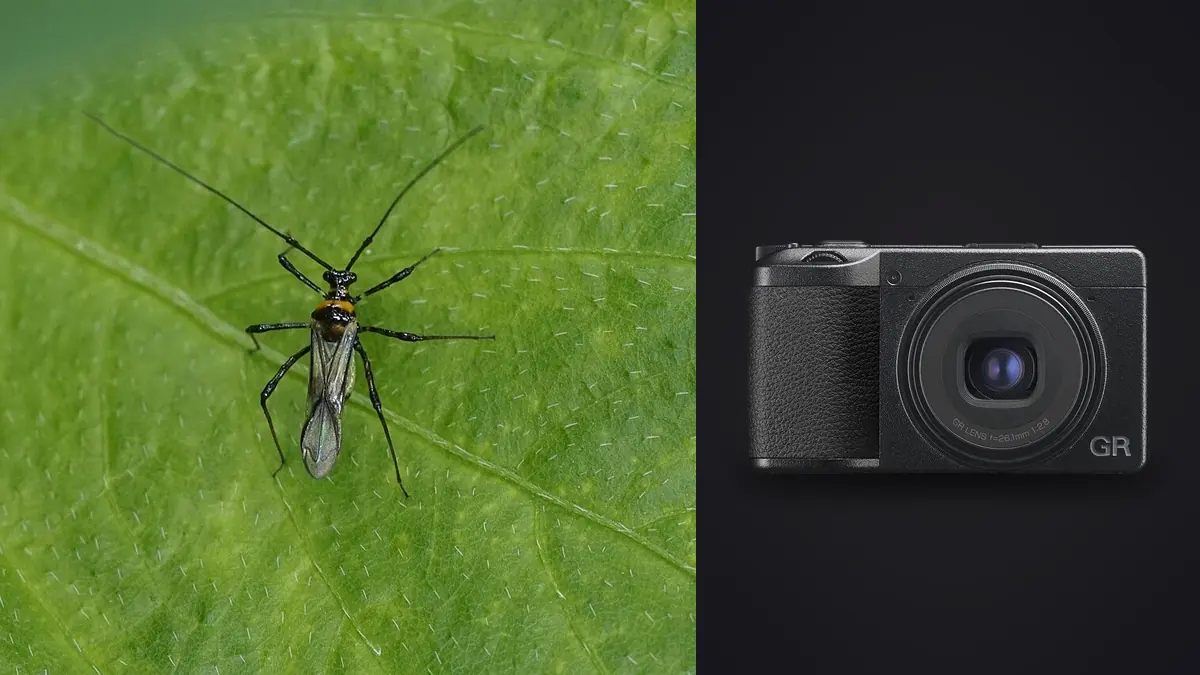
I carried a Ricoh GR IIIx through three seasons of garden and woodland close-up shooting before I trusted it enough to leave the "real" macro lens at home. It is not sold as a macro camera. The 26.1mm lens (a 40mm full-frame equivalent) was built for street work, and Ricoh's own marketing leans on discretion and pocketability, not bugs and pollen. But the Macro mode buried in the focus menu turns out to be genuinely useful for a specific slice of close-up photography, and useless for another slice. This is a field report on which is which, written from actual walks with wet knees and a fogged-up LCD, not from a spec sheet.
What the Macro Mode Actually Does
The GR IIIx has two relevant focus states for close-up work: Normal AF, which racks from about 20cm to infinity, and Macro mode, toggled with a dedicated press of the down arrow, which narrows that range down to roughly 12cm to 20cm. That 12cm figure is measured to the front of the lens barrel, not the sensor, so by the time you account for the lens itself, your actual clearance to the subject is closer to 8 to 9cm. That is close enough to fill the frame with a large flower head or a resting dragonfly's wing detail, and it is also close enough that your own shadow, or the lens barrel, regularly blocks the light before you get the shot.
What it is not is a 1:1 macro lens. Ricoh never rates a reproduction ratio for the GR IIIx because the fixed 40mm-equivalent focal length simply does not get you there. At closest focus you are somewhere in the neighborhood of 1:4 to 1:5 magnification, meaning a 2cm beetle occupies maybe a quarter to a fifth of the frame's short edge. Compare that to a dedicated macro lens (a 90mm or 100mm 1:1 optic) and the GR IIIx is doing "close-up" photography, not true macro, even though Ricoh's own menu calls it Macro. That distinction matters for planning: if the goal is a frame-filling portrait of an ant, this camera will disappoint. If the goal is an intimate, environmental shot of a dragonfly perched on a reed with the wing venation actually resolving, it delivers.
Working Distance Is the Real Limiting Factor
Every macro or close-up shooter eventually learns that working distance, not magnification, decides which subjects cooperate. An 8 to 9cm gap between lens and subject is workable for a mushroom cap, a dew-covered leaf, or a caterpillar that is not going anywhere. It is a non-starter for a jumping spider, most bees, or anything with a startle radius bigger than your fist. I lost more shots to insects bolting the instant the lens shadow crossed them than to any focus miss. The practical upshot: the GR IIIx earns its keep on static or slow subjects and struggles on flighty ones, which reframes the whole "insect photography" pitch. It is closer to a plant-and-fungus close-up tool that occasionally nails a resting or overnight-cold insect than a hummingbird-hawkmoth chasing rig.
The table below is built from actual settings I used across a season, not the manual's abstract ranges, and it maps each focus mode to what it is realistically good for.
| Focus mode | Closest usable distance | What fills the frame at that distance | Best suited to | Where it falls apart |
|---|---|---|---|---|
| Normal AF (full-area) | ~20cm | A whole flower head or a fist-sized cluster of leaves | Habitat shots, pollinators mid-approach, slow bees on a bloom | Hunts badly in dense, low-contrast foliage; will lock onto a background leaf instead of the insect |
| Macro mode (toggle down-arrow) | ~8-9cm from lens front | A single petal, a beetle's whole body, dew droplets in detail | Fungi, resting insects, texture and pattern shots, dead or cold-morning subjects | Working distance is short enough that most alert insects flee before the shutter fires |
| Snap Focus (preset 1m or 2.5m) | N/A (fixed distance) | Whatever sits at the preset distance, no AF lag | Grabbing a wider habitat frame the instant a subject bolts | Not usable for anything resembling macro framing |
| Manual focus (rear dial, on-screen scale) | Same floor as Macro mode | Whatever you rock the camera onto | Shooting through a gap in foliage where AF can't find the subject at all | Slow, and focus peaking on the rear LCD is genuinely hard to read in direct sun |
Settings That Held Up Outdoors
Depth of field at 8-9cm is measured in millimeters, not centimeters, so aperture choice matters more here than almost anywhere else I use this camera. My default for a resting insect (a damselfly on a stem, a hoverfly on a leaf) was f/5.6 to f/8, which gets enough of the body in focus to read as sharp without turning the background into distracting clutter. Wider than that, at f/2.8 to f/4, only the eyes or the nearest few millimeters are crisp, which works for abstract detail shots (a single compound eye, the texture of a wing) but rarely reads as a complete "photo of the bug."
Shutter speed is the other half of the equation, and it matters more than the camera's stabilization does. The GR IIIx has a competent 3-axis in-body Shake Reduction system, and it genuinely helps with your own hand tremor at these magnifications, but it does nothing about a wing twitching or a stem swaying in the faintest breeze. I stopped trusting anything below 1/500s for live insects and went to 1/1000s or faster whenever the light allowed it, using Auto ISO capped around 3200 to get there. The lens's built-in leaf shutter helps in a way that is easy to overlook: it is close to silent, with none of the mirror-slap or shutter clack of an SLR, so a resting insect is far less likely to startle at the moment of exposure than it would with louder gear.
One quirk worth knowing before you're in the field: the leaf shutter tops out at 1/4000s, and on a bright midday subject you sometimes want a wide aperture for background separation and a fast shutter at the same time, which pushes you past that ceiling. The built-in 2-stop ND filter (toggled in the function menu) solves this without carrying a screw-on filter you'd have to fumble with at 8cm from a beetle.
Lighting a Subject You're Almost Touching
This is the GR IIIx's weakest point for close-up work, and it is a hardware limitation, not a technique problem. There is no hot shoe and no built-in flash on this body, so at working distances under 10cm your own lens and hand routinely shadow the subject, and there is no way to mount a ring flash or macro twin-flash to fix it. In practice I worked around this three ways: shooting in open shade rather than direct sun so the shadow problem is softer to begin with, carrying a small folded white card as a bounce reflector held in my off hand, and, for anything stationary long enough, a clip-on continuous LED light angled from the side rather than straight on, which also does a better job of showing texture on a beetle's shell or a leaf's surface than flat on-axis light would.
Overcast mornings turned out to be the best conditions for this camera specifically, not because the light is prettier, but because soft, even light removes the shadow problem almost entirely and lets you shoot at f/8 without fighting harsh contrast on tiny, reflective insect bodies.
What You Bring Home, and What Happens Next
Because depth of field is so thin at these distances, the reliable technique is not to nail focus once but to rock the camera slightly forward and back through the plane of focus while firing several frames, the same trick macro shooters have used with manual-focus lenses for decades. On the GR IIIx, with autofocus that hunts more than a dedicated macro lens would, I found myself doing this constantly: five to twelve frames per subject just to land one or two that were actually sharp where it counted. A three-hour walk in the garden regularly produced 700 to 1,000 DNG files, of which maybe 60 to 90 were keepers.
That ratio is exactly the kind of set that is miserable to sort by eye at 100% zoom, frame by frame, and it's the part of this workflow where imagic actually earns its place on my laptop. Its local sharpness and focus scoring flags which frame in each little rocking-focus sequence actually landed on the antennae or the compound eye rather than the leaf behind it, and the burst and duplicate clustering groups those near-identical sequences together automatically instead of leaving them scattered through a folder of 900 thumbnails. Because it runs entirely on-device, culling a card full of macro DNGs happens on a laptop on the tailgate of the car before I've even got signal, with nothing uploaded anywhere. If you haven't looked at how that kind of automated focus scoring actually works under the hood, our breakdown of how AI photo culling works covers the mechanics in more depth than fits here.
The other piece that's saved real time is imagic's apply_my_style feature, which trains an AI preset off edits I've already made rather than a generic macro or nature look. Insect and plant close-ups tend to need a specific, repeatable touch (slightly desaturated greens so foliage doesn't fight the subject, warmer midtones on insect bodies), and rebuilding that from scratch every session in Lightroom used to eat into actual shooting time. Now the first pass happens automatically and I'm only correcting outliers rather than starting from zero on every import. For anyone whose macro sessions are producing similarly bloated card dumps, it's worth reading through general tips for a faster photo workflow alongside this, since a lot of it applies directly to high-frame-count close-up shooting.
Where This Camera Runs Out of Road
A few honest limitations, because a fixed-lens compact is not going to replace a real macro setup and shouldn't be sold as one. There's no in-camera focus stacking or bracketing (cameras like Olympus's OM-1 or several Panasonic bodies offer this natively), so if you want a beetle sharp from antennae to abdomen at true macro magnification, you're stacking manually in third-party software afterward, and you'll want to shoot a deliberate bracket rather than relying on the rocking technique for that specific purpose. Battery life is modest too, around 200 shots CIPA-rated from the small DB-110 pack, which sounds worse than it is in practice but still means carrying two or three spares for a full field day of high-frame-count shooting. And because there's no viewfinder on the standard body (the optional GV-3 is an accessory finder with no exposure info), composing in bright midday sun on the rear LCD at ground level, on your knees, with a dragonfly six inches away, is exactly as awkward as it sounds.
None of that erases what the camera does well. It is small enough to carry on every walk without a second thought, quiet enough not to spook what you're photographing, and the RAW files it produces hold up to real post-processing work once you're back at a desk. It just is not, and was never going to be, a substitute for a dedicated macro lens if frame-filling insect portraits are the actual goal.
Frequently Asked Questions
How close can the GR IIIx actually focus in Macro mode?
Ricoh's own figure is about 12cm, but that's measured to the front element, not the subject-to-sensor distance photographers usually mean by "working distance." In practice you have roughly 8 to 9cm of clearance between the lens barrel and whatever you're photographing, which is close enough to fill the frame with a flower or a resting insect but close enough that your own shadow becomes a real problem in direct light.
Do I need a ring light or external flash for insect shots with this camera?
You can't mount one even if you want to. The GR IIIx has no hot shoe and no built-in flash, so ring flashes and macro twin-flash units are off the table entirely. Open shade, a small reflector card, or a clip-on continuous LED held off-axis get you most of the way there without needing camera-mounted lighting.
Is the GR IIIx a true macro camera or just a close-focusing compact?
It's the latter. At closest focus you're looking at roughly 1:4 to 1:5 magnification, well short of the 1:1 reproduction ratio a dedicated macro lens delivers. It's genuinely good for environmental close-ups of larger insects and plant detail, but a small beetle or ant will never fill the frame the way it would through a real macro optic.
Why do so many of my close-up frames come out soft even with Shake Reduction turned on?
Shake Reduction compensates for your hand movement, not subject movement, and at these magnifications even a light breeze moving a stem, or an insect's wing twitching mid-breath, is enough to blur the shot regardless of stabilization. Shutter speed matters more than IS here; treating anything under 1/500s as unreliable for live subjects, and pushing ISO higher to get there, produces a noticeably higher keeper rate than leaning on stabilization alone.