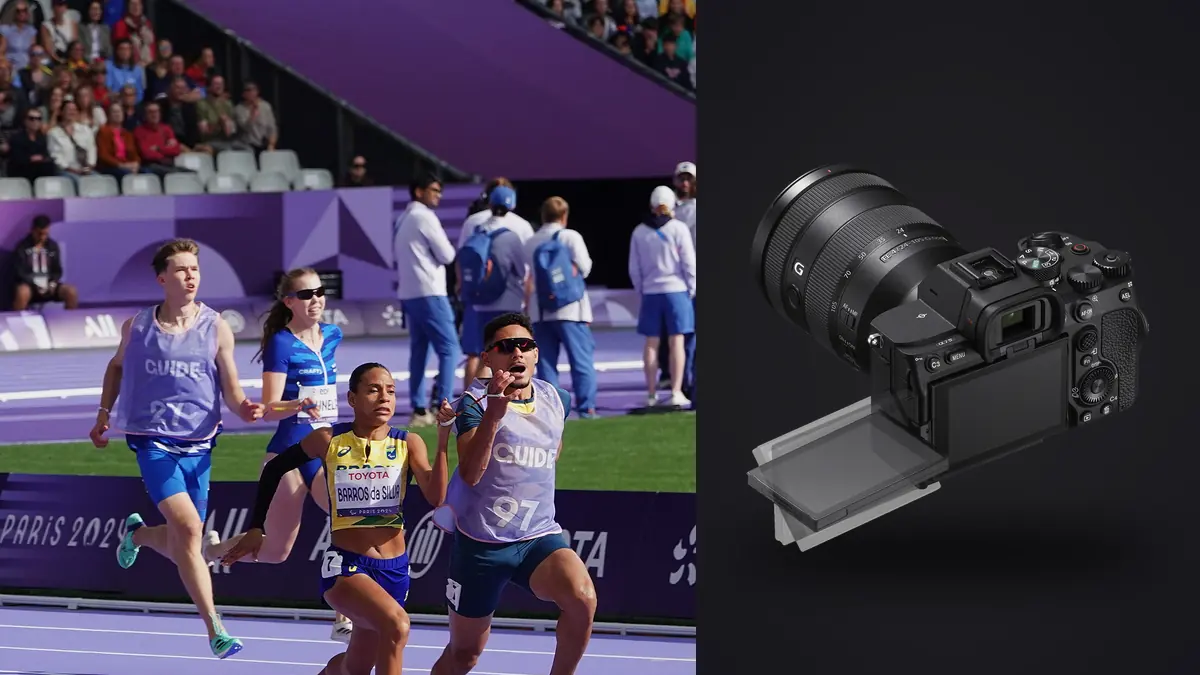
I shot my first indoor track meet with the Sony A7 IV almost by accident. A friend who normally shoots it with an A9 II was out sick, so I took my A7 IV along to a regional qualifier and tried for lane-by-lane shots. I went in expecting to be annoyed by the buffer. I came out with a much clearer picture of what this camera is actually good at on a track, and where you have to work around it rather than through it.
The A7 IV was never marketed as a sports camera. Sony positioned it as the do-everything hybrid between the A7R V's resolution and the A7S III's video chops, and most of the marketing copy talked about weddings, documentary work, and run-and-gun video. But a huge number of working photographers don't get to own a dedicated A9 III just for eight track meets a season. They own one body, and sometimes that body has to freeze a 100m final. This is what that actually looks like in practice, not on a spec sheet.
What the A7 IV Gets Right for Track and Field
Track and field is really three different sports stitched together: sprints and hurdles that need brutal shutter speed and fast, confident autofocus; jumps that need you to predict a takeoff point and nail focus on a moving body against a busy background; and throws (shot put, discus, javelin, hammer) where the action is slower but the framing window is tiny and unforgiving. The A7 IV handles these three disciplines with noticeably different levels of confidence.
For throws and for most field events shot from a fixed position, the A7 IV is genuinely good. Its subject recognition autofocus, updated by the 2.0 firmware release that added dedicated human pose detection, will lock onto a shot putter's torso and hold it through the wind-up and release far more reliably than the original launch firmware did. If you bought your A7 IV used or inherited one that's still on an older firmware version, updating before a meet is not optional. It is the single biggest autofocus improvement Sony has shipped for this body since release, and it costs nothing but twenty minutes with the Sony PDT app.
For sprints, the story is more mixed. The A7 IV's continuous shooting tops out at 10fps in its Hi+ mode with the electronic shutter, and that number holds with full AE/AF tracking, which is the important part. A lot of cameras claim a high frame rate but drop tracking or exposure metering to hit it. The A7 IV doesn't do that at 10fps. What it does do is fill its buffer fast enough that a single 100m race, if you hold the shutter down from gun to tape, will often outrun the card before the runner crosses the line.
Autofocus Settings That Actually Held Up Trackside
I stopped using Wide-area AF for anything but crowd shots of the stands. On the track itself, Zone or Spot S focus area combined with subject recognition set to Human gave me the most consistent hit rate, especially in lanes 1 through 4 where a runner from an adjacent lane can cross into frame and steal focus if you're on a wider area mode. Tracking sensitivity I left at the default 3, and only pushed it toward 5 (locked on) during hurdles, where a trailing runner's leg kicking into frame between hurdles was causing the camera to jump subjects mid-sequence at the default setting.
Eye AF for humans works on the track, but only reliably inside about 15 to 20 meters with a 200mm or longer lens. Past that distance the eye is too small a target in the frame and the camera falls back to torso or full-body recognition anyway, so I stopped worrying about forcing eye priority for anything shot from the far straight or from bleacher seats across the infield. For 90 percent of a typical meet, body-and-head tracking is doing the actual work regardless of what priority mode you've selected in the menu.
One setting that made a bigger difference than I expected: AF tracking sensitivity aside, dropping the pre-AF (constant autofocus while composing, before the shutter is pressed) to on rather than off shaved a noticeable amount of hunting when I raised the camera at the last second for a false-start recall or an unexpected lead change. Battery drain went up, but on the A7 IV's NP-FZ100 that cost was easy to absorb across a two-hour meet.
Buffer Depth and the Card That Actually Matters
This is where the A7 IV shows its age against purpose-built sports bodies, and it's worth being specific about numbers rather than vague about "buffer limitations." Shooting compressed RAW with a fast CFexpress Type A card, Sony's own figures put the buffer at roughly 800 frames before the camera slows down, which sounds enormous until you realize that at 10fps that's still only about 80 seconds of continuous shooting. In practice you never hit that ceiling on a single sprint. Where it bites is toward the end of a long meet, shooting relay handoffs back to back with only a minute or two between exchanges to let the buffer clear, especially if you're also writing full-size JPEGs alongside the RAW for a quick same-day upload to a coach or a paper's website.
Switch to a UHS-II SD card instead of CFexpress and the usable buffer before slowdown drops meaningfully, often by close to a third depending on the card's actual sustained write speed rather than its marketing number. I run a CFexpress Type A card as primary and a UHS-II SD as backup in the second slot, and the difference in how often the camera stutters mid-burst between the two is obvious enough that I'd call CFexpress close to mandatory for anyone shooting the A7 IV at a track meet with any regularity.
| Shooting mode | Frame rate | AF/AE tracking | Approx. buffer (compressed RAW, CFexpress A) | Best use at a meet |
|---|---|---|---|---|
| Hi+ | 10 fps (electronic shutter) | Full tracking | ~800 frames | Sprints, hurdles, relay exchanges |
| Hi | 8 fps (mechanical or electronic) | Full tracking | ~1000+ frames | Jumps, pole vault approach and clearance |
| Mid | 6 fps | Full tracking | Effectively unlimited in practice | Throws, distance events, crowd and coach reaction shots |
| Single | 1 frame per press | Full tracking | N/A | Podium, medal ceremony, portraits |
Rolling Shutter: The Thing Nobody Warns You About Until It Happens
The A7 IV's sensor readout in electronic shutter mode is not fast. It's fine for most subjects, but on a track it will occasionally show up as skew, most visibly on discus and hammer throwers mid-spin, where the top of the frame and the bottom of the frame are effectively capturing the athlete's rotation at very slightly different moments. The result is a subtly warped implement or a limb that looks bent in a way it wasn't. I didn't notice this on my first few meets because I was reviewing shots on the camera's small screen between events. It only became obvious later on a full-size monitor.
The fix is simple once you know to look for it: switch to the mechanical shutter for the throwing events, where the frame rate ceiling of the mechanical shutter (also 10fps on this body, so you lose nothing there) doesn't matter because throws don't need sustained high-speed bursts the way a 100m dash does. I now default to mechanical shutter for shot put, discus, javelin, and hammer, and electronic shutter for everything on the track surface itself, where subjects move in a straighter line relative to the sensor's readout direction and skew is far less visible.
Lens Pairings That Earned Their Keep
For lanes 1 through 8 shot from an infield position, the 70-200mm f/2.8 GM II is the lens I reach for most. It's light enough to hand-hold for a full session without a monopod, focuses fast enough to keep pace with the A7 IV's tracking, and the reach covers a full lane width from a standard infield photographer position without forcing constant repositioning between heats.
For field events and for shooting the far straight from the home stands, the 100-400mm GM earns its weight. Discus and hammer, in particular, need the extra reach if officials have you positioned behind the cage rather than beside the circle, which is standard at most sanctioned meets for safety reasons. I've also used a 200-600mm for finish-line shots from the opposite side of the track at outdoor meets with a wide enough infield, though autofocus speed does soften slightly with that lens compared to the GM primes and zooms, especially in the flatter light of an overcast afternoon session.
A 1.4x teleconverter on the 70-200mm GM II gets you to just under 300mm without giving up much autofocus speed, and it's a lighter kit to carry between the infield and the stands than swapping bodies or lenses mid-meet, which matters more than it sounds like it should when you're covering six hours of a two-day invitational.
Shutter Speed by Event: What Actually Freezes the Action
| Event | Shutter speed that reliably freezes motion | Notes |
|---|---|---|
| 100m / 200m sprints | 1/2500s or faster | Leg and arm blur is visible even at 1/2000s at the moment of full stride extension |
| Hurdles | 1/3200s | Trail leg motion over the barrier is the fastest movement in the meet |
| Long jump / triple jump | 1/2500s | Peak height in flight is the easiest moment to freeze; takeoff is the hardest |
| Pole vault | 1/2500 to 1/3200s | Pole flex recoil at the top of the clearance is fast enough to blur at slower speeds |
| Shot put / discus / hammer | 1/1600 to 1/2000s | Release moment matters more than sustained sharpness through the spin |
| Javelin | 1/2000s | The javelin itself blurs before the arm does; accept it or go faster |
| Distance events (800m+) | 1/1000 to 1/1250s | Slower pace tolerates a slower shutter, freeing up ISO headroom in dim stadium lighting |
What Happens After the Meet
A two-day invitational with a decent number of events will leave you with anywhere from three to six thousand frames once you add up every heat, every flight, and every burst you fired at a jump or a throw hoping one frame in fifteen landed on peak action. Going through that manually, event by event, is the part of shooting track that nobody enjoys and everybody underestimates when they're planning the day.
This is the part of my workflow where imagic actually earns its place. I dump both card slots into a folder and let it run its local sharpness and focus scoring across the whole batch before I touch a single image, which means by the time I sit down to review, the genuinely soft frames (the ones where tracking briefly grabbed a runner in an adjacent lane, or where a throw sequence caught mostly wind-up rather than release) are already sorted to the bottom instead of mixed in with the sharp ones. Because everything runs locally on the laptop rather than uploading to a cloud service, I'm not waiting on a connection at a stadium with patchy wifi, which at some of the smaller regional venues I've shot is a real, not hypothetical, problem.
The other piece that matters specifically for track is imagic's duplicate and burst clustering. A 10fps sequence through a hurdle clearance can produce eight or nine frames that are all technically in focus, and picking the one where the lead leg is fully extended over the bar from a folder of near-identical thumbnails is exactly the kind of decision that eats an evening. Having those bursts grouped automatically instead of scattered across a flat filmstrip cuts that review time down to something that fits between dinner and actually going to bed, which after a twelve-hour meet day is not a small thing.
Once the keepers are picked, I run imagic's apply_my_style preset, which is trained on my own past edits rather than a generic filter, to get a consistent first pass across every event before I do any per-image adjustment. Track lighting swings hard between indoor fieldhouses with mixed sodium and LED banks and outdoor afternoon sessions with harsh top light, and having a starting point that already reflects how I personally tend to correct for that saves real time compared to building a grade from a flat default every time the light changes between events. If you're trying to get faster at the review stage generally, our piece on speeding up a photo workflow covers some of the same ground from the ingest side rather than the shooting side, and it's worth reading alongside this if a meet day workflow is the part that's actually slowing you down rather than the camera settings.
For anyone still culling by hand or with basic star ratings in a catalog tool, it's worth understanding how automated culling actually evaluates a frame before trusting it with a full card dump. Our breakdown of how AI photo culling works goes into the mechanics in more depth than makes sense to repeat here.
Where the A7 IV Falls Short
I want to be honest about the limits rather than sell the camera as something it isn't. If you're shooting a state or national-level meet where every frame might end up in a college recruiting reel or a wire photo feed, the A7 IV's buffer and 10fps ceiling will occasionally cost you a frame that an A9 III or a Canon R3 would have caught. I've missed a lean at the tape by half a frame more than once because the burst had briefly slowed while clearing to the card. For a local invitational, a conference championship, or a youth meet, it is genuinely more camera than most photographers on the sideline are using, and the gap between it and a flagship sports body matters far less than the gap between having good autofocus habits and not having them.
Frequently Asked Questions
Is the Sony A7 IV fast enough for competitive track and field coverage?
For most levels of competition, yes. Its 10fps Hi+ mode holds full AF and AE tracking, and the subject recognition autofocus (especially after the 2.0 firmware update) is confident enough for sprints, jumps, and throws. It will occasionally lose a frame to buffer clearing during long bursts like a full relay leg, which is the main gap between it and a dedicated sports body.
Do I need a CFexpress card, or will a fast SD card work?
A UHS-II SD card will work and won't stop you from shooting a meet, but the usable buffer before the camera slows drops noticeably compared to CFexpress Type A. If you're shooting relay exchanges back to back with little recovery time between events, CFexpress is worth the cost.
Should I use electronic or mechanical shutter for track events?
Mechanical shutter for throws (discus, hammer, shot put) avoids visible rolling shutter skew during the athlete's rotation. Electronic shutter is fine, and quieter, for sprints, hurdles, and jumps, where motion is more linear relative to the sensor's readout direction.
What's the biggest autofocus mistake people make shooting sprints with this camera?
Leaving the focus area on Wide. In tight lanes, a runner in an adjacent lane crossing into frame can steal focus from your subject on a wide area setting. Switching to Zone or Spot S with Human subject recognition enabled keeps the camera locked on the runner you actually intended to track.