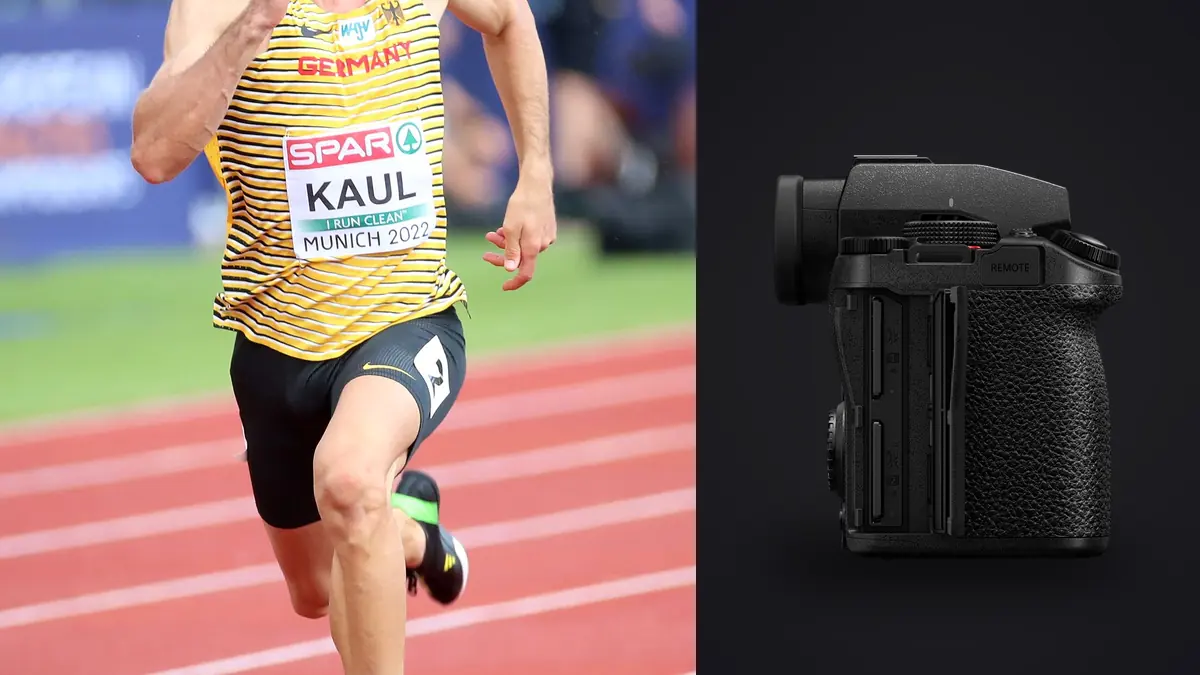
Why the S5IIx Ends Up in My Bag on Meet Days
I did not buy the Panasonic Lumix S5IIx for sports. I bought it for video, because the internal ProRes and the active cooling fan solved a real problem on long recordings. What surprised me was how often it became my first choice for shooting a regional track meet, mostly because it is the camera I already own and trust, and partly because the phase-detect autofocus that Panasonic added starting with this generation actually holds up on a 100m sprinter coming out of the blocks. That was not true of the original S5, which hunted on anything moving faster than a walk.
Track and field is an unforgiving test for a camera because it is not one sport, it is six or seven happening in parallel across a stadium. Sprinters need fast, sustained tracking. Field events like long jump and pole vault need you to nail a single decisive instant. Distance races need you to hold focus on a moving pack for minutes at a time without your buffer filling up. The S5IIx was never marketed as a sports camera, so I want to be specific about where it earns its keep and where it does not.
The Autofocus System: Phase Detection Changes the Calculus
The single biggest change from the original S5 to the S5II generation (both the II and IIx share the same imaging pipeline) is the move to a phase-hybrid autofocus system. Panasonic's older contrast-only AF used to wobble visibly, that little in-and-out pulse as the lens hunted for confirmation, and on a runner moving at speed that wobble meant missed frames. The phase-detect points fix most of that. Locking onto a sprinter mid-race and letting the camera hold body and head detection through a 9 fps burst is dependable now in a way it was not on the previous body.
Where it still shows its limits is in dense, low-contrast scenarios: a pack of distance runners in matching team singlets, backlit by low evening stadium lights, at the far side of the track where your lens has already lost some resolving contrast. In that situation I switch from full-area tracking to a single, smaller AF zone and place it deliberately on the runner I actually want, rather than trusting the camera to pick the right person out of a crowd. Subject detection for humans works well when there is one clear subject filling a reasonable portion of the frame. It gets less reliable when there are twelve athletes bunched together 60 meters out.
For field events the calculus flips. A long jumper on the runway, a pole vaulter mid-clearance, a shot putter at release, these are single, isolated subjects against a comparatively clean background, and the AF system handles them about as well as anything I have used at this price point. I get a noticeably higher keeper rate on jump take-offs than I did with the S5.
Burst Speed and the Shutter Choice Nobody Talks About
Here is the part that trips people up if they only read the spec sheet. The S5IIx is not a stacked-sensor camera. It shares the same sensor architecture across mechanical and electronic shutter modes, which means the electronic shutter's readout speed is not fast enough to avoid rolling shutter distortion on quick lateral motion. If you pan hard on a sprinter using the silent electronic shutter, you will get a skewed frame, legs leaning at an angle they were not actually leaning at. It is subtle at slower pans and obvious once someone is running flat out toward the line.
Mechanical shutter tops out at 9 fps with full continuous autofocus, and that is what I use for anything involving a runner moving across my frame. The high-speed electronic burst mode gets you dramatically faster frame rates, but autofocus and exposure lock to the first frame in that mode, so it is only useful for subjects that are not changing distance from you quickly, think a discus thrower mid-spin shot roughly square-on, not a 400m runner coming around the bend.
| Shutter Mode | Frame Rate | Autofocus Behavior | Rolling Shutter Risk | Best For at a Track Meet |
|---|---|---|---|---|
| Mechanical, continuous AF | 9 fps | Full AF-C between frames | None | Sprints, hurdles, relay exchanges, jump take-offs |
| Mechanical, single low-vibration | Up to 5 fps | Full AF-C | None | Distance packs when you want minimal shutter noise near officials |
| Electronic, high-speed burst | Up to 30 fps | Locked at first frame | Noticeable on fast lateral motion | Shot put and discus release shot square-on |
| Electronic, continuous AF | Roughly 10 fps in my use | AF-C between frames, slight viewfinder lag | Moderate, worse when panning | Pole vault clearance tracked head-on |
The practical takeaway: for anything where a body is moving across your field of view at speed, stay on mechanical shutter even though the electronic modes advertise bigger numbers. The 9 fps ceiling feels slow next to a stacked-sensor flagship that can do 20 or 30 fps with zero distortion, but it is honest, predictable performance, and I would rather have 9 clean frames than 20 with warped limbs.
Handling a Full Meet: Cards, Battery, and Weight
A track meet is a marathon for the photographer even when nobody is running a marathon. You are on your feet for four or five hours, moving between the infield, the field event stations, and the finish line, usually carrying a telephoto zoom the whole time. The S5IIx's magnesium alloy body sits around 740 grams without a lens, which is reasonable for handholding but starts to add up once you have a 70-200mm f/2.8 mounted and you are holding it up for a 400 meter final.
Card handling is where I have the biggest reservation about using this body for high-volume sports work. There is no CFexpress slot, both bays are SD UHS-II. That is fine for stills in isolation, but at 9 fps over a full meet you are generating a lot of RAW files, and buffer clearing to a UHS-II card is noticeably slower than clearing to CFexpress on cameras built specifically for this. I run V90-rated cards and still feel the buffer catch up with me during a long, chaotic 4x100m relay where I am firing in short bursts across the whole exchange zone. Dual card slots mean I always shoot RAW to both simultaneously during meets, since a corrupted card at a one-off event is not something you get to redo.
Battery life is workable but not generous. I carry two spares and a small battery grip for all-day coverage, since the official CIPA rating undersells real-world use but a stadium full of events across an afternoon will still get you swapping batteries at least once.
Lenses That Actually Make Sense for a Track Circuit
The L-mount alliance has matured enough that lens choice is no longer the limiting factor it once was for Panasonic sports shooters. For track and field specifically, I split my kit into two roles rather than trying to cover everything with one lens.
- Panasonic Lumix S 70-200mm f/2.8 OIS for anything on the near side of the track, sprints at the finish, hurdles, relay hand-offs. Fast enough aperture to keep shutter speeds up under stadium floodlights, and the OIS pairs with the body's in-body stabilization for steadier handheld panning.
- Sigma 100-400mm DG DN for field events happening far from the stands, javelin, discus, and long jump when you are shooting from the opposite side of the infield. It is slower and less impressive wide open, but the reach matters more than the aperture for these.
I have not found a strong case for a 400mm or 600mm prime on this body for track work specifically. The venues are compact enough that 200-400mm covers nearly everything, and the extra weight and cost of the longer glass is hard to justify unless you are also shooting American football or similar sports on bigger fields.
From Memory Card to Edit: Where imagic Fits
Shooting 9 fps bursts across a five-hour meet means coming home with several thousand frames, most of them near-duplicates of the same stride or the same jump attempt. Sorting that manually used to eat an entire evening. I now run the card straight into imagic and let its local sharpness and focus scoring do the first pass, flagging the technically sharp frames out of each burst before I look at anything with my own eyes. Because the app clusters bursts and near-duplicate frames automatically, I am not scrolling past forty nearly identical shots of the same 100m start to find the one where the athlete's front foot has actually left the block.
The other reason it stays in my workflow for this kind of shoot is that everything processes on the machine, nothing uploads anywhere. When you are photographing minors at a school meet, that matters, coaches and parents ask, and being able to say the images never leave your laptop is a real answer, not a marketing line. Once the culling pass is done, I apply a preset built from imagic's apply_my_style feature, which is trained on my own previously edited photos rather than a generic sports template, so a stack of 300 keepers from a single meet gets a consistent look without me manually grading each one. If you have not built a workflow around this kind of local-first culling before, the breakdown at how AI photo culling works covers the mechanics in more depth, and the tips for a faster photo workflow piece has a few habits I picked up specifically from shooting high-volume events like this one.
Frequently Asked Questions
Is the S5IIx fast enough to shoot sprint finishes reliably?
Yes, with a caveat. At 9 fps mechanical with continuous autofocus, you will get a usable sequence around the finish line, but you need to start your burst a beat earlier than you think, since 9 fps leaves noticeably more gap between frames than a 20 fps stacked-sensor body. I typically start firing as the pack enters the final 15 meters rather than waiting for the exact moment they hit the line.
Should I use electronic shutter for field events like javelin or discus?
Only when the subject's motion relative to your position is mostly rotational or vertical rather than lateral, a discus thrower's spin shot roughly head-on, for example. Anything with fast side-to-side motion toward your camera position will show rolling shutter skew in electronic mode, so I default to mechanical shutter unless I have a specific reason not to.
How does the S5IIx compare to the standard S5II for stills sports work?
For stills, they are effectively identical. Same sensor, same autofocus system, same 9 fps mechanical ceiling. The IIx's extra cost buys internal ProRes, unlimited recording via the active fan, and streaming features aimed at video producers. If track and field stills are your main use case, the standard S5II gets you the same autofocus and burst performance for less money.
What card should I be using to avoid buffer slowdowns during a meet?
A fast UHS-II SD card rated V90 is the minimum I would run. Because there is no CFexpress slot on this body, buffer clearing during long bursts (a messy relay exchange, for instance) is the most likely place you will feel the camera slow down, and a slower card makes that noticeably worse.