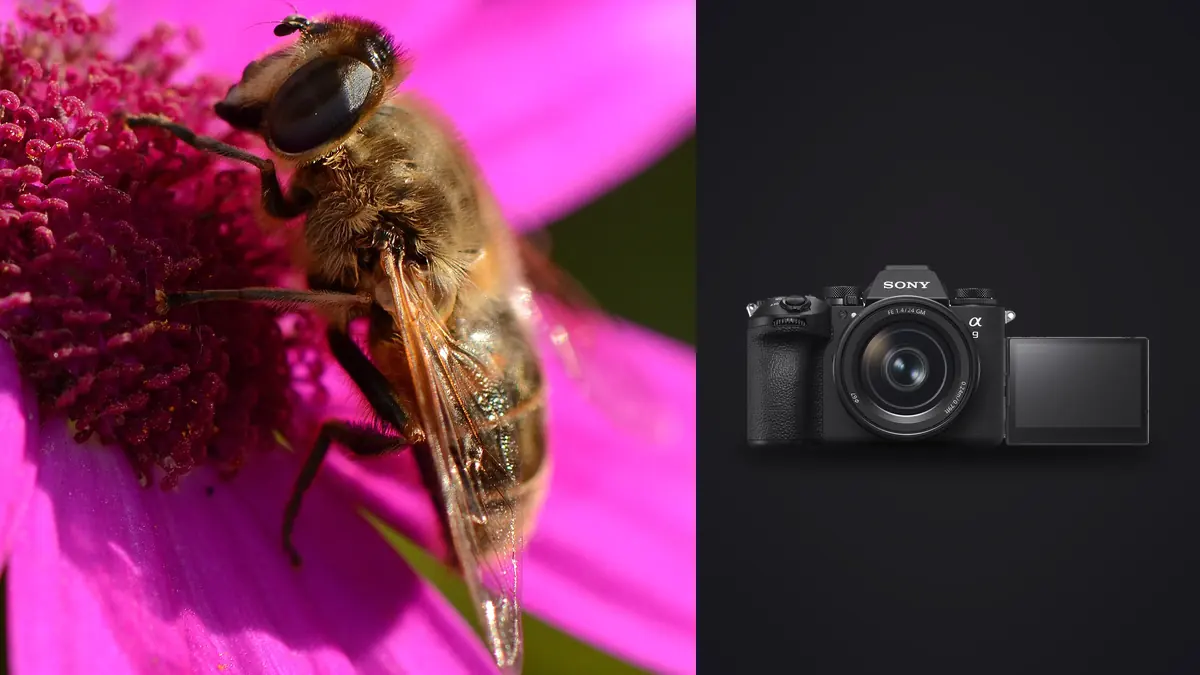
Why the Global Shutter Is the Real Story for Bug Photography
I did not buy the Sony A9 III for macro work. I bought it because I shoot a lot of fast sport, and the global shutter sold itself the first time I saw a baseball bat with zero skew at 1/8000. What I did not expect was how much that same sensor would change the way I photograph insects, and specifically how much it would change my flash technique, which for anyone doing serious bug photography is the whole game.
Most articles about this camera talk about it as a sports and motorsport tool, which it is. Almost nobody talks about what happens when you point a 24.6MP global shutter stacked sensor at a jumping spider two inches from the front element. That is what this piece is about: the parts of the A9 III that matter specifically for macro and insect shooters, the lenses that actually pair well with it, the settings I have landed on after a season of use, and the workflow problem that a 120fps burst rate creates once you get home.
Full Flash Sync at Any Shutter Speed Changes How You Light Bugs
Every macro photographer who works with flash eventually runs into the same wall: your camera's mechanical or electronic shutter has a max sync speed, usually 1/200 to 1/250, and anything faster either forces high-speed sync (which throws away a stop or two of flash power) or gives you a black band across the frame. At macro magnifications, where you are often stopped down to f/11 or f/16 for depth of field and relying almost entirely on flash to freeze a moving insect and separate it from a busy background, that ceiling is a constant fight.
The A9 III's global shutter reads every pixel at once instead of scanning row by row, so there is no rolling curtain and therefore no sync speed limit at all. I have synced flash at 1/16000 with this camera, which sounds like a novelty until you actually use it. It means I can run a small on-camera flash or twin macro flash at full power without switching to HSS, which in turn means more usable light reaching a subject that is often shaded by its own leaf. On a windy day photographing a hoverfly on a swaying flower head, that extra flash power at a shutter speed fast enough to freeze the stem's motion is the difference between a sharp frame and a blurred one.
No Wing Distortion on Fast Fliers
The second, less advertised benefit is that a global shutter has no rolling shutter artifact at all, not reduced, eliminated. Try photographing a dragonfly's wings mid-beat with a rolling shutter sensor at a fast frame rate and you will occasionally get a slight skew or wobble where the wing tip was in a different position when the top of the sensor read out versus the bottom. It is subtle, but at 100% crop on a dragonfly's leading wing edge it shows up. On the A9 III it simply does not happen, because every pixel exposes at the same instant. For anything with wings moving fast (bees, wasps, most flies) this matters more than the megapixel count.
Insect Recognition Autofocus: Genuinely Useful, With Caveats
Sony's real-time recognition AF originally shipped on the A9 III with categories for humans, animals, and birds. Insects were added as a dedicated recognition target in a later firmware update, and it changed how I shoot moving subjects at close range. Point the camera at a bee working a lavender spike and the camera will find the compound eyes and lock there rather than drifting to the nearest high-contrast edge, which on a macro lens at f/5.6 is often a petal, not the insect.
The caveat: insect recognition works best when the subject has some size in the frame and reasonable separation from the background. At 1:1 or higher magnification, where the whole frame might be one eye and part of a leg, the algorithm sometimes hunts because there is no obvious "whole insect" shape to lock onto. In that situation I switch back to a single small AF point and manual focus rock (physically rocking forward and back at the point of focus) rather than trusting the tracking. For anything perched and still, like a resting butterfly or a spider in its web, I turn recognition off entirely and use focus bracketing instead, which the A9 III has built in as a native shooting mode.
Lens Pairings That Actually Work for Macro and Insects
The A9 III body does nothing for magnification on its own; the lens is doing all the work. Here is what I have used on this body over a season of shooting, with the numbers that actually matter for bug work rather than a generic spec dump.
| Lens | Max Magnification | Working Distance at 1:1 | AF Speed with A9 III | Notes for Insect Work |
|---|---|---|---|---|
| Sony FE 90mm F2.8 Macro G OSS | 1:1 | ~9 in / 23 cm | Fast, quiet, tracks recognition AF well | Best all-round choice; OSS helps handheld framing on flowers |
| Sigma 105mm F2.8 DG DN Macro | 1:1 | ~11 in / 29 cm | Fast, occasional hunting past 1:1 | Extra working distance is kinder to skittish subjects |
| Sony FE 50mm F2.8 Macro | 1:1 | ~2.4 in / 6 cm | Fast but working distance is the problem | Too close for most live insects; better for static subjects |
| Laowa 100mm F2.8 2X Macro APO | 2:1 | ~6 in / 15 cm at 2:1 | Manual focus only, no electronics | For extreme magnification on cooperative or dead-still subjects; the A9 III's global shutter EVF blackout-free feed helps manual focus tracking |
| Sony FE 300mm F2.8 GM OSS + extension tube | ~1:4 | 6.5 ft / 2 m | Very fast, full recognition AF | Odd but effective for large, wary insects like dragonflies you can't approach closely |
The 90mm G OSS is what stays mounted most days. It is the only one on this list with real autofocus performance the A9 III's tracking system can fully use, and the working distance is enough that a bee will tolerate you getting the shot before it moves on. The Laowa is a special-occasion lens: fully manual, and honestly better paired with a slower shutter and a tripod than with anything the A9 III's speed advantages are built for. I include the 300mm GM combination because it is the one nobody suggests and it solves a real problem, photographing dragonflies perched over water that will not let you within six feet.
120fps Bursts Solve One Problem and Create Another
Insects do not hold still, and even the ones that mostly do (a resting butterfly, a spider in a web) sway with every breath of wind. The A9 III's ability to shoot RAW bursts at up to 120fps with full autofocus calculation between frames means that during a two-second window where a bee's antennae, legs, and wings are all in slightly different positions, I can grab dozens of frames and pick the one where everything lines up. This is a real advantage over a camera capped at 10 or 20fps, where you might get three usable frames of that same window instead of thirty.
The problem is obvious the moment you get home. A single afternoon at a wildflower meadow chasing bees and hoverflies with bursts left me with over 4,000 frames, and the vast majority of any given burst is redundant: the same bee in nearly the same position, five or ten frames in a row. Scrolling through that manually in Lightroom, zooming to check focus on compound eyes frame by frame, is genuinely the worst part of macro photography. This is where I lean on imagic to do the first pass. It scores sharpness locally on the actual insect (not just a general center-frame estimate) and clusters near-duplicate burst frames together so I am reviewing "this bee, best of nine" instead of nine separate thumbnails that all look the same at a glance. Everything runs on the laptop with no upload, which matters when I am culling in a car in a nature reserve parking lot with no signal.
Field Settings I Actually Use
These are not universal recommendations, they are what I have converged on for the A9 III specifically, since the global shutter and the sync speed ceiling being gone changes some of the usual macro advice.
| Subject Type | Shutter Speed | Aperture | ISO / Base ISO Choice | Drive / AF Mode |
|---|---|---|---|---|
| Static insect (resting butterfly, spider) | 1/250 (ambient) or flash-synced up to 1/2000 | f/11 to f/16 | ISO 250 (low base) | Single-shot, focus bracketing, small AF point |
| Bee or hoverfly on flower (semi-mobile) | 1/4000 to 1/8000 flash-synced | f/8 to f/11 | ISO 250-800 | Hi+ burst, Insect recognition AF |
| Dragonfly in flight | 1/8000 (ambient, no flash) | f/5.6 to f/8 | ISO 2500 (second base) | 120fps burst, Insect recognition + tracking |
| Wasp or fly on backlit leaf | 1/500 to 1/1000 ambient | f/5.6 | ISO 250 | Single AF point, no flash, watch highlight clipping |
The second base ISO of 2500 is worth knowing about specifically for dragonflies and other flying subjects photographed without flash: it keeps noise reasonable at the fast shutter speeds you need without you having to shoot wide open, which at macro distances would leave you with almost no depth of field.
From Card to Finished Image: My Actual Workflow
Card to keeper looks like this for me now. I pull the CFexpress card straight into the laptop, no cloud step, because half the places I shoot macro have no signal anyway and I do not want a workflow that depends on one. From there imagic handles the first cull: local sharpness and focus scoring on each frame, burst clustering to collapse those hundred-frame bee sequences into representative groups, and a quick pass to strip the obvious misses (motion blur, closed eyes if you can call it that on an insect, backgrounds that ruined the shot). That step alone used to take me over an hour per outing in a general-purpose photo manager; it now takes closer to fifteen minutes because I am reviewing clusters instead of individual frames. If you want the mechanics of how that kind of automated first pass actually scores sharpness instead of just guessing from file size or a blur filter, I wrote about it separately in how AI photo culling actually works, which goes into more depth than makes sense to repeat here.
After the cull, the second thing that has changed my macro editing specifically is imagic's apply_my_style preset feature. Insect photography edits are repetitive in a specific way: I want the same kind of shadow lift on carapaces, the same slight desaturation pulled back on oversaturated flower petals that would otherwise fight for attention with the subject, on every image from a session. Rather than rebuilding that look from scratch or fighting a generic preset pack that was made for portraits, I trained it on a batch of my own already-edited macro shots, and now new sessions get my actual editing habits applied automatically as a starting point, not somebody else's idea of what a bug photo should look like. I still adjust individual frames, but I am adjusting from something already close instead of from a flat RAW.
Where the A9 III Actually Falls Short for This Use Case
I would be doing this camera a disservice if I only listed the wins. Three things are worth knowing before you spend $6,000 on a body specifically for bugs.
First, 24.6MP is on the low side if you plan to crop in heavily during editing rather than getting full magnification in-lens. Sports shooters do not mind because they are usually filling the frame with a 300mm or 600mm lens; macro shooters sometimes want the crop headroom that a 45 or 61MP body gives you, especially for smaller subjects like jumping spiders where every extra pixel of native resolution is a pixel of extra working distance you did not have to give up.
Second, dynamic range at base ISO is good but not exceptional. Stacked global shutter sensors trade a bit of dynamic range headroom for their readout speed, and on a bright day with a pale insect against dark shaded foliage I have blown highlights on the insect's back that a Sony A7R V would likely have held. In practice, controlled flash largely solves this because you are not relying on ambient dynamic range in the first place, but if you shoot mostly natural light macro without flash, this is a real consideration.
Third, and this is just physics, none of the speed advantages matter if your lens cannot autofocus fast enough to use them. The Laowa and most fully manual macro lenses waste the A9 III's tracking system entirely. If your plan is manual-focus extreme macro at 2:1 and beyond, a cheaper body with a better EVF magnification aid might serve you just as well, and you would be paying $6,000 largely for burst speed and flash sync you are not using.
For context beyond the mastering sony a9 iii for macro insect photography guide focus in entry 59, continue with photography guide library. These resources connect the subject to a practical local review process.
Frequently Asked Questions
Is the Sony A9 III worth buying specifically for macro and insect photography, or only if you also shoot sports?
If macro and insects were genuinely my only subject, I would have a hard time justifying the full price over something like an A7R V, which costs less and gives you more resolution for cropping. The A9 III earns its keep for insect work specifically because of the flash sync ceiling being gone and the insect recognition AF, but those two features alone are a tough sell at $6,000 if you never shoot fast action elsewhere. It is a much easier buy if sports, birds, or other fast subjects are already part of your work and macro is an added bonus.
Do I need flash to take advantage of the A9 III's global shutter for insect photography?
No, but it is where the advantage is largest. Without flash, the global shutter still removes rolling shutter distortion on wing beats and lets you use faster shutter speeds without banding under LED or artificial light, which matters for anyone photographing insects at dawn under garden lighting or indoors in a controlled setup. The unlimited flash sync speed specifically only matters once you introduce a flash unit into the shot.
How many keeper images should I expect from a 120fps burst on a moving insect?
In my experience, roughly one genuinely sharp, well-composed frame per one to two seconds of continuous 120fps shooting on an actively moving subject like a bee, meaning a two-second burst of around 200 frames might yield two or three real keepers once you account for wing position, eye focus, and background. That ratio is exactly why culling software that clusters near-duplicate bursts matters more with this camera than with a slower one; scrolling 200 nearly identical frames by hand is not a reasonable use of an evening.
What macro lens should I start with on the A9 III?
The Sony FE 90mm F2.8 Macro G OSS. It is the only lens in the current native lineup with autofocus fast and reliable enough to make real use of the A9 III's tracking and recognition system, and the working distance at 1:1 is forgiving enough that most insects will tolerate you getting close before it matters. Save extreme magnification lenses like the Laowa 2:1 for a second purchase once you know whether that style of shooting suits you, since they bypass most of what makes this particular body worth the price.