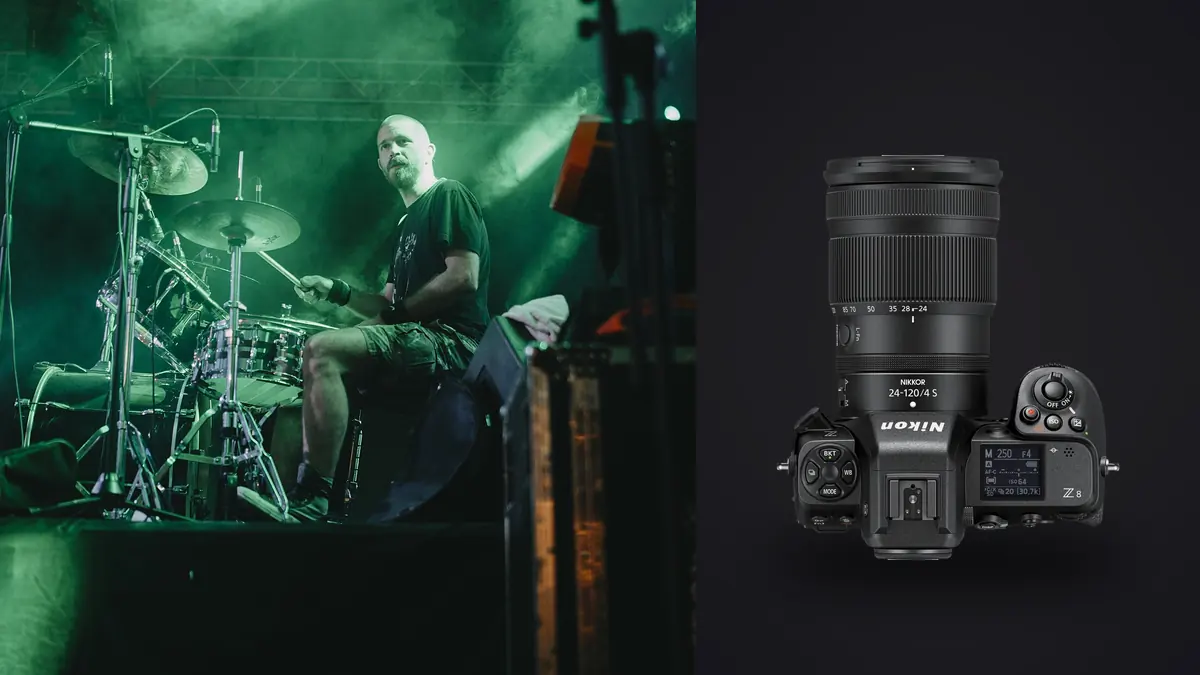
Three songs, no flash, house lights that swing from pitch black to blinding in under a second. That's the deal at most photo pits, and it's a genuinely hostile environment for a camera. I started bringing the Nikon Z8 to shows about a year ago, mostly because I was tired of my previous body hunting for focus every time a guitarist stepped into a red wash. This isn't a spec sheet regurgitation. It's what actually mattered once I was three feet from the barricade with a security guard tapping his watch.
Why the shutter is the first thing that matters
The Z8 has no mechanical shutter at all. Everything is electronic, which sounds like a minor engineering footnote until you're shooting a seated acoustic set where the loudest thing in the room is supposed to be the artist. A clacking shutter in that context gets you a dirty look from the tour manager and possibly escorted out before the encore. With the Z8 you can shoot at any frame rate up to its max burst and the only sound is your own breathing.
It also solves a problem I didn't expect: rolling shutter smear on fast-moving light sources. Stage lighting rigs sweep beams across the crowd constantly, and on cameras with slower sensor readout those beams can skew or band in a frame. The Z8's stacked sensor reads fast enough that I stopped noticing the problem, even panning with a drummer mid fill.
Exposure when your only light source keeps moving
Forget anything you know about "correct" exposure for a portrait session. Stage lighting is designed to look good to the human eye in a dark room, not to sit nicely inside a camera's dynamic range. A single spotlight can blow out a singer's face to pure white while the drummer six feet back is a silhouette. There's no metering mode that fixes that for you.
What I actually set
Manual exposure, always. Auto ISO with a floor around 1/500s for anything with movement (1/320s if the band is genuinely static, which is rare), aperture wide open unless the lens is soft there, and I let ISO float. On the Z8 that usually means somewhere between 1600 and 6400 depending on the venue, and the files hold up fine at those numbers with a bit of noise reduction in post. I'll push to 12800 in tiny clubs with almost no stage lighting and accept the tradeoff.
Metering, and why I ignore it half the time
Spot metering off the performer's face is the textbook answer and it's a reasonable starting point, but I ride exposure compensation constantly because the light changes faster than any metering pattern can track. I'd rather chimp the histogram between songs and nudge exposure than trust the camera to guess correctly on a beam that just went from amber to deep blue.
Autofocus in the pit is a different problem than autofocus anywhere else
The Z8's subject detection is genuinely good at finding a human face in a crowd, but concert lighting throws it curveballs a portrait session never will. Backlit silhouettes against a single kicker light, faces half in shadow from a hat brim, a singer's face lit entirely by the glow of their own in-ear monitor screen. I've had it lose a face for a frame or two under a strobe hit and then snap right back once the light settled.
My workaround is boring but reliable: I keep 3D-tracking or wide-area AF as the default and only drop to single-point when I'm deliberately focusing on something the camera keeps ignoring, like a guitarist's hands on the fretboard rather than their face. I also turn off animal and vehicle detection entirely for gigs. It's one less thing for the AF system to consider when the only subject in the frame is a person.
Lenses for a three-song pit
Most photo pits enforce the first three songs, no flash rule, and you're often shooting from a fixed barricade position with no room to reposition. That changes lens priorities compared to a studio kit.
- A 24-70mm f/2.8 covers the widest range of situations: wide crowd shots from the barricade, tighter frames on the singer if they come close.
- A fast 70-200mm f/2.8 is what actually gets the "money shot" of a guitarist mid-solo from thirty feet back, especially in bigger venues where the pit is roped off further from the stage.
- I've started carrying a 50mm f/1.2 for small clubs specifically because the extra stop matters more than reach does when you're already at ISO 6400 and the room is the size of a living room.
What I've stopped bringing: anything slower than f/2.8. A kit zoom at f/4 or f/5.6 sounds fine on paper until you do the math on how much ISO you're giving up in a dim room, and the Z8's files are good but they're not magic past a certain point.
How the Z8 stacks up against two other bodies I've actually shot shows with
I borrowed a friend's Sony A7 IV for a festival weekend and used a Canon R6 Mark II on a separate assignment last winter. Here's how the three compare on the things that matter specifically for a photo pit, not a general spec sheet.
| Camera | Shutter type | Fastest fully silent burst | Native ISO ceiling | RAW buffer before slowdown | Body weight (w/ battery) |
|---|---|---|---|---|---|
| Nikon Z8 | Electronic only | 20 fps (12-bit RAW) | 25,600 | 1,000+ frames to fast CFexpress | ~910g |
| Sony A7 IV | Mechanical + electronic | 10 fps | 51,200 | Compressed RAW clears in a few seconds, uncompressed fills fast | ~658g |
| Canon R6 Mark II | Mechanical + electronic | 40 fps (full resolution) | 102,400 | ~190 RAW frames | ~670g |
The numbers make Canon look like the obvious low-light winner on paper, and its expanded ISO ceiling is real. But raw ISO headroom isn't the whole story in a pit. The Z8's buffer depth means I can hold the shutter down through an entire chorus without the camera choking, and I genuinely use that more than I use ISO 102,400, which produces files I wouldn't deliver anyway. The A7 IV is the lightest to carry for a four hour set standing at the barricade, and that matters more than people admit after hour three.
What nobody tells you until you've done a few shows
Battery life takes a real hit when you're shooting bursts at 20fps for three songs straight, plus reviewing constantly on the tilting screen. I carry two spares minimum and charge in the car between venues on a multi-band tour. Card choice matters more than I expected too: a slow CFexpress card will still bottleneck that buffer, so don't pair a fast body with a bargain card and wonder why it stutters on song three.
The blackout-free viewfinder is the feature I'd fight hardest to keep if someone tried to take it away. Tracking a singer who jumps off a monitor wedge is genuinely difficult on a camera that blacks out between frames, because you lose the subject at exactly the moment you need to reframe. On the Z8 you can watch the whole arc without the image ever dropping out.
Getting through a few thousand frames without losing the night
A three-band bill shot at 20fps easily produces four or five thousand frames by the time load-out starts, and a huge share of those are near-duplicates from a single burst where the singer's expression barely changed between frames. Sorting that by eye at 1am is how you miss the one usable shot of the night hiding in frame six of an eleven-frame burst.
This is the part of the job where I actually rely on imagic rather than eyeballing thumbnails at full zoom. It scores sharpness locally, so it can tell me which frame in a burst of a drummer's stick mid-swing actually landed in focus rather than me guessing from a laptop screen backstage. It also groups bursts and near-duplicates together instead of dumping four thousand flat thumbnails at me, which turns an hour of scrolling into something closer to fifteen minutes. Because it runs entirely offline, none of the files ever leave my laptop before an artist's team has approved anything, which matters more than people expect when a label wants first look before anything goes anywhere. If you want more on how that scoring actually works under the hood, there's a breakdown at how AI photo culling works.
The other piece that's saved me real time across a run of shows is imagic's apply_my_style preset. I trained it on a batch of gig photos I'd already graded by hand, and it now applies a close approximation of that same look to a fresh set automatically, so a photo from Tuesday's show in Manchester and one from Thursday's in Leeds land in roughly the same place tonally before I ever touch a slider. I still tweak individual frames, but I'm not starting from a flat RAW every single time. For anyone trying to speed up the rest of a shoot-heavy workflow, our tips on a faster photo workflow cover more of that ground.
When the Z8 is more camera than you need
I'll say this plainly because most gear writeups won't: if you're shooting one local band a month in a small venue with decent house lighting, you don't need this camera. A Z6III or even a well-used Z6II will get you usable files at half the price, and the buffer depth advantage only matters once you're routinely shooting bursts long enough to fill it. Where the Z8 earns its cost is multi-act festival days and tour tickets where you're covering three or four sets back to back and can't afford a camera that hesitates.
Frequently Asked Questions
Is the Z8 quiet enough for a strict no-noise photo pit rule?
Yes. It has no mechanical shutter option to accidentally trigger, so there's nothing to disable before a set. Just double check your electronic front-curtain and mechanical shutter settings aren't forcing a simulated sound in the menu, since some bodies add an artificial shutter sound by default that you'll want to mute.
If I can only bring one lens to a gig, what should it be?
A 24-70mm f/2.8 covers the widest range of realistic pit positions and venue sizes. It won't get you a tight headshot from the back of an arena, but for club and mid-size venue work it's the single lens I'd trust over a 70-200mm if forced to choose.
Do I need to shoot RAW for stage lighting, or is JPEG good enough?
Shoot RAW. Stage lighting regularly clips highlights and crushes shadows in ways JPEG's baked-in processing can't recover from. RAW gives you real latitude to pull back a blown spotlight or lift a shadowed face without the banding you'll see trying to do the same to a compressed JPEG.
How many usable photos should I expect from a three-song set?
Out of a few hundred frames from three songs at high burst rates, I typically deliver somewhere between fifteen and thirty final images after culling. The rest are duplicates, blinks, or moments where the lighting simply didn't cooperate, which is normal and not a sign you did anything wrong.