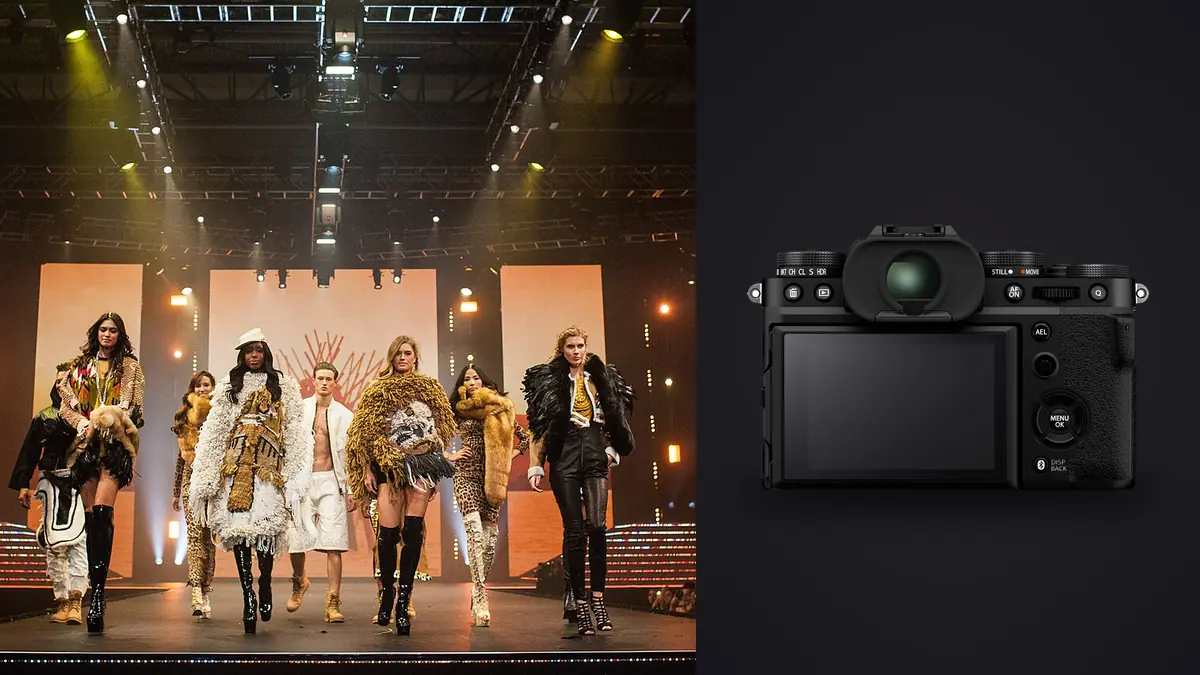
Picture a resort-wear lookbook for a small label: twelve looks, one model, one location, delivered by end of week. The brief says "clean, consistent, catalog-ready." No art direction budget for a stylist assistant, no second body as backup, and a client who wants to approve final images from a shared folder before you touch a single edit. The camera in your bag is a Fujifilm X-T5. This is what that week might actually look like, not the marketing version.
Why the X-T5 keeps showing up on lookbook jobs
Lookbook work is not editorial fashion. Nobody is paying for atmosphere shots of a model disappearing into fog. A lookbook has to show the garment: cut, drape, fabric texture, how a hem moves when someone walks, how a collar sits against skin. That's a resolution and color-accuracy problem before it's a creative one, and it's also a volume problem, because you shoot far more frames per look than the client will ever see.
The X-T5's 40.2-megapixel X-Trans sensor is the first reason it earns a spot in this kind of shoot. Full-frame bodies from Fujifilm's own GFX line or from Sony and Canon obviously out-resolve it in absolute terms, but for lookbook delivery, where images typically get cropped to 4:5 or 1:1 for e-commerce and social, having 40 megapixels of APS-C sensor to crop into is genuinely useful. You can punch into a fabric detail from a three-quarter body shot without the image falling apart at 100% on a retailer's zoom feature.
The second reason is less obvious and more practical: weight. A full lookbook day means holding the camera up for six, eight, sometimes ten hours between wardrobe changes, hair and makeup breaks, and reshoots when a zipper won't sit right. The X-T5 body is 557g. Pair it with something like the XF33mm f1.4 and you're under 900g total. On a full-frame body with an equivalent fast prime, you're often 400-600g heavier, and by hour six of a standing shoot that difference is not trivial.
The multi-aspect sensor thing nobody mentions enough
This is the detail that actually changes how you plan a lookbook shoot list. The X-T5's sensor is built oversized relative to the 3:2 image circle, which means switching the in-camera aspect ratio to 4:3, 1:1, or 16:9 doesn't crop into the sensor and lose angle of view the way it does on most APS-C or full-frame cameras. You get the full field of view at every ratio, just framed differently at capture.
For a lookbook that's going to live primarily on a shopify grid at 4:5 or on Instagram at 1:1, that means I can compose in the actual delivery ratio on the back of the camera instead of guessing where the crop will land later. It sounds like a small thing until you're the one standing in front of a client's laptop at 6pm trying to explain why the hero shot doesn't crop cleanly to square.
Lens choices that actually earn their place in the bag
Don't bring a full lens case to a lookbook shoot. Changing glass mid-shoot while a model is mid-pose kills momentum, and momentum is what keeps a twelve-look day on schedule. Here's what tends to work, not a generic "best lenses for the X-T5" list.
| Lens | 35mm-equivalent | Max aperture | Where it earns its keep on set | Weight |
|---|---|---|---|---|
| XF16-55mm f/2.8 R LM WR | 24-84mm | f/2.8 (constant) | The one-lens answer when you can't change glass between looks; wide enough for full-length in tight studio space, long enough for a tighter three-quarter | 655g |
| XF33mm f/1.4 R LM WR | 50mm | f/1.4 | Standard walking-around length for full-body looks with natural perspective, no wide-angle distortion on garment lines | 360g |
| XF56mm f/1.2 R WR II | 84mm | f/1.2 | Beauty crops, detail shots of embroidery or hardware, backgrounds melted away for e-commerce hero images | 445g |
| XF50-140mm f/2.8 R LM OIS WR | 76-213mm | f/2.8 (constant) | Outdoor lookbooks where you want compression on the garment silhouette without crowding the model or blocking natural light | 995g |
| XF18-55mm f/2.8-4 R LM OIS | 27-84mm | f/2.8-4 | Budget-friendly kit option; genuinely fine for daylight lookbook work where you don't need f/2.8 across the whole range | 310g |
The 16-55mm has become my default because a lookbook rarely gives you room to swap lenses gracefully. That said, on the resort job I mentioned, most of the set was outdoors with strong Mediterranean light, so I actually left the zoom in the bag and shot the whole thing on the 33mm and 56mm, switching bodies of work rather than lenses, and letting the model's positioning do the framing work instead of the lens.
Autofocus and the electronic shutter trade-off
The X-T5's phase-detect AF covers the frame with 425 points and does a reasonable job of tracking a moving subject, but I'll say plainly: it is not as sticky as Fuji's own X-H2S, which uses a stacked sensor built for exactly this kind of tracking work. For a model walking toward camera or a jacket being flipped over a shoulder mid-stride, the X-T5 will hunt occasionally if you're relying on wide-area tracking. What works better in practice is single-point or a small zone, placed on the sternum or collarbone rather than the face, because fabric movement confuses face-detect far more than a static portrait would.
On the shutter question: the X-T5 will do 20fps in electronic shutter mode, which sounds perfect for catching a garment mid-swing, but the sensor isn't stacked, so rolling shutter shows up as skew on fast horizontal movement, a spinning skirt or a fast head turn will visibly lean. For anything with real motion I drop back to the mechanical shutter at up to 15fps, which is plenty for a lookbook (you're not shooting sports) and avoids the wobble entirely. Electronic shutter earns its keep for silent shooting near a meeting or when I need the extra frame rate on something genuinely static, like catching the exact moment fabric settles after a step.
Managing the frame count without losing the day
Here's the part nobody warns new lookbook shooters about: the file count. Twelve looks, three to five setups per look, twenty to forty frames per setup while you wait for the right expression and the right hang of the fabric, and you're looking at 800 to 1,500 RAW files by the end of the day, all at 40 megapixels, most of them near-duplicates of each other with only a millimeter of difference in where a sleeve fell.
This is where the shoot stops being a photography problem and becomes a triage problem. On a shoot like this, I'd run the day's cards through imagic that evening rather than opening Lightroom cold. It clusters near-duplicate bursts (the twenty variations of "model standing, garment settled" collapse into one group instead of twenty separate thumbnails to click through) and scores sharpness locally on the machine, so the actual in-focus frame in each burst surfaces first instead of me squinting at 1,200 thumbnails at 2am. Because it runs entirely on the laptop with no upload step, there's no waiting on anything and no handing unreleased images to a server somewhere while the shoot is still under embargo.
The other piece that mattered for a lookbook specifically: consistency across twelve looks shot at different times of day as the light shifted. The first two looks get graded the way the brief calls for (clean, slightly warm, not too much contrast crushing the fabric detail), and imagic's apply_my_style feature lets you carry that same edit character across the rest of the set without manually matching sliders look by look. That's the difference between a lookbook that reads as one cohesive shoot and one where look seven looks like it was color-graded by someone else. If you're new to how automated culling tools actually decide what's sharp versus soft, this piece on how AI photo culling works covers the mechanics in more depth than I've got room for here.
Battery life and card strategy for a full day
The NP-W235 battery in the X-T5 is rated for roughly 580 frames on CIPA testing, but CIPA numbers assume a shooting pattern nobody actually uses. In real lookbook conditions, chimping the back screen constantly, tethered previewing on a monitor, and long idle stretches during wardrobe changes, you can get closer to 700-900 frames per charge, sometimes more if you're disciplined about the screen timeout. Still, I never run a full shoot day on one battery. Two charged spares live in a jacket pocket, and I swap proactively during outfit changes rather than waiting for a low-battery warning mid-look.
Card strategy matters more on commercial work than personal shooting because there's a client waiting on delivery and no room for "sorry, the card corrupted." The X-T5 has dual UHS-II SD slots, and I run them in backup mode, not overflow, so every frame writes to both cards simultaneously. It costs a little buffer speed on long electronic-shutter bursts, but for a shoot where reshoots aren't an option, that redundancy is worth more than the marginal fps.
What I'd tell someone shooting their first commercial lookbook on this body
Shoot in mechanical shutter unless you have a specific reason not to. Pick one lens per outfit change rather than trying to zoom your way through everything with the 16-55mm alone, your framing gets lazier when you can just twist a ring instead of moving your feet. And build the aspect ratio decision into your shot list before the shoot, not after, because the X-T5 will genuinely let you compose in 4:5 without a crop penalty if you set it up front.
On the editing side, don't underestimate how much a consistent look-to-look color match matters to a client who's going to place these images side by side in a single lookbook PDF or product grid. Culling fast so you're not still sorting bursts at midnight, and keeping the grade consistent across every look, matters as much as any single camera setting. If your current workflow has you dragging through folders one image at a time, these workflow tips are worth a look regardless of which camera body you're shooting.
Frequently Asked Questions
Is the X-T5's APS-C sensor a real limitation for commercial fashion clients?
Not for lookbook and catalog work specifically. Clients care about garment detail, accurate color, and consistent framing across a set, not sensor format. Where APS-C shows a real difference is in extremely shallow depth-of-field editorial work or large-format print campaigns, neither of which is what a standard lookbook delivery calls for. Expect little pushback on file size or format once the images are delivered.
Do I need the 50-140mm f/2.8 for a lookbook, or can I get away with primes only?
Depends entirely on the location. Studio and tight interior lookbooks rarely need it, a 16-55mm or a pair of primes covers it. Outdoor lookbooks where you want to compress a garment silhouette against a background, or shoot from across a street without disrupting a model's walk, are where the 50-140mm actually earns its weight in the bag.
How many shots should I expect to take per look on a typical lookbook day?
Plan on 60 to 120 frames per look once you count multiple angles and expression variations, more if the garment has movement (a coat, a skirt, anything with flow) that needs several attempts to land right. That's exactly why burst-aware culling matters here; going through that volume image-by-image at the end of a twelve-look day is the fastest way to burn out on the editing side of the job.
Does the X-T5's rolling shutter actually matter for lookbook work, or is that overblown?
It matters more than most gear reviews suggest, but only in specific situations. Static or slow-movement shots in electronic shutter are fine. Anything with a fast garment swing, a spin, or a quick head turn will show visible skew if you're in electronic shutter at high frame rates. Since a lot of lookbook work is deliberately about capturing fabric in motion, I default to mechanical shutter unless I've got a specific reason to switch.