AI in photography is not one ethical question. A tool that groups similar frames, a tool that smooths skin, and a tool that invents a person perform different acts with different consequences. Ethical review should begin with the purpose, data, affected people, reversibility, and claim made by the output. A general declaration that AI is either beneficial or harmful avoids the decisions a working photographer actually faces.
The useful goal is proportional governance. Low-consequence assistance can run with ordinary review. Decisions that affect a person's representation, privacy, livelihood, legal rights, or the truth of a documentary image require explicit approval and stronger records. Some uses should be prohibited even when software makes them easy.
Classify the action before debating the tool
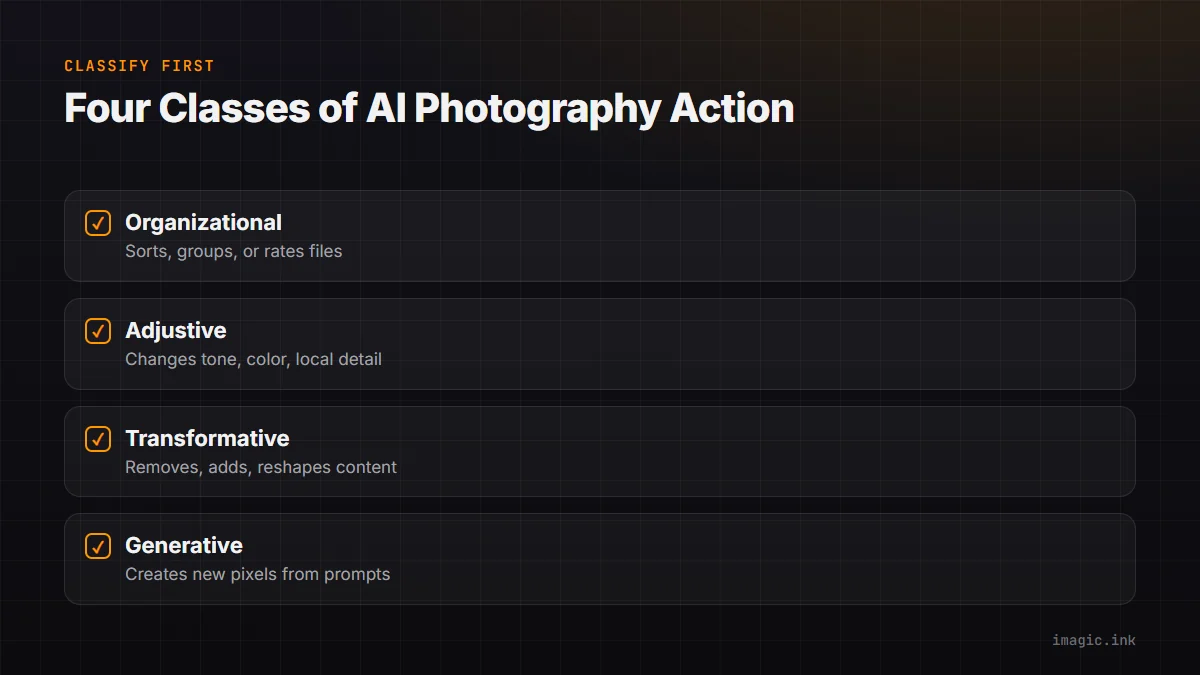
Start with four broad action classes. Organizational systems sort, search, group, or rate existing files. Adjustive systems change tone, color, noise, focus appearance, masks, or local detail. Transformative systems remove, add, reshape, or composite meaningful content. Generative systems create new pixels or assets from prompts and references. Boundaries can overlap, but the classification forces a more precise question.
Then state the output claim. Is the image a personal artwork, commercial illustration, accurate product depiction, portrait, documentary record, news photograph, scientific observation, legal evidence, or client proof? The same background replacement may be harmless in fantasy art and unacceptable in evidence. Ethics follows the relationship between operation and claim.
Record who is affected: photographed people, photographer, client, public audience, rights holder, editor, and workers whose tasks or credit change. Efficiency for one participant can transfer risk or unpaid review to another.
Recognize legitimate benefits without exaggeration
Organizational assistance can reduce repetitive navigation through large shoots. Grouping bursts and surfacing likely technical failures gives a photographer more attention for story, consent, and final selection. Adjustment assistance can create consistent starting points, help isolate a subject, or make routine corrections more accessible to people with limited time or motor precision.
Generative and transformative tools can support previsualization, clearly fictional art, privacy-preserving substitutions, set extension, and restoration where the intervention is wanted and disclosed appropriately. They can help a small team explore options before committing physical resources. These benefits are contextual, not proof that every generated output is acceptable.
AI can also expose uncertainty. A confidence indicator, grouped comparison, or visible mask may prompt closer review than an invisible default. Tool designers and studios should favor interfaces that make suggestions inspectable and reversible.
Protect consent and personal identity
Permission to take a photograph is not automatically permission to train a model, generate new poses, alter body shape, synthesize nudity, change expression, or reuse a likeness in another campaign. Releases should describe material uses in language the subject can understand. Sensitive transformations need specific consent rather than an expansive interpretation of a generic clause.
Children, patients, students, employees, and people in dependent relationships may have limited practical ability to refuse. Extra care is required even when a form can be signed. Ask whether the use benefits the subject, could embarrass or endanger them, and would be reasonably expected from the original session.
Consent should remain connected to the asset. Store release scope, restrictions, expiry where applicable, and approved transformations in project records. If an image is separated from that context, a future operator may assume a permission that never existed.
Address bias in culling and representation
Technical systems can perform unevenly across skin tone, lighting, age, disability, cultural expression, makeup, eyewear, movement, and photographic style. A closed-eye detector may misread a deliberate expression. A sharpness model may penalize motion central to the work. A beauty tool may encode narrow norms and erase meaningful features.
Evaluate a tool on the studio's own varied, authorized examples. Inspect false rejections and harmful alterations by group and condition rather than relying on one overall score. Protect unusual frames and provide a direct way to reverse status or edits. Do not allow an opaque score to become a judgment about a person's attractiveness, professionalism, or value.
Representation also affects the final edit. If automated ranking repeatedly favors one face, pose, or lighting condition, a technically efficient gallery may become socially or narratively distorted. Sequence review must consider who appears, who is missing, and why.
Map privacy and data use
Determine whether originals, previews, embeddings, face data, metadata, prompts, or edits leave the workstation. Read current provider terms for retention, training, human access, subprocessors, deletion, and regional processing. Consumer and business plans may differ. Contractual requirements and local law can impose stricter duties.
Local processing reduces one external data path but does not solve weak passwords, unencrypted drives, shared caches, malware, remote support, or uncontrolled backups. Cloud processing can offer mature security controls yet introduce provider and account dependencies. Evaluate the entire system rather than treating location as a complete answer.
Use minimization. Process only the files and metadata needed for the task, restrict access, remove temporary copies, and retain logs without unnecessary personal data. A useful feature does not justify indefinite storage of every rejected frame.
Preserve truth appropriate to the genre
Documentary integrity is not identical to visual purity. Cropping, tonal adjustment, and color correction have long been part of photography, but publishers and genres define acceptable limits. Generating a person, moving an object, combining moments, or changing environmental conditions can alter the factual claim. Follow the strictest applicable editorial policy.
Commercial images also make truth claims. Product color, size, included features, food appearance, property condition, and before-and-after results can influence decisions. A generated improvement may be misleading even when the image is not journalism. Legal review may be needed in regulated advertising.
Keep the original, edit record, approvals, and final output. When disclosure is required, use direct language. "AI-assisted" can be too vague if audiences need to know that a background, person, or product feature was generated.
Consider labor, credit, and professional accountability
Automation can remove repetitive work, but it can also transfer responsibility to an operator who must inspect more variations in less time. Define review scope and schedule realistically. Do not promise that generated options are free merely because they are quick to request; selection, correction, rights review, and delivery still require skilled labor.
Credit should describe contribution honestly. A captured-and-retouched photograph, a composite, and a primarily generated illustration may warrant different attribution. Client teams should know who approved the prompt, source assets, retouching, and final claim. Accountability cannot be delegated to the software vendor.
When a workflow changes a role, provide training and update job expectations. Hidden automation can undermine trust inside a team just as undisclosed transformation can undermine trust with an audience.
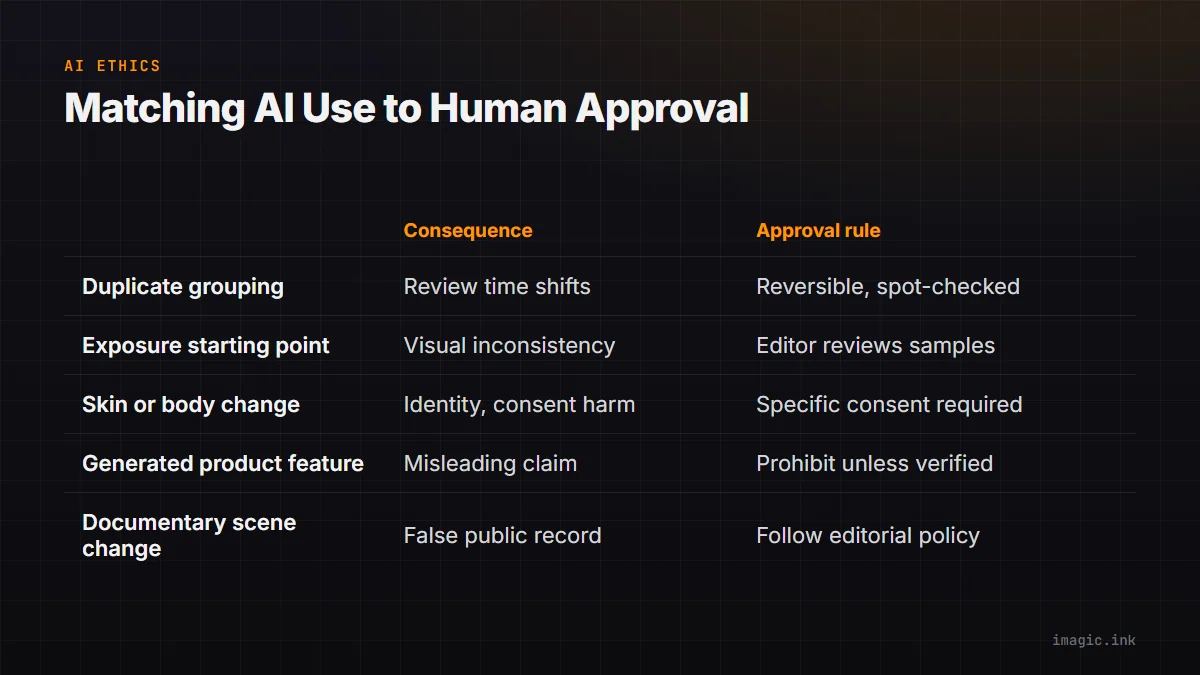
Match human approval to risk
| Use | Typical consequence | Approval rule |
|---|---|---|
| Duplicate grouping | Extra or missed review work | Reversible status plus exception pass |
| Exposure starting point | Visual inconsistency | Editor reviews representative scenes |
| Skin or body alteration | Identity and consent harm | Specific brief, consent, and final approval |
| Generated product feature | Misleading commercial claim | Prohibit unless verified and legally approved |
| Documentary scene change | False public record | Follow editorial policy, often prohibit |
Risk increases with irreversibility, scale, sensitivity, and the difficulty of detecting an error. A suggestion shown to one editor is different from an automatic alteration published to a large audience. Configure checkpoints at the transition, not as a retrospective promise to review everything eventually.
Ask vendors and internal teams precise questions
- What data enters the feature, where is it processed, and how long is it retained?
- Can inputs or outputs be used for training, service improvement, or human review?
- Which model and application changes can alter behavior?
- Can every decision be inspected, overridden, and exported with an audit trail?
- How are errors reported, and what happens after interruption?
- Which rights does the provider claim in input and output?
- What happens to projects if the account, service, or license ends?
An evasive answer is a risk signal. Marketing statements should not replace current terms, security documents, compatibility information, and a test using approved material. Reassess when the provider or use changes.
Use a written stop rule
Some conditions should halt automation: uncertain consent, unsupported camera files, unexpected model behavior, a protected documentary category, missing originals, an unapproved cloud transfer, or an export destination that has not been confirmed. A stop rule helps an operator resist schedule pressure when the next click could create a larger problem.
imagic's documented culling changes status without deleting sources, edits are non-destructive, and processing happens on the local machine. Its agent instructions also require confirmation before exporting somewhere new. Those properties support reversible control, but the photographer remains responsible for selection, consent, security, and output. See the local workflow and the AI and Technology section for related context.
A defensible AI policy is specific enough to guide a difficult frame. It identifies the allowed act, protected person or claim, reviewer, record, and point at which the tool must stop.
Create an appeal and incident-response path
People affected by an automated selection or alteration need a way to challenge it. A subject may object to a body change, a photographer may find that a significant frame was rejected, or a client may discover a generated product detail that was never approved. Record the contested asset, preserve the original and system state, pause further distribution when appropriate, and route the decision to a named human with authority.
An incident plan should distinguish privacy exposure, unauthorized generation, discriminatory behavior, false publication, corrupted files, and ordinary quality defects. Each category has a different response. Privacy events may require security and legal notification; a documentary alteration may require an editorial correction; an unreliable mask may require rollback and rework. Do not conceal a serious event inside routine retouching notes.
After resolution, document cause, affected scope, corrective action, and the policy or technical control that will change. Recheck similar projects rather than assuming the reported asset was unique. Preserve enough evidence for accountability while minimizing further circulation of sensitive images.
Appeal is also a design test. If a team cannot explain which input, setting, model, and reviewer produced a consequential outcome, the workflow is too opaque for that use. Move the action into a lower-risk category, add a checkpoint, or stop using the feature until a reliable review path exists.
Frequently asked questions
Is using AI for photo culling unethical?
Not inherently. It can reduce repetitive review when decisions are reversible and exceptions receive human attention. Risk rises if scores silently erase meaningful or unevenly represented frames.
Does consent to photography include consent to generative edits?
Not automatically. Material changes to likeness, body, expression, or reuse should be covered by specific, understandable permission and the applicable contract or law.
Is local AI ethically safer than cloud AI?
It can reduce external data exposure, but local security, bias, truth, consent, and human review still matter. Evaluate the complete use rather than one technical location.