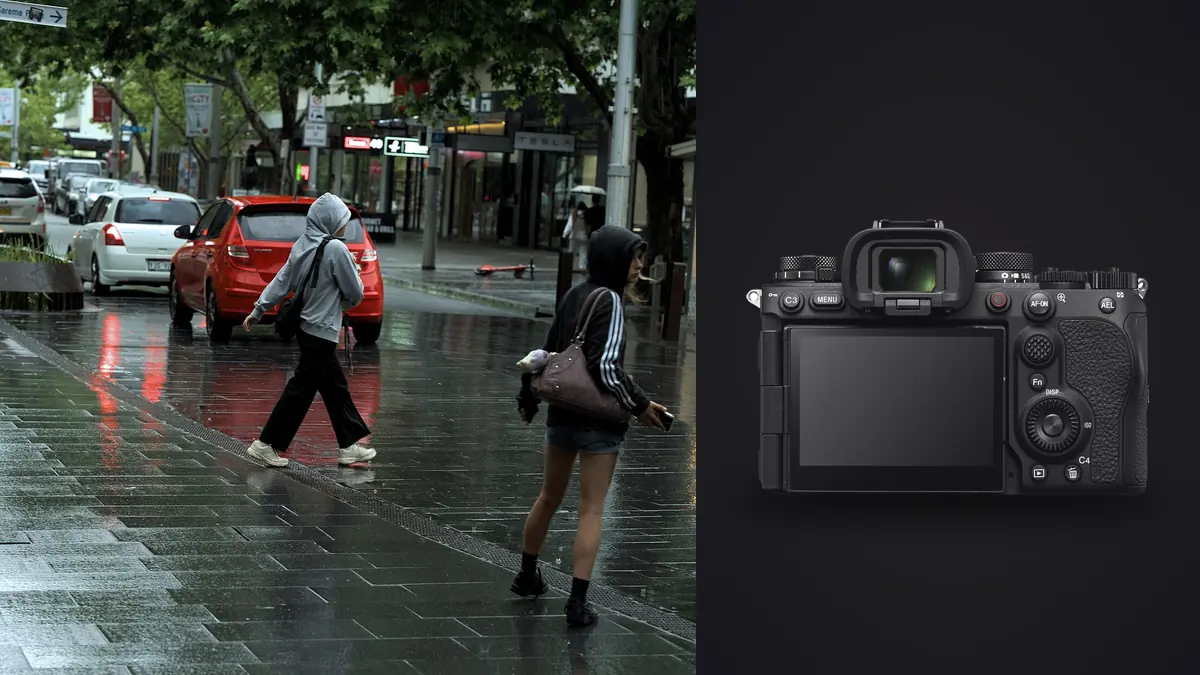
The Sony A9 III was built for sideline sports shooters chasing a football through a scrum, not for someone drifting through a night market with a 35mm prime. That mismatch is exactly why it's interesting on the street. A camera engineered to freeze a cyclist mid-crash turns out to solve a handful of problems that documentary photographers have quietly tolerated for years: rolling shutter skew on fast pans, banding under sodium streetlights, and the flat, mechanical clack of a shutter going off six inches from someone's face. I've spent the better part of four months carrying one on assignments that had nothing to do with sports, and the results are more mixed, and more specific, than the marketing suggests.
Why a sports camera keeps showing up in my street bag
The headline feature of the Sony A9 III is the global shutter, a first for a full-frame body. Every pixel on the sensor exposes and reads out at exactly the same instant, instead of the usual rolling shutter sweep that scans the frame line by line in a few milliseconds. On paper that sounds like a spec-sheet curiosity. On a street corner it means a cyclist cutting diagonally across your frame doesn't come out leaning like a skewed parallelogram, and a subway train pulling into a platform doesn't warp along its length the way it does on nearly every other mirrorless camera I've used, my own A7 IV included.
There's no mechanical shutter in the A9 III at all. Sony didn't just add a fast electronic option, it removed the mechanical curtain entirely, because the global shutter design doesn't need one. That has a side effect worth caring about if you shoot people up close: there's no shutter slap, no mirror or curtain sound, just a small artificial click you can turn off completely. Working a crowded street market, that difference is the gap between people noticing you and people not noticing you.
The global shutter changes what "fast" actually means here
Rolling shutter distortion is the obvious win, but the quieter benefit is how the sensor behaves under artificial light. Fluorescent tubes, cheap LED signage, and sodium vapor streetlights all flicker at a rate tied to AC power, and rolling shutter cameras shooting fast electronic bursts under that light get visible banding, dark or discolored stripes across the frame that shift from shot to shot. I've thrown away entire sequences shot under strip-mall lighting on older bodies because of this. The A9 III's global shutter reads the whole frame at once, so that banding effect essentially disappears without needing an anti-flicker scan mode that slows the camera down to compensate.
Flash sync without the ND filter dance
The other consequence of no mechanical shutter is flash sync at any shutter speed, all the way to 1/80,000s. For documentary work that includes staged portraits (a shopkeeper in a doorway, a fixer introducing you to a subject in harsh noon light), that means you can use fill flash at f/1.4 in direct sun without stacking neutral density filters or dropping to a sync speed that forces you to stop down and lose your background separation. I used this exactly twice on a recent trip, both times for environmental portraits where the light was ugly and a pop of off-camera flash saved the frame. It's a niche use case for pure street shooting, but if your documentary work drifts into portraiture, it's a real advantage, not a marketing bullet point.
What you give up for that sensor
None of this is free. The global shutter architecture trades away some dynamic range compared to a conventional stacked sensor. Shadow recovery on the A9 III is noticeably less forgiving than what I get out of the A7 IV, maybe a stop and a half worse in the deep shadows when I push files hard in post. For street photography that leans into contrasty light, doorways, underpasses, the gap between a blown highlight and a blocked shadow, that matters. I've started exposing slightly more conservatively on the A9 III than I would on other bodies, biasing toward protecting shadow detail rather than trusting it to hold.
Resolution is another compromise. At 24.6 megapixels it's not chasing detail the way the A7R V or even the standard A7 IV crop flexibility would let you. For most street and documentary delivery that's genuinely fine, publications rarely need more than that, but if you like to crop aggressively in post to re-frame a moment you almost missed, you have less room to work with than on a higher-resolution body.
Then there's size, weight, and price. At just under six thousand dollars body only, and roughly 700 grams before you attach a lens, this is not a discreet, light travel camera in the way a Fujifilm X100VI or a Leica Q3 is. Paired with a 35mm f/1.4 GM it's a substantial handful, and after eight hours walking a city grid for a documentary assignment, that weight shows up in your shoulder before it shows up in your images.
Autofocus in a crowd that won't hold still
The 759-point phase-detection AF system covers about 93 percent of the frame and includes subject recognition trained on human pose, not just face and eye. That distinction matters more on the street than it does at a stadium. A sports camera tracking a running back knows where a body usually is relative to a ball; on a sidewalk, the same pose-recognition logic keeps a lock on a subject even when they turn away, duck behind a pole, or get partially blocked by another pedestrian for a beat. I tested this deliberately at a crowded festival, tracking a single person through foot traffic for close to thirty seconds, and the AF box held onto them through two partial occlusions without hunting.
The viewfinder helps this feel usable in practice. It's a 9.44-million-dot EVF that can refresh at up to 240fps, and combined with the global shutter there's genuinely no blackout during continuous shooting. You keep a live, smooth view of the scene while firing a burst, which sounds like a small thing until you've missed a peak expression on another camera because the viewfinder froze on a black frame for a tenth of a second at exactly the wrong moment.
How it stacks up against other street-friendly bodies
| Camera | Shutter type | Max flash sync | Rolling shutter skew on fast pans | Body weight (approx.) | Launch price (body only) |
|---|---|---|---|---|---|
| Sony A9 III | Global shutter, fully electronic | 1/80,000s (any speed) | None | ~703g | $5,999 |
| Sony A7 IV | Mechanical / rolling electronic | 1/250s | Noticeable on fast pans | ~659g | $2,499 |
| Fujifilm X100VI | Leaf shutter, hybrid | 1/4000s (leaf, all apertures) | Minimal (leaf shutter) | ~521g | $1,599 |
| Leica Q3 | Mechanical / electronic hybrid | 1/2000s (mechanical) | Mild on electronic shutter | ~743g | $5,995 |
The X100VI wins on every discretion and portability metric and costs a third of the price, but it can't track a moving subject through a crowd the way the A9 III does, and its leaf shutter caps out well below the A9 III's sync speed range. The comparison isn't really "which is better," it's "which trade-off matches your actual shooting."
The buffer creates a culling problem nobody mentions in the reviews
Continuous shooting tops out at 120fps with full AE and AF tracking, and the buffer is deep enough to sustain that for a genuinely long run before it slows down. That's fantastic for not missing a moment. It's also a way to generate four hundred nearly-identical raw files from an eight-second sequence of someone crossing a street, and every one of those files needs to get looked at, compared against its neighbors, and either kept or discarded before you can even start editing.
This is where I lean on imagic rather than scrubbing through a burst manually in a Lightroom filmstrip, using the same local sharpness scoring and burst grouping I've written about in how AI photo culling actually works. It runs entirely on my machine (no upload queue, which matters when I'm shooting in places where I don't want images leaving my laptop before I've reviewed them myself), and it groups burst sequences and near-duplicate frames automatically so I'm comparing four or five real candidates from that eight-second run instead of four hundred. Its local sharpness and focus scoring also catches the frames where the pose-tracking AF held focus on a shoulder instead of an eye, which happens more often in the pose-recognition mode than Sony's marketing implies.
What happens to the files after the shoot
Documentary work usually means editing fast and editing consistently, especially if you're filing to an editor same-day or delivering a set to a client the next morning. One thing I didn't expect to like as much as I do is imagic's apply_my_style preset, which trains itself on edits I've already made rather than shipping a generic film-emulation look. After feeding it a folder of A9 III files I'd graded by hand, it started replicating my actual white balance habits and contrast curve on new imports close enough that I'm doing touch-ups instead of full re-edits on most frames. For a body that can hand you several hundred images from a single afternoon out shooting, that consistency is the difference between a two-hour edit session and a six-hour one.
None of that is specific to the A9 III, obviously, any high-volume shooter benefits from faster culling and consistent grading. But the A9 III's shooting speed makes the volume problem worse than most cameras do, so the tooling around it matters more than it would with a body that tops out at 10fps.
Battery, cards, and the practical stuff nobody photographs
CIPA-rated battery life sits around 530 shots per charge with the same NP-FZ100 pack Sony has used across the A7 and A9 lines, which is respectable but not exceptional given how power-hungry a 120fps global shutter sensor and a 240fps EVF refresh can be if you're chimping and burst-shooting all day. I carry two spares on a full documentary day and have used both by early evening on busier days. Dual card slots (CFexpress Type A and SD) let you shoot to both simultaneously for a live backup, which is worth doing for anything you can't reshoot, like one-off protests or anything with a hard deadline and no do-over.
Who this camera actually makes sense for
If your street photography is mostly slow, deliberate, zone-focused walking-around work, a heavy six-thousand-dollar sports body solves problems you don't have. A Ricoh GR or the Fujifilm X100VI will serve you better and weigh a third as much. Where the A9 III earns its keep is documentary work that mixes unpredictable human movement with difficult lighting: protests, transit, night markets, anything where subjects move erratically and the light is doing something ugly like flickering LED signage or harsh midday sun you need fill flash to fight. I'd point a photojournalist covering breaking news or a documentary shooter working night shifts at this camera before I'd point a pure street photographer at it. The tool is specific, and it's expensive enough that the mismatch costs you real money if you guess wrong.
Frequently Asked Questions
Is the Sony A9 III overkill for casual street photography?
For slow, observational street work where you're not chasing fast-moving subjects, yes. The camera's strengths (global shutter, extreme burst speed, pose-tracking AF) solve problems that mostly show up when subjects are moving unpredictably or light is flickering. A lighter, cheaper, more discreet camera will serve casual street shooting better.
Does the lack of a mechanical shutter make the A9 III quieter on the street?
Yes. Because there's no mechanical curtain at all, the camera can shoot completely silently, and the artificial shutter sound (added for feedback) can be switched off entirely. This is one of the more genuinely useful traits for documentary work where you don't want to announce every frame you take.
Will the A9 III's global shutter actually fix rolling shutter skew on panning shots?
In practice, yes, and it's the clearest visible difference from a conventional sensor. Subjects moving quickly across the frame (cyclists, trains, cars) come out without the leaning or stretching distortion that rolling shutter sensors introduce during a fast pan.
How many raw files does a typical street burst on the A9 III produce?
At 120fps, an eight to ten-second burst can easily produce 300 to 400 raw frames. That volume is manageable if you have a culling workflow built around burst grouping and automated sharpness scoring rather than reviewing each frame individually; without one, it becomes the slowest part of the entire shoot.