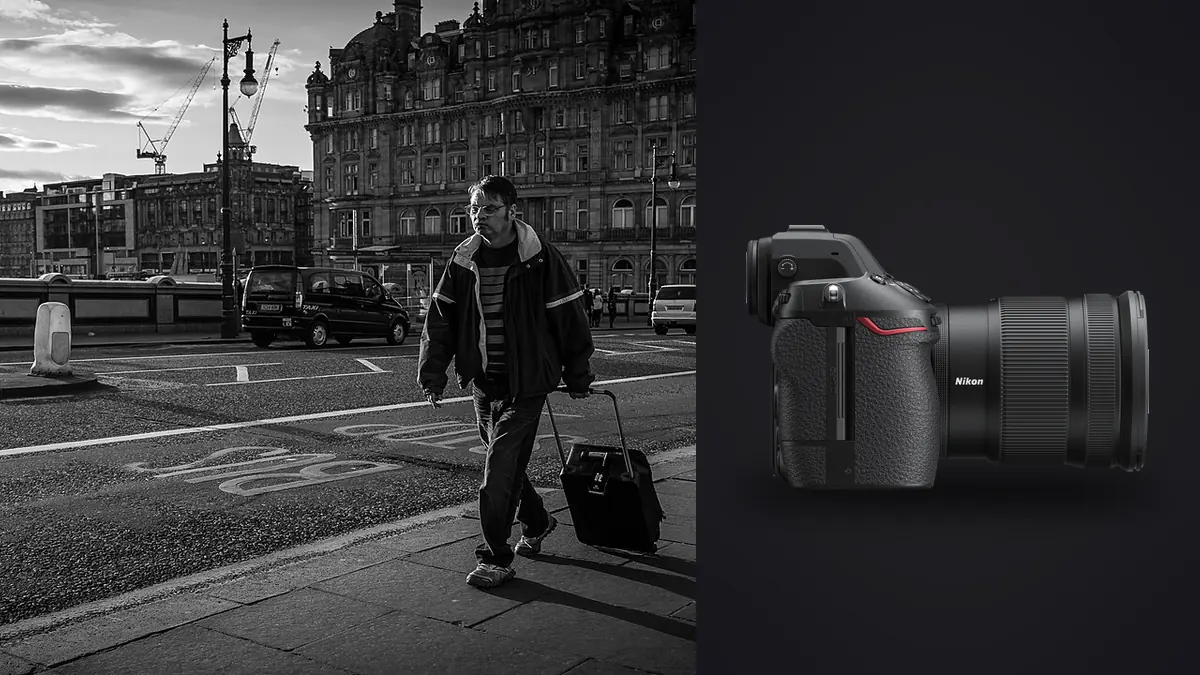
I put a Z6 II down for good about eighteen months into a long-term documentary project following a fish market co-op through its last season before a redevelopment closed it. The camera kept doing the thing DSLRs and early mirrorless bodies both do: blacking out at the exact half-second I needed to see the frame, right as a hand crossed a face or a kid ducked under a stall table. I switched to the Z8 mostly out of spite, expecting to just tolerate a bigger, heavier body in exchange for a viewfinder that didn't quit on me. What I didn't expect was how much the rest of the camera would end up mattering just as much for this kind of work.
This isn't a spec sheet regurgitation. It's what changed in practice once I started carrying the Z8 through markets, protests, a couple of long hospital-adjacent shoots, and a lot of very ordinary sidewalks, and where it still gets in its own way.
Why the viewfinder is the actual headline feature here
Nikon rates the Z8's EVF at 3.69 million dots with a 120fps refresh option, and on paper that reads like a minor bump over cameras from three or four years ago. In practice, for street and documentary work, the thing that matters isn't the dot count, it's that the finder never cuts out while the buffer is writing. On the Z6 II, a burst of six or seven frames would blank the viewfinder for long enough that I'd lose the thread of a moving scene and have to re-find my subject. On the Z8 you watch the action continuously through a 20fps run. That sounds like a small thing until you're following someone's hands as they gut a fish or gesture mid-argument, and you realize you never lost visual contact with the moment.
No mechanical shutter changes what rooms you can work in
The Z8 has no mechanical shutter at all, the same design choice Nikon made on the Z9. In fully silent mode there's no click, no vibration, nothing. I've used this in a small courtroom gallery, at a wake, and inside a mosque during Friday prayers, three settings where a DSLR's shutter slap would have been genuinely disruptive and where I would not have gotten the shot otherwise, or wouldn't have been allowed to try. The tradeoff is that a fully electronic shutter brings rolling shutter risk back into the conversation. Fast horizontal pans, or subjects moving quickly across frame under low light where the sensor read speed slows down, will occasionally show skew. I've had a handful of frames where a passing cyclist looks slightly slanted. It's rare enough not to change how I shoot, but it's real and worth knowing about before you rely on silent mode for anything that pans hard.
It is not a small camera, and it won't disappear
I want to push back on some of the marketing language around the Z8 as a "compact Z9." At roughly 910g body-only it is lighter than the Z9, but it is not light, and paired with even a modest lens like the 40mm f/2 it's still a visibly serious camera. If your mental benchmark for street discretion is a Fujifilm X100-series body or a Ricoh GR, the Z8 will not get you there. What it does buy you is a camera nobody mistakes for a phone, which has its own value in documentary contexts: people register you as working, not sneaking, and in my experience that changes how they react more than raw size does. Bigger cameras get you asked "what's this for," small cameras get you asked nothing and sometimes get you a more suspicious reaction when someone notices you afterward.
Lenses that actually stay in the bag
I tried carrying a 24-70mm f/2.8 for the first few weeks and gave up on it entirely for this kind of shooting. Zooms invite you to stand still and compose, and documentary work rewards moving your feet and committing to a focal length. Here's what's actually earned a permanent spot in the bag, with real weights, not brochure numbers.
| Lens | Focal length | Weight | Max aperture | Where it earns its keep |
|---|---|---|---|---|
| NIKKOR Z 40mm f/2 (SE) | 40mm | 135g | f/2 | Default walk-around lens; small enough that it doesn't change how the camera reads on the street |
| NIKKOR Z 28mm f/2.8 | 28mm | 155g | f/2.8 | Interiors, market stalls, anything where you need the environment in the frame with the subject |
| NIKKOR Z 35mm f/1.8 S | 35mm | 370g | f/1.8 | Low-light interiors, night market work, when you need real subject separation |
| NIKKOR Z 50mm f/1.8 S | 50mm | 415g | f/1.8 | Closer, more deliberate portrait-documentary frames, less useful for reactive grabs |
If I had to keep exactly one lens on the Z8 for a week-long assignment, it's the 40mm f/2 SE. It's cheap, it's light enough that a full day of carrying doesn't wreck your neck, and the focal length sits right in the zone where you can shoot a scene wide or step in for a tighter cut without feeling cropped either way. The 28mm comes out when I know I'm going to be working interiors or tight alleys where 40mm won't fit the scene.
Autofocus in scenes that don't cooperate
Nikon's subject detection on the Z8 handles people reliably when there's one clear subject and a reasonably separated background. Street and documentary scenes are rarely that clean. Put the camera on Wide-area AF (Human) in a crowded frame and it will sometimes lock onto the face nearest the center of the frame rather than the person you actually care about, especially if that person is turned away or partially obscured. I've had it grab a mannequin in a shop window once, and it occasionally snags on printed faces on posters and billboards in the background of a scene, which is a genuinely funny failure mode until it costs you a frame you can't get back.
What's worked for me is running back-button AF-ON permanently, keeping the camera in Wide-area AF (Human) as a default, and mapping one of the front function buttons to cycle AF-area modes so I can drop to a single point in half a second when the scene has too many faces for the tracking to sort out reliably. It's a habit that took a couple of weeks to build, but once it's automatic it removes almost all of the false-lock frustration.
The volume problem nobody mentions in the reviews
A 45.7-megapixel sensor shooting at 20fps produces an amount of raw data that catches people off guard the first time they try it on a moving scene. I clocked one afternoon at a street festival where I shot in bursts trying to catch a specific hand gesture during a dance performance, and came home with just over 1,100 frames from about ninety minutes of actual shooting. Multiply that across a five or six day assignment and you're looking at several thousand raw files, the overwhelming majority of which are near-duplicates of each other from the same three-second bursts.
Culling that by hand, frame by frame in a raw processor, is how a week of shooting turns into two weeks of sitting at a desk. This is the part of the Z8 experience that changed my workflow more than any single camera setting: I run the take through imagic before I touch anything else, letting it cluster the near-identical burst frames and flag the sharpest one in each group using its local focus and sharpness scoring, rather than me scrolling through forty frames of the same gesture trying to eyeball which one is actually in focus. It runs entirely on the machine, which matters more than it sounds for documentary work specifically. Some of what I shoot involves people who did not consent to being photographed for publication, or scenes where I'd rather not have raw files touching a cloud service before I've made an editorial decision about what gets used. Not uploading anything until I choose to is not a nice-to-have on this kind of project, it's close to a requirement.
Once the first pass is done, I lean on imagic's apply_my_style preset for the initial grade pass across the keepers. It's trained on my own past edits rather than a generic film emulation, so a batch shot on a grey overcast afternoon in one city and a batch shot in harsh midday sun in another still come out reading as the same project rather than two different photographers' work. I still hand-finish the images that make the final edit, but getting three thousand frames down to a coherent, consistently graded set of two hundred candidates in an evening instead of three days is the actual productivity win, not any single camera feature. If you want the mechanics of how that kind of local culling works, this breakdown of how AI photo culling works covers the sharpness scoring and clustering approach in more detail.
The settings I actually run, day to day
- Aperture priority, with a minimum shutter speed floor around 1/250s for handheld street work, faster if I'm anticipating a fast subject
- Auto ISO with a ceiling around 12800; the Z8's high-ISO files hold up better than I expected up to that point, past it the noise reduction starts eating detail I want back
- Back-button AF-ON, shutter release dedicated to firing only
- Wide-area AF (Human) as the default AF-area mode, with a function button mapped to drop to single-point AF for crowded or ambiguous scenes
- Fully silent electronic shutter as the default mode, switched off only when I know I'll be panning fast enough to risk rolling shutter skew
- Flicker reduction enabled by default, because a lot of the interiors I shoot in are lit with cheap LED fixtures that will band under electronic shutter without it
That last one is easy to miss and it bit me early. A market hall lit with fluorescent tube fixtures produced visible horizontal banding across a whole take before I turned flicker reduction on. It's a one-time menu setting, not something you want to discover after the fact on images you can't reshoot.
Where it actually falls short for this kind of work
Battery life is the honest complaint. Nikon's CIPA rating for the EN-EL15c is conservative and I usually beat it, but a genuinely busy documentary day, heavy EVF use, a lot of chimping to check focus on fast bursts, will still run a battery down faster than the number on the box suggests. I carry two spares as a rule now, three if I know I won't have a chance to charge overnight.
There's no built-in ND filter, which matters more than it sounds like for anyone shooting wide apertures in harsh midday light, a fairly common documentary situation. You end up either stopping down and losing the separation you wanted, or carrying a filter kit, which cuts against the whole point of trying to travel light. And while the subject detection is genuinely good, it still struggles with reflective glass storefronts and scenes with a lot of low-contrast backlighting, hunting for a beat longer than I'd like right when timing matters most.
Price is the other honest one. The Z8 sits meaningfully above a Z6 III, and if your subject matter doesn't actually need 45.7 megapixels or 20fps raw bursts, that gap is real money that could go toward lenses or travel instead. I'd only recommend it for this genre specifically to someone who knows they'll use the frame rate and the silent shutter regularly, not as a default "best camera" recommendation. The same logic applies to the software side of the workflow: it's worth checking what a faster photo workflow actually looks like in practice before assuming more megapixels alone will fix a slow editing process, and it's worth knowing imagic is a one-time purchase rather than another subscription line item before you budget the rest of the kit; the pricing page has the specifics.
Frequently Asked Questions
Is the Z8 quiet enough for sensitive settings like courtrooms, funerals, or religious services?
Yes, in fully silent electronic shutter mode there is no sound and no vibration at all. The tradeoff is rolling shutter risk on fast pans or quick subject movement under certain lighting, so it's worth testing the specific scenario beforehand rather than assuming zero compromise. For genuinely still or slow-moving documentary moments, which describes most of these settings, it's a non-issue.
What's a realistic one-lens kit for a week of street documentary work?
The NIKKOR Z 40mm f/2 SE is the lens I'd choose if forced to pick one. It's light, cheap relative to the S-line primes, and the focal length works for both environmental context and closer, more direct frames without feeling like a compromise either way. A 28mm is the second choice if you know most of the work will happen in tighter interiors.
Does the electronic-only shutter cause problems under LED or fluorescent lighting?
It can, in the form of horizontal banding, if flicker reduction isn't enabled. With flicker reduction turned on in the menu, the camera times exposures to avoid the flicker cycle of most artificial light sources and the banding disappears in the vast majority of cases. It's worth checking on-site with a test burst before committing to a full shoot under unfamiliar lighting.
How do you avoid drowning in raw files after a week of 20fps bursts?
Cull immediately and don't let it stack up. Running the day's cards through imagic at the end of each shooting day, letting it cluster the burst duplicates and surface the sharpest frame from each group locally on the machine, keeps the backlog from ever reaching the "three thousand unsorted raw files" stage that turns editing into a multi-day chore. Doing this daily instead of at the end of the assignment is the single biggest time saver in the whole workflow, more than any in-camera setting.
None of this makes the Z8 the right camera for everyone shooting street or documentary work, and I'd talk a lot of people out of it if pocketability is the priority. But for the specific combination of fast, unpredictable human subjects, mixed and difficult lighting, and a need to work without drawing attention through noise, it's earned its place as the camera I reach for first, heavy as it is.