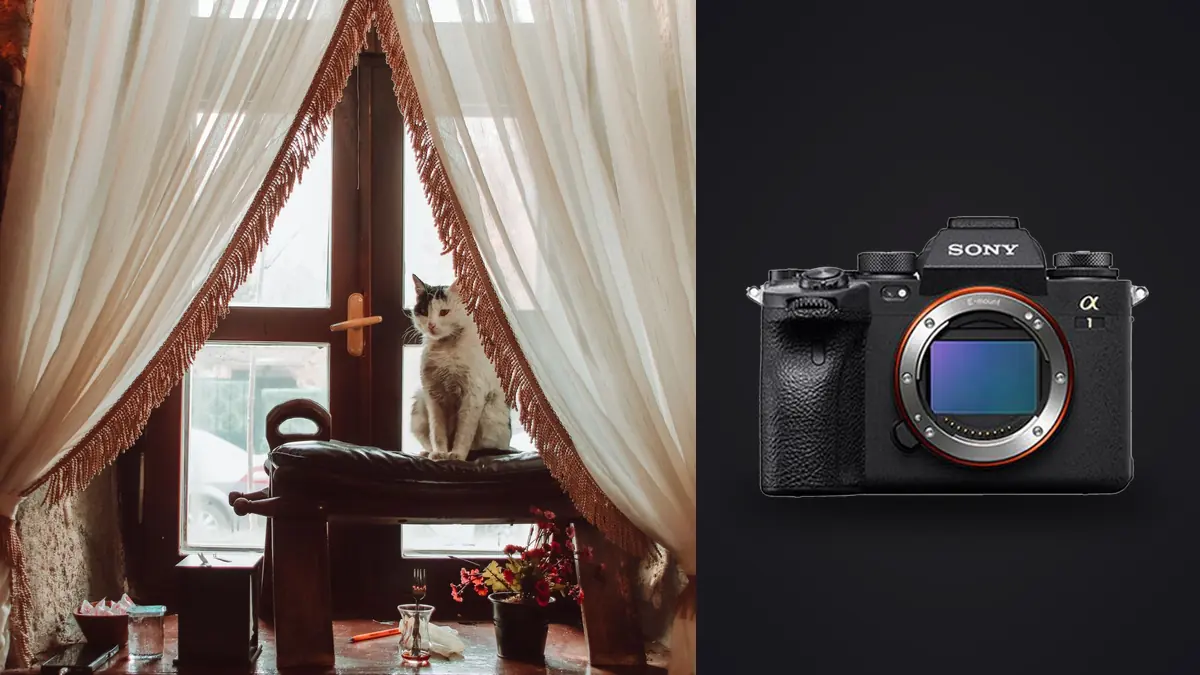
Boudoir is not landscape work. Nobody is standing around for forty minutes waiting for the light to turn. You've usually got a hotel room, a bedroom, or a small studio corner, a client who is nervous about being photographed in the first place, and a shooting window that shrinks the moment anyone starts checking their phone for the time. I've been running boudoir and intimate portrait sessions on a Sony A1 for a bit over two years now, after moving off an A7 III, and I want to walk through what actually mattered in that switch. Not the marketing bullet points. The stuff that changed how a session felt in the room.
The room is almost always darker than you planned for
Even with a softbox or two, most boudoir setups run on ambient-heavy lighting: a single key light bounced off a wall, window light through sheer curtains, maybe a small LED panel for fill. Clients don't want hard studio strobes flashing in their face every three seconds while they're already self-conscious. That means you're frequently working at ISO 3200 to 8000, sometimes higher once the sun drops and you're still finishing the last third of the shoot.
The A1's 50.1-megapixel stacked sensor holds up better than I expected at those ISOs, particularly in skin tones, which is really the only part of the frame that matters here. Shadows under a blanket or a sheet get a bit of grain past ISO 6400, but skin stays clean enough that I'm not fighting noise reduction later and softening detail I actually want to keep. I wouldn't push much past 12800 for final images, but I rarely need to.
The quiet shutter changes how a client behaves, not just how the camera sounds
This one surprised me more than the resolution did. Boudoir clients are hyper-aware of the camera. Every click is a reminder that a photo just got taken of them in a vulnerable pose, and that awareness makes people stiffen up. Shooting on the A1's fully electronic shutter, up to 1/32000, with the blackout-free viewfinder means I can fire off a burst during a natural movement (a laugh, a shift in weight, hair falling across a shoulder) without the mechanical clatter that used to make people flinch and immediately ask "did you get that one?" self-consciously.
It sounds like a small thing until you've run forty sessions with it. Clients relax faster. I get more unposed, in-between frames that end up being the ones they actually love, because they didn't know exactly when the shutter fired.
Autofocus that holds up wide open, in a room too small to back away in
Most boudoir work happens between f/1.4 and f/2, partly for the shallow depth of field and partly because the rooms are dim enough that you need the stop. The problem with wide apertures in tight spaces is that the margin for a missed focus point is razor thin, and there's rarely room to step back and reframe. Eye AF on the A1 tracks through hair, through fabric, through a hand passing in front of the face, and it recovers fast enough that I'm not chimping the LCD after every pose change to check focus.
Lenses I actually reach for
The 85mm f/1.4 GM is my default for anything from the waist up, it's flattering at typical boudoir working distances without the stretched-nose effect you get from a 50mm too close. The 50mm f/1.2 GM comes out in smaller rooms where 85mm just doesn't have enough room to breathe. And the 35mm f/1.4 GM handles the wider environmental shots, a subject draped across a bed with the whole room visible, where I still want subject separation from the background.
| Body | Resolution | Low-light AF rating | Silent shutter | Card slots | Street price (2026) | Where it wins for boudoir |
|---|---|---|---|---|---|---|
| Sony A1 | 50.1MP | -4 EV | 1/32000, fully silent | CFexpress A + SD | ~$6,500 | Crop room plus fast, quiet bursts during movement |
| Sony A7 IV | 33MP | -4 EV | 1/8000 (partial e-shutter) | Dual SD (UHS-II) | ~$2,500 | Best value if you don't need heavy cropping or 8K |
| Sony A7R V | 61MP | -4 EV | 1/8000 e-shutter | CFexpress A + SD | ~$3,900 | More resolution for large prints, slower buffer clearing |
| Canon EOS R5 II | 45MP | -7.5 EV | 1/32000, fully silent | CFexpress B + SD | ~$4,300 | Better AF in near-dark rooms, smaller RAW files |
Two card slots stop being a nice-to-have on this kind of shoot
I've had exactly one card fail on a live job in twelve years, and it happened to be a boudoir session. Nothing about that scenario is fun to explain to a client, and there's no reshoot option when someone has taken a day off, done their hair, and mentally prepared themselves once. The A1's dual CFexpress Type A and SD slots let me mirror every frame to both cards as I shoot, so a card failure mid-session is an inconvenience instead of a disaster. For genres where the images carry real personal weight, that redundancy is worth more than almost any other spec on the body.
The privacy angle matters here too. These are files a client trusts you with completely. I don't run anything through cloud-based culling or editing tools for this work, and honestly I wouldn't want to even if the results were better, because the idea of intimate images passing through someone else's server doesn't sit right with me or with most people who ask about it directly.
What happens after the shutter stops: 50-megapixel files pile up fast
A two-hour boudoir session on the A1, shooting bursts through pose changes, routinely leaves me with 1,800 to 2,500 RAW files. At roughly 60-90MB each, that's a card full of nearly identical frames: the same pose shot six times as a client's expression shifts by a fraction. Sorting that by hand used to eat an entire evening, scrubbing through burst after burst trying to spot the one frame where the eyes are sharp and the chin angle is right.
I moved that part of my workflow to imagic a while back, mainly because it runs the culling entirely on my own machine rather than uploading a folder of sensitive images anywhere. It scores each frame for sharpness and focus accuracy, which matters a lot at f/1.4 where the difference between a keeper and a reject is a few millimeters of misfocus on an eyelash, and it clusters the burst sequences and near-duplicates together so I'm choosing between six similar frames instead of scrolling past all six individually. On a session that size it turns roughly two hours of manual sorting into something closer to twenty-five minutes, and I still make the final call on every image myself. If you're new to how that kind of automated first-pass culling actually works under the hood, this breakdown of AI photo culling covers the mechanics better than I can in a paragraph here.
The other piece I've leaned on is imagic's apply_my_style preset, which is trained on my own past edits rather than a generic filter. Boudoir retouching is subtle work, skin needs to stay skin, not turn plastic, and having a starting point built from how I've actually graded my own previous sessions saves a lot of the early back-and-forth in Lightroom before I get to the parts that need a human eye.
Where the price stops making sense
I'll say this plainly: the A1 is not the right first camera for someone starting a boudoir business. If you're shooting one or two sessions a month and not printing large, the A7 IV will get you results your clients can't tell apart from A1 files, and you'll have thousands of dollars left over for lighting gear, which does more for boudoir images than sensor resolution ever will. I'd only point someone toward the A1 specifically once they're shooting boudoir as a meaningful part of a full-time business, need the buffer depth for burst-heavy sessions, and are cropping hard enough on delivery that the extra resolution earns its keep. For most people building a boudoir portfolio, the lens budget matters more than the body.
Skin tone out of camera versus what happens in the grade
Sony's out-of-camera color has a reputation for running a touch cool and clinical on skin, and I don't think that reputation is wrong. I set a custom white balance shift of roughly +4 amber on most boudoir shoots to compensate before I even open a RAW file, otherwise the base skin tone leans slightly grey next to what a Canon body would give me straight out of camera. It's a five-second camera setting, not a real flaw, but it's worth knowing before your first delivery comes back looking flatter than you expected. Once I'm into the actual grade, consistency across a full gallery matters more than any single image looking perfect, and that's really a color grading workflow question more than a camera one. This guide on photo color grading gets into keeping tone consistent across a full set, which is the harder problem once the shoot itself is done.
Frequently Asked Questions
Is the Sony A1 actually necessary for boudoir photography, or would a cheaper body do the job?
For most photographers starting out, no. The A7 IV covers the low-light autofocus and silent shooting that matter most in this genre for a fraction of the price. The A1 earns its cost mainly through buffer depth and resolution headroom for photographers already shooting boudoir at volume and cropping hard on delivery.
What lens should I pair with the Sony A1 for boudoir sessions?
The 85mm f/1.4 GM is the most versatile choice for close and mid-distance work without distortion. In smaller rooms, a 50mm f/1.2 GM gives more working room, and a 35mm f/1.4 GM handles wider environmental frames where you still want the background to fall away.
Does the Sony A1's silent shutter actually make a difference with nervous clients?
In my experience, yes, more than any other single feature. Clients relax noticeably faster when they aren't hearing a mechanical click every time the camera fires, and it lets you capture natural, unposed moments without the client bracing for the sound first.
How do you deal with hundreds of nearly identical boudoir frames after a shoot?
I run everything through imagic before touching Lightroom. It clusters burst sequences and near-duplicate poses together and scores each frame for sharpness, so instead of scrubbing through every single shot I'm comparing a short list of real contenders per pose. It runs locally on my own machine, which matters a lot given how personal this kind of imagery is.