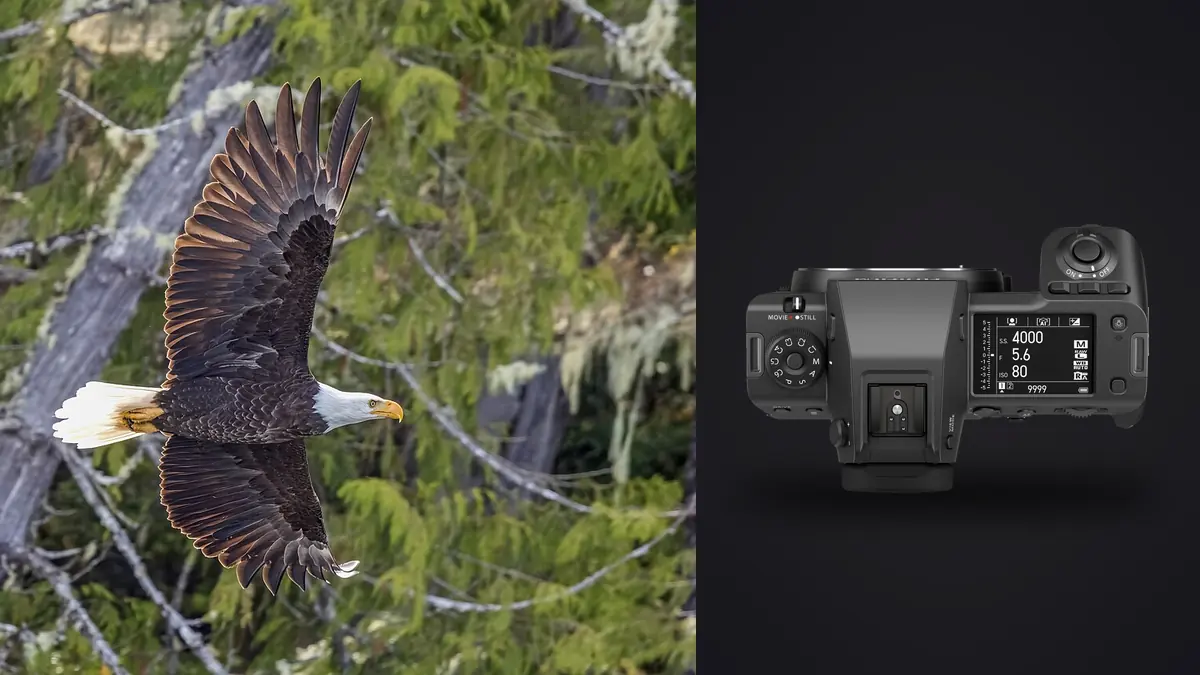
Most people who shoot birds in flight for a living would tell you a 102-megapixel medium format body is the wrong tool for the job, and for the first few outings with the Fujifilm GFX 100 II strapped to a monopod at a wetland reserve, I agreed with them. This is not a camera that was designed with a peregrine stoop in mind. But after a season of dragging it out to herons, gulls, ospreys and one memorably stubborn barn owl, I came away with a more complicated opinion than "buy the stacked-sensor sports body instead," which is the answer you get from almost every wildlife forum thread on the subject.
This isn't a spec-sheet review. It's what actually happens when you point a sensor built for landscapes and studio portraiture at something moving forty miles an hour, and where that combination genuinely earns its keep versus where it just makes you miss the shot.
Why point a medium format body at something this fast
The case for the GFX 100 II in wildlife work has nothing to do with tracking speed and everything to do with what happens after the shutter fires. At 102 megapixels, a bird that fills a third of the frame still leaves you enough resolution to crop hard and print big, or to crop hard and just get the framing you wish you'd nailed in the field. Cut a full-frame 45-megapixel file down by half its linear dimensions and you're left with roughly 11 megapixels, usable but thin. Do the same crop on a GFX 100 II file and you're still sitting on about 25 megapixels, which is more resolution than most dedicated wildlife bodies deliver uncropped.
That math only matters if your subject cooperates by not requiring split-second tracking to begin with. Herons stalking a shallow, ospreys circling a fishing spot, swans doing a slow, telegraphed takeoff across open water: these give you time to compose and pan smoothly, and the GFX rewards that patience with detail you can't get from a smaller, faster sensor. Point the same camera at a flock of swallows working a hedge line and the calculus flips hard against you.
What the autofocus actually does with birds
Fujifilm brought its AI-based subject detection algorithm, the same engine that debuted on the X-H2S and X-T5, over to the GFX line, and it does recognize birds specifically, not just "moving object." In practice it's decent at locking onto a bird's eye once the subject is reasonably large in frame and moving on a predictable line. It's noticeably less confident the moment a bird banks hard, disappears behind a branch and re-emerges, or gets small against a busy background like reeds or tree canopy. I lost more keepers to the system briefly locking onto a foreground twig than to any hardware limitation.
Worth saying plainly: this is not the same tracking experience as a modern sports body. It doesn't have the sheer number of phase-detect points crammed into the frame, and the algorithm sometimes hesitates for a frame or two when a bird changes direction sharply, which for something the size of a swift is the difference between a sharp capture and a blurred one. For anything flying in a straight, sustained line, it's genuinely reliable. For anything doing what a barn swallow does over a pond at dusk, it's a coin flip.
Frame rate, buffer, and the rolling shutter question
Fujifilm rates the mechanical shutter at around 6 fps and the electronic shutter, with the optional booster grip attached, at up to 8 fps. That is workable for wading birds and soaring raptors where the interesting moment (wings fully extended, talons down, the strike) unfolds over a second or two rather than a tenth of a second. It's slow next to what a stacked-sensor body offers, and you feel that gap most during a fast wingbeat sequence, where an 8 fps camera simply records fewer of the in-between positions a wing passes through.
The sensor readout on the GFX 100 II is meaningfully faster than the original GFX100S, which is why Fujifilm can offer an electronic shutter option at all without the image turning to jello. But it is still not a stacked, near-global-shutter sensor. Push the electronic shutter on a fast wingbeat, a duck exploding off the water or a heron's initial downstroke, and you can see skew in the wingtips if you pixel-peep, the classic rolling shutter signature where the top and bottom of the frame were exposed at slightly different moments. For anything with a slower wingbeat cadence, herons, cranes, gulls, it's a non-issue. For hummingbirds or teal, switch back to the mechanical shutter and accept the fps hit.
How it stacks up against the cameras people actually cross-shop
| Camera | Sensor | Resolution | Max burst | Rolling shutter risk | Native reach at f/5.6ish | Body price at launch |
|---|---|---|---|---|---|---|
| Fujifilm GFX 100 II | Medium format BSI CMOS | 102 MP | ~8 fps (electronic, with grip) | Reduced but present | GF500mm f5.6 ≈ 395mm-e | ~$7,499 |
| Sony a9 III | Full-frame, global shutter | 24.6 MP | Up to 120 fps | None, true global shutter | 600mm f4 GM native | ~$5,999 |
| Nikon Z9 | Full-frame, stacked CMOS | 45.7 MP | Up to 20 fps RAW | Minimal | 600mm f4 TC native | ~$5,499 |
| OM System OM-1 II | Micro Four Thirds, stacked | 20.4 MP | Up to 50 fps w/ AF | Minimal | 150-400mm f4.5 TC ≈ 300-800mm-e | ~$2,399 |
Read that table as a set of tradeoffs rather than a ranking. The GFX wins on raw pixel count and loses on everything related to speed and reach per dollar. If your subject list skews toward small, fast, erratic birds in cover, every other camera on that table will land you more keepers per outing. If it skews toward large, slower-moving birds where framing and detail matter more than tracking eight frames a second, the GFX's numbers stop looking so lopsided.
Glass is the honest limitation
This is where the medium format argument gets shakier. Fujifilm's GF lens lineup has exactly one long telephoto built for this kind of work, the GF500mm f5.6 R LM OIS WR. Because the GFX sensor is larger than full-frame, that focal length behaves like roughly 395mm on a full-frame body once you account for the 0.79x crop factor working in the opposite direction from what APS-C shooters are used to. Stack the GF 1.4X teleconverter on it and you get to about 700mm physical, roughly 553mm-equivalent, at f8, which starts to strain the autofocus in anything but good light.
Compare that to a native 600mm f4 on a Z9 or an a9 III, or the OM System combo that gets you to 800mm-equivalent at a usable f4.5-5.6 in a package that weighs a fraction as much, and the reach gap is real. You can adapt full-frame super-telephotos to the G-mount, but most weren't designed with an image circle large enough to fully cover the GFX sensor, so you're often trading autofocus speed and sometimes clean corners for a longer lens, which defeats a lot of the purpose. If you're buying into this system specifically for birds, budget for the 500mm and the teleconverter and adjust your expectations on reach accordingly, rather than assuming you'll adapt your way around it.
Handling in a hide, weight, and battery reality
The body alone is around 1,030 grams, which sounds hefty until you compare it to a Z9's integrated-grip build pushing past 1,300 grams before a lens goes on. Pair the GFX with the 500mm f5.6, itself a comparatively light lens at around 1.4 kg because of that modest maximum aperture, and the whole rig comes in lighter than a Z9 or a9 III paired with a 600mm f4. If you're hiking into a blind rather than shooting from a car window, that's not nothing.
Battery life is where the medium format sensor and the huge files it produces start to bite. CIPA rates the GFX 100 II in the mid-500-shot range, but in practice, chimping through 102-megapixel RAW files on the rear screen, which take a beat to render, burns through that faster than the number suggests. I carry three batteries for a full day in a hide and still watch the meter with more attention than I do on smaller-sensor bodies. Weather sealing held up fine through a wet, cold morning shoot on a tidal flat, no complaints there.
On settings: I run AF-C with the widest zone box the subject-detection menu allows, drive mode on continuous low rather than the fastest setting, and pre-shot buffering off. Pre-shot capture on this body eats into an already shallow buffer fast, and with only 6 to 8 fps to work with in the first place, I'd rather keep every frame of buffer for the moment the bird actually commits to a flight line instead of burning it on speculative frames before takeoff.
What happens after the shutter closes
The part nobody mentions in gear reviews: a day chasing birds with this camera produces file sizes that change your entire workflow. A single compressed RAW from the GFX 100 II runs well past 100MB, and a five-second burst at 8 fps chasing one flight pass is 40 frames of it, most of which are near-duplicates with one or two actually sharp on the eye. Multiply that across a morning of multiple passes and you're looking at tens of gigabytes before lunch, from a location that, if you're anywhere near decent birding habitat, probably doesn't have reliable signal for a cloud upload anyway.
This is the part of the workflow where I lean on imagic rather than scrolling through a folder at 100% zoom. It runs its sharpness and focus scoring locally, so it flags which frame in a 40-shot burst actually has the eye in focus without needing to send gigabytes of RAW files anywhere, which matters when you're reviewing take from a hide with no signal. It also clusters those burst frames together instead of listing them as forty separate images to click through one at a time, which is a real time save when a single osprey dive can generate that many nearly identical frames. If you haven't looked at how automated culling actually scores sharpness versus just guessing from thumbnails, this breakdown of how AI photo culling works covers the mechanics better than I can in a paragraph here.
Once you've settled on a color treatment for a particular light or habitat, imagic's apply_my_style feature lets you train a preset off your own past edits rather than starting from a generic wildlife preset pack, which matters more with GFX files than most because the color response out of that sensor is distinctive enough that a preset built for a different camera rarely translates cleanly. Between the huge file sizes and the sheer number of near-duplicate frames a burst produces, tightening the culling side of the workflow is honestly where I've gained more time back than anywhere else. Some general habits around that are in this rundown on speeding up a photo workflow, most of which apply whether you're shooting 20 or 100 megapixels.
Who this camera actually suits
If you already own the GFX system for landscape or portrait work and want one body that also handles the occasional heron or gull without buying a second system, it's genuinely capable, more capable than its reputation on wildlife forums suggests, provided you're realistic about which birds it's good for. If you're starting from zero and birds in flight are the primary reason you're spending this kind of money, buy the a9 III or the Z9 first and don't look back. The GFX 100 II is a specialist's second camera for this genre, not a first one, and the honest reason to own it for birding is the print quality on a static or slow-moving subject, not the burst rate on a fast one.
I'd also flag the OM System route for anyone reading this because they're weight-conscious and hiking into remote sites: 800mm-equivalent reach at under 2 kg for the body-and-lens combo is a genuinely different physical experience in the field than anything medium format offers, and worth trying before committing to the GFX purely on resolution envy.
Frequently Asked Questions
Is 102 megapixels wasted on a flying bird, or does it actually pay off?
It pays off specifically when you can't get physically closer and know you'll be cropping hard afterward. For a bird that already fills most of the frame, the extra resolution mostly shows up as bigger print sizes and finer feather detail, not a functional advantage over a 45-megapixel file. It's a tool for distance and detail, not for framing you nail perfectly in camera.
Will the autofocus keep up with fast, erratic fliers like swallows or terns?
Not reliably. The subject detection is genuinely good at locking onto a bird's eye when the flight path is steady and the bird is decently sized in frame. Sharp direction changes, especially from small birds against cluttered backgrounds, expose the gap between this system and a dedicated sports body's tracking.
What's the minimum lens I should budget for if I'm doing this seriously?
The GF500mm f5.6 R LM OIS WR plus the GF 1.4X teleconverter is the realistic starting point, giving you roughly 553mm-equivalent reach at f8. Anything shorter leaves you cropping from further away than the sensor's resolution can comfortably make up for; anything relying on an adapted full-frame super-telephoto usually costs you autofocus speed or clean corners.
Does the rolling shutter actually matter, or is it mostly a spec-sheet concern?
It shows up specifically on fast wingbeats with the electronic shutter engaged, visible as a slight skew in the wingtips if you zoom into the pixels. For slower-cadence fliers like herons or gulls it's a non-issue in practice. For hummingbirds, teal, or anything with a rapid wingbeat, switch to the mechanical shutter and accept the drop to around 6 fps.