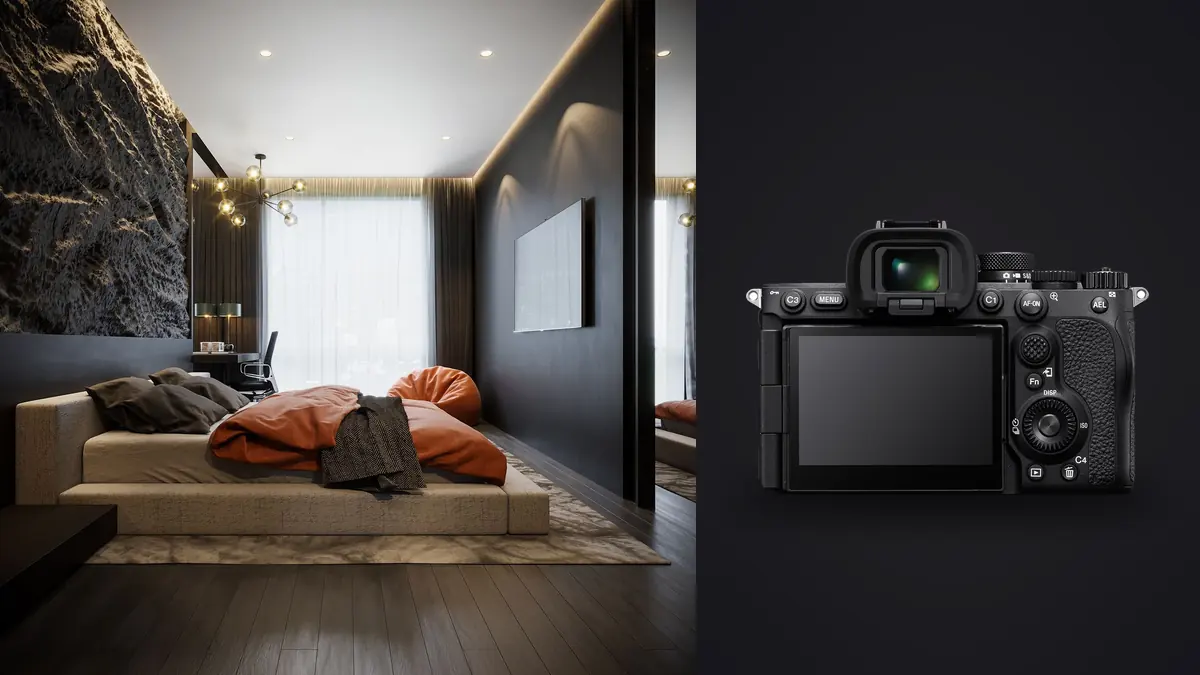
Boudoir is the genre that punishes cameras nobody talks about punishing them for. It is not sports, so autofocus tracking speed matters less than people assume. It is not landscape, so nobody cares about your dynamic range at base ISO in a studio with three softboxes. What it actually demands is quiet operation, forgiving low light performance, a screen you can see from a low angle while kneeling on a hotel bed, and a sensor that keeps skin looking like skin instead of plastic. I have been shooting the Sony A7R V for personal boudoir and intimate portrait sessions for a stretch now, mostly in Airbnbs and home bedrooms with mixed window and lamp light, and this is what actually held up versus what I expected going in.
The 61-megapixel question nobody asks correctly
The first thing every photographer asks about the A7R V is whether 61 megapixels is "too much" for portrait work. Wrong question. The right question is what you do with a file that big when your subject is six feet away in low, directional light. At that resolution, every stray hair, every bit of texture on a duvet cover, every softbox reflection in an eye becomes visible in a way that a 24-megapixel body simply glosses over. That is a gift for print sales and detail crops, and a liability if your focus is off by even a hair, because this sensor will show you exactly how far off you were.
For boudoir specifically, I found the resolution most useful in two places: cropping tighter on a hip-to-shoulder frame without losing print quality, and pulling detail shots (hands, jewelry, fabric texture) out of a session without a separate macro setup. I found it least useful, honestly, on wider environmental frames where nobody is printing a 40-inch canvas of a hotel room. On those frames I now shoot compressed RAW rather than lossless, just to keep card space and processing time sane.
Autofocus in a bedroom, not a stadium
Sony sells the A7R V on its AI-based subject recognition, and in boudoir work the part that actually matters is how it handles a reclining or side-lying pose where the face is at an angle and partially in shadow. It handled this better than the A7 IV I shot before it, mostly because the eye detection holds through more head rotation before it gives up and hunts for the whole face instead. In lamp-only light (I am talking one 40-watt bulb and a window with sheers, no strobe), it slowed down and occasionally locked onto the wrong eye when both were visible, but it did not lose the subject entirely the way older Sony bodies would.
Where it struggles: soft focus intentionally, like when a client wants dreamy backlit hair with the face slightly soft. The camera wants to snap to the eye whether you want it there or not, and I ended up switching to manual focus with focus peaking for a handful of deliberately soft frames rather than fight the AI for control. That is a minor complaint, but it is real, and I have not seen it mentioned in the usual spec-sheet reviews.
Silent shutter, and why it matters more here than in most genres
Boudoir sessions are intimate in a literal sense, and clients are often nervous, especially first-timers. A loud mechanical shutter clacking away every few seconds keeps reminding someone that a camera is pointed at them. The A7R V's electronic silent shutter mode removes that entirely. I switched to it full time for these sessions and the difference in how relaxed subjects look by frame thirty versus frame three is noticeable. The tradeoff is a slightly higher risk of banding under certain LED or fluorescent lighting, which came up exactly once in an Airbnb with cheap ceiling fixtures, and switching to the electronic first curtain shutter fixed it in under a minute.
The screen, the grip, and other things that sound boring until you are on the floor
The 4-axis multi-angle screen is the unsung feature for this genre. Boudoir involves a lot of low angles, shooting up from the foot of a bed or across a chaise, and a screen that only tilts up and down (like the older A7 III style) leaves you guessing at framing when the camera is rotated for a vertical composition. The A7R V's screen flips out and swivels, so I can check a vertical low-angle frame without contorting myself under the subject's eyeline, which also just feels less invasive to the person being photographed.
The grip is deep enough for a full session of handheld shooting, which matters because boudoir rarely happens on a tripod. Clients move, poses shift constantly, and you are chasing small adjustments in real time. After a two-hour session my hand is tired the way it would be with any full-frame body carrying a fast prime, nothing worse, but nothing better either. This is not a small, light camera.
How the A7R V compares to the other Sony bodies I would consider for this work
I get asked constantly whether the resolution jump is worth it over an A7 IV, or whether the A7S III's low-light reputation makes more sense for dim bedroom sessions. Here is how they actually stack up for boudoir and intimate portrait work specifically, based on what I have shot with each:
| Camera | Resolution | Usable ISO for dim rooms | Screen articulation | Avg. RAW file size | Best fit |
|---|---|---|---|---|---|
| Sony A7R V | 61MP | Clean to ~3200, workable to 6400 | 4-axis flip + tilt | ~120MB (lossless compressed) | Print sales, detail crops, editorial clients |
| Sony A7 IV | 33MP | Clean to ~6400 | Standard flip-out only | ~55MB | Volume shooters, faster turnaround |
| Sony A7S III | 12MP | Clean to ~12800+ | Standard flip-out only | ~25MB | Available-light purists, video-hybrid shooters |
My honest take: unless you are shooting almost exclusively by candlelight or genuinely no supplemental light at all, the A7S III's low-light edge is overkill for boudoir, where you almost always have a window, a lamp, or a small continuous light in the room. The A7R V's noise at 3200 is entirely usable once you run it through even light noise reduction, and the resolution pays for itself the moment you want an 11x14 wall print of one frame. The A7 IV is the sensible middle ground if you are shooting high volume and don't need the crop flexibility, but I moved off it because I kept running out of pixels on detail crops.
Lenses that actually pair well with this body for the genre
The 85mm f/1.4 GM is still my most-used lens for boudoir on the A7R V, mostly for three-quarter and closer framing where I want the background to disappear completely. The 50mm f/1.2 GM earns its keep on environmental frames in smaller rooms where 85mm forces you into a hallway or a doorway to get the shot. I use a 35mm occasionally for wider room context, but rarely below f/2 for this genre since the point is intimacy, not depth of field showing off.
One practical note: wide-open apertures on a 61-megapixel body are unforgiving. Focus that would read as "close enough" on a 24-megapixel file will show visible softness at 100% on this sensor. I stop down to f/1.8 or f/2 more often than I used to on lower-resolution bodies, purely because the margin for focus error at f/1.4 shrinks when every pixel is doing more work.
Dealing with the file volume afterward
A two-hour boudoir session on this camera, shooting in bursts to catch natural movement between poses, routinely leaves me with 800 to 1,200 RAW files, most of them in tight bursts of near-identical frames as the subject shifts weight or breathes. At 120MB a file, that is well over 100GB before I have even opened an editor. Culling that volume by eye, frame by frame, used to eat half a day per shoot.
This is honestly the part of the workflow I changed the most. I run the card straight into imagic and let it cluster the burst sequences and flag the sharpest, best-focused frame in each group before I look at anything. Because the sharpness scoring runs locally on the files themselves rather than relying on embedded thumbnails, it catches the difference between "eyes sharp" and "eyes just barely soft" at this resolution, which is exactly the distinction that matters most when a body is producing 61-megapixel files where softness hides in plain sight until you zoom in. It also matters for a genre like this one that the culling never leaves the machine. Intimate portrait work is not something I want touching a cloud service, and imagic processes everything locally, so nothing gets uploaded anywhere during the sort.
Once the burst clustering has done its job, I am usually down from 1,000 files to a working set of 150 to 200 without having lost anything worth keeping. If you shoot volume-heavy genres and haven't looked at how automated culling actually handles duplicate detection, it's worth reading through how AI photo culling works before assuming it's just a basic blur filter.
Color and skin tone out of camera
Sony's color science took real criticism for years on skin tones specifically, tending slightly cool and sometimes a little flat straight out of camera compared to Canon's warmer default rendering. The A7R V hasn't fundamentally changed that story, but the extra resolution gives you more room to work in post before things fall apart. I built a custom edit profile in imagic using the apply_my_style feature, trained on a batch of my previously graded boudoir sessions, and it now handles the first pass of warmth and skin tone correction on new imports automatically, matching the look I'd otherwise spend twenty minutes per session dialing in by hand. It's not a replacement for a final look pass on the selects, but it means my culled folder already looks close to finished before I open anything for fine adjustment.
Frequently Asked Questions
Is the Sony A7R V's resolution actually necessary for boudoir, or is it just marketing?
It's necessary for a specific subset of the work: large prints, tight crops on detail shots, and clients who want album layouts with mixed framing pulled from a single capture. If you're delivering mostly web-sized galleries, 61 megapixels is more file management overhead than benefit, and something like the A7 IV would serve you just as well with smaller, faster-to-handle files.
Does the A7R V handle low-light bedroom sessions without flash?
Reasonably well up to about ISO 3200 with a single lamp or window light, and it stays workable to 6400 with light noise reduction applied afterward. It is not the low-light specialist the A7S III is, but for the light levels most home boudoir sessions actually use, it holds up fine.
What's the biggest practical downside of shooting boudoir on this camera?
File size and the discipline it demands on focus accuracy. Every soft-focus mistake shows up clearly at this resolution, and the sheer volume of data from a burst-heavy session (RAWs well over 100GB per shoot) means your culling and storage workflow needs to be sorted out before you shoot your first client, not after.
Should I buy the A7R V specifically for boudoir, or is it better suited to other genres?
It's a strong fit if boudoir is one part of a broader portrait and print-sales business, since the resolution pays off in wall art and album work. If boudoir is your only genre and you never sell large prints, the A7 IV gets you nearly the same shooting experience with smaller files and a lower price, and the difference in final client-facing output is smaller than the spec sheet suggests.