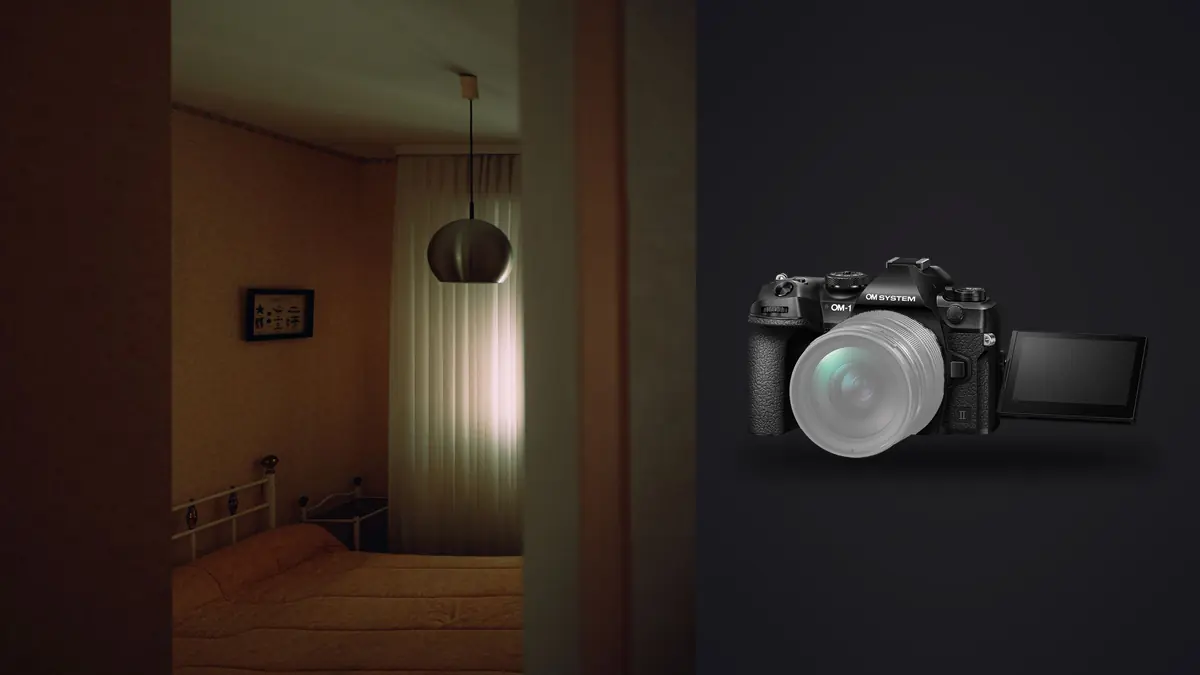
The first time I brought the OM-1 Mark II into a private bedroom instead of a rented studio, I expected to spend the session missing my full-frame kit. I didn't. What I noticed instead was how much less the camera got in the way, physically and psychologically, in a room that already feels loaded with tension before you've taken a single frame. That's the actual question worth answering here, not "is this a good camera" in the abstract, but whether a Four Thirds body built for wildlife and adventure shooters has any business in a genre built on stillness, trust, and skin.
Short version: yes, with real caveats. The rest of this is the caveats.
The sensor conversation nobody wants to have
Micro Four Thirds runs a 2x crop factor. That's not a marketing footnote, it's the single biggest thing that changes how you'll work compared to a full-frame body. A 45mm lens behaves like a 90mm for framing. More relevant for this genre, depth of field at a given f-stop behaves roughly two stops deeper than the same f-number on full frame. Shoot the 45mm f/1.2 PRO wide open and you get a rendering closer to what a full-frame shooter gets from an 85mm at f/2.4, not f/1.2. This matters in boudoir because so much of the genre's visual language depends on that razor-thin plane of focus, one eye sharp, the rest of the frame dissolving. You can still get it on the OM-1 Mark II, but you need the fast primes to do it, and even then the falloff reads a little more gradual than a full-frame f/1.2 look. Someone comparing a hotel room shot to a reference image saved from Pinterest might ask why the background isn't "as blurry", and the honest answer is sensor geometry, not settings.
Where the smaller sensor stops being a compromise and starts being genuinely useful is size and weight. A body plus 45mm PRO plus 75mm f/1.8 fits in a bag that doesn't scream "photography session" when a subject is already nervous about a knock at the door. A smaller setup also tends to feel less clinical than a DSLR with a battery grip and a 70-200mm hanging off it.
Lens pairing for the genre
OM System and Panasonic both make glass for this mount, and for boudoir work you're choosing between three jobs: the room-context shot, the classic close portrait, and the detail/getting-ready work. Here's how I'd actually spec a kit, with the numbers that matter for depth of field, not just the marketing spec sheet.
| Lens | Full-frame equivalent | Max aperture | Depth-of-field equivalent | Where it earns its keep |
|---|---|---|---|---|
| M.Zuiko 25mm f/1.2 PRO | 50mm | f/1.2 | ~f/2.4 | Room-context frames, getting-ready sequences, storytelling wides |
| M.Zuiko 45mm f/1.2 PRO | 90mm | f/1.2 | ~f/2.4 | The signature close portrait, working across a bedroom without crowding the client |
| Panasonic Leica 42.5mm f/1.2 | 85mm | f/1.2 | ~f/2.4 | Cheaper alternative to the 45mm PRO, slightly warmer rendering, less snap in the corners |
| M.Zuiko 75mm f/1.8 | 150mm | f/1.8 | ~f/3.6 | Backlit window light, compression, shooting from across the room when proximity feels wrong for the moment |
| M.Zuiko 12-40mm f/2.8 PRO II | 24-80mm | f/2.8 | ~f/5.6 | Tight bathrooms, hotel rooms with no room to back up, product/detail shots for a client's own use |
If I could only own two of these for boudoir work, it's the 45mm PRO and the 75mm f/1.8. The 45mm does almost everything in a normal bedroom-sized space. The 75mm becomes the lens you reach for when a client wants distance, whether that's because a window is doing the lighting or because the pose is more vulnerable and physical closeness with the camera would change the energy of the room. That's a real consideration in this genre in a way it isn't in most others: where you stand affects how the client feels, not just how the frame looks.
The 12-40mm is not a compromise lens here
I used to think of standard zooms as the thing you use when you can't be bothered to change lenses. In boudoir work, the 12-40mm f/2.8 PRO II earns a spot in the bag for a different reason: a huge number of these sessions happen in small rented Airbnbs and hotel rooms where you physically cannot back up far enough to use a 45mm or 75mm for a wider shot. Being able to zoom to 24mm equivalent without changing glass, mid-session, without breaking the mood, is worth more than the extra stop and a half you lose compared to the primes.
Stabilization and the handheld advantage
OM System rates the in-body stabilization on this body at up to 8.5 stops with certain lenses. I don't shoot at 8.5 stops slower than a "safe" shutter speed and expect a usable frame, nobody should, but the real-world benefit is concrete: I can shoot ambient-light portraits at 1/15s or 1/8s handheld, using window light or a single practical lamp, without a tripod eating up floor space in a room that's already tight. Tripods change the pace of a boudoir shoot. Once you set one up, you're locked to a spot, adjusting the client to the light instead of moving the camera to the client. Being able to work handheld at slow shutter speeds means you can chase the light around the room the way you'd chase it with a phone camera, except with actual image quality behind it. The tradeoff is motion blur risk on the subject, not the camera. IBIS does nothing for a client shifting their weight or breathing. In practice I keep shutter speed no slower than 1/60s for anything with visible movement (hands, hair, breathing chest) and reserve the really slow handheld shutter speeds for genuinely static poses.
Shutter noise and the psychology of the room
This is the part that doesn't show up on a spec sheet comparison but matters more than almost anything else in this specific genre. The OM-1 Mark II's electronic shutter is silent. Fully silent, no simulated clack, no sound at all. In a studio environment that's a nice-to-have. In a client's bedroom, with a nervous first-time boudoir client who's already self-conscious about every sound in the room, it removes one more thing that reminds them a machine is pointed at them fifty times a minute during a burst. I switch to electronic shutter for essentially the entire session now, mechanical only in situations with strong continuous LED lighting where I'd worry about banding, which is rare indoors with modern fixtures. The difference in how a session feels, for both of us, is bigger than I expected before I tried it.
Autofocus for wide-open, close-range work
Shooting the 45mm PRO at f/1.2 a few feet from a face means the acceptable focus plane might be a few millimeters deep. The Mark II's subject-detection autofocus, tuned for eye recognition, holds up well here as long as there's enough light for the sensor to lock onto an eye in the first place. Where it struggles is low, warm, single-source lighting, a bedside lamp with no fill, where contrast is low and the AF system hunts more than I'd like. In those situations I've had better luck switching to single-point AF and placing it manually rather than trusting subject detection to find the eye in a low-contrast, warmly lit frame.
ISO reality, without the marketing gloss
Native ISO tops out around 25600 with extended modes beyond that, but "usable" and "native ceiling" are different conversations. For skin tones specifically, I stop trusting files much past ISO 3200 for anything that needs heavy post-production lifting, and I try to keep working ISO in the 800 to 1600 range for anything shot on available light alone (window light, practical lamps, no strobe). Push past that and you start fighting noise in shadow areas of skin, which is exactly where boudoir retouching tends to concentrate its attention. A full-frame body will give you another stop or so of headroom before the same noise shows up. That's the real, honest cost of the smaller sensor in this genre, not depth of field, which you can work around with fast primes, but high-ISO skin rendering, which you mostly can't. My workaround has been leaning harder on continuous LED panels with a warm gel rather than pure ambient light for anything indoors after golden hour, which keeps ISO down in the 400 to 800 range where the files are clean.
What happens after the shoot
A typical two-hour boudoir session on this body, shot loosely with bursts for expression variation, easily produces 1,200 to 1,800 raw frames. That volume is where the actual bottleneck of this genre lives, not the camera. Sorting a shoot that size by hand, looking for the one frame per setup where the eyes are sharp, the expression lands, and nothing is a duplicate of the frame two shots earlier, is a multi-hour job on its own, and it's the part of the workflow nobody else sees or thinks about. This is where I've started running sessions through imagic before I touch Lightroom. It scores sharpness and focus locally on the machine, clusters bursts and near-duplicates so I'm not scrubbing through fifteen nearly identical frames from the same three-second sequence, and gets me to a shortlist fast enough that the culling stops eating into editing time (the mechanics behind that scoring are covered in how AI photo culling works). For a genre where clients are paying as much for turnaround discretion as for the images themselves, cutting that step down matters. The bigger reason it fits this specific genre, though, is that it runs entirely on-device. Nothing gets uploaded anywhere to be culled or scored. For most photography that's a nice technical detail. For boudoir and intimate portraiture, where clients are trusting you with images they'd never want to see outside your hard drive, a tool that never sends a single frame to a server isn't a convenience feature, it's close to a non-negotiable. Anyone sitting for intimate portraits may well ask whether their photos "go to the cloud" during editing, and being able to say no, honestly, matters for the relationship as much as any lighting decision does. Once I've got a shortlist, I lean on imagic's apply_my_style feature to run a first pass that matches the tone I've already established across a shoot, since it's trained on my own past edits rather than a generic preset pack, which keeps skin tones consistent across a set shot under three or four different light sources in one session. It's not a replacement for finishing each image by hand, but it gets the starting point much closer than a stock preset does, which saves real time on a body of work that leans heavily on consistent, warm skin tones across dozens of final images. For more on tightening up the post-shoot side of a workflow like this generally, see our tips for a faster photo workflow.
A note on High Res Shot mode
The Mark II's handheld high-resolution mode, which composites multiple exposures into a much larger file, is genuinely impressive for landscape and product work. Skip it for boudoir. It relies on the subject staying essentially motionless across the composite exposures, and even minor breathing movement produces visible artifacting around edges and hair. I've tested it a handful of times on posed, held-still frames and it works, but it's not worth the friction of asking a subject to freeze for a specialty mode when a standard 20.4-megapixel raw file prints beautifully at any size a boudoir print realistically needs.
Settings I actually use
For anyone bringing this body into a bedroom or hotel room session for the first time, here's roughly where I start before adjusting to the room:
- Electronic shutter, silent mode, full time
- Aperture priority, f/1.8 to f/2.5 on the primes for most poses, closing to f/2.8-f/4 for two-person or wider environmental frames
- Auto ISO capped at 3200, floor at 200
- Shutter speed floor set to 1/60s in Auto ISO to protect against motion blur on skin and hair
- Face/eye priority AF with a manual fallback point for low-contrast lamp lighting
- Warm white balance preset (around 3400-3800K) rather than auto, since auto WB tends to cool skin tones down under mixed lamp and window light
Frequently Asked Questions
Is the Four Thirds sensor a real problem for the shallow-focus look boudoir clients expect?
Not a dealbreaker, but it's a real difference. Fast primes like the 45mm f/1.2 or 75mm f/1.8 get you close to the look, roughly two stops shallower in real terms than the f-number suggests versus full frame. Reference images shot on a 50mm f/1.4 full-frame setup will still look slightly softer in the background than what you'll produce here at the same working distance, so it's worth setting that expectation with clients who bring in comparison photos.
How much noise does the camera actually make during a session?
None, in electronic shutter mode, which is what I use for essentially the entire session. That's a bigger deal for client comfort in an intimate setting than it sounds like on paper, especially with clients doing their first boudoir shoot who are already hyper-aware of the camera.
Do I need the Mark II specifically, or is the original OM-1 close enough for this genre?
For boudoir specifically, the gap is smaller than for wildlife or sports shooters who bought the Mark II for the autofocus and buffer improvements. The sensor and core image quality are similar between the two. If you already own an original OM-1 and your budget is better spent on the 45mm PRO or 75mm f/1.8, buy the glass first. The Mark II's improvements matter more for continuous tracking and buffer depth than for a genre built on slower, deliberate frames.
What's the safest way to handle and cull this kind of sensitive session afterward?
Keep the culling and initial review process off the cloud entirely. Tools that upload frames to a remote server for AI sorting or scoring create a copy of client images somewhere outside your control, which is a real liability in this genre regardless of what a privacy policy claims. Running culling locally, the way imagic does, means the images never leave the machine during that stage, which is worth prioritizing over marginal speed gains from a cloud-based tool.