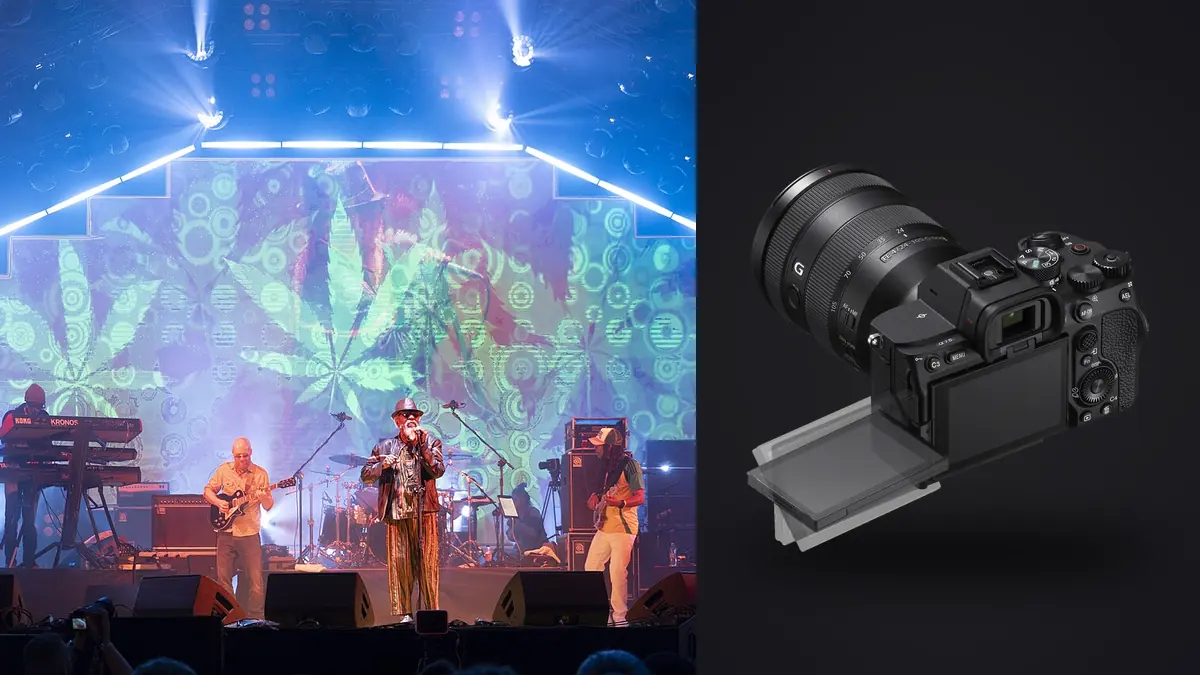
I've shot somewhere around sixty club and theater shows with a Sony A7 IV over the last two years, plus a handful of festival slots where the photo pit rule is three songs and out. It isn't the body Sony built for sports or wildlife tracking, and if you put the spec sheet next to an A9 II you'll see exactly why some photographers still carry the older, faster camera into a pit. But for the kind of live music work most working photographers actually do, meaning clubs, theaters, mid-size venues, and the occasional arena night, the A7 IV covers nearly everything I need. The two places it falls short are worth being honest about, and I'll get to both.
What the sensor gives you in a dark room
The 33-megapixel sensor gets talked about for resolution, but for concert work what matters more is how the files hold up at ISO 6400 and higher, because that's where a typical club show actually lives once the house lights drop and you're working off stage wash alone. I shoot most small venue sets somewhere between ISO 3200 and ISO 8000, and the A7 IV files clean up in post without turning to mush, provided you exposed correctly in camera rather than trying to save a dark frame afterward. Push past ISO 12800 and you start losing color fidelity in the shadows first, particularly under the mixed tungsten-and-LED rigs a lot of smaller venues run. It's usable up there in a pinch, but I treat anything above ISO 12800 as a "get the shot or don't" setting, not a place I want to live for a whole set.
Dynamic range is the other piece that matters more at concerts than most other genres, because stage lighting swings from near-black to blown-out spotlight within the same frame constantly. The A7 IV's sensor recovers highlights reasonably well if you're shooting raw and not clipping by more than a stop, which is about what I'd expect from a body in this class. It won't match what a dedicated cinema sensor does, but for stills work it's given me enough headroom to pull back a hot spotlight on a singer's face without the recovery looking artificial.
Autofocus when the subject won't hold still
Real-time Eye AF for humans is the feature that actually changed how I shoot pits, more than any resolution or ISO number. Singers move fast, they turn away from the crowd mid-line, they duck under a boom mic, and the A7 IV's tracking sticks to a face through most of that as long as there's enough light for the AF system to find contrast in the first place. Where it struggles is in near-total darkness between light cues, the half-second blackout before a chorus hits, where the camera will occasionally hunt and I've lost a frame or two waiting for it to lock back on. I've learned to preempt that by switching to a single focus point on the joystick during those known dead spots rather than trusting wide-area tracking to save me.
The joystick itself is worth mentioning specifically because a lot of the older A7 bodies made you dig through a menu or a d-pad to move your focus point, which is exactly the wrong workflow when a guitarist is diving off a monitor wedge. Being able to nudge the AF point with a thumb without taking your eye off the viewfinder is a small thing that adds up over a three-hour set.
Buffer depth matters more than the fps number
Sony advertises 10fps on the A7 IV, and that number is technically true, but it only holds at full speed with a fast CFexpress Type A card and it drops off once you're shooting compressed raw plus JPEG for a long burst, which is how a lot of pit shooting is set up (JPEG for a fast turnaround post to the venue or artist team, raw for anything that goes to a client later). In practice, a six or seven second burst during a big chorus moment will start to stutter toward the tail end on an SD UHS-II card, which is the card type most of us actually have a drawer full of, because CFexpress Type A cards are still expensive and slot into almost nothing else you own. I keep a Type A card in slot one for the nights I know I'll need it, arena headline sets, anything with pyro or confetti cannons where the moment is genuinely once, and shoot SD the rest of the time.
The three-song rule that most photo pits enforce actually works in the A7 IV's favor here. You're not shooting a four-hour marathon at full burst, you're shooting nine minutes of intense continuous work and then you're done, so buffer clearing between songs is rarely the problem it would be on a full festival headline slot where you're in for the whole set.
Settings I actually start from, by venue
| Venue type | Starting shutter speed | Aperture | ISO range | Shutter mode |
|---|---|---|---|---|
| Small club, single wash light | 1/200s | f/1.8 to f/2.8 | 3200-8000 | Mechanical |
| Theater with moving heads | 1/320s | f/2.8 | 1600-6400 | Mechanical |
| Arena, LED wall backdrop | 1/500s | f/2.8 to f/4 | 800-4000 | Electronic (banding test first) |
| Outdoor festival, daylight set | 1/1000s | f/4 to f/5.6 | 100-800 | Mechanical or electronic |
| Outdoor festival, night set | 1/250s | f/2.8 | 3200-10000 | Mechanical |
These are starting points, not rules. I adjust shutter speed up or down within the first two songs based on how much the performer moves and whether strobes are in the rig, and I check the back of the camera at 100% zoom during the first break for banding before committing to electronic shutter for the rest of the set.
Silent shooting and the LED banding problem
The A7 IV's fully silent electronic shutter mode is genuinely useful for the quieter moments of a set, an acoustic breakdown, a spoken intro, anything where a mechanical shutter clack would be audible over the PA or, worse, show up in someone's phone recording of the moment. The tradeoff is banding under LED lighting, which is nearly universal in modern concert rigs because most stage lights now run on PWM dimming rather than a steady current. At certain shutter speeds you'll get visible horizontal bands across the frame that weren't there a moment ago when the lighting cue changed. There's no single shutter speed that fixes this everywhere, because different rigs flicker at different frequencies, so what I actually do is shoot a test burst in electronic mode during soundcheck or the opening act, chimp the results at full zoom, and either lock in a speed that avoids the banding or just default back to mechanical shutter for anything with heavy LED use. It's an extra step, but it's a five-minute one, and skipping it is how you end up with an otherwise perfect frame of the lead singer that's unusable because of a stripe across their face.
Lenses that actually get used
My most-used pairing is the 24-70mm f/2.8 GM II on the A7 IV body and a 70-200mm f/2.8 GM OSS II on a second body, or swapped in when I know I'll be shooting from further back. The 24-70 covers probably 70% of a typical pit set for me, wide enough for a full-stage shot with the whole band, tight enough to isolate a face. For smaller rooms where I can get close, I'll sometimes drop in a 35mm f/1.4 GM instead of the zoom, purely for the extra stop and a half of light and the character it gives backlit smoke and haze, though you give up reach if the singer works the far side of the stage.
A 50mm f/1.2 GM shows up in my bag for acoustic sets and smaller listening-room shows where subjects are closer and slower moving, and the extra light-gathering lets me keep ISO down without slowing shutter speed below what I need to freeze a hand on a fretboard. I don't bring it to anything with real stage movement because f/1.2 depth of field at close range misses focus constantly on a moving subject, even with good tracking.
Sorting hundreds of near-identical frames afterward
A three-song pit set at 8 or 9fps generates an absurd number of frames in a very short window, and most of them are separated from the next by a fraction of a second and look nearly identical at a glance. That's the part of concert photography nobody warns you about before you start doing it professionally: the shooting is over in nine minutes, and then you're sitting at a laptop for two hours trying to find the three or four frames per song that are actually sharp, actually well-timed, and don't have a bandmate's elbow crossing a face.
This is where I lean on imagic rather than dragging a loupe across every frame in Lightroom the way I used to. It runs local sharpness and focus scoring against the whole card and flags which frames in a burst are actually in focus on the eye versus which ones drifted during a fast head turn, which happens constantly when you're tracking a singer at 1/250s. It also clusters the burst sequences together so I'm reviewing "this moment" as a group of six frames instead of scrolling through six hundred images in chronological order trying to remember which song they came from. Because it runs entirely on my laptop rather than uploading a card full of unreleased tour photos to somebody's cloud, I don't have to think twice about doing this backstage on a venue's questionable wifi, or with no signal at all in a basement club.
If you're new to the idea of software doing a first pass on culling before you touch anything yourself, this breakdown of how AI photo culling actually works covers the mechanics better than I can in a paragraph here. The short version for concert work specifically is that it saves the most time exactly where you have the least of it: the night of a show, tired, with a client or an editor waiting on a same-day turnaround.
Where I've built my own preset for stage lighting
Color grading concert photos is its own small skill, because you're constantly fighting whatever a lighting designer decided that night: magenta washes, green side light, a single hard white spot against total darkness. Once I'd graded a handful of shows the way I actually like them (slightly desaturated skin tones, blacks that stay black instead of going purple, highlights that don't clip on skin), I trained an apply_my_style preset in imagic off those edits, so a new set of raw files from a new venue gets a first pass that already leans toward my grading habits instead of starting from a flat baseline every single time. It's not a substitute for actually looking at each image, colored stage lighting is too unpredictable for any preset to nail every frame, but it cuts a real chunk off the editing time on nights when I'm turning around images for an artist's socials before I've even left the venue.
Battery life and the arena problem
One practical note that doesn't show up in any spec comparison: the A7 IV's battery life is fine for a club set but gets tight on a long arena night with an opener, a headliner, and meet-and-greet coverage tacked on either side. Cold venues make it worse, outdoor winter festival stages especially. I carry three batteries minimum for anything longer than a single headline set and keep one in an inside jacket pocket rather than the camera bag, because a battery that's been sitting at ambient temperature in a cold bag will read lower than one that's been kept warm against your body, even at identical charge levels.
None of this replaces just shooting more shows and learning a venue's habits. But if you're deciding whether the A7 IV is the right body to build a live music kit around, it's a genuinely good one for the volume of work most club and theater photographers actually shoot, and the money you save over an A9-series body buys a second lens or a year of festival submission fees instead. For anyone trying to tighten the actual workflow around a shoot like this, from card dump to delivered gallery, a few workflow habits that shave real time off the process pair well with everything above.
Frequently Asked Questions
Do I need an A9 II or A9 III instead of the A7 IV for shooting pits?
Only if you're shooting sports-adjacent movement at high volume regularly, meaning full festival days with dozens of acts back to back, or you're competing with wire photographers for a handful of usable frames per song. For club and theater work with the standard three-song pit access, the A7 IV's autofocus and buffer keep up fine. The A9 series earns its price mainly in blackout-free viewfinder shooting and sustained burst depth, which matters more than most single-headliner club photographers actually need.
What shutter speed avoids banding under concert LED lighting?
There isn't one universal answer because different lighting rigs run at different PWM frequencies. Mechanical shutter sidesteps the issue entirely, which is why I default to it for anything with heavy LED use and only switch to silent electronic shutter after testing a burst during soundcheck or an opening act and checking for bands at full zoom.
Is the A7 IV good enough in near-total darkness between light cues?
It's usable but not magic. Autofocus can hunt during the true blackout moments some songs use for effect, and I've missed a frame or two waiting for it to reacquire a face. Switching to a single focus point rather than wide tracking during those known dark moments helps, since a single point locks faster than the camera scanning a whole zone for contrast.
SD card or CFexpress Type A for concert bursts?
SD UHS-II handles a standard three-song pit set fine, since you're rarely sustaining more than six or seven seconds of continuous burst before a natural break. I only reach for a CFexpress Type A card on nights with genuinely once-only moments, pyro, confetti, a specific stage effect I know is coming, where I don't want any buffer stutter at all.