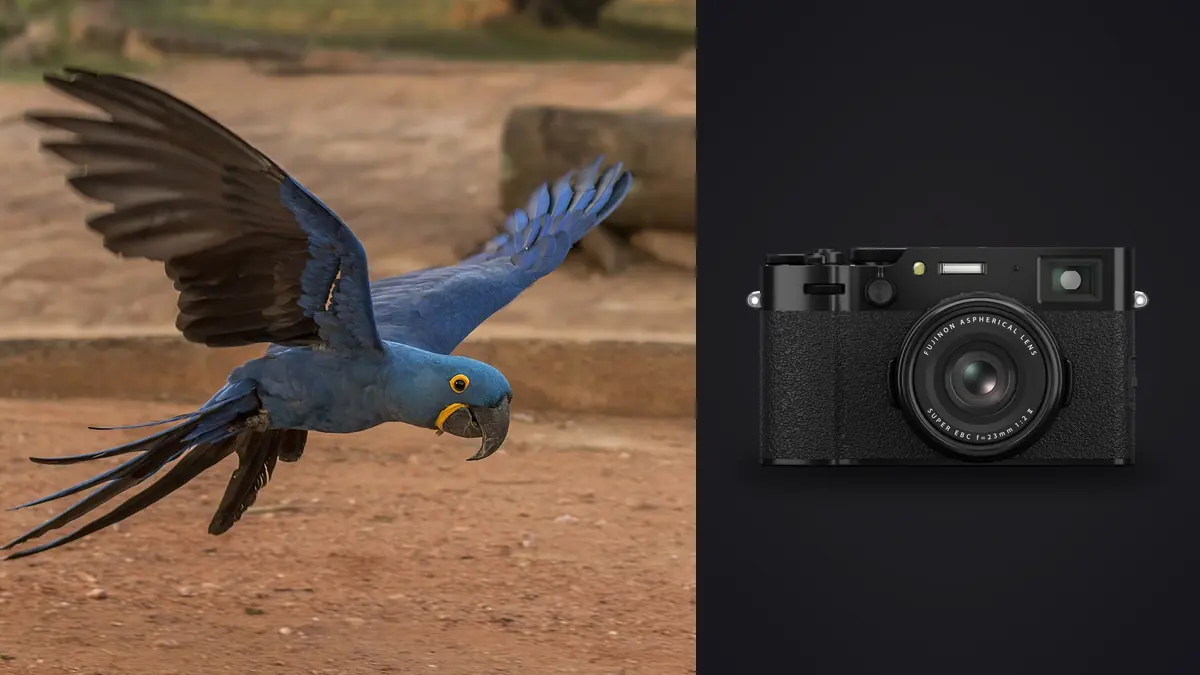
Every time someone posts a Fujifilm X100VI photo of a bird mid-wingbeat, the comments split into two camps: people amazed it's possible on a fixed 35mm-equivalent lens, and people insisting the camera has no business anywhere near birding. Both are half right. I've spent enough mornings at the local reservoir with this camera around my neck, alongside a proper telephoto rig in the bag, to say plainly: the X100VI is not a bird-in-flight camera in the way a superzoom or a long native lens is, and pretending otherwise sets people up for a frustrating first outing. But it does something specific and genuinely useful that a 400mm lens can't, and once you stop trying to make it be something it isn't, it earns a spot in a birding kit.
The Focal Length Problem Nobody Mentions in the Marketing
The X100VI's lens is a fixed 23mm f/2, which works out to roughly 35mm in full-frame terms. That's a normal-to-wide field of view, the kind you'd use for street photography or environmental portraits, not the kind you'd point at a kestrel hovering eighty meters up. A small garden bird at ten meters occupies maybe a few hundred pixels on the 40.2-megapixel sensor before any cropping. Compare that to even a modest 300mm lens on the same sensor size and the bird is roughly nine times larger in the frame. No amount of autofocus sophistication changes that basic geometry.
This matters because most people searching for "X100VI wildlife" or "X100VI birds in flight" are picturing tight portraits of raptors against clean skies, the kind of shot that sells this camera as some hidden birding secret. It isn't that. If your goal is filling the frame with a single bird from any reasonable distance, buy a telephoto system and don't look back. What follows is for people who already own an X100VI, want to bring it on a birding walk anyway, and want to know what it can genuinely deliver rather than what a thumbnail promises.
Where a 35mm Field of View Actually Earns Its Keep
The trick with this camera and birds in flight is to stop thinking about the individual bird and start thinking about the scene the bird is part of. A wide-normal lens is bad at isolating a subject and good at showing context, scale, and movement across a frame. There are three situations where that trade genuinely works in your favor.
Murmurations and large flocks
Starling murmurations, wader flocks lifting off a mudflat, geese skeins crossing a low winter sky: these are wide-angle subjects whether you like it or not. A 500mm lens gives you a beautiful slice of a thousand-bird flock and throws away everything that made it dramatic. I've had far better luck at 23mm f/2 shooting a murmuration low against a dusk sky over Otmoor than I ever got trying to track individual birds with a long lens shaking on a monopod. The X100VI's leaf shutter is near silent too, which matters less for the birds (they can't hear a shutter over their own noise at that scale) and more for not disturbing the handful of other photographers standing shoulder to shoulder with you at a popular murmuration site.
Gulls and terns close to a boat or jetty
Gulls following a ferry wake, or terns working a harbor wall, will often come within a few meters if there's bait, bread, or fish scraps involved (ferry crossings and fishing boats are the classic case). At that distance a 35mm-equivalent field of view isn't limiting, it's exactly right, because the bird plus the water, the boat rail, or the harbor light in the background is the actual picture. I've gotten sharp, full-frame gull shots off the Portsmouth to Caen ferry with this camera that a 400mm lens simply couldn't have composed, because the bird was close enough that a telephoto would have clipped wingtips.
Garden and feeder takeoffs
If you've got a feeder set up a couple of meters from a window or hide, the X100VI's close focus and fast f/2 aperture let you catch the actual launch moment, wings fully spread, in a way that includes the feeder, the perch, and some garden context. It reads more like a wildlife documentary still than a bird ID photograph, which is a different genre but not a lesser one.
Autofocus and Subject Detection Against Real Wingbeats
The X100VI inherited its autofocus core and subject detection from Fujifilm's X-Processor 5 generation, the same brains found in the X-T5 and X-H2. In the AF menu there's a dedicated subject detection mode for animals and one for birds specifically, and in daylight, against a reasonably clean sky, it does lock onto a bird's eye or head with more consistency than I expected from a compact. The catch is subject size in frame. Detection works from contrast and shape recognition across a reasonable number of pixels, and a bird that's a speck against a bright sky at 35mm equivalent doesn't give the algorithm much to grab onto. It tends to default to general area tracking rather than true eye detection once the subject drops below a certain size, which in practice means anything more than about fifteen or twenty meters out.
Where it genuinely impresses is close-range, unpredictable movement: a bird hopping along a branch, then launching. I switched from single-point AF to Wide/Tracking with bird detection active and left it there for an entire morning at a local wetland reserve, and the hit rate on launch sequences (bird still on the perch, first wingbeat, clear of the branch) was noticeably higher than with the older X100V's contrast-heavy AF. Use the electronic viewfinder for this rather than the optical finder. The OVF is lovely for composing a static street scene but gives you no real sense of focus confirmation on something moving fast, and you'll waste frames.
Stretching the Reach: Digital Tele and the TCL-X100 II
There are two ways to get more apparent reach out of this body without changing the fundamental math, and it's worth knowing exactly what each one costs you.
The in-camera Digital Tele-Conversion setting crops the sensor to simulate 50mm and 70mm equivalent fields of view. Because the X100VI has 40.2 megapixels to spare, the 50mm crop still leaves a genuinely usable file, and even the 70mm crop is fine for web use or a modest print. The TCL-X100 II is the screw-on optical teleconverter Fujifilm still sells for the X100 line (it dates back to the X100V and remains compatible), and it gets you to roughly 50mm equivalent optically, meaning you keep the full 40.2-megapixel resolution rather than cropping it away. Neither option turns this into a telephoto camera. Both just make the wide-normal shots I described above a little tighter when you need them to be.
| Setup | Effective focal length | Resolution you keep | Best real use for flight shots |
|---|---|---|---|
| Bare 23mm f/2 (native) | ~35mm equivalent | 40.2MP, full frame | Murmurations, flocks, close gulls and terns |
| Digital Tele, 50mm setting | ~50mm equivalent | ~19-20MP (cropped in-camera) | Tightening a feeder launch shot without a lens change |
| Digital Tele, 70mm setting | ~70mm equivalent | ~10MP (cropped in-camera) | Web-sized shots only, not for cropping further |
| TCL-X100 II attached | ~50mm equivalent | 40.2MP, full frame | Same framing as digital tele but no resolution loss |
| For comparison: APS-C body + 100-400mm zoom | 150-600mm equivalent | Full sensor resolution | Actual distant birds in flight, raptors, waders at range |
That last row is the honest reality check. Even stacked with the TCL-X100 II, you're nowhere near what a dedicated telephoto setup does for a bird thirty meters out. The X100VI's reach options are for fine-tuning a composition that's already close, not for reaching out to a subject that isn't.
Shutter Speed, Burst Rate, and the Buffer Wall
The leaf shutter in this lens tops out at 1/4000s mechanically, which is plenty for freezing a wingbeat in good light, and it's essentially silent, a genuine advantage at a quiet hide where a mechanical SLR-style shutter would announce every frame. Switch to the electronic shutter and you get up to 1/180,000s and a burst rate of 20fps, but there's a 1.29x crop applied at that speed and rolling shutter becomes a real risk on fast horizontal wing motion, showing up as a slight skew on wingtips if you pan quickly. For most flight sequences I stay on the mechanical shutter at 11fps and accept the (very minor) shutter sound rather than fight rolling shutter artifacts.
Buffer depth is the part that catches people out. Shooting raw plus fine JPEG at 11fps, I've found the buffer fills in roughly two seconds of sustained shooting on a fast SD card before the frame rate throttles noticeably. Two seconds sounds short, and it is, but a bird launch sequence rarely needs more than that: perch, crouch, first wingbeat, clear of frame is usually done in under a second and a half anyway. The lesson is to time your burst to the launch moment rather than holding the shutter down the whole time the bird is on the perch, which is good practice, but this camera makes sloppy timing more expensive than a body with a deeper buffer would.
Weather Sealing Isn't Automatic
One detail that trips people up: the X100VI body on its own is not weather resistant. You need the AR-X100 adapter ring and a protective filter screwed onto it to get the sealing Fujifilm rates for the system. Birding regularly means damp mornings, drizzle, and spray near water, so if this camera is going to be a real part of a birding kit rather than a fair-weather extra, budget for the adapter ring and filter as part of the purchase, not as an optional accessory.
Sorting Thousands of Nearly Identical Wingbeats
Here's the part nobody warns you about before you actually try this: even a modest 11fps burst on a good flight sequence produces a folder of thirty or forty frames that all look nearly identical at a glance, wings up, wings down, wings up again, and only two or three of them have the eye sharp and the wing position that actually reads as dynamic rather than awkward. On a morning where you've shot several launch sequences plus a murmuration burst or two, you can easily end up with six or seven hundred frames to get through before dinner.
This is exactly the kind of grind I built imagic to cut through. It runs entirely on the machine, no upload, and does local sharpness and focus scoring on every frame in a burst so the genuinely sharp wing-up-and-clear-of-branch shot gets surfaced instead of buried in near-duplicates. The duplicate and burst clustering groups those thirty nearly identical frames together automatically rather than making you page through them one by one, which after a day at a wetland reserve is the difference between an hour of culling and fifteen minutes. If you want the mechanics of how that scoring actually works, I wrote up the details separately in how AI photo culling works.
Building a Kit Around It Rather Than Relying On It
The honest way to use an X100VI for birding is as a second camera, not the primary tool. Carry a telephoto-equipped body for the birds themselves and let the X100VI handle everything around them: the habitat, the other photographers at the hide, the boat you're shooting the gulls from, the moment a flock lifts off the whole mudflat rather than one wader in it. That's a genuinely different set of pictures from what a 400mm lens produces, and having both on a shoot gives you a more complete story of the day than either alone.
Once you're mixing two bodies and two very different focal-length ranges, consistency in the edit matters more, not less. I trained imagic's apply_my_style preset on a batch of my own finished wetland and coastal edits, and now new imports from either camera land close to my usual grading before I touch a slider, which keeps a mixed-body gallery from looking like two different photographers shot it. If burst volume and mixed-camera consistency are the actual bottleneck in your workflow rather than gear choice, it's worth a read through faster photo workflow tips before you buy anything else.
Frequently Asked Questions
Is the 23mm f/2 lens ever close to enough reach for birds in flight?
Only when the bird is already close, within roughly ten to fifteen meters, such as gulls near a boat, feeder birds launching from a nearby perch, or a flock filling a wide sky. For anything at typical birding distance, thirty meters or more, the field of view is too wide to isolate a single bird meaningfully.
Does the bird detection autofocus actually track a bird once it's airborne?
It tracks well when the bird occupies a reasonable portion of the frame, which in practice means close-range launches rather than distant flight. Once a bird shrinks to a small silhouette against the sky, the camera tends to fall back to general area tracking instead of true subject lock, so results get less reliable the farther out the bird is.
Should I buy the TCL-X100 II specifically for bird photography?
Only if you're already shooting close-range subjects like feeder birds or harbor gulls and want the framing a bit tighter without cropping in post. It optically gets you to roughly 50mm equivalent with no resolution loss, but that's still far short of what any dedicated telephoto lens offers, so it's a modest refinement rather than a real solution to the reach problem.
What camera setup actually makes sense if birds in flight are my main subject?
An APS-C or full-frame body paired with a telephoto zoom in the 100-400mm or 150-600mm range will outperform the X100VI at actual bird-in-flight work in every practical way, from subject size in frame to autofocus tracking on distant, fast-moving subjects. The X100VI's place in that kit is as a second body for context and habitat shots, not as a replacement for the telephoto.