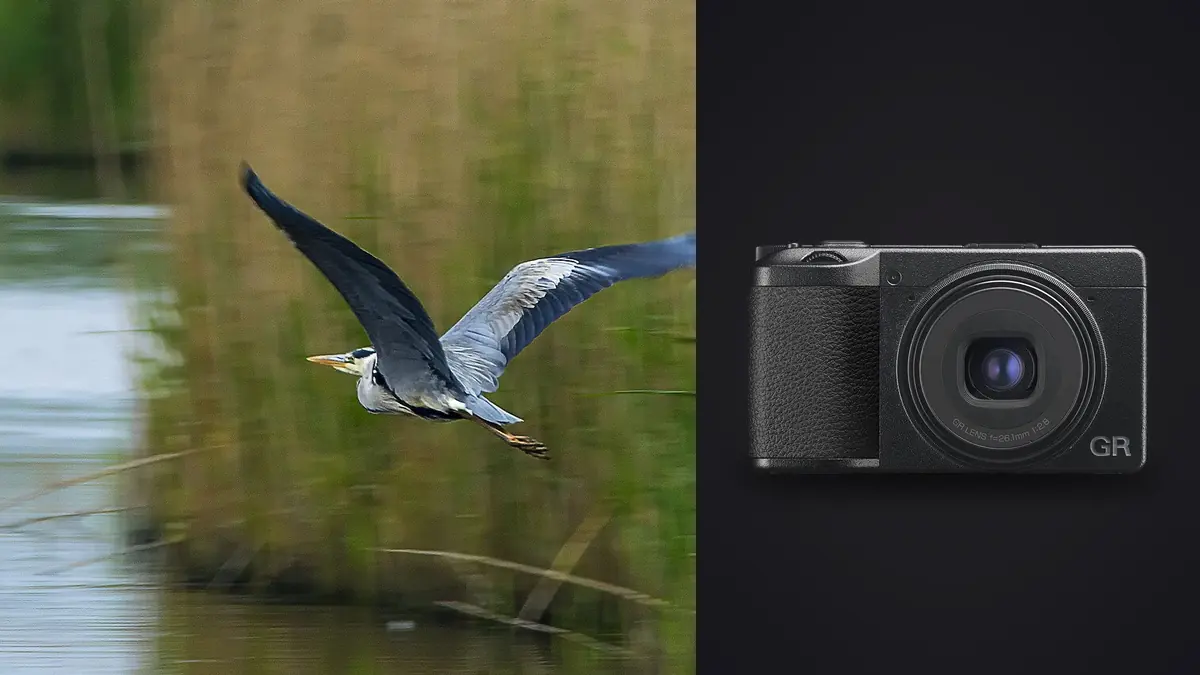
I need to say this up front because it will save some readers ten minutes: the Ricoh GR IIIx is not a birding camera. It has no zoom, no long lens option, no phase-detect tracking autofocus worth mentioning, and a burst rate that a wildlife shooter with a Nikon Z9 would call a joke. If someone in a Facebook group tells you to buy a GR IIIx for birds in flight, they are either trolling you or they mean something much narrower than what you're picturing. What I actually want to talk about is that narrower thing, because it turns out to be real and, for a specific kind of photographer, genuinely useful.
I picked up a GR IIIx last winter mostly for street work, the 40mm-equivalent crop being the reason I bought it over the standard GR III with its 28mm. Within a few weeks I was carrying it on dog walks along a reservoir that has a resident heron colony and a stretch of reed bed where reed warblers and reed buntings sit up on the stems in early morning light. I was not trying to photograph birds with it. It just happened, the way a compact camera in your jacket pocket ends up photographing whatever's in front of you. What follows is what I learned from several months of that, not a lab test and not a spec sheet rewrite.
What "birding" even means with this camera
Forget the classic long-lens birding shot: bird fills the frame, background creamy, eye tack sharp at 500mm. The GR IIIx cannot do that and pretending otherwise wastes your time. What it can do is environmental bird photography, the kind where a heron stands in a wide, moody frame with reflections and reed texture doing half the work, or where a group of waders on a mudflat becomes a pattern shot rather than a portrait. The 40mm equivalent field of view (26.3mm actual, on the APS-C sensor) is roughly a "normal" human perspective, which is completely wrong for isolating a small bird but quite good for putting a bird into a place.
The other genuinely usable case is birds in flight that are large, close, or flying directly at you, none of which sounds like typical birding but all of which happen more often than people expect. Herons taking off from ten meters away. Gulls wheeling over a harbor while you're standing on the pier. Swans coming in to land on a lake right next to a path. Corvids mobbing a buzzard overhead. In every one of those situations the bird is close enough or big enough that a 40mm crop still leaves you something to work with after cropping in post, and the GR IIIx's autofocus, while not a tracking system in the Sony or Canon sense, is fast enough to lock onto a large, high-contrast subject against open sky.
The leaf shutter is the actual selling point
Here's the part nobody talks about. The GR IIIx uses a leaf shutter built into the lens rather than a focal-plane shutter, and it is nearly silent, more of a soft click than the clack of a mirrorless shutter. I did not expect this to matter for birds until I was crouched near a low branch trying to photograph a robin at close range and realized it hadn't flinched at three consecutive shots. With a DSLR or most mirrorless bodies in mechanical shutter mode, that robin would have been gone after the first frame. Small perched birds at close range, the kind you get in a garden or hedgerow rather than out on open water, are far more approachable with a camera this quiet. That's not a wildlife-photography superpower, it's a specific, narrow advantage, but it's real and I'd bet most people who buy this camera for birds discover it by accident, same as I did.
Autofocus and burst rate: the honest numbers
The GR IIIx does continuous AF but it is a contrast-detect and hybrid phase-detect system tuned for street shooting, not subject tracking. It has no bird-eye AF, no animal detection mode, nothing resembling the subject-recognition systems that have become standard on flagship mirrorless bodies. Point it at a bird moving unpredictably against a cluttered background (trees, water with glare, reeds) and it will hunt or lock onto the background more often than not. Point it at a bird moving in a straight line against clean sky, and single-shot AF with a fast half-press, fired right before the bird crosses your focus point, works surprisingly often.
Burst shooting tops out at roughly 4 fps in continuous high mode, and the buffer is shallow, something like 10 to 12 raw frames before it stalls to write to the card. Compare that to a dedicated wildlife body shooting 20 or 30 fps with a buffer of a hundred-plus frames and you can see why nobody serious about flight sequences would choose this camera on purpose. What it means practically: you get one, maybe two attempts at a wingbeat sequence before the buffer chokes, and you'd better have nailed focus on frame one because there's no volume of frames to fish a sharp one out of.
| Scenario | GR IIIx reality | What actually works |
|---|---|---|
| Small perched bird, close range, garden/hedge | Near-silent shutter is a real advantage; AF struggles with foliage clutter | Manual focus lock via snap focus mode, pre-set to 2-3m |
| Large bird taking off nearby (heron, swan, goose) | Slow burst but subject is big enough to survive the crop | Single AF, fire on anticipation, crop hard in post |
| Small bird in flight, distant (warbler, finch) | Essentially unworkable, subject becomes a speck | Don't attempt it, wrong tool entirely |
| Gulls/raptors circling overhead against open sky | AF tracks reasonably well on high contrast against sky | Continuous AF, burst mode, accept a shallow buffer |
| Waders/shorebirds on mudflat, static | 40mm crop gives environmental context, not a tight portrait | Shoot wide, treat as landscape-with-birds, crop selectively later |
Snap focus is the trick most reviews skip
The single biggest improvement I made to my hit rate had nothing to do with autofocus mode and everything to do with switching to snap focus, Ricoh's zone-focus system where you set a fixed distance (I use 2.5m for garden birds, 5m for the reed bed) and the camera fires instantly at that distance with zero AF hunting delay. Combined with a stopped-down aperture, f/5.6 to f/8, for extra depth of field, this turns the shutter lag problem into a non-issue. You pre-focus on the branch or perch a bird is likely to land on, wait, and fire the instant it lands. This is an old birder's trick borrowed from rangefinder shooting, and it works better on this camera than autofocus does for anything closer than about eight meters.
Image quality when you do get the shot
The 24-megapixel APS-C sensor is genuinely excellent, on par with what you'd get from a mid-range mirrorless body, and that matters more than usual here because you will be cropping aggressively to compensate for the fixed 40mm field of view. A bird that fills a tenth of the frame at 40mm can survive a crop down to something resembling a usable composition, and the file still holds up at moderate print sizes because the base resolution and dynamic range are there to support it. I would not try this with a 12-megapixel sensor. At 24 megapixels, cropping to roughly 40 to 50 percent of the frame area still leaves you something print-worthy at 8x10, which is the actual math that makes "bird photography with a 40mm compact" not a complete joke.
Noise performance above ISO 3200 gets rough, and dawn or dusk shooting, when birds are often most active, pushes you into that territory fast given the leaf shutter's practical minimum shutter speed limitations at wider apertures (it caps around 1/2000s wide open, which is fine for most flight work but does force ISO up in low light since you can't open the aperture further to compensate without hitting the shutter ceiling).
Building a workable field routine
Because the buffer is shallow and the burst rate is low, spraying and praying does not work with this camera the way it might with a dedicated wildlife setup. I ended up shooting far more single frames and far fewer bursts than I would with any other camera I own, which changed how I approached the whole outing. Fewer frames per session but a much higher percentage of intentional ones. That habit, oddly, made culling faster once I got home. When a session produces 40 deliberate frames instead of 1,200 burst frames of the same heron taking off, sorting through them by eye takes ten minutes instead of an hour.
That said, on the days I did use full burst mode, chasing a specific action shot, I still ended up with the usual pile of near-duplicates and soft-focus rejects mixed in with the keepers. I run those sessions through imagic before I do anything else, mostly for the sharpness scoring, since with a lens this wide and a subject this small in the frame, it's genuinely hard to tell at a glance on a laptop screen which of six near-identical heron takeoff frames is actually sharp versus which just looks sharp at thumbnail size. The duplicate and burst clustering groups the sequence automatically so I'm not scrubbing through frame by frame, and because it runs entirely on my machine, nothing about a card full of unedited raws needs to touch a cloud service before I've even looked at it myself.
Where a fixed lens actually helps your editing
One underrated side effect of a fixed focal length: your keepers all share the same rough tonal and perspective character, so a consistent edit applies across a session far more cleanly than it would from a zoom lens where every shot has a different compression and framing logic. I built a preset in imagic using apply_my_style, trained on a batch of reed-bed and reservoir edits I'd already finished by hand, and it now gets new sessions from this camera close to a finished look on the first pass more reliably than it does with files from my zoom-lens cameras, because the lighting and distance patterns repeat so much session to session. That's specific to shooting one lens for one location repeatedly, not a general claim about the tool, but it's a real workflow benefit that came directly out of the GR IIIx's limitations rather than despite them.
Who this is actually for
If you already carry a long-lens setup for serious bird photography and you're wondering whether a GR IIIx is a lightweight second option for flight shots, the honest answer is no, leave it at home on those trips. But if you're a street or travel photographer who already owns one, or is considering one, and wants to know whether it's worth pointing at birds when they show up in front of you, the answer is yes, with the caveats above. It rewards patience, pre-focus, and proximity, and it punishes the instinct to spray a burst at a distant, fast-moving subject. Treat it like a rangefinder with a sensor rather than a wildlife camera and it stops being frustrating.
I would also flag it as a decent teaching tool, oddly enough. Shooting birds with a camera that has no zoom and a shallow buffer forces you to think about anticipation, light, and composition in a way that a 600mm lens with 30 fps lets you skip. I got better at reading bird behavior, when a heron is about to lift off, how a gull banks before it turns, specifically because I had one shot to get it right rather than a burst to bail me out. That's a real, if unusual, argument in the camera's favor that has nothing to do with its spec sheet.
Frequently Asked Questions
Can the Ricoh GR IIIx track a bird in flight the way a mirrorless camera with animal-eye AF does?
No. It has no subject-recognition autofocus and its continuous AF is tuned for street and general use, not fast erratic motion. It can lock onto a large bird moving predictably against a clean background, but it will not track a small, fast bird through foliage or a turning flock the way a modern wildlife-focused mirrorless body will.
Is the fixed 40mm-equivalent lens too short for any bird photography at all?
For distant or small birds, yes, it's the wrong tool entirely, the subject just becomes too small in the frame to be useful even after cropping. It works for large birds at close-to-moderate range (herons, swans, geese, gulls near a harbor) or for environmental shots where the bird is part of a wider scene rather than the sole subject filling the frame.
Does the leaf shutter actually make a noticeable difference with skittish birds?
In my experience yes, particularly with small perched birds at close range in gardens or hedgerows, where a mechanical shutter clack will often spook a subject that the GR IIIx's quiet leaf shutter does not. It won't help with birds already at a distance where sound isn't the limiting factor, but for close approach work it's a genuine, if narrow, advantage.
What settings should I actually use for flight attempts with this camera?
Snap focus set to your expected distance beats autofocus for anything under about eight meters, since it removes AF hunting delay entirely. For birds already airborne and further out, single-shot continuous AF with the aperture stopped down to roughly f/5.6-f/8 for extra depth of field gives the most consistent results, and I'd budget for one or two usable bursts per session given the shallow buffer rather than planning to spray continuously.
If you're weighing this camera against a dedicated wildlife setup, our software comparison for culling workflows is a reasonable next stop, and if you end up shooting a lot of burst sequences regardless of camera, how AI photo culling works covers the sharpness and clustering approach in more depth.