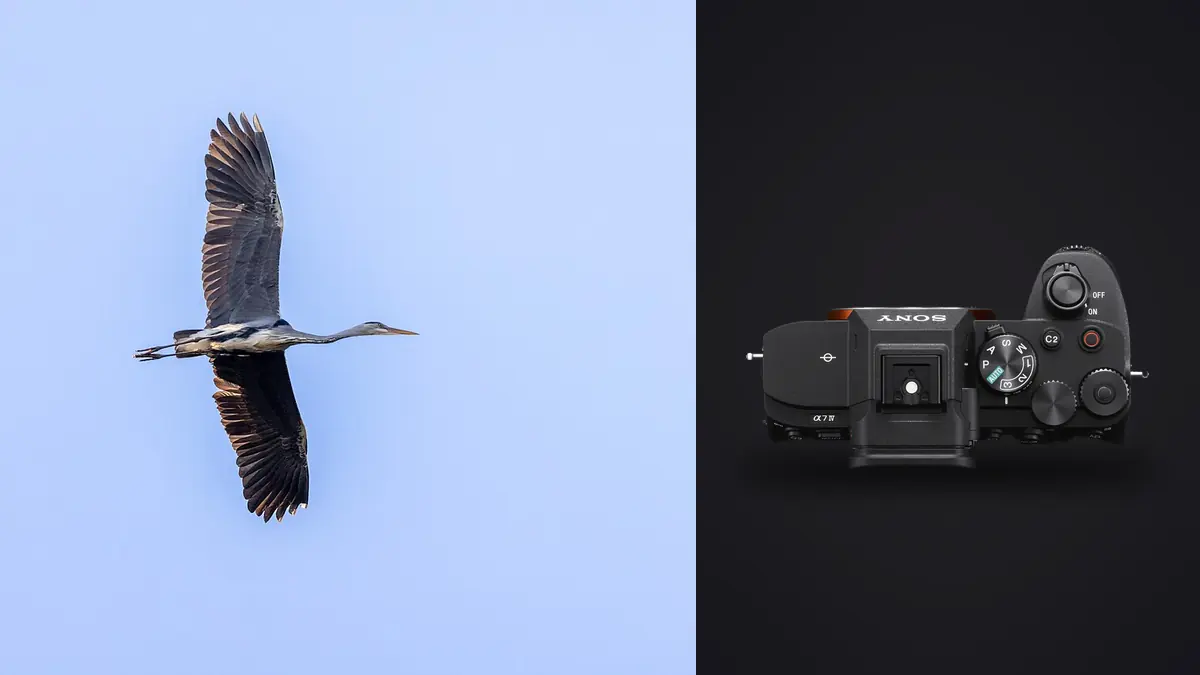
I spent four mornings in a row at a heron rookery last spring trying to decide whether my Sony A7 IV was actually the right tool for the job, or whether I was fighting the camera as much as I was fighting the wind. By the fourth morning I had an answer, and it's more nuanced than the marketing copy or the forum arguments suggest. The A7 IV is not a birding camera in the way the A9 II or A1 are birding cameras. It was never built around a stacked sensor or a 20fps blackout-free viewfinder. But it is a genuinely capable stills body that a lot of photographers already own, and understanding exactly where it bends under pressure (and where it doesn't) matters more than any spec sheet.
What the A7 IV actually brings to flight photography
The 33-megapixel Exmor R sensor is the headline spec, and for wildlife work it cuts both ways. On the plus side, 33MP gives you room to crop a bird that's smaller in the frame than you'd like, which happens constantly with anything faster than a heron. On the minus side, more pixels means bigger files, slower buffer clearing, and less forgiving high-ISO performance than the 24MP A7 III it replaced. If you shoot herons and egrets that hold a predictable flight line, the extra resolution is a genuine win. If you shoot swifts or terns that change direction three times a second, you'll feel the tradeoff.
Autofocus is where the A7 IV earns its keep. The 759-point phase-detection array covers roughly 94% of the frame, and Sony's real-time tracking with bird eye detection (added originally on the A1 and pushed down through firmware) works on the A7 IV too. In practice, bird eye AF locks reliably on anything roughly crow-sized or larger against open sky. It gets noticeably less confident on small, fast passerines against cluttered backgrounds, where it will happily lock onto a twig with more contrast than the bird's eye. That's not a knock specific to this body, every camera in this price range struggles with the same scenario, but it's worth knowing before you plan a trip around warblers in dense canopy.
The buffer, not the frame rate, is the real ceiling
Ten frames per second sounds fine on paper until you actually try to hold it. The number that matters far more for birding is how long the camera can sustain that rate before it slows down to write data, and that number changes drastically depending on which RAW format you pick. Shooting compressed RAW, I can hold 10fps for a genuinely long burst, past a thousand frames according to Sony's own figures, because the files are small enough that the buffer barely notices. Switch to lossless compressed RAW, which is what I'd actually want for a bird against a bright sky where I might need to pull back highlight detail in the wingtips, and the buffer runs dry in a few seconds. Uncompressed RAW is worse still.
The fix that made the biggest practical difference for me wasn't a menu setting, it was the card. A UHS-II SD card clears the buffer noticeably slower than a CFexpress Type A card in the same slot. If you're serious about flight sequences and you're still running SD cards from your A7 III days, that's the first upgrade to make, ahead of any lens purchase. It won't turn the A7 IV into a stacked-sensor camera, but it meaningfully shortens how long you're locked out while the buffer clears mid-sequence, which is exactly the moment a bird decides to bank and catch the light.
Rolling shutter is the thing nobody warns you about
The A7 IV doesn't have a stacked sensor, so the electronic shutter reads the frame line by line rather than all at once. For a bird flying roughly perpendicular to your pan, this shows up as a subtle skew, wingtips that look slightly swept back from where they actually were, or a prop-blur type warp if you're shooting something fast like a peregrine in a stoop. It's not dramatic in most shots and you'll rarely notice it in a single frame, but pixel-peep a fast wingbeat against a straight horizon and you'll see the distortion. My workaround is boring but effective: I use the mechanical shutter for anything under about 8fps where rolling shutter isn't a factor, and I reserve full electronic silent shooting for situations where noise actually matters, like photographing birds on a nest at close range where shutter clack will flush them. For pure flight tracking, mechanical shutter at 10fps has served me better than the numbers suggest it should.
Settings I actually use, by scenario
There's no single "correct" settings bank for birds in flight, the right combination depends heavily on what's moving and what's behind it. Here's what I've settled on after a season of testing different combinations against different subjects.
| Scenario | AF area mode | Drive / shutter | Shutter speed | File format |
|---|---|---|---|---|
| Raptor soaring against open sky | Tracking: Wide, bird eye AF on | Mechanical, Hi+ (10fps) | 1/1600s | Lossless compressed RAW |
| Small passerine in fast, erratic flight | Tracking: Zone, bird eye AF on | Mechanical, Hi+ (10fps) | 1/3200s or faster | Compressed RAW (buffer matters more here) |
| Bird launching off a perch | Tracking: Spot S, bird eye AF on | Mechanical, Hi (8fps) | 1/2000s | Lossless compressed RAW |
| Flight against cluttered foliage/reeds | Tracking: Spot M, manual back-button reacquire | Mechanical, Hi (8fps) | 1/2500s | Compressed RAW |
The pattern across all four rows is that I lean on the mechanical shutter more than most current guides suggest, and I switch AF area size based on how much visual clutter is competing with the bird rather than defaulting to Wide tracking for everything. Wide tracking is fantastic against open sky and genuinely unreliable against a busy background where it doesn't know which contrasty edge is actually the subject.
APS-C crop mode: useful reach or a false economy
Switching the A7 IV into its APS-C crop mode gives you an effective 1.5x reach boost, turning a 400mm lens into roughly 600mm of field of view. It's tempting, and for distant raptors circling a thermal it genuinely helps. The catch is that you're now working with a downsampled roughly 14-megapixel image instead of the full 33-megapixel file, so you lose most of the cropping headroom that made the sensor appealing in the first place. My rule of thumb: if the bird already fills a reasonable portion of the frame at full sensor width, don't bother cropping in-camera, shoot full frame and crop in post where you can judge the actual composition. If the bird is genuinely small and distant and you have no longer lens available, APS-C crop mode is a legitimate way to get more pixels on the subject than a full-frame crop of the same shot would give you. It's a tool for a specific situation, not a default setting.
Glass that actually pairs well
The A7 IV isn't picky, but a few lenses make a bigger practical difference than the body itself. The 200-600mm f/5.6-6.3 G is the lens I reach for most, mostly because the reach-to-weight ratio makes it usable handheld for a full morning, and its optical stabilization pairs well with the body's in-body stabilization for anything under about 1/500s where you're not already freezing motion with shutter speed alone. The 100-400mm GM II focuses faster and is noticeably sharper wide open, but you'll want a 1.4x teleconverter on it for anything genuinely distant, and that costs you close to a stop of light exactly when you need shutter speed the most. I've also used the 70-200mm GM II with a 2x teleconverter for birds close to shore, and while the AF slows down slightly with the extender attached, it's still usable in good light. None of these are cheap, but the lens matters more than the body upgrade for most people already sitting on an A7 IV.
Sorting what you actually shoot
Here's the part nobody mentions in gear reviews: a single good morning of flight photography on the A7 IV, shot in bursts at 10fps to catch wing position, easily produces two or three thousand frames. Most of those are near-duplicates of each other by design, since you're deliberately holding the shutter down through a wingbeat cycle to land on the one frame with the wings in a clean position and the eye lit. Going through that manually in a normal RAW browser is genuinely the worst part of the hobby, and it's the part that made me start running imagic on the card dump before I even open Lightroom. It clusters those burst sequences together automatically instead of showing you three thousand nearly identical thumbnails in a flat grid, and its local sharpness scoring flags which frame in each burst actually has the sharpest eye, which matters a lot more with fast wingbeats than it does with a static portrait. Everything runs on the machine itself with no upload step, which matters when you're working through a card in a hotel room with bad wifi at the end of a shooting day.
The other thing that's saved me time is training imagic's apply_my_style preset on a batch of flight shots I'd already graded the way I like them (slightly cooler shadows, a touch of extra contrast in the wing feathers). Running that preset across a fresh culled batch gets me to a consistent starting point before I do any per-image tweaking, rather than reinventing the same edit three hundred times in a session. That single pass handles the boring, repetitive 80% of the edit so the actual sitting-down-and-editing time goes to the handful of frames that deserve real attention. If you're weighing culling tools generally rather than just for this camera, it's worth reading through how AI photo culling actually works before you commit to a workflow, and the broader faster photo workflow habits matter just as much as any single piece of software.
None of this replaces good field technique. No software fixes a soft frame because your AF area was set wrong for the background, which is really the core lesson of shooting birds in flight on this body: the A7 IV rewards deliberate settings choices per situation far more than it rewards leaving everything on one all-purpose tracking mode and hoping.
Frequently Asked Questions
Is the Sony A7 IV fast enough for birds in flight, or should I wait and save for an A9 II?
It depends on what you're photographing. For raptors, herons, gulls, and other birds with relatively predictable flight paths, the A7 IV's 10fps and bird eye AF are enough to come home with keepers consistently. For fast, erratic small birds in flight, particularly against cluttered backgrounds, the gap to a stacked-sensor body like the A9 II becomes obvious in AF confidence and burst depth. I'd say learn the A7 IV's limits first rather than assuming a body upgrade fixes a technique problem, because a lot of missed BIF shots come down to AF area choice, not camera speed.
Does bird eye AF actually work reliably on the A7 IV, or is it mostly marketing?
It works, but it's not magic. Against open sky with decent contrast between the bird and the background, it locks fast and holds well through banking turns. Against foliage, reeds, or a busy shoreline, it will occasionally jump to a high-contrast edge that isn't the eye, and you'll need to be ready to reacquire with back-button focus. Firmware updates since launch have improved detection distance and consistency, so make sure you're running current firmware before judging the feature.
What memory card do I actually need for flight bursts on this camera?
A CFexpress Type A card in the primary slot makes a real difference to how quickly the buffer clears between bursts, which matters more for flight sequences than almost any other setting. A fast UHS-II SD card will work, but you'll notice longer lockouts if you're shooting lossless compressed or uncompressed RAW through long sequences.
Should I shoot compressed or lossless compressed RAW for birds in flight?
Compressed RAW if you're prioritizing burst depth and plan to shoot long sequences trying to catch a specific wing position, since the smaller files keep the buffer from filling. Lossless compressed RAW if the bird already fills a good portion of the frame and you know you'll need to recover highlight detail in bright wing feathers or pull shadow detail out of an underexposed body against a bright sky. I switch between the two depending on the subject rather than picking one permanently.