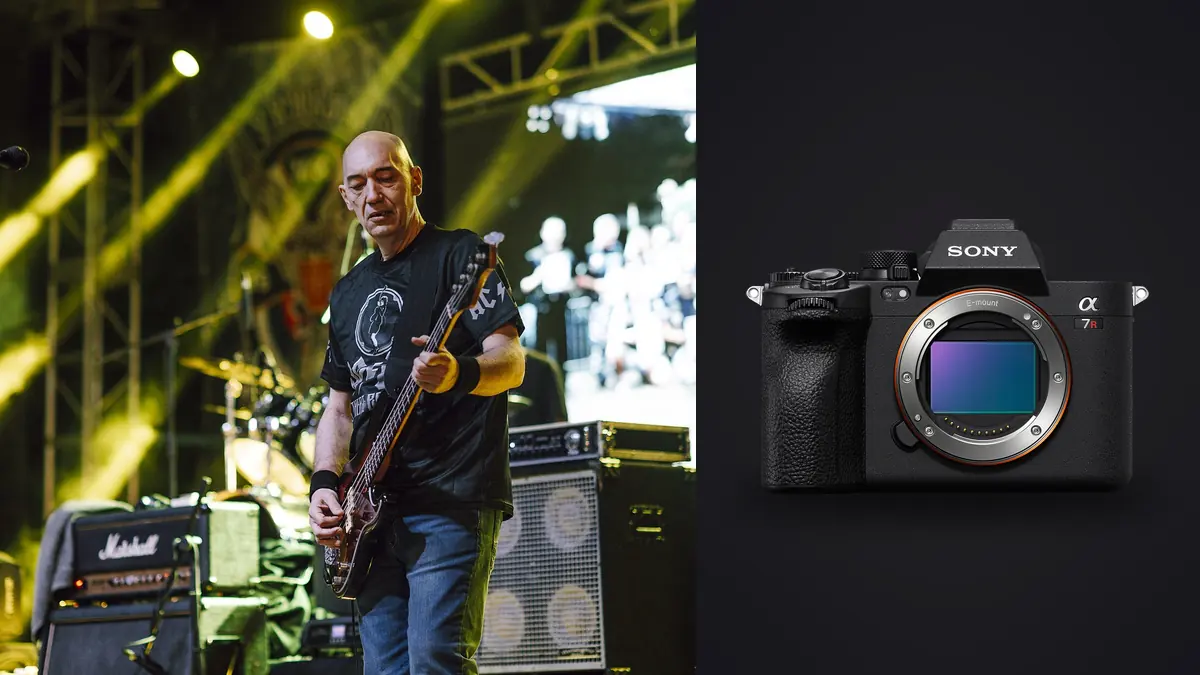
I get asked a version of the same question every time I post a gig gallery shot on an A7R V: "isn't that the resolution camera, not the speed camera?" Fair question. Sony built the A7R V for landscape and studio shooters chasing 61 megapixels of detail, not for chasing a singer across a stage in green stage-wash lighting. And yet it's been my main concert body for the better part of a year now, alongside an older A9 II I keep as backup. This isn't a spec sheet regurgitation. It's what actually happens when you point a resolution-first camera at a moving target in the dark.
Why a 61MP body even makes sense at a gig
The instinct is to reach for a camera built around speed and clean high ISO, an A7S III or a used A9, and for a lot of touring photographers that's still the right call. But resolution buys you something specific in this genre: reframing after the fact. Photo pits are brutal. You get three songs, no flash, a rail that puts you fifteen to twenty feet back from the stage, and a set list you don't control. A 24MP file shot at 70mm from the rail gives you one crop option. A 61MP file gives you room to punch in on a guitarist's hands or crop a wide stage shot down to a tight portrait without the file falling apart in a magazine spread or a large print for the artist's team.
The tradeoff is obvious the moment you look at your ISO dial. Those 61 million photosites are smaller than what you'd find on a 24MP sensor of the same physical size, and smaller photosites gather less light per pixel. In practice that means the A7R V starts showing its age around ISO 6400, where an A9 II or A7S III still looks clean. I've made peace with that because most of my work ends up resized for web and print, not pixel-peeped at 100%, but if you shoot exclusively for tight editorial crops at native resolution, this matters more to you than it does to me.
Autofocus in the dark, with people who won't hold still
This is where the A7R V surprised me. The AI-driven subject recognition (Sony calls it the AI processing unit, separate from the main Bionz XR chip) tracks a human subject shockingly well even when a lighting designer is throwing hard backlight and colored gels at the stage. I've had it lock onto a singer's eye through a haze machine and hold it through a spin. It's not infallible, and it will occasionally grab a nearby mic stand or a bandmate's shoulder if your subject turns fully sideways, but for a body not marketed as a sports camera, the hit rate on usable focus is high.
Where it struggles is fast horizontal light sweeps, the kind you get from moving-head fixtures during a drop or a chorus hit. The AF will occasionally hunt for a frame or two when the whole frame goes from black to blown-out white and back. My workaround is boring but effective: I predict the beat and half-press ahead of the light hit rather than reacting to it. That's a shooting technique fix, not a camera fix, and no firmware update solves bad anticipation.
Continuous shooting reality, not the marketing number
Sony lists up to 10fps on the A7R V, but that number only holds with the mechanical shutter or in a specific compressed RAW mode, and the buffer empties faster than you'd like at full resolution. Shooting uncompressed RAW at full 10fps, I get a genuine two to three seconds of sustained bursts before the buffer backs off and the rear screen starts showing "processing" more than I'd like. For a three-song pit set, that's rarely a dealbreaker since you're picking moments, not machine-gunning an entire set. For festival work where you're covering six or seven acts back to back with almost no card-swap downtime, it's the single biggest argument for carrying a second body.
Silent shooting and the etiquette of a quiet room
Electronic shutter (fully silent) is one of the underrated reasons to bring this camera to seated venues, acoustic sets, or anywhere a mechanical shutter slap is genuinely rude. The A7R V's silent mode is dead quiet, which matters a lot at a small jazz club or a stripped-down acoustic set where the room is dead silent between phrases. The catch is rolling shutter distortion under fast-moving stage lighting or with quick pans, since the sensor readout isn't a global shutter design. I've gotten warped, skewed verticals on quick pans during silent-mode bursts under LED wall backdrops that refresh at a frequency the sensor doesn't love. If I know a show has heavy LED video walls behind the band, I'll switch back to mechanical or electronic front-curtain shutter and accept the extra decibel of shutter noise.
How I actually set the camera up, venue by venue
This is the part that changes more than people expect. Club gigs, theater seated shows, and arena productions with a real lighting rig each need a different starting point, and I've stopped trying to run one universal setting.
| Venue type | Typical light | ISO range I run | Shutter mode | AF setting | Biggest headache |
|---|---|---|---|---|---|
| Small club / bar stage | Single wash, often one color | 3200-12800 | Mechanical, 1/200s min | Tracking, small zone | Color-cast focus hunting under deep red or purple gels |
| Seated theater / acoustic | Controlled, warm key light | 1600-6400 | Fully silent | Eye AF, wide tracking | Rolling shutter on quick pans, plus needing total quiet |
| Festival day stage | Daylight to dusk transition | 100-3200 | Mechanical, high shutter speed | Wide tracking, fast subjects | Exposure swings as the sun drops mid-set |
| Arena with production rig | Fast strobes, moving heads, pyro | 1600-8000 | Mechanical (rolling shutter risk in silent mode) | Zone tracking, anticipate light hits | Strobe flicker banding and light sweeps confusing AF |
The row that surprises people is the arena one. You'd think more production budget means easier shooting, but a full lighting rig throws more chaos at the sensor than a single stage wash ever will. Strobes and rapid color changes are the main reason I keep mechanical shutter as my default rather than silent mode once a show has a real production budget behind it.
In-body stabilization actually earns its keep here
I didn't expect to care about the A7R V's 8-stop IBIS rating for concert work since I'm rarely shooting at shutter speeds slow enough to need it for a moving subject. Where it matters is handheld wide shots of the crowd, the stage, and the room itself between songs, when I want a slower shutter to let stage haze and light trails read properly without a tripod I can't fit in a photo pit anyway. It also saves the b-roll stills, the shots of the sound desk, the merch table, the line outside, where a slightly slower shutter with good stabilization beats bumping ISO another stop.
The file management problem nobody warns you about
Here's the part that has nothing to do with the sensor and everything to do with what happens after the show. A three-song pit set at high burst rates on a 61MP body generates an enormous number of massive RAW files fast, easily 40 to 60GB from a single set if you're shooting loosely to make sure you don't miss the moment. Multiply that by a four-night festival run and you're staring down half a terabyte of nearly identical burst frames, most of which are the same expression, the same gesture, a fraction of a second apart.
This is honestly where I've changed my workflow the most in the last year. I used to sit at a laptop backstage or in a hotel room at 2am scrubbing through hundreds of near-duplicate frames by eye, trying to catch which one had the sharpest eye focus on a 61MP file where soft focus is brutally obvious the second you zoom in. I now run everything through imagic before I touch Lightroom. It does local sharpness and focus scoring on the actual pixel data, so it flags which frame in a burst of eight nearly identical stage jumps is genuinely the sharpest, not just the one that looks fine at thumbnail size. On a high-resolution body like this, that distinction actually matters, because a frame that looks acceptable at a glance can fall apart the moment a client crops in tight.
The duplicate and burst clustering helps just as much on the culling side. It groups those rapid-fire near-identical frames instead of making me scroll past forty variations of the same guitar solo one at a time, which is the single biggest time sink when you shoot loose bursts on a fast-focusing body like this. If you want the mechanics of how that scoring actually works under the hood, I wrote more about it in how AI photo culling works, but the short version for concert shooters specifically is: it saves the most time exactly where you have the least patience for it, at 1am after a four-hour show.
Everything runs locally too, which is not a small detail on tour. A lot of artist teams and label reps get genuinely nervous about unreleased tour photography touching a cloud service before it's cleared, and I've had tour managers ask directly whether images get uploaded anywhere during editing. Being able to say no, all of it happens on the laptop, offline, has closed that conversation more than once.
Building a consistent look across a whole tour
Multi-night runs create a different problem: keeping the color and contrast treatment consistent from Tuesday's club show to Saturday's arena date, even though the lighting conditions are nothing alike. I trained imagic's apply_my_style preset on a batch of edits from my own back catalog of concert work, my usual contrast curve, how I treat skin tones under colored gels, how far I push shadows. Running new imports through that preset gets me to a consistent starting point across wildly different venues before I do any manual adjustment, which matters a lot when a label wants a tour gallery that reads as one cohesive body of work rather than four disconnected shoots.
None of this replaces actual editing judgment, especially for hero images going to press. But for the bulk of a 2,000-frame night, getting a fast, consistent first pass matters more than most people admit, and it's the kind of speed gain that shows up in the general faster photo workflow advice too, just applied specifically to a genre where you're doing it on a four-night deadline with no days off in between.
Lens pairing notes
Two lenses cover probably 90% of my concert work on this body. A 24-70mm f/2.8 GM II handles wide stage shots and mid-range portraits from the rail, and it's sharp enough at f/2.8 that the 61MP sensor doesn't outresolve it, which isn't true of every zoom you'd pair with this body. For the far side of the stage or a drummer buried behind cymbals, a 70-200mm f/2.8 GM II earns its weight, though I'll admit the combined weight of body plus that lens for a full festival day starts to wear on a shoulder by the fourth act. I've tested the 135mm f/1.8 GM for isolated portrait work during ballads and it's genuinely gorgeous wide open, but it's a one-trick lens for this genre and I don't bring it unless I know the set list well enough to plan for it.
Frequently Asked Questions
Is the Sony A7R V too slow for photo pit work?
Not in practice for the standard three-song pit rule. The 10fps ceiling and buffer limits become a real constraint during longer, uninterrupted coverage like a full festival headline set or a livestream-adjacent shoot where you're shooting continuously for twenty or thirty minutes at a stretch. For a three-song pit window, the buffer rarely runs out before the moment does.
Should I shoot compressed or uncompressed RAW for concerts on this body?
I shoot compressed RAW for club and theater work where file size and buffer depth matter more than absolute pixel-level data, and switch to uncompressed only for hero shots I know are going to press or a large print. Compressed RAW on the A7R V is genuinely good, not the aggressive lossy compression some older Sony bodies used, so the quality hit is smaller than the file size savings would suggest.
How high can you realistically push ISO on the A7R V at a dark club show?
I treat ISO 6400 as my practical ceiling for anything I plan to deliver at full resolution. Past that, noise reduction in post starts eating into the fine detail that's the entire reason to shoot 61MP in the first place, at which point you may as well have brought a lower-resolution, cleaner-ISO body instead.
Does the high resolution actually help with cropping tour photos for different deliverables?
Yes, and it's the strongest argument for using this body over a speed-first camera for this genre. A single wide stage frame can be recropped into a square social post, a vertical story frame, and a horizontal press shot without upscaling, which saves you from having to reshoot or guess which framing a client will want later.