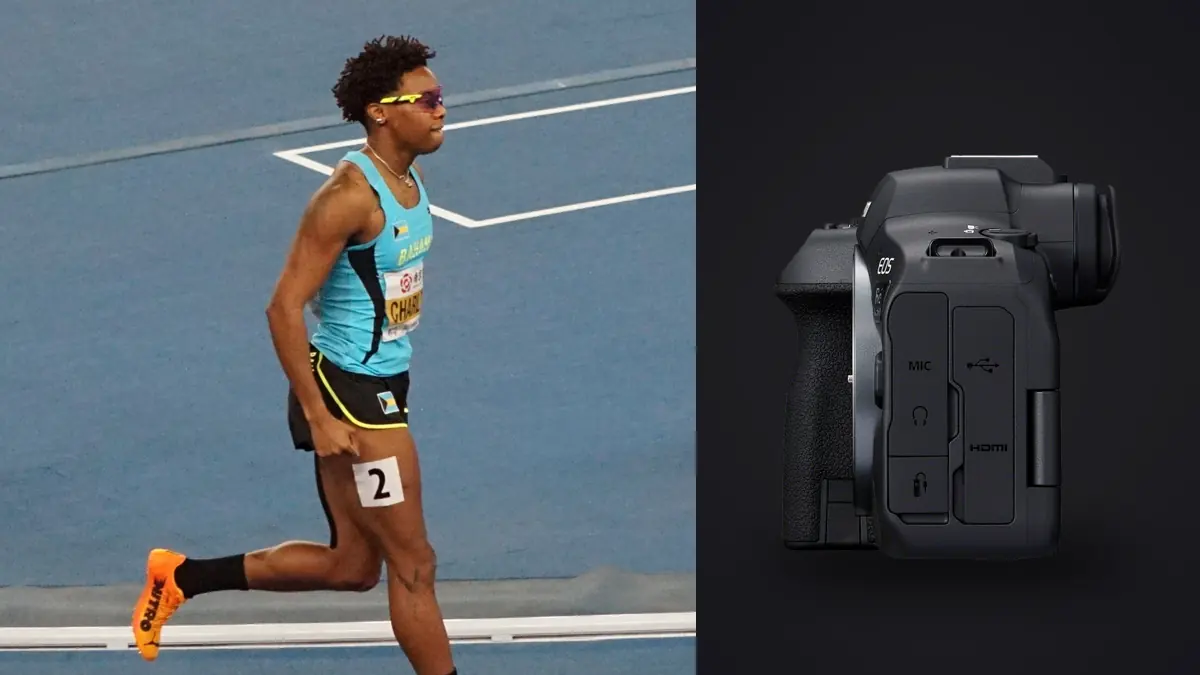
I shot my first outdoor track invitational with the Canon EOS R6 Mark II two seasons ago, mostly because my old R6 was showing its age on the 100m final and I needed something that could keep up with eight lanes of sprinters hitting top speed at the same instant. What I came away with wasn't a spec sheet opinion, it was a list of settings that work and a shorter list of things the camera genuinely struggles with. Track and field is a strange sport to shoot because it's really six or seven different sports happening on the same infield at once, and no single autofocus mode or shutter setting covers a 100m dash, a pole vault, and a shot put circle equally well.
Where the R6 Mark II actually earns its keep on the track
The R6 Mark II isn't a stacked-sensor camera. That distinction matters more for track than almost any other sport I shoot, because sprinters cross the frame laterally at close to top human speed and the sensor has to read out fast enough not to skew straight lines into diagonals. Canon's R3 and R1 use stacked sensors that read out nearly instantly, which is why those bodies can run 30fps electronic shutter with almost no rolling shutter penalty. The R6 Mark II uses a conventional CMOS readout, and at its full 40fps electronic shutter mode you will see skew on a fast-panning shot of a sprinter mid-stride, especially if you're panning against the runner's direction of travel. It's not dramatic on a 100m runner shot from the infield at a normal angle, but shoot a relay hand-off from close to the track with a wide lens and you'll notice verticals leaning.
Where the camera does earn its keep is autofocus. Dual Pixel CMOS AF II with People priority detection (eye, face, head, body) is genuinely good at holding onto a single athlete even when they're partially obscured by a hurdle, a competitor in an adjacent lane, or their own arm swinging across their face mid-stride. I run it in Case 4 for sprints (subjects that accelerate or decelerate quickly) and switch to Case 2 for hurdles and steeplechase, where the tracking needs to ignore the hurdle itself rather than snapping focus onto it as the athlete clears. That single setting change has saved more usable frames for me than any lens upgrade.
Sprints and hurdles
For the 100m and 110m hurdles I shoot mechanical shutter at 12fps rather than the full 40fps electronic mode, and I know that sounds backwards given the whole pitch of this camera. But 12fps with the mechanical shutter avoids the rolling shutter skew entirely, and honestly 12 frames per second is still plenty of coverage for a race that's over in under 11 seconds when you're tracking one athlete through a fixed focal length. I save 40fps electronic for moments where I specifically want a frame-by-frame sequence of a single technical movement, like a hurdler's trail leg clearing the barrier, where I'll crop the best single frame out of a burst anyway.
Distance events
1500m and up are the easiest events on this camera by a wide margin. Athletes are moving slower relative to the frame, the pack thins out so subject detection has less to confuse it, and you have time to recompose between laps. This is where I'll happily run 40fps because the pace of the runners doesn't push the readout speed hard enough to cause visible skew, and having a deep burst to pick the exact stride I want from is genuinely useful for a mid-race pack shot with six athletes at different points in their gait.
Field events
Pole vault and high jump are vertical, not lateral, so rolling shutter is far less of an issue since the subject isn't moving fast across the sensor's scan direction. The harder problem here is that the interesting moment (bar clearance, or the vaulter's release at the top of the pole) happens in a fraction of a second and the athlete is briefly silhouetted against open sky, which throws off exposure if you're in any kind of evaluative metering mode. I switch to spot metering off the athlete for vault and high jump specifically. Shot put and discus are almost the opposite problem: short, explosive, rotational movement in a tight circle, where I lean on Case 3 (accelerating subjects, ignore focus changes) and just let AF hold on the thrower's torso rather than chasing the implement.
Lens pairings that actually make sense for a track budget
The RF 100-500mm F4.5-7.1 IS USM is the lens I recommend to anyone shooting scholastic or club-level track on a real budget, and I use it myself for outdoor daytime meets. At 500mm it's f7.1, which is fine in full sun but starts to hunt in the shade of a stadium roof or under cloud cover, and the AF hunting is where the R6 Mark II's otherwise excellent tracking falls apart, because it can't track what it can't lock onto. For indoor track (which is a different animal entirely, usually under mixed fluorescent and LED lighting with a tight, banked 200m oval) I switch to the RF 70-200mm F2.8L IS USM. You lose reach but you gain two full stops of light and noticeably faster, more confident AF acquisition, which matters more indoors than anywhere else.
If you're adapting older EF glass, an EF 300mm f2.8L IS II on the RF-to-EF adapter performs essentially identically to native RF lenses on this body, no meaningful AF speed penalty, which is worth knowing if you already own the glass and don't want to buy into the RF telephoto lineup yet. The RF 800mm F11 is tempting for the reach at a low price, but the fixed f11 aperture is a real handicap for anything indoors or under stadium lights at dusk, and I'd only recommend it for daytime outdoor meets where you're shooting from a fixed press position a long way from the track.
Burst modes on this camera, compared honestly
Canon gives you four meaningfully different ways to capture a burst on the R6 Mark II, and they are not interchangeable for track work. Here's how I actually use each one across a meet:
| Mode | Max rate | Rolling shutter risk | Practical buffer before slowdown | Where I use it |
|---|---|---|---|---|
| Mechanical / 1st-curtain electronic | 12fps | None | Deep, rarely an issue with a fast UHS-II card | Sprints, hurdles, relay exchanges |
| Full electronic (silent) shutter | 40fps | Noticeable on fast lateral motion | Roughly 2 seconds of RAW before the camera throttles | Distance packs, jump takeoff sequences, vault release |
| RAW burst mode (pre-shoot) | 30fps | Moderate, same sensor readout as electronic | 0.5s pre-capture buffer plus however long you hold the shutter | Baton hand-offs, discus release, unpredictable start-gun reactions |
| Single shot / low-speed continuous | 1-3fps | None | Unlimited, card-speed dependent | Podium and post-race portraits, coach reaction shots |
The RAW burst pre-shoot mode is the one nobody talks about enough for track. It starts buffering frames the instant you half-press the shutter, so when the starter's gun goes off and you're a fraction of a second slow to react (which happens to everyone eventually), you still get the actual gun-start frame because the camera was already capturing before your finger moved. I use it almost exclusively for relay exchanges now, where the exact moment of the baton passing hands is genuinely unpredictable frame to frame.
Settings I actually run, meet after meet
Shutter speed for anything on the track itself sits at 1/2000s minimum, and I'll push to 1/2500s for the 100m and 200m where limb speed at full sprint can still show minor blur at 1/1600s with a long lens. For field events I drop to 1/1000s, which is plenty to freeze a shot put or discus mid-throw without needing to push ISO unnecessarily. Auto ISO with a ceiling around 6400 keeps exposure workable through the shift from bright sun to shaded grandstand without me riding the dial between events, and the sensor holds up reasonably well at 6400 for web and print sizes, less so if you're planning a large print.
In-body stabilization matters less than you'd think for handheld panning shots since you're intentionally moving the camera, but it's genuinely useful for the RF 100-500mm at the long end during slower events where you're holding a static frame on a runner approaching from distance. I turn IS to the panning-detection mode for lateral tracking shots and leave it in standard mode for anything vertical, like pole vault.
The part nobody warns you about: what comes after the meet
A single afternoon track invitational, shot the way I've described above across a full slate of events, easily produces four to six thousand frames once you account for RAW burst mode and the 40fps sequences on jumps and vaults. That volume is the actual bottleneck in track photography, not the camera. Sorting through a folder of near-identical burst frames to find the one where the hurdler's trail leg is fully extended and their eyes are open is not a fun way to spend a Sunday night before parents start emailing asking for their kid's photos.
This is the part of my workflow where imagic actually changes how I shoot, not just how I edit. Since it clusters burst sequences and duplicate frames locally on my laptop, I can pull a 40fps vault sequence, let it group the near-duplicates, and jump straight to the two or three frames it ranks highest for sharpness rather than clicking through eighty frames of the same clearance one at a time. The sharpness scoring is specifically useful here because a lot of those burst frames look fine at a glance and are actually a hair soft from the athlete's motion blur at the edges, which is easy to miss scrubbing through a lightbox quickly but shows up clearly once something is actually scoring focus per frame. If you're curious how that kind of automated culling actually works under the hood rather than as a black box, I wrote more on it in how AI photo culling works.
The other piece that matters for meet photography specifically is that none of this requires uploading a card's worth of a track meet to anyone's cloud service before you can start working. Stadium wifi at a scholastic meet is not something I'd trust with four thousand RAW files, and imagic processes everything on-device, which means I can start culling in the car in the parking lot five minutes after the last event finishes. Between meets I've also set up an apply_my_style preset trained on my own past track edits, so the color and contrast treatment stays consistent across a whole season of meets without me manually matching white balance and contrast every single week. If your bigger issue is just getting through a shoot day faster in general rather than track specifically, the workflow tips in 10 tips for a faster photo workflow cover more of that ground.
Battery and card logistics for a full meet day
Track meets run long, often four to six hours for a full invitational with prelims and finals split across a day. The LP-E6NH is rated around 580 shots by CIPA standard, but that number assumes normal shooting, not repeated 40fps and 30fps bursts through an entire slate of events. I go through two to three batteries on a full meet day and always carry a third as backup. Dual SD UHS-II card slots (this body doesn't take CFexpress, which surprises people coming from the R5 or R3) are enough for the write speeds involved, but I still shoot RAW to one card and a JPEG backup to the second, mostly so I have something I can hand off on the spot to a coach or parent without exporting from RAW first.
Frequently Asked Questions
Is the Canon EOS R6 Mark II fast enough for photo finishes at a track meet?
For amateur and scholastic meets, yes, with a caveat. At 12fps mechanical shutter you're capturing a frame roughly every 83 milliseconds, which is tight enough to catch a lean-in finish in most close races, but it's not a dedicated photo-finish timing system and shouldn't be used to adjudicate an actual result. For that role meets use dedicated finish-line cameras with continuous line-scan capture. Treat the R6 Mark II's output as documentation and a great shot, not a timing record.
Do I need the 100-500mm lens, or can I get by with something shorter for track?
It depends entirely on where you're allowed to stand. If you have infield or trackside credential access, a 70-200mm covers sprints and most field events comfortably and focuses faster in low light. If you're shooting from the stands or a fixed press box position at a larger venue, you'll want the reach of the 100-500mm even accepting the slower aperture at the long end.
Why do my panning shots of sprinters look slightly skewed or slanted?
That's rolling shutter distortion from the electronic shutter's sensor readout, which the R6 Mark II (as a non-stacked sensor camera) is more prone to than flagship stacked-sensor bodies. It shows up most on fast lateral subjects at high electronic shutter rates. Switching to the mechanical shutter at 12fps eliminates it entirely, at the cost of frame rate.
How do I realistically manage thousands of photos from a single meet?
Cull in passes rather than trying to grade every frame individually. A first pass to kill obvious misses (eyes closed, focus miss, awkward mid-blink expressions), then a burst-clustering pass to collapse near-duplicate sequences down to the one or two sharpest frames, then a final style pass. Doing this on-device rather than round-tripping through a cloud service is the difference between a same-day turnaround and a three-day one when you're working off patchy venue wifi.