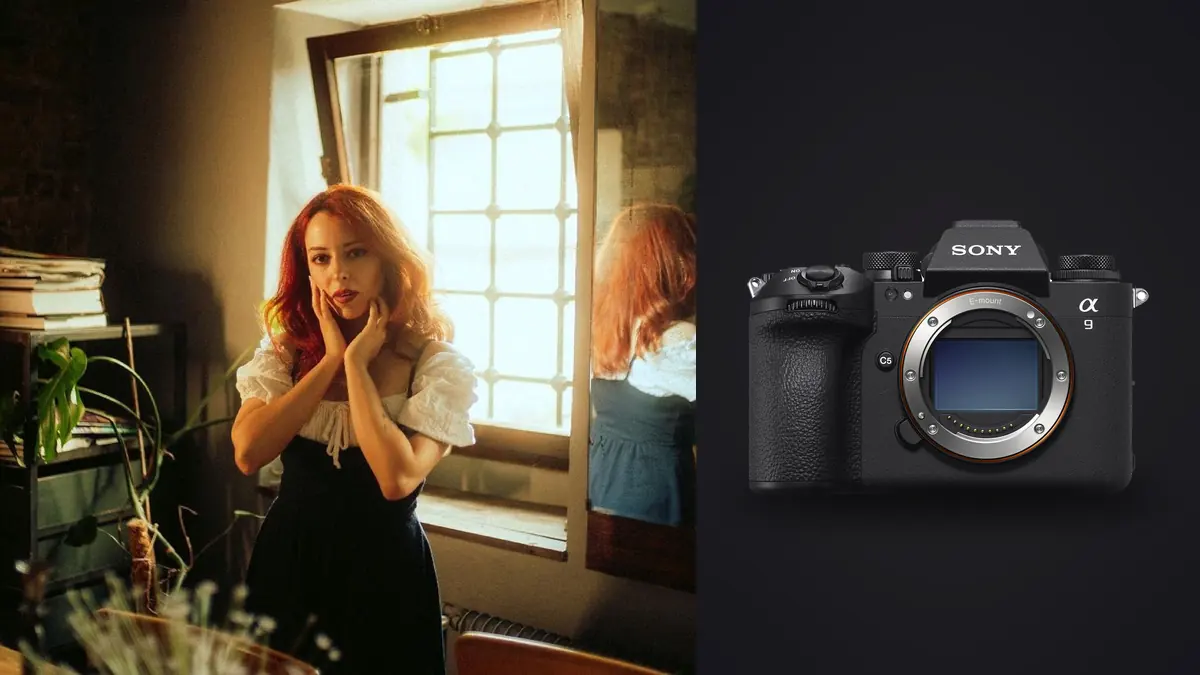
Boudoir is a strange genre to shoot technically. The lighting is usually soft and low-key, the subject is often nervous for the first fifteen minutes of the session, and the images that matter most are the quiet, in-between ones rather than the posed hero shots. When Sony put a global shutter into the A9 III, most of the coverage went straight to sports and wildlife shooters chasing 120fps and zero rolling shutter on a golf swing. Almost nobody talked about what that sensor design does for a genre built entirely around trust and a quiet room. I have been shooting boudoir and intimate couples work for about six years, on Canon before switching systems, and I want to walk through what actually changes on a shoot day with this body, not the marketing bullet points.
Why This Camera Even Comes Up in Boudoir Circles
Boudoir sessions live or die on the client feeling comfortable enough to relax her shoulders, drop the performative smile, and let you catch something real. Every mechanical noise, every flash pop, every moment you break eye contact to check a screen chips away at that. Most camera reviews evaluate autofocus and burst speed against action photography criteria. Almost none of them ask what a camera sounds like and feels like in a hotel room with one client, one assistant holding a reflector, and nothing else happening. That is the lens I am using here.
The Shutter Is the Whole Story
The A9 III has no mechanical shutter at all. It is fully electronic, always, because the global shutter reads every pixel at the same instant instead of scanning line by line. That single design choice solves two problems I used to work around constantly.
Silence changes the room
On my old A7R IV, the shutter had a distinct clack, and people would flinch on the first few frames of a session even at low volume. With the A9 III there is genuinely nothing to hear beyond the faint whir of the lens focusing. It is common for a subject to ask, mid-shoot, whether the photographer has actually started taking pictures yet. That sounds like a small thing until you have watched a nervous first-time client visibly relax because the camera stopped announcing every frame. I can shoot forty or fifty frames of a subtle shift in posture, from a slight head turn to a hand moving through hair, without the room registering that anything happened. The images end up looser and more natural because the act of photographing stops interrupting the moment.
No more banding under hotel lamps
A lot of boudoir work happens in hotel rooms and rented Airbnb spaces with mixed lighting: LED lamps, string lights, whatever ambient sources are already in the room layered under your key light. Rolling shutter sensors can produce banding under flickering LED sources at faster shutter speeds, and I used to burn time chasing anti-flicker settings or just avoiding certain lamps in frame. Because every pixel exposes simultaneously, that banding is gone regardless of shutter speed. I leave problem lamps on in the background now instead of working around them, which opens up compositions I would have avoided before.
The other practical win is flash sync. Because there is no shutter curtain to travel across the sensor, the A9 III syncs flash at any shutter speed, all the way up to 1/80,000s with a compatible speedlight. In practice that means I can shoot a strobe-lit boudoir set at f/1.4 in a bright window-lit room at 1/8000s and still get full flash output with zero ambient bleed, something that used to require a leaf-shutter lens or an ND filter with any other camera in my bag.
Autofocus When the Face Is Turned Away
A large share of boudoir compositions deliberately keep the face partially hidden, turned toward a window, buried in a pillow, or covered by hair or a sheet. Most eye-AF systems get noticeably less confident the moment the eye disappears from frame. Sony's subject recognition on the A9 III is built around a broader human pose model rather than eye-detection alone, and it holds focus on the torso or shoulder line reliably even when there is no visible eye or face to lock onto. I shoot the 50mm f/1.2 GM wide open for most of a session, and the hit rate on frames where the subject's back is to the camera has been noticeably better than it was on my A7R IV, where I would frequently get soft frames because the AF hunted for a face that was never coming.
High ISO, Honestly
I want to be straight about a tradeoff here because most coverage glosses over it. Global shutter sensors have historically carried a dynamic range and high-ISO noise penalty compared to conventional stacked sensors, and the A9 III is not fully exempt from that pattern. Base ISO sits at 250, and shadows pushed hard above ISO 6400 show more chroma noise than what I get out of an A7R V or A1 II file at the same ISO. For a genre that leans into moody, low-key lighting with deep shadow falloff, that matters. My workaround has been simple: I keep sessions lit closer to ISO 800 to 3200 with continuous LED panels rather than pushing ISO to preserve ambient ratio, and I lean on fast primes to keep shutter speed comfortable instead of ISO. The files are clean and usable in that range. Above ISO 8000 I notice it, and I would not recommend this body to someone whose style depends on shooting available darkness at ISO 12800 and grading it moody afterward.
| Spec relevant to boudoir work | Sony A9 III | Sony A7R V | Sony A1 II |
|---|---|---|---|
| Shutter type | Fully electronic, global shutter | Mechanical + electronic | Mechanical + electronic |
| Flash sync at full power | Up to 1/80,000s (compatible flash) | 1/200s (1/250s w/ APS-C crop) | 1/400s mechanical, 1/200s e-front curtain |
| Base ISO | 250 | 100 | 100 |
| Resolution | 24.6MP | 61MP | 50MP |
| Rolling shutter distortion under mixed LED | None | Present at fast shutter speeds | Minimal, still present |
| EVF blackout during burst | None | Brief blackout | None |
| Approx. launch price (body only) | ~$5,998 | ~$3,898 | ~$6,499 |
If your priority is skin-tone resolution for large prints or heavy crops, the A7R V's 61MP file is genuinely a better tool for the job and costs two thousand dollars less. The A9 III earns its keep specifically on the silent, distortion-free, any-shutter-speed-flash-sync combination, which is a narrower but very real need in this genre.
Lenses That Actually Work in a Bedroom
Boudoir locations are rarely spacious. Hotel rooms and home bedrooms rarely give you more than eight or ten feet of working distance, so the wide-aperture primes matter more here than in most portrait work. My rotation is the 35mm f/1.4 GM for full-room environmental frames, the 50mm f/1.2 GM as the workhorse for most of a session, and the 85mm f/1.4 GM for tight, compressed detail shots from across the room when space allows. The 24-70mm f/2.8 GM II comes out when I am shooting a couple and need to zoom rather than physically move around furniture. None of this is specific to the A9 III, but the camera's low-light AF confidence at f/1.2 and f/1.4 apertures is what makes shooting that wide practical for a whole session instead of a handful of hero frames.
What Happens After the Shutter Stops
Here is the part nobody mentions in gear reviews: a silent, blackout-free 120fps body changes your shooting behavior in a way that has real downstream consequences. Because there is no friction to firing off a burst, and because people respond to subtle direction with tiny shifts rather than distinct poses, a single boudoir session can end with two to four thousand frames now, up from roughly six hundred to a thousand on an older body. A huge percentage of those are near-duplicate bursts of the same three-second moment, a hair toss captured across fifteen frames that all look almost identical at a glance.
Culling that volume by eye is where the session actually starts costing you time, and it is the reason I moved my import workflow onto imagic. It runs locally on my laptop, scores sharpness and focus accuracy per frame, and groups burst sequences and near-duplicates together so I am picking the one sharp frame out of a cluster of fifteen instead of scrubbing through all of them one at a time. For boudoir specifically there is a second reason this matters more than it would for, say, landscape work: the images never leave my machine. Everything runs offline with no cloud upload, which is not a minor feature when the files on the memory card are this sensitive and clients are trusting you with them. If you want the mechanics of how frame-scoring and clustering actually work under the hood, this breakdown of how AI photo culling works covers it in more detail than I can here.
Keeping the Look Consistent Across Clients
The other workflow change worth mentioning: boudoir clients talk to each other, and a consistent signature tone across a portfolio matters more in this genre than in most, because prospective clients are scrolling a gallery specifically to decide if they trust you with their body and their privacy. I spent a long time building a grade in Lightroom that leans warm in the shadows and slightly desaturated in the highlights, and re-applying that consistently across a four-thousand-frame session used to be its own multi-hour task. imagic's apply_my_style feature trains on a batch of my own previously edited images rather than a generic filter, so new sessions come in already close to my grade before I do the manual pass. It is not a replacement for actual color grading judgment, more of a fast first pass that gets me eighty percent of the way there. If you have not built a grading process for your own work yet, this guide to color grading is a reasonable place to start before you try to automate any of it.
Is It Worth the Upgrade for This Genre Specifically
Honestly, only if the silent shutter and any-speed flash sync solve a problem you are actively fighting. If you shoot boudoir primarily with continuous light and never use flash, and your clients have never once flinched at a shutter sound, the A9 III's headline features are mostly wasted on you and the A7R V will give you better resolution for the same genre at a lower price. But if you have ever had a session stall because a client tensed up at the sound of the camera, or you have fought rolling shutter banding under hotel room lighting, the difference is not subtle. It is the first camera I have used where the gear genuinely gets out of the way of the actual work, which in this genre is mostly about making someone feel safe enough to be photographed honestly.
Frequently Asked Questions
Does the lack of a mechanical shutter cause any problems for boudoir work specifically?
Not in my experience. The concerns you sometimes hear about electronic-only shutters, like banding under certain light sources or distortion on fast-moving subjects, are exactly what the global shutter design eliminates. For a genre with relatively slow, deliberate movement and mixed ambient lighting, it is a net improvement rather than a compromise.
Is 24.6 megapixels enough resolution for boudoir prints and albums?
For the album and wall-print sizes most boudoir clients order, yes, comfortably. Where you would feel the difference is heavy cropping for detail-focused compositions or very large prints above roughly 30 inches, and in those specific cases the A7R V's 61MP sensor gives you more room to work with.
Do I need special flash equipment to use the fast sync speeds?
Yes. The full 1/80,000s sync speed requires a compatible Sony speedlight, not a generic third-party strobe or studio pack triggered normally. If you are using standard studio strobes through a regular trigger, you are still bound by more conventional sync limits, though you still get the rolling-shutter-free benefit at any speed.
How does the high ISO performance compare to what I am used to on a standard sensor camera?
It is good through roughly ISO 3200, with noise becoming more noticeable above ISO 6400 compared to a conventional stacked sensor like the one in the A7R V or A1 II. If your boudoir style depends on shooting in near-darkness and grading heavily afterward, plan your lighting a stop or two brighter than you might otherwise, or expect to lean on noise reduction in post.
None of this is a case for every boudoir photographer to run out and buy a $6,000 body. It is a case for matching the tool to the specific friction point in your actual workflow, whether that is a nervous client, a banding hotel lamp, or a memory card full of near-duplicate frames waiting to be culled before you can even start editing.