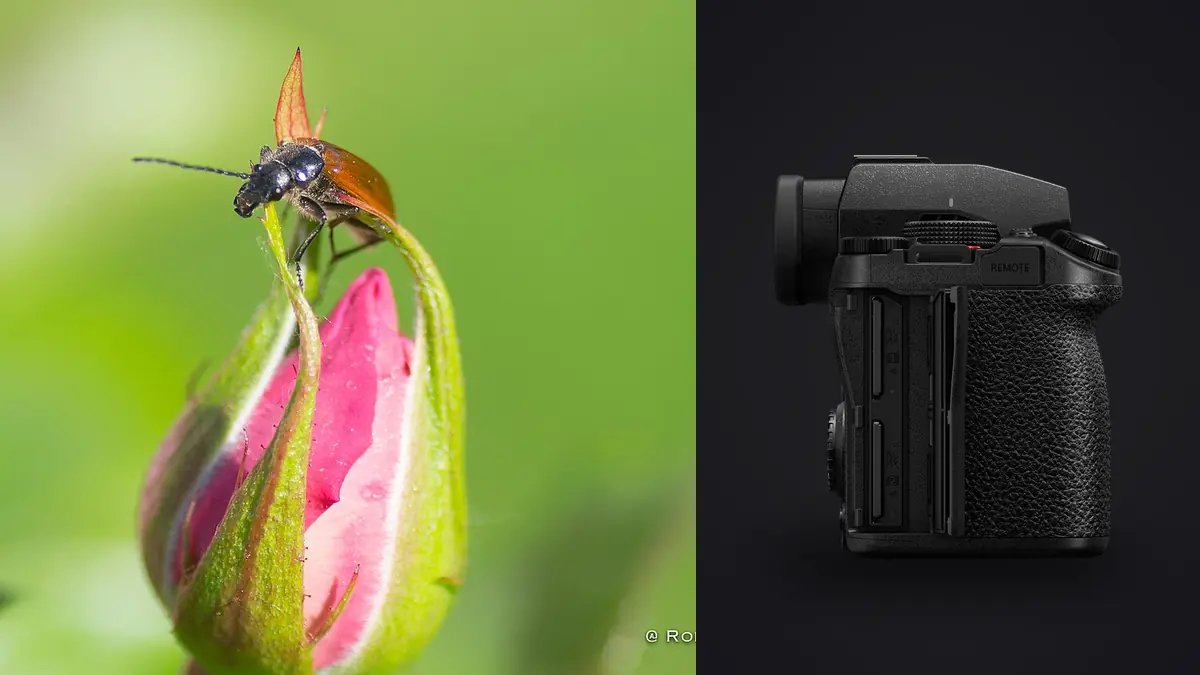
The first hour after sunrise is when insect macro actually works: the air is still, dew has pinned the wings down, and a damselfly that would normally bolt at forty feet of movement will sit still enough for a 1:1 lens to get within a hand's width. It's also the hour when a camera's autofocus, stabilization, and battery all get tested in ways a spec sheet doesn't capture. I've been running a Panasonic Lumix S5IIx through exactly that routine for the better part of a season, mostly on a local reserve with a marsh edge that's thick with dragonflies from June through August, and this is what actually matters if you're considering it as a dedicated (or secondary) macro insect body.
Full frame changes the working-distance math
The S5IIx is a full-frame L-mount body, and that matters more for insect work than it does for landscapes or portraits, because your effective magnification and working distance are tied directly to focal length once you're shooting true 1:1. On a full-frame sensor, a 100mm macro lens gives you roughly 13-15cm of working distance at maximum magnification, which sounds generous until you're trying to fill the frame with a hoverfly that spooks at anything closer than 20cm. That's the actual argument for reaching past the "kit" macro focal lengths (50-60mm equivalents) toward 100mm and longer glass when insects, not flowers or product shots, are the subject.
What the full-frame sensor buys you in exchange is a genuinely shallow depth of field at f/2.8-f/4, which is useful for isolating a subject from cluttered vegetation, but it's a liability at true macro ratios. At 1:1 on an insect's compound eye, your in-focus slice can be under a millimeter even stopped down to f/11. I shoot the vast majority of live-insect macro on this camera between f/8 and f/16, accepting some diffraction softening in exchange for enough of the subject actually being sharp. Below f/8 you're basically photographing an eyeball with a blurred abdomen attached.
Autofocus for subjects that don't sit for a portrait
This is the part that actually changed my opinion of the camera. The original S5 used Panasonic's contrast-only DFD autofocus, and it was genuinely bad for handheld macro: the lens would pump back and forth hunting for contrast on a subject with almost no depth to focus into, and by the time it locked, the dragonfly had moved its head. The S5IIx (and the S5II it's built from) switched to a phase-hybrid AF system, and for macro that's the single biggest practical upgrade in the lineup. Focus acquisition on a still insect at 1:1 is fast enough now that I trust single-shot AF for perched subjects rather than falling back to manual focus by default.
That said, I don't use the camera's subject-detection modes for insects, because they're not built for them. The AI detection covers humans, animals (mostly birds and mammals), and vehicles; it will occasionally lock onto a large moth or a beetle's outline by accident, but it's not reliable enough to build a workflow around, and it will just as often ignore an insect entirely or lock onto a leaf edge behind it. For anything at true macro magnification I switch to single-point AF with the smallest AF box available, place it directly on the eye, and use back-button focus so a half-press doesn't re-hunt every time the insect twitches. For genuinely fast subjects like a hunting dragonfly in flight, I've mostly given up on autofocus altogether and pre-focus manually on a likely perch, waiting for the subject to enter the plane.
Focus peaking and manual focus assist actually matter here
Because so much macro work ends up manual regardless of AF quality, the S5IIx's focus peaking implementation is worth calling out. It's adjustable in both color and sensitivity, and at high magnification with a narrow depth of field, a high-sensitivity peaking overlay in a color that isn't green (I use red against the mostly green marsh backdrop) makes it much easier to see exactly which sliver of the insect is in the focal plane before you commit to the shot.
Stabilization helps less than you'd expect at 1:1
The S5IIx carries the same 5-axis in-body stabilization as the S5II, rated around 5 stops on the sensor alone and up to roughly 6.5 stops in Dual IS combinations with stabilized lenses. Those numbers are real at normal shooting distances. At macro magnification they mean much less, because IBIS is fighting rotational and translational camera shake, not the fact that your own breathing is moving the entire rig a millimeter forward and back relative to a subject where a millimeter is the entire depth of field. Handheld at 1:1, I'm still shooting shutter speeds in the 1/500-1/1000s range regardless of what IBIS claims to buy me, both to freeze subject micro-movement and to freeze the focus breathing of my own hand.
Where the stabilization genuinely earns its keep is in the setup phase: framing a handheld shot at high magnification without a gimbal-smooth viewfinder is exhausting, and IBIS makes it possible to actually compose and check peaking without the image swimming around. It just isn't a substitute for shutter speed once the shutter fires.
Lens choice does more for insect macro than the body does
The L-mount lineup has matured enough that there are now real options rather than one obvious default, and the trade-offs are mostly about working distance versus weight and price.
| Lens | Focal length | Working distance at 1:1 | Weight | Approx. street price | Best suited to |
|---|---|---|---|---|---|
| Panasonic Lumix S 100mm F2.8 Macro | 100mm | ~13cm | 298g | $600 | Travel and hiking kits where every gram counts |
| Sigma 70mm F2.8 DG DN Macro | 70mm | ~10cm | 515g | $570 | Flowers, static insects, tighter budgets |
| Sigma 105mm F2.8 DG DN Macro Art | 105mm | ~11cm | 715g | $760 | Sharpest option; doubles as a short portrait lens |
| Sigma 180mm F2.8 EX DG OS HSM (adapted via MC-21) | 180mm | ~24cm | 1630g | $1,300 used | Skittish dragonflies and butterflies that won't tolerate a close approach |
I'd push back a little on the instinct to buy the longest lens automatically. The 180mm on the MC-21 adapter is the one I reach for on open-winged dragonflies that flush at anything under 30cm, but it's heavy enough that handholding it steady for more than a few minutes at 1:1 gets genuinely tiring, and autofocus through the adapter is noticeably slower than the native Panasonic and Sigma DG DN lenses. For anything that tolerates a closer approach (jumping spiders, most beetles, caterpillars), the 100mm Panasonic is the one that actually stays in the bag on longer hikes.
Weather sealing, cold mornings, and battery reality
Panasonic doesn't publish a formal IP rating for the S5IIx, but it carries the same dust and splash resistant sealing as the S5II, and after a season of kneeling in wet grass at dawn with dew soaking through my trousers, the camera hasn't cared. The bigger practical issue for early-morning insect work isn't sealing, it's cold. Battery life is CIPA-rated around 360 shots on the standard BLK22 pack, and on a 4-5°C dawn shoot with the rear screen active for peaking and manual focus checks, I've seen that number drop by close to a third. I carry a spare battery on any shoot starting before sunrise, which wasn't optional gear before I started shooting this way.
What happens after the shutter clicks
Insect macro produces an ugly volume problem that landscape or portrait work mostly avoids. A single perched dragonfly session, shooting in short bursts to catch the moment the wings settle, easily produces 400-600 frames in twenty minutes, and the overwhelming majority are near-duplicates separated by a fraction of a second and a fraction of a millimeter of focus drift. Sorting that by eye is the part of macro photography nobody enjoys, and it's where I've actually changed my post-processing workflow this year. I run the day's card through imagic before touching Lightroom: its local sharpness and focus scoring flags which frame in each burst actually nailed the eye, and the duplicate and burst clustering groups the near-identical shots so I'm not scrolling past the same damselfly forty times to find the one with clean wing edges. Because all of that runs locally on the laptop rather than uploading a card full of RAWs somewhere, it works fine at a marsh with no signal, which is most of the marshes I shoot.
The other piece that's saved real time is imagic's apply_my_style feature, which trains a preset from edits I've already made rather than a generic macro preset baked in by someone else. Insect macro tends to need a consistent, fairly specific color treatment (the greens and yellows of foliage backgrounds get muddy fast if you're not careful), and once I'd built out that look on a batch of keepers, having it apply automatically across the rest of a season's shoots instead of re-adjusting sliders on every single frame cut a meaningful chunk out of my editing time. If you're working through the broader logic of why culling before editing saves more time than editing faster, the breakdown in how AI photo culling actually works covers the mechanics better than I can in a paragraph here, and the field-tested habits in our faster photo workflow guide apply directly to burst-heavy macro sessions.
Where the S5IIx falls short for this specific use
Being fair about it: this is fundamentally a video-first body wearing a stills-capable sensor. The active cooling fan, ProRes internal recording, and USB-SSD workflow are all dead weight for a macro insect shooter, and you're paying for them in the price gap over the plain S5II, which shares the same sensor, AF system, and IBIS without the video extras. Unless you're also shooting hybrid video work, the S5II gets you to the same macro results for less money and less body weight in the bag. I'd only actively recommend the "x" over the base model to someone who genuinely needs the video side too.
Frequently Asked Questions
Does the S5IIx's subject-recognition autofocus work on insects?
Not reliably. The AI detection is built around humans, animals like birds and mammals, and vehicles. It occasionally catches a large moth or beetle by chance, but it isn't trained for insect eyes and will regularly miss or misfire. Single-point AF placed manually on the eye, combined with focus peaking, is the more dependable approach for anything at true macro magnification.
Is the 24.2-megapixel sensor enough resolution for cropped insect detail shots?
For most subjects, yes. 24.2MP gives enough headroom to crop in on a compound eye or wing pattern after the fact without visible softness on a normal print or web size. If you need more, the camera's high-resolution composite mode produces roughly a 96-megapixel file, but it requires the subject to hold still through multiple exposures, which rules it out for anything but dew-pinned or otherwise motionless insects on a tripod.
Can I use my existing DSLR macro lenses on this camera?
Yes, via an adapter like Sigma's MC-21 for Canon EF or Sigma SA mount glass, or a Nikon F to L-mount adapter for Nikon lenses. Autofocus speed and accuracy through an adapter is noticeably slower than native L-mount lenses, which is more forgivable on a static macro subject than on anything with wings.
Do I need image stabilization at all for handheld macro with this body?
It helps you compose and check focus in the viewfinder without the frame swimming, but it does very little to let you shoot at slower shutter speeds once you're near 1:1 magnification, because the dominant blur source at that distance is your own micro-movement toward and away from the subject rather than angular camera shake. Plan your shutter speed (1/500s or faster for live insects) as if IBIS weren't there.