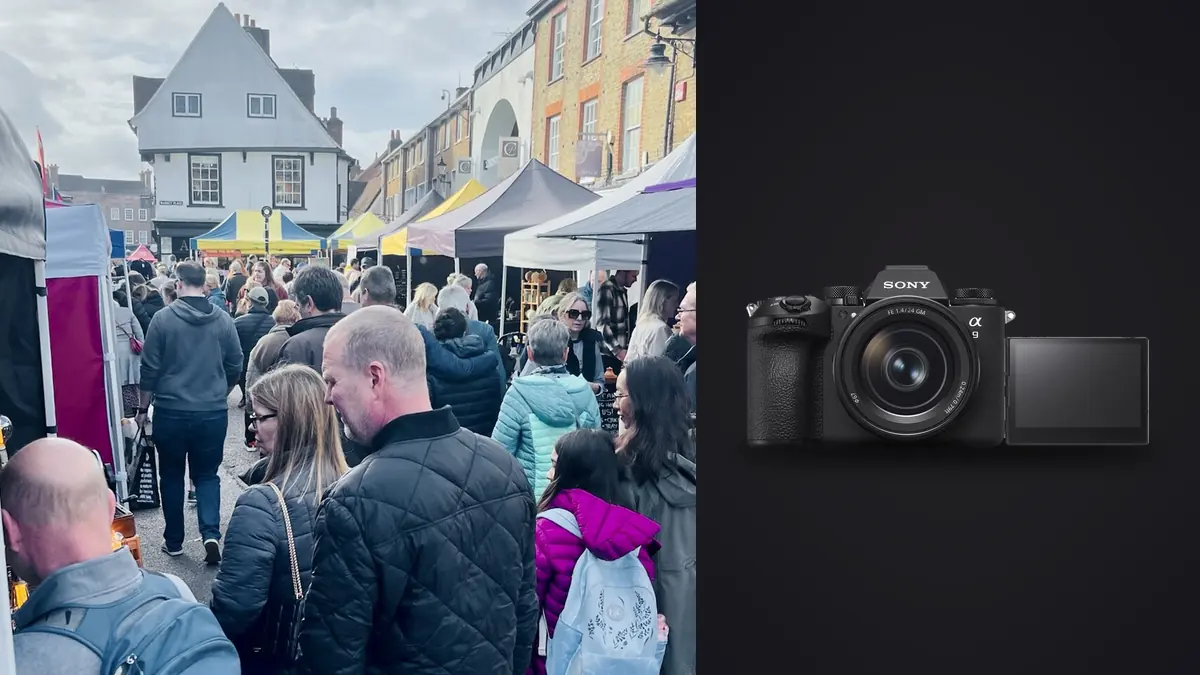
I spent four nights in October following a night market vendor for a small documentary project, the kind of job where you're eighteen inches from someone's face under sodium lighting and a mechanical shutter clack might as well be a tap on the shoulder. Halfway through the second night I realized I'd stopped thinking about the sound my camera made, because the Sony A9 III doesn't have one to think about. That's the detail that actually matters for street and documentary work, more than the marketing language Sony wrapped around "global shutter," and it's the thread I want to pull on here.
What the Global Shutter Actually Changes When You're Working Close
Every mirrorless camera before this one read its sensor a row at a time, top to bottom, in a fraction of a second that was fast but never zero. Most of the time you never noticed. But point a rolling-shutter sensor at someone jogging across a frame, or fire a flash at a fast shutter speed, or pan hard through a crowd, and you'd get skew, banding, or a sync ceiling around 1/250. The A9 III reads the entire sensor at once. No skew on a running subject, no jello on a whip-pan through a parade, and flash sync at literally any shutter speed the camera offers, up to 1/80000 if you want it.
For documentary work specifically, the sync-anywhere part is bigger than people give it credit for. I've shot fill flash on a subject walking past a lit shopfront at 1/2000 to freeze motion and kill ambient without touching a neutral density filter or a high-speed sync mode that eats two stops of power. That used to require compromise. Now it doesn't.
The trade you make for a global shutter is base-ISO dynamic range. Stacked global shutter sensors have historically given up a bit of headroom compared to the best backside-illuminated sensors without one, and the A9 III is no exception, it sits a shade behind the A7R V or even the older A9 II in pure shadow recovery at ISO 250. In practice, for street and documentary work where you're rarely pushing five stops out of a shadow in post, I never noticed it. If you shoot a lot of static high-contrast landscape or architectural work where you lean hard on recovered shadows, you'll feel it more than a street shooter will.
Full-Time Silent Shooting Changes How You Work, Not Just What You Hear
Older Sony bodies had an electronic silent mode you could switch to, but it came with rolling-shutter skew as the cost of silence, so a lot of documentary shooters left it off and ate the shutter sound because a warped subject was worse than a clack. The A9 III has no mechanical shutter at all. There's nothing to switch. Every frame is silent, every frame is skew-free, all the time. That single decision removes a choice photographers used to have to make on the fly, and it changes body language on the street. You stop flinching before you press the shutter. You stop timing shots around ambient noise to mask the click. You shoot more, and more of what you shoot is the moment before the subject reacts to being photographed, rather than the moment after.
I'll say the honest, slightly uncomfortable part too: full-time silence raises the ethical bar a notch for documentary work, not lowers it. A subject who can't hear you shooting also can't opt out by giving you a look that says "that's enough." I've started narrating out loud when I'm working a scene for more than a few frames, partly for consent, partly because a documentary photographer who wants to be invisible forever eventually gets treated like a surveillance camera by the people they're photographing, and that's not the relationship you want with a community you're documenting.
Handling Through a Full Shooting Day
At roughly 703 grams body only, the A9 III is not a small camera. It's built on the same chassis as the A1 and A9 II, with the deep grip and the twin-dial control layout that flagship Sony bodies have had for a few generations now. Next to a Leica M11 or a Fujifilm X100VI it reads as a "camera-shaped camera" on the street rather than something that disappears into a jacket pocket. That matters if your documentary approach depends on looking like a tourist rather than a photojournalist. It matters less if you're working press credentials openly or shooting a project where being visibly a photographer is part of the access agreement.
Weather sealing is genuinely good, magnesium alloy shell, sealed dials and ports, and I've shot through drizzle at a coastal fish market without a rain cover and had zero issues. Battery life on the NP-FZ100 is rated conservatively; in real documentary use with the EVF on most of the day and a lot of chimping between setups, I land closer to 450 to 550 frames before I swap, which is fine for a day but means carrying two spares if you're shooting multi-day away from a charger. The dual CFexpress Type A slots are the one line item that actually costs real money on top of the body: to use the 120fps RAW burst mode for more than a couple of seconds you need fast Type A cards, and those are not cheap the way SD cards are.
How the Cameras Documentary Shooters Actually Compare
People ask me why not just use an A7 IV, or why not go rangefinder. Here's the honest side-by-side from a street and documentary lens, not a spec sheet lens.
| Camera | Approx. body weight | Shutter | Fastest silent burst | Discretion on the street | Rough street price (body) |
|---|---|---|---|---|---|
| Sony A9 III | 703 g | Global (fully electronic, always silent) | 120 fps RAW | Moderate, visibly a pro body | $5,999 |
| Sony A7 IV | 658 g | Mechanical + rolling electronic | 10 fps | Moderate | $2,499 |
| Leica M11 | 530 g | Mechanical/electronic hybrid, manual focus only | 4.5 fps | High, reads as a hobbyist or tourist | $8,995 |
| Fujifilm X100VI | 478 g | Leaf shutter, silent to 1/4000 | 20 fps (crop) | Very high, fixed lens reads as a compact | $1,599 |
The A9 III wins outright when the story is fast-moving and unpredictable, protests, parades, sports-adjacent documentary work, anything where you genuinely need autofocus tracking and a deep buffer. The M11 wins when the story depends on you not looking like a photographer at all, at the cost of manual focus and a much slower shooting rhythm. The X100VI is the honest middle ground for a lot of long-form documentary projects: cheap enough to risk in bad weather, small enough to carry all day, silent leaf shutter, and a fixed 35mm-equivalent lens that forces the kind of discipline a lot of street photographers actually want. I own two of these cameras (the A9 III and an X100VI) and reach for whichever one matches how close I expect to be working that day.
Autofocus in Actual Crowds, Not on a Test Chart
Sony's AI subject recognition on the A9 III is genuinely excellent at holding a face through occlusion, someone stepping in front of your subject for half a second no longer costs you the frame the way it would on older bodies. In a market or a protest that's a real, measurable improvement in keeper rate. But it's worth naming the part nobody puts in the marketing copy: eye-AF and subject tracking are built for a photographer who knows who the subject is before pressing the shutter. Documentary work is often the opposite, you're scanning a scene for a moment that hasn't happened yet and the "subject" might be a hand, a gesture, or a relationship between two people rather than a face. I keep the camera in wide-area tracking with a manual override on the AF joystick rather than letting face-priority run the whole time, because I don't want the algorithm deciding who the photo is about.
Lenses That Keep the Rig Fast Without Making It a Brick
The body alone doesn't determine how the rig feels on the street, the lens does more of that work. My rotation for documentary assignments is the FE 40mm F2.5 G and FE 24mm F2.8 G, both under 200 grams, both small enough that the whole kit stays under a kilo and doesn't scream "professional camera" the way a 24-70mm GM zoom does. For low light interiors and evening work I'll swap to the FE 35mm F1.4 GM, which is a genuinely excellent lens but adds enough size and weight that the discretion advantage of the small primes disappears. If you're buying into this system for street and documentary work specifically, buy the small G primes before the GM zooms. The zoom versatility rarely outweighs what you give up in size and speed of handling.
Low Light, Realistically
The 24.6MP stacked sensor is clean up to about ISO 6400 for documentary purposes, usable with some noise reduction to ISO 12800, and I wouldn't push past ISO 25600 unless the alternative is missing the frame entirely. That's respectable but not class-leading, the A7S III and A1 both hold detail slightly better at the top end because they're not carrying the global shutter tax. For most street and documentary lighting (open shade, indoor markets, streetlight-lit scenes) it's a non-issue. Where it shows up is deep interior work with mixed tungsten and shadow, the kind of thing you'd shoot in a workshop or a small kitchen, where you'll want to bias toward wider apertures over cranking ISO past 12800.
Where the Edit Actually Happens
Here's the part of A9 III ownership nobody warns you about until you live with it: a 120fps buffer produces an obscene number of near-identical frames. A ten-second sequence of someone crossing a street can hand you 300 to 500 RAW files where maybe four are genuinely different from their neighbors. Multiply that across a multi-day documentary shoot and you're looking at tens of thousands of files that all need to be looked at, scored, and thinned before you can start actually editing.
This is the part of the workflow I stopped doing by hand a while back. I run every card through imagic before I open Lightroom, letting its local sharpness and focus scoring flag which frames in each burst are actually sharp on the eyes rather than technically "in the burst," and letting the duplicate and burst clustering group those 300-frame sequences down to the handful worth a second look. Because it runs entirely on-device rather than uploading anything, it's also the one part of the pipeline I don't have to think twice about when the subjects are people who didn't sign a release and would rather their faces weren't sitting on someone else's cloud server while I sort through them. For anyone curious about the mechanics behind that kind of scoring rather than just taking my word for it, I wrote up how AI photo culling actually works separately.
The other feature that's become part of my actual workflow rather than a nice-to-have is imagic's apply_my_style preset, which trains on edits you've already made rather than shipping a generic look. Documentary work usually needs a consistent, restrained grade across a whole project shot over weeks, and training the preset on the first real editing session of a project means the other three thousand frames land close to on-target before I touch a slider. It's a one-time purchase rather than a subscription, which matters when you're already paying for CFexpress cards and don't want another monthly line item. If the broader culling-to-edit pipeline is new to you, the rundown at 10 tips for a faster photo workflow covers more of the sequence I'm describing here.
Frequently Asked Questions
Is the global shutter on the A9 III actually noticeable in street photography, or is it a spec that doesn't matter in practice?
It's noticeable in two specific situations: fast lateral motion (someone running, a bike, a whip pan) where older electronic shutters would skew the frame into a parallelogram, and any time you want flash at a shutter speed above your camera's normal sync limit. Outside those two cases, most static or slow-moving street scenes look the same as they would on a good rolling-shutter sensor.
Is the A9 III too big and obvious for someone trying to shoot unnoticed on the street?
Compared to a Leica M or a Fuji X100-series body, yes, it reads more like professional gear. Compared to putting a 24-70mm GM zoom on an A7 IV, it's actually more discreet once you pair it with one of the small G-series primes. Size perception is mostly about the lens, not the body.
Do I need to shoot at 120fps for documentary work, or is that overkill?
Overkill for most of it. I use 120fps rarely, mostly for unpredictable action within a documentary sequence (a scuffle breaking out, a sudden gesture). For the bulk of a day I shoot 10fps or single frames, both to save card space and because a giant burst of near-identical frames just becomes more culling work later.
How do you deal with the sheer number of files a body like this produces on a multi-day shoot?
Cull immediately and locally rather than letting it pile up. I run cards through imagic the same night to score sharpness and cluster bursts before anything hits Lightroom, which turns a multi-thousand-frame day into a shortlist I can actually make editorial decisions on, rather than scrolling through duplicates at 11pm trying to remember which of six nearly identical frames was the one where the expression actually worked.