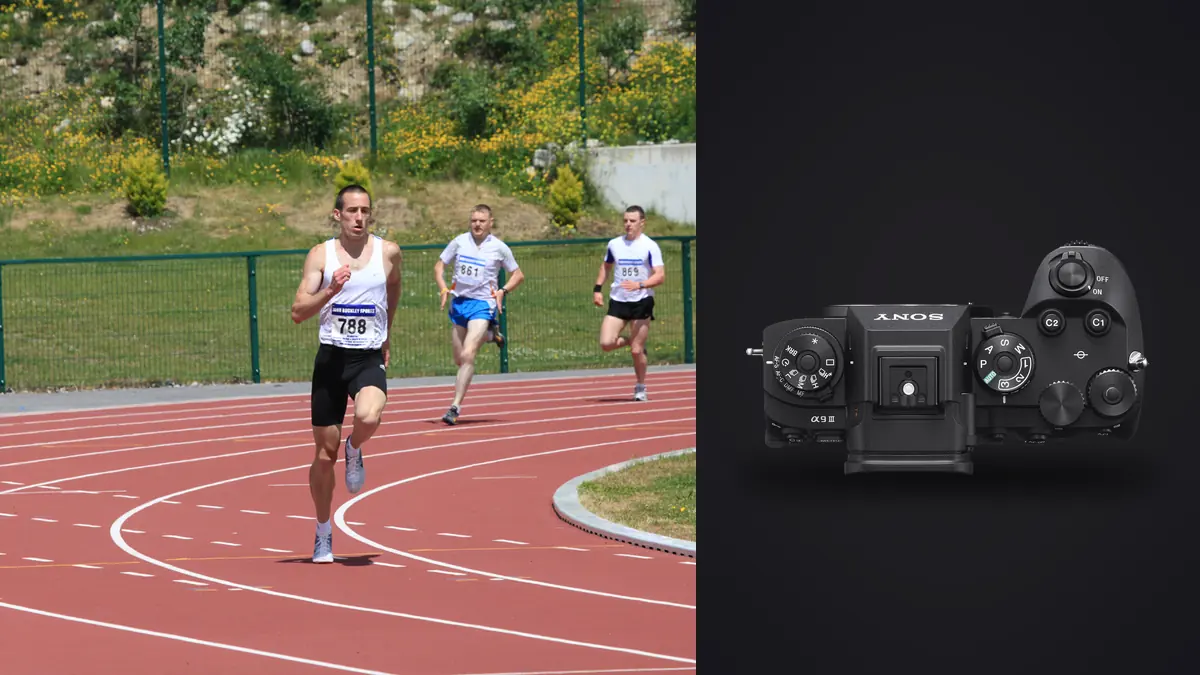
The meet that made me stop trusting my old buffer math
I shot a regional qualifier meet last spring with a body I'd used for three seasons and got burned in the 4x100m final. The buffer choked mid-handoff, right as the second exchange happened, and I came away with a gap in the sequence exactly where I needed it most. That's the meet that pushed me to the Sony A9 III, and it's also the meet I keep coming back to when people ask whether the upgrade is worth it for track specifically, as opposed to field sports where the pace is more forgiving.
Track and field is a strange test case for a camera. You've got sprint events that are over in under ten seconds, throws where the entire useful action window is maybe half a second around release, and distance events where nothing happens for minutes except a photographer standing there wondering if they should have brought a stool. The A9 III's headline features (the global shutter sensor, up to 120fps stills, pre-capture buffering) sound like marketing copy until you actually put them against these specific event types. Some of them matter enormously. One or two matter less than Sony's launch materials implied.
Global shutter: the one spec that actually matters trackside
Every mechanical and electronic rolling shutter sensor reads the frame line by line, top to bottom, over a span of milliseconds. Most of the time you never notice. At a track meet you notice constantly, because tracks are full of exactly the conditions that expose rolling shutter: LED results boards and timing clocks refreshing at their own frequency, sprinters moving at 10+ meters per second across your frame, and stadium floodlights that many venues still run on older ballasts.
The A9 III reads the entire sensor at once. That single change removes three problems I used to plan around: skewed verticals on fast lateral pans (a sprinter's torso leaning at an angle that has nothing to do with their actual lean), banding from LED boards in the background, and the wobble you'd get shooting through a chain-link fence or hurdle when panning quickly. None of these are dealbreakers on a rolling shutter body if you know to avoid them, but avoiding them means compromises: shooting narrower, cropping tighter, or just accepting a percentage of unusable frames from every burst.
Where the old rolling shutter camera let me down
The specific failure I remember most was shooting the long jump runway with a telephoto pan, following an athlete through their approach. On my previous body, maybe one in five frames in a fast pan showed visible skew in the athlete's legs, like the frame had been sheared. It's subtle enough that a viewer scrolling through a gallery might not consciously flag it, but I could see it, and it meant I was culling harder than I wanted to just to avoid keeping a slightly-off frame. With the A9 III that entire failure mode is gone. Every frame in a pan sequence has the same geometry regardless of shutter speed or subject velocity.
120fps sounds great until you check your card at the end of finals
The frame rate number gets all the attention, but the number that actually governs your day is how many total frames you walk away with. Run 120fps continuous through a 90-minute sprint and hurdles session, even shooting selectively, and you can end a meet with 4,000 to 6,000 raw stills without really trying. I learned this the hard way at my second meet with the camera: I shot most finals at full 120fps because I could, and came home to an import that took long enough to make coffee, then a culling session that took longer than the drive to the venue.
The practical adjustment I've made is to reserve 120fps for the specific moments where frame-by-frame separation actually matters (baton exchanges, the exact instant a jumper leaves the board, a hurdle clearance where I want to pick the peak extension) and drop to 30fps or even 15fps for anything with more visual redundancy, like the back half of a 1500m where the field is strung out and nothing changes frame to frame. Compressed RAW helps the buffer and card math considerably compared to uncompressed, and for meet coverage that gets used on results pages and athlete socials rather than gallery prints, compressed RAW is genuinely enough.
Settings I actually use, event by event
This is less a spec sheet and more what's in my head walking up to each event. Distances assume a mid-size outdoor stadium, shooting from the infield or a photo position along the home straight.
| Event type | Typical shooting distance | Drive mode | Shutter speed | AF area |
|---|---|---|---|---|
| 100m / 200m sprint | 15-40m, long lens | Hi+ up to 120fps for the finish, 30fps for heats | 1/3200-1/4000 | Tracking: Spot S, locked to torso |
| Hurdles | 20-35m | 60fps around each barrier, 20fps between | 1/2500-1/3200 | Tracking: Expand Spot |
| Long jump / triple jump | 10-25m, wide-to-mid | 30fps continuous through the approach, 120fps burst at takeoff | 1/2000-1/2500 | Tracking: Expand Spot, watch for the pit sand throwing off exposure |
| Shot put / discus / javelin | 20-45m | 20-30fps in a short burst bracketing release | 1/2000+ (1/3200 for javelin release) | Zone, recomposed manually if the circle rotation confuses tracking |
| 800m-5000m distance | Variable, often 30-60m | 10-15fps, occasional panned sequence at 20fps | 1/1000-1/1600, or slower with a pan for motion blur | Wide tracking, less critical with more separation between runners |
| 4x100m / 4x400m relay | 15-30m at each exchange zone | 120fps for a 1-2 second window around the handoff only | 1/3200 | Tracking: Spot S, pre-focused on the exchange zone |
The relay row is the one setting combination I'd genuinely call a workflow win from the pre-capture feature. Rather than trying to anticipate the exact frame of the baton changing hands, I half-press to start pre-capture roughly a second before the incoming runner reaches the zone, and the camera has already buffered frames from before I fully pressed the shutter. I no longer lose exchanges to reaction time, which used to happen at least once a meet.
Autofocus in a stadium is a different problem than autofocus on a pitch
Most AF marketing talks about soccer, football, or motorsport, where the subject usually contrasts against grass or asphalt. Track surfaces are a different problem: a uniform red or blue rubberized surface, athletes in team colors that sometimes closely match the track or the infield grass, and lane lines that can confuse edge detection during a fast pan. I've had more false-positive AF locks onto lane markings with track shooting than with any other sport I cover.
The other variable specific to track meets is sun angle. Afternoon sessions on an east-west oriented track put the sun low and direct into the lens for roughly half the field of view, and backlighting a sprinter against a bright infield can pull focus toward the brighter background if you're on a wide tracking area. Narrowing to Spot S and staying disciplined about recomposing rather than trusting Wide tracking has fixed most of this for me, though it does mean more manual attention than I'd give on a cloudier day or an indoor meet under even lighting.
Lens pairing that survives a full day at the track
I run two bodies for a full meet: one with the 300mm f/2.8 GM for sprints, hurdles, and finish-line work from a fixed position, and one with the 70-200mm f/2.8 GM II for field events and anything closer, like award ceremonies or coach reactions on the infield. The 300mm at f/2.8 on the A9 III's global shutter sensor is where the combination really shows off, since fast glass plus a sensor with no rolling shutter penalty means I can shoot wide open at high shutter speeds without worrying about skew even during aggressive pans following a sprinter down the straight.
For throws, where I'm often further back and want more reach, a 400mm f/2.8 or the 200-600mm (accepting the slower aperture) covers shot put and discus circles that are frequently positioned in a corner of the venue, further from the general spectator area than the track itself.
The real bottleneck isn't the camera, it's the card full of near-duplicates
Here's the part nobody puts in the camera review. Shooting 120fps bursts through an entire meet solves the capture problem and creates an editing problem of roughly equal size. A three-second burst at 120fps is 360 frames of essentially the same sprinter mid-stride, and if you shot six finals plus qualifying heats that way, you're looking at a card full of frames where 95% of them are near-identical to their neighbors and only a handful actually represent the peak moment you want.
This is the exact situation I built my culling workflow around after switching to the A9 III. I run the meet's full card through imagic before I open anything in an editor, letting its local sharpness and focus scoring flag which frames in each burst are actually in focus on the athlete rather than the background or a passing official, and letting the duplicate and burst clustering group each 120fps sequence so I'm reviewing one representative cluster instead of scrolling through 360 nearly-identical frames one at a time. Because it runs entirely on the laptop, there's no upload step between finishing a session and starting the cull, which matters when you're trying to get a same-day gallery up for parents and athletes before the next meet buries it in their inbox.
The other piece that's saved real time is having imagic apply my own edit style automatically to the first pass rather than starting every image flat. I trained it on a set of my previously graded track images, so bursts I pull out of culling already carry roughly the color and contrast treatment I'd apply by hand, and I'm doing final adjustments rather than building the look from scratch on five hundred selects. If you're coming from a rolling shutter body and shooting fewer frames per event, this part matters less. At A9 III frame rates it's close to mandatory if you want to deliver a gallery within 24 hours. Our breakdown of how AI photo culling actually scores frames covers the sharpness detection side in more detail if you're curious how that part works technically, and the workflow tips piece has a few more habits worth adopting once volume goes up this much.
Frequently Asked Questions
Do I need to shoot every event at 120fps?
No, and I'd argue you shouldn't. Reserve the top frame rate for moments with a narrow, high-value window (baton exchanges, takeoff on a jump, the instant of release on a throw) and drop to 20-30fps for anything with a longer, more forgiving action window like a mid-race pan during a distance event. Shooting everything at maximum rate just multiplies your culling time without adding usable variety to the final selects.
Does the global shutter actually fix LED scoreboard banding?
In my experience, yes, consistently. Rolling shutter sensors capture LED boards mid-refresh often enough that you get visible dark bands across the sign in a percentage of frames, especially at faster shutter speeds. Since the A9 III reads the whole sensor simultaneously, that banding pattern doesn't occur regardless of shutter speed, which matters a lot for meets where the finish line photo also needs to show a clean, readable time on the board behind the athletes.
What's a realistic number of RAW files from a full day of track coverage?
For a multi-event high school or college dual meet shot the way I described above (selective frame rates by event, not maximum burst on everything) I typically land between 2,500 and 4,000 compressed RAW files. Push everything to 120fps across the board and that number climbs past 6,000 easily, which is where the culling step stops being optional and starts being the actual bottleneck in getting a gallery delivered.
Is the A9 III overkill for a smaller club-level meet?
Honestly, for a lot of club meets, yes. The pre-capture and 120fps ceiling earn their keep at championship-level meets with tight, unpredictable moments like relay exchanges and finish-line separations that decide placings. For a low-pressure dual meet where you're mostly documenting rather than chasing a photo-finish, a body with a more modest frame rate and no global shutter will get you 90% of the same usable gallery with noticeably less time spent culling afterward.