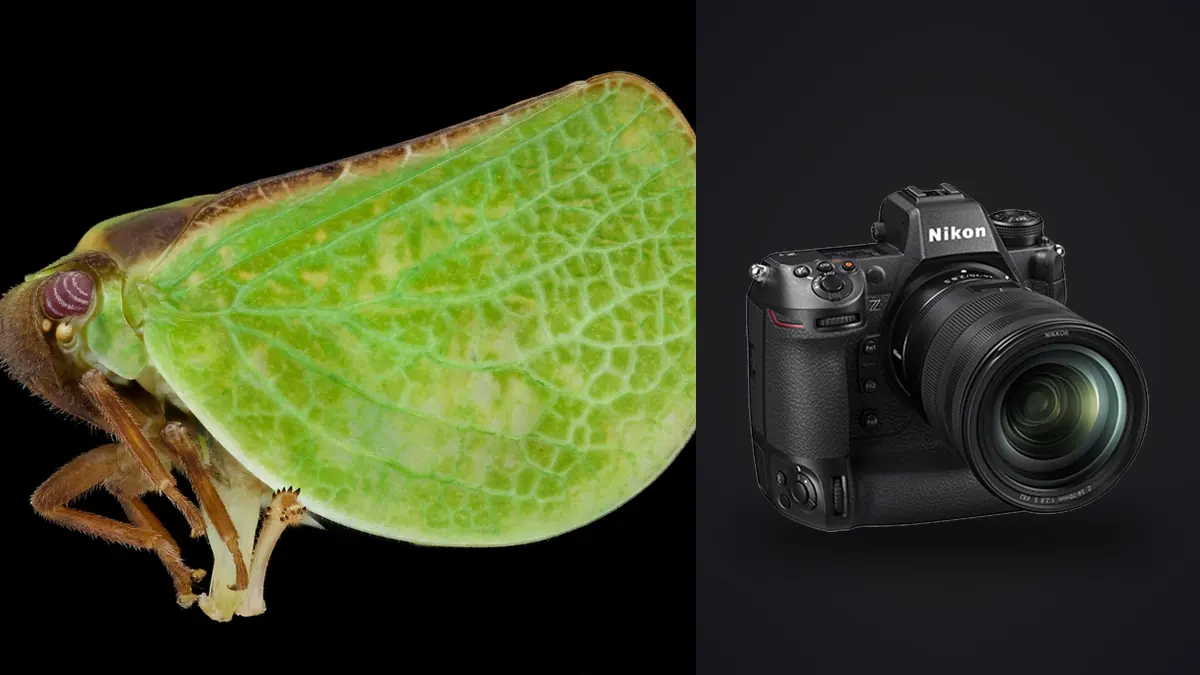
Most of what gets written about the Nikon Z9 is aimed at sports and bird shooters who care about 20 frames a second and autofocus that never blinks. None of that is really why the Z9 turns out to be a good macro insect camera, and honestly some of it is close to irrelevant at this scale. What matters when you're three centimetres from a jumping spider is different: how the sensor behaves when you fire a flash at it, whether the body runs hot after two hours crouched in wet grass, and whether the buffer keeps up with a hundred-frame focus stack before the subject decides it's had enough and flies off. I've been running a Z9 with the 105mm MC macro for insect work for about a year, alongside an older D850 kit I kept around as backup, and the differences between the two are specific enough to be worth writing down.
The sensor readout matters more than resolution here
Insect macro at 1:1 and beyond isn't a resolution game. A 45.7-megapixel file gives you more room to crop a damselfly's compound eye after the fact, but it doesn't change how sharp that eye is when you press the shutter. What actually changes the outcome is the stacked sensor's readout speed, and that shows up in two places: rolling shutter and flash sync.
The Z9 has no mechanical shutter at all, it's fully electronic. For most genres that's a curiosity. For macro it removes a real problem: shutter shock. On a body with a conventional shutter, the small vibration from the curtain moving can smear detail at high magnification, especially in the 1/60 to 1/250 range where you're often working with ambient-plus-fill light. That's gone entirely here because there's nothing mechanical to move.
The readout speed also keeps rolling shutter distortion from wrecking shots of anything with fast-moving parts, a fly cleaning its legs, a hoverfly's wings mid-beat, a beetle's antennae twitching between frames. On older mirrorless bodies with slower sensor scan rates you'd see skewed wing shapes or warped legs in a percentage of frames. I don't see that on the Z9 even in bursts at 20fps.
Flash sync is the other piece. Native sync tops out at 1/200s, which is standard, but Auto FP high-speed sync pushes that to 1/8000s. For insect work that means you can use a small flash for fill and still shoot at 1/1000 or faster to freeze a bee's wings without the shutter speed being capped by the flash. It also means you can properly underexpose ambient light and let the flash do the work, which is how you get insects photographed against a clean, near-black background even at midday.
Lens and extension choices that actually pair with this body
The Z9 doesn't come with a dedicated insect lens, obviously, so the glass you put in front of it does most of the actual work. Here's what I've used and roughly what each combination gets you in the field, not on a test chart.
| Setup | Max magnification | Approx. working distance | Best suited to |
|---|---|---|---|
| Nikkor Z MC 50mm f/2.8 | 1:1 | ~4.5cm at max mag | Static subjects, flowers with visiting bees you can get very close to |
| Nikkor Z MC 105mm f/2.8 VR S | 1:1 | ~14cm at max mag | Dragonflies, damselflies, anything that bolts if you get too close |
| 105mm MC + Kenko 20mm extension tube | ~1.4:1 | ~9cm | Smaller beetles and ants without buying a second lens |
| 105mm MC + Raynox DCR-250 clip-on | ~2 to 2.5:1 | ~6-7cm | Extreme close-ups on eyes and mouthparts of larger insects |
| Laowa 100mm f/2.8 2x Ultra Macro (FTZ II adapted) | 2:1 native | ~15cm at 2:1 | Reaching 2x without stacked accessories, manual focus only |
The 105mm MC is the default I reach for. The extra working distance over the 50mm is the difference between a dragonfly tolerating you and a dragonfly leaving the frame, and the VR helps more than I expected when you're hand-holding at 1/125 trying to keep a hovering subject roughly centred. The Laowa is manual focus only and Nikon's body won't meter it in any useful automatic way, but it gets you to 2x without a clip-on diopter degrading the image, and at that magnification every bit of optical quality you can keep matters.
A note on teleconverters
Skip them for true macro work. A 1.4x teleconverter on the 105mm MC does increase working distance slightly at a given magnification, which sounds useful, but it also costs you a stop of light right when you're already stopping down to f/13 or f/16 for depth of field, and autofocus (what little you're using at this range) gets noticeably less confident.
Autofocus at this scale is mostly a manual game, and that's not really the Z9's fault
The Z9's subject-detection AF covers people, dogs and cats, birds, and vehicles. It does not have an insect mode, and I don't think any current mirrorless body does this reliably yet. Past roughly 0.5x magnification, autofocus hunting becomes the norm on almost every system, because the depth of field is measured in millimetres and the AF system simply doesn't have enough contrast information at that scale to lock confidently.
In practice this means single-point AF-S at best, and manual focus with focus peaking for most of the actual keeper shots. Where the Z9 helps is the viewfinder itself: the blackout-free EVF at high refresh rate makes manual focus by eye genuinely easier, because you're not losing the subject in a blacked-out frame between shots the way you would on a DSLR mid-burst or an older mirrorless body with a slower panel. Focus peaking overlaid on a bright, high-resolution EVF is what actually gets me sharp shots more than any AF mode does at this range.
One feature worth calling out specifically: in-camera focus shift shooting. The Z9 can fire up to 300 frames in a sequence with adjustable step width and interval, racking focus a tiny amount between each shot, which is built for stacking. It works well on a still subject on a tripod, a chilled insect photographed indoors on a natural perch, a dead specimen, a sleeping bee at dawn before it's warmed up enough to move. It's much less useful on an active subject in the field because even small movements between frames (a leg shift, an antenna twitch, wind moving the stem) throw off alignment badly enough that stacking software struggles to blend them cleanly.
Flash, diffusion, and actually freezing wingbeats
Ambient-light-only insect macro works fine for slow subjects on an overcast day. It falls apart the moment you want a fast shutter speed to freeze a wing mid-beat, because you simply don't have the light. This is where the Z9's Auto FP sync earns its keep. A pair of small flashes on a bracket (I run a basic dual-flash rig, nothing exotic) set to manual power, diffused through a folded piece of white plastic or a small softbox taped over each head, gives enough output at 1/2000 or faster to stop a bee's wings while the high-speed sync keeps exposure balanced.
The trick that took me longest to get comfortable with is deliberately underexposing ambient by two to three stops and letting flash carry the subject. Done right you get a bee or fly rendered crisply against a background that reads as near-black even though it was shot at 11am in full sun. Done wrong you get a flat, obviously-flashed insect floating on a muddy grey background, which is the single most common mistake I see in insect macro generally, not a Z9 problem specifically.
Silent shooting matters here too, though not for the reason people usually assume. It's not that insects hear the shutter. It's that you don't flinch at the sound and shift your hand-held rig half a millimetre right as the shutter fires, which at 2:1 magnification is enough to throw focus off the eye entirely.
Focus stacking in the field versus focus stacking at the desk
For live insects, the practical stacking technique isn't the in-camera focus shift mode, it's the handheld rocking method: lean slightly toward and away from the subject while firing a burst, letting your own body motion rack focus across the frame instead of a motor doing it. At 20fps with a blackout-free viewfinder you can genuinely watch the plane of focus travel across the insect in real time and stop once you've covered the depth you need, which is a real advantage over a body where the finder blacks out between frames and you're shooting blind.
The cost of this technique is volume. A single decent insect encounter, one dragonfly perched on a reed, one jumping spider on a leaf, can easily produce 60 to 150 raw frames once you've tried the rocking method three or four times from slightly different angles because the first two attempts had the wings or legs move mid-stack. Most of those frames are near-duplicates of each other, and a meaningful chunk are out of focus in ways that are hard to judge from a camera's rear screen in daylight.
This is genuinely where the workflow bottleneck lives for this kind of shooting, more than the shooting itself. I run these sessions through imagic afterward specifically because of two things: the local sharpness scoring catches which frame in a stack actually has the eye critically sharp, which at 2:1 magnification is not something you can reliably judge on a 3-inch LCD in the field, and the duplicate and burst clustering groups the rocking-method sequences together automatically instead of leaving you to scroll through 150 nearly-identical frames one at a time. Since it processes everything locally, the RAW files (45MB-plus each off the Z9) don't need to go anywhere before you can start sorting, which matters when you're doing this triage from a laptop in a car boot at a nature reserve car park with no signal. If you haven't looked at how AI-assisted culling actually separates sharp frames from near-misses, this breakdown of how AI photo culling works covers the mechanics in more detail than I'll go into here.
Once the keepers are picked out, I also use imagic's apply_my_style preset on the insect sets specifically, trained on how I've edited past macro work, because insect exoskeletons and wings have a color and micro-contrast look I want consistent from one species to the next rather than reinventing the grade every session.
Carrying this thing for two hours in wet grass
The Z9 body alone is around 1340g. Add the 105mm MC (roughly 630g), a flash bracket, and a couple of diffusers, and you're holding something close to 2.3kg out at arm's length, often at ground level, often into a hedge. That's not light. But the grip is large enough that my hand doesn't cramp the way it does on smaller bodies during long macro holds, which for me matters more over a two-hour session than the raw weight does. Weather sealing is the other piece that quietly earns its keep: the best insect activity is usually right after dawn, when dew is heaviest, subjects are sluggish and easiest to approach, and you're kneeling in soaked grass with the camera close to the ground.
Battery life on the EN-EL18d is excessive for this use case in a good way. I've done full dawn-to-midday sessions without a swap, which matters more than it sounds like when changing a battery means putting a muddy camera down on wet ground to do it.
Where it doesn't really pay for itself in this genre
If insect macro is the only thing you shoot, the Z9 is hard to justify on its own merits. The flagship AF system that the price largely reflects, the 20fps mechanical-equivalent burst, the subject tracking, none of it does meaningful work at 1:1 and beyond, because none of it was built for a subject with no eye to detect and no reliable AF contrast to lock onto. A Z8 gets you the same sensor and largely the same image quality in a noticeably smaller, lighter body for less money, and for macro specifically you're not losing anything that mattered. Dual CFexpress Type B slots with no SD backup option is also a real inconvenience if you like keeping cheap SD cards around as a spare for casual days out, since none of your old SD cards work as a fallback here.
None of that makes it a bad choice, especially if you also shoot birds or sport with the same body and macro is a side interest. But buying a Z9 specifically for insects, and only insects, is spending for a feature set that this genre barely touches.
Frequently Asked Questions
Does the Nikon Z9's animal detection autofocus work on insects?
No. The Z9's subject detection covers people, dogs and cats, birds, and vehicles, and there's no insect-specific mode. Past roughly 0.5x magnification you're relying on single-point AF-S at best, and manual focus with focus peaking for most keeper shots. This isn't unique to the Z9, it's true of essentially every current mirrorless system at true macro magnifications.
Is the Z9 too heavy for handheld insect macro?
It's on the heavy side, around 1340g for the body alone and closer to 2.3kg once you add a macro lens and flash bracket. In practice the large grip makes sustained handheld holds more comfortable than a smaller, lighter body would be, but if you're specifically prioritizing weight for long walking sessions, a Z8 with the same sensor in a lighter shell is worth considering.
What lens setup is best for starting out in insect macro with a Z9?
The Nikkor Z MC 105mm f/2.8 VR S is the most versatile starting point because its working distance (roughly 14cm at 1:1) gives skittish subjects like dragonflies room to tolerate you. Add a Raynox DCR-250 clip-on later if you want to push past 1:1 without buying a second dedicated macro lens.
How do you manage the huge number of frames a focus-stacked insect session produces?
Handheld rocking-method stacking on live insects can easily generate 60 to 150 near-duplicate frames per subject. Running these through local sharpness scoring and burst clustering, rather than sorting by eye on a laptop screen, is what actually makes the volume manageable. It's worth reading up on the general approach if you're new to it, and pairing it with a faster overall culling routine like the one in these workflow speed tips keeps a big shoot day from turning into an evening spent scrolling thumbnails.